

Anticuchos are Peru’s smoky beef-heart skewers, marinated in ají panca, vinegar, garlic and cumin. A hot grill gives them a charred crust, while potatoes, corn and ají amarillo sauce complete the street-food plate.
Anticuchos usually come with a rocoto or huacatay sauce on the side. Our guide to Peruvian sauces covers both, plus the anticuchera marinade.
Anticuchos at a Glance
What Are Anticuchos?
Anticuchos are skewers of marinated meat grilled over an open flame. In Peru the classic version, anticuchos de corazón, is always beef heart, cut into flat pieces about the size of a matchbox and threaded three or four to a skewer.
The marinade is what makes them anticuchos and not just kebabs. Ají panca gives the deep brick-red color and a smoky, raisin-like sweetness. Red wine vinegar tenderizes and adds tang. Garlic, cumin and oregano round it out.
The skewers are basted with marinade reserved separately before any contact with raw meat, so the outside builds up a lacquered, slightly charred crust while the meat cooks through. They are served on the skewer, with a boiled potato or two and a wedge of corn.

The name is older than the beef. Most food historians trace anticucho to Quechua, the language of the Inca Empire: anti for the eastern Andes, and kuchu (cut) or uchu (a spicy mix). Either way, it describes meat cut and seasoned in the style of the east. You’ll hear it pronounced an-tee-KOO-chohs.
What Does Beef Heart Taste Like?
If you have never cooked heart, this is the question that matters. The short answer: like lean beef. Heart is a muscle, not a gland, so it has none of the strong, minerally flavor of liver or kidney.
The texture is tighter and more uniform than steak, a little like a very lean sirloin or flank. It has almost no marbling, which is why it soaks up a marinade so well, and why prolonged cooking can dry it out; cook beef heart to 160°F, then remove it from the heat.

The Anticucho Marinade: What Goes In and Why
Every anticuchera (the women who run Lima’s anticucho carts are famous) guards her own ratios, but the core never changes. Here is what each ingredient does.
| Ingredient | What it does | Swap if you must |
|---|---|---|
| Ají panca paste | Color, smoke and a dried-fruit sweetness. The defining flavor. | Guajillo or ancho chiles, soaked and blended |
| Red wine vinegar | Tenderizes the lean meat and adds the signature tang | White vinegar or chicha de jora vinegar |
| Garlic | Lots of it. A full head is not unusual | None. Don’t skip it |
| Ground cumin | Warm, earthy backbone | None |
| Dried oregano | Herbal lift | Mexican oregano works well |
| Ají amarillo paste | Optional fruity heat in the marinade | Leave it out for a milder skewer |
| Oil | Keeps the basting liquid glossy so it chars, not burns | Any neutral oil |
Ají panca is the one ingredient worth seeking out. It is sold as a ready-made paste in jars, which is what most Peruvian home cooks use. Read more in our guide to ají panca, and to its yellow cousin, ají amarillo.

Pantry shortcuts for anticuchos
- Inca’s Food Ají Panca Paste: the marinade base. One jar covers two batches.
- Inca’s Food Ají Amarillo Paste: for the yellow dipping sauce.
- Aji Rojo Peruvian Hot Sauce: a ready-made red sauce made with rocoto, for when you don’t want to blend your own.
- Aji Verde Peruvian Green Sauce: cilantro and ají limo, bright and fresh next to the smoky meat.
- A cast-iron grill pan: the best indoor stand-in for a charcoal grill.
As an Amazon Associate, AmigoFoods earns from qualifying purchases.
How to Buy and Clean a Beef Heart
Most of the work in anticuchos happens before the grill. A clean, well-trimmed heart is the difference between tender skewers and chewy ones.
Where to buy it. Ask for corazón de res at a Latin or Mexican carnicería, or check halal, Asian and whole-animal butchers. Many sell it whole and frozen. If the butcher will trim and cube it for you, say yes.
- Thaw and dry. Thaw a frozen heart overnight in the fridge. Pat it dry without rinsing to avoid splashing raw-meat juices.
- Open it up. Cut the heart in half lengthwise so it lies flat like a book, exposing the chambers inside.
- Remove the fat and tubes. Cut away the hard white fat cap at the top, the valves, and every white tube and artery. These never soften.
- Peel the membrane. Slide a thin knife under the silvery outer skin and the inner membrane and trim them off, the same way you would silverskin on a tenderloin.
- Cut flat pieces. Slice the clean muscle into pieces about 1½ to 2 inches wide and ½ inch thick. Flat pieces, not cubes, are the Lima street-cart style: they cook fast and char evenly.
How to Grill Anticuchos Like a Lima Street Cart
Street anticucheras cook over a long, narrow charcoal grill, fanning the coals by hand to keep them glowing, and painting the skewers with marinade using a brush made from corn husks. You don’t need the husk brush. You do need the heat.
- Get it very hot. Heart needs a fast, hard sear. Bank the charcoal high or run a gas grill on full, 500°F or more.
- Baste, flip, baste. Before adding the raw meat, reserve ¼ cup of clean marinade separately in the refrigerator. Loosen that portion with oil for basting; discard the marinade used on raw meat. Each layer chars into the crust.
- Check the temperature. Start with about 3 to 5 minutes per side and cook until the thickest pieces reach 160°F. Insert the thermometer sideways into the meat; color is not a reliable doneness test.
- Serve straight off the grill. Anticuchos don’t hold. Grill the potatoes first, then the skewers, and eat right away.

No grill? These are the options that work, from best to acceptable. Times below are approximate starting points: with every method, cook beef heart to 160°F and allow longer if needed.
| Method | How | Time per side |
|---|---|---|
| Charcoal grill | Hot coals, grate close to the fire, baste each turn | 2 to 3 min |
| Gas grill | All burners on high, lid open, preheated 15 min | 2 to 3 min |
| Cast-iron grill pan | Smoking hot, lightly oiled; open a window | 3 min |
| Oven broiler | Rack 3 inches from the element, skewers on a foil-lined sheet | 3 to 4 min |
Anticuchos Recipe (Anticuchos de Corazón)
The recipe below makes about 12 skewers, enough for 6 as a main with potatoes and corn, or a crowd as a starter. Start the marinade in the morning for dinner, or the night before.
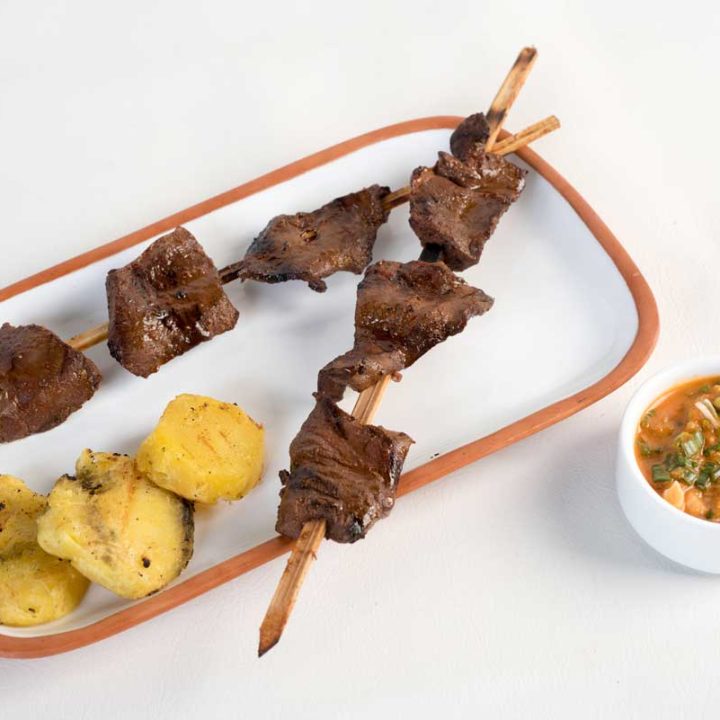
Anticuchos de Corazón (Peruvian Beef Heart Skewers)
Peru's favorite street food at home: beef heart in a smoky ají panca, vinegar and garlic marinade, threaded on skewers and grilled hot and fast. Served with potatoes, corn and a bright ají amarillo sauce.
Ingredients
Anticuchos and marinade
- 1 beef heart, 3 to 4 pounds (1.4 to 1.8 kg), or 2 pounds (900 g) cleaned heart meat
- ⅓ cup (80 g) ají panca paste
- ½ cup (120 ml) red wine vinegar
- 8 garlic cloves, finely grated or minced (about 2 tablespoons)
- 1½ teaspoons ground cumin
- 1 teaspoon dried oregano
- 1 teaspoon freshly ground black pepper
- 2 teaspoons kosher salt
- 1 tablespoon ají amarillo paste (optional)
- ¼ cup (60 ml) vegetable oil, divided
To serve
- 1½ pounds (680 g) small yellow potatoes
- 2 ears corn, preferably choclo, cut into 2-inch rounds
- Lime wedges
Ají amarillo sauce
- ¼ cup (60 g) ají amarillo paste
- 1 tablespoon huacatay paste (optional)
- 2 tablespoons fresh lime juice
- 2 tablespoons vegetable oil
- 1 scallion, finely chopped
- Salt to taste
Instructions
- Clean the heart. Pat dry; do not rinse raw meat. Halve it lengthwise and cut away the fat cap, valves, white tubes and arteries, and the outer and inner membranes. Slice the clean muscle into flat pieces 1½ to 2 inches wide and ½ inch thick. You should have about 2 pounds.
- Make the marinade. In a blender or bowl, combine the ají panca paste, vinegar, garlic, cumin, oregano, pepper, salt, ají amarillo paste (if using) and 2 tablespoons of the oil. Blend or whisk until smooth. Reserve ¼ cup in a separate covered container for basting before the rest touches raw meat; refrigerate it.
- Marinate. Toss the heart with the remaining marinade in a glass or plastic container, cover and refrigerate for at least 4 hours or up to 24 hours. Soak the skewers in water for 30 minutes before grilling.
- Cook the sides during the last 30 minutes of marinating. Boil the potatoes in well-salted water until just tender, 15 to 20 minutes, adding the corn for the last 5 minutes. Drain and halve the potatoes.
- Make the sauce. Blend the ají amarillo paste, huacatay paste (if using), lime juice and oil until smooth. Stir in the scallion and season with salt.
- Skewer. Thread 3 or 4 pieces of heart onto each skewer, keeping them flat. Discard the marinade that touched raw meat. Stir the remaining 2 tablespoons of oil into the separately reserved clean marinade for basting.
- Grill. Heat a charcoal or gas grill until very hot (500°F or more). Grill the potatoes until marked, then move them to the side. Grill the skewers about 3 to 5 minutes per side, brushing with the clean reserved basting mixture as you turn them, until charred outside and the thickest pieces reach 160°F (71°C). Use a thermometer inserted sideways into the meat; time and color alone are not reliable. Keep a clean serving plate and discard any remaining basting liquid.
- Serve. Serve right away with the potatoes, corn, lime wedges and ají amarillo sauce.
Notes
Buying beef heart: look for corazón de res at Latin carnicerías, or at halal, Asian and whole-animal butchers. It is often sold frozen. Ask the butcher to trim it if you can.
Substitutes: beef sirloin or flank cut into flat pieces should reach 145°F and rest 3 minutes. For anticuchos de pollo, use boneless chicken thighs and grill 4 to 5 minutes per side, to 165°F.
No grill: use a smoking-hot cast-iron grill pan (about 3 minutes per side) or the broiler, with the rack 3 inches from the element (3 to 4 minutes per side).
For beef heart, every method must reach 160°F; allow longer than these approximate times if needed.
More heat: make a rocoto sauce instead of (or as well as) the ají amarillo sauce by blending 2 tablespoons rocoto paste with oil, lime and a chopped scallion.
Don't overdo it: marinating past 24 hours makes the surface mushy, and prolonged cooking dries it out. Remove heart once it reaches 160°F.
The Best Sauces for Anticuchos
Anticuchos themselves are only mildly spicy. The fire comes from what you dip them in, and Peruvians expect at least one sauce on the table, usually two.
The classic
Ají amarillo sauce
Yellow pepper paste blended with oil, lime and often huacatay (Peruvian black mint). Fruity, medium heat. It’s in the recipe card.
Hot
Rocoto sauce
Made from the fiery rocoto pepper, often with chopped scallion. The one to reach for if you like real heat.
Creamy
Huancaína
Salsa huancaína, the cheese-and-ají amarillo sauce, cools things down and is great on the potatoes.
Fresh
Salsa criolla
Salsa criolla, a quick lime-pickled red onion relish, cuts through the richness of the char.
What to Serve with Anticuchos
On a Lima street corner the plate is simple: skewers, a boiled potato and a hunk of corn. At home you can build out from there.
- Potatoes. Yellow potatoes boiled until just tender, then halved and grilled next to the skewers so they pick up the drippings.
- Choclo. Peruvian corn has huge, chewy, mildly sweet kernels. Boil it in rounds, or serve choclo con queso. Sweet corn is fine if you can’t find choclo.
- Dessert. Anticucho stands and picarones (sweet-potato doughnuts in chancaca syrup) are old companions, often sold side by side.
- To drink. Chicha morada for everyone, a pisco sour for the adults, or an ice-cold Inca Kola.

Anticuchos Variations
Beef heart is the original and still the best seller, but an anticuchería menu runs longer than one skewer, and the dish has traveled beyond Peru.
Peru
Anticuchos de pollo
Chicken thigh in the same ají panca marinade. Milder, and the easy sell for first-timers.
Peru
Rachi and pancita
Beef tripe, marinated and grilled until crisp at the edges. Sold at the same carts, for the adventurous.
Peru
Seafood and modern
Restaurants grill octopus, fish and shrimp anticucho-style, and vegetarian skewers of mushrooms take the marinade well.
Bolivia
Bolivian anticuchos
A late-night street food of thin heart fillets with grilled potatoes and a spicy peanut sauce. See our Bolivian street food guide and llajua.
Chile
Chilean anticuchos
In Chile the word means mixed meat skewers, often with sausage, onion and pepper, grilled for the September Fiestas Patrias. More in Chilean street food.
Andes
Alpaca and llama
In the highlands, camelid meat is grilled on skewers too, a nod to the dish’s pre-Hispanic roots.

The History of Anticuchos
Skewered, grilled meat was eaten in the Andes long before the Spanish arrived, most likely made with llama or alpaca. The Spanish brought cattle and garlic in the 16th century, and the dish began to change.
The decisive turn came in colonial Lima. Prime cuts went to Spanish households. Enslaved Africans, who were concentrated in Lima and on the coast, were left with the offal, and they turned beef heart into something delicious: marinated in vinegar and Andean peppers, threaded on cane and grilled over coals. Anticuchos are a creation of Afro-Peruvian cooks as much as of the Andes. The same kitchens gave Lima cau cau, its golden tripe and potato stew.
For centuries they were sold by street vendors, many of them women, from portable grills. Today they are everywhere from those same street corners to white-tablecloth restaurants.
October is anticucho month. During the processions of the Señor de los Milagros, Lima’s most important religious festival, the streets fill with anticucho grills and stalls selling turrón de Doña Pepa. Peru also celebrates the Día del Anticucho on the third Sunday of October, a celebration started by the chamber of commerce of Lima’s Jesús María district, home to more anticucherías than anywhere else in the city. Demand peaks again in July around the Fiestas Patrias, Peru’s independence holidays.
Where to Eat Anticuchos in Lima
The best anticuchos in Peru are still mostly cooked on the street, after dark, from carts with a grill and a stack of skewers. A few tips for finding them:
- Go at night. Most anticucheros set up in the early evening and stay until the coals die.
- Follow the smoke and the line. A busy cart means fresh skewers coming off the grill constantly.
- Head to Jesús María. The district has the highest concentration of anticucherías in Lima.
- Visit Grimanesa Vargas in Miraflores. She famously went from a street cart to her own restaurant, and TasteAtlas has named her anticuchos among the best in the world.
- Go in October. During the Señor de los Milagros processions and around Día del Anticucho, the whole city is grilling.

Anticuchos are one of many dishes worth hunting down in Peru. For the full list, see our roundup of the best Peruvian street foods.
Anticuchos FAQ
What are anticuchos made of?
Traditional Peruvian anticuchos are made of beef heart marinated in ají panca paste, red wine vinegar, garlic, cumin and oregano, then grilled on skewers. Chicken, tripe and seafood versions also exist.
What does anticucho mean?
The word is generally traced to Quechua: anti (the eastern Andes) plus kuchu (cut) or uchu (a spicy mixture). It roughly means meat cut or seasoned in the eastern style.
Are anticuchos spicy?
Only mildly. Ají panca is more smoky than hot. The heat comes from the ají amarillo or rocoto sauces served alongside, so each person can choose their own level.
How long should I marinate anticuchos?
At least 3 to 4 hours, and up to overnight. Past about 24 hours the vinegar starts to make the surface of the meat mushy, so don’t go longer.
Can I make anticuchos without beef heart?
Yes. Beef sirloin or flank, cut into flat pieces, is the closest substitute. Chicken thighs make anticuchos de pollo, a popular version in Peru.
Can I cook anticuchos in the oven?
Use the broiler, not the oven. Set the rack about 3 inches from the element and broil 3 to 4 minutes per side, basting each turn. A smoking-hot cast-iron grill pan also works well.
Is beef heart healthy?
Beef heart is a lean, protein-rich cut that is naturally high in iron and B vitamins, especially B12. Like any red meat, enjoy it as part of a balanced diet.
What is the difference between Peruvian, Bolivian and Chilean anticuchos?
Peruvian anticuchos are beef heart in an ají panca marinade. Bolivian anticuchos use thin heart fillets and come with a spicy peanut sauce. Chilean anticuchos are mixed meat and vegetable kebabs, a staple of the September Fiestas Patrias.
Bring a Lima Street Corner Home
Anticuchos ask very little: a cheap cut, a jar of ají panca, a few hours in the fridge and a very hot fire. What you get back is one of the great grilled foods of Latin America, and a dish with five centuries of Peruvian history on every skewer.
Make them for your next cookout and put a bowl of ají sauce on the table. Then save room for dessert: our list of Peruvian Desserts: 26 Traditional Sweets to Try has plenty of ideas.
Keep cooking Peruvian
More Peruvian Foods
See all →
Jorge Garcia is the founder of AmigoFoods, where he has spent over 20 years helping readers discover authentic Latin American and Spanish cuisine. Raised in a Cuban-American household, Jorge learned to cook at the hands of his mother and grandmother, carrying forward generations of family recipes. That heritage, backed by his family’s four-generation history in the Latin food industry, inspired him to launch AmigoFoods in 2003. With more than 1,000 published articles on recipes, ingredients, and food culture, Jorge’s mission is simple: make authentic Latin cooking approachable for home cooks everywhere while honoring the traditions behind every dish.