

Pulpo a la gallega pairs tender octopus with boiled potatoes, coarse salt, Spanish paprika and olive oil. This Galician favorite is served warm, with thick slices of octopus and bread to soak up the seasoned oil.
Pulpo a la Gallega at a Glance

What Is Pulpo a la Gallega?
Pulpo a la gallega means “octopus in the Galician style.” It’s a classic Spanish seafood tapa made from whole octopus that’s boiled, sliced and dressed at the last second, so the paprika still looks bright red and the oil pools on the plate.
In Galicia you’ll see it written as polbo á feira. The name comes from the fairs (feiras) and village festivals where pulpeiras, the women who specialize in cooking octopus, set up huge copper pots and served it straight onto wooden plates. Outside Galicia the dish is usually served over sliced potatoes; at a Galician fair the octopus often comes on its own, with potatoes (cachelos) as a side.
Good pulpo a la gallega tastes clean and sweet, like the sea, with smoky-sweet heat from the pimentón and a peppery finish from the olive oil. The texture is the whole point: tender enough to cut with the side of a fork, but with a little spring to it.
Pulpo a la Gallega vs. Pulpo a Feira vs. Grilled Octopus
These names get mixed up on menus, so here’s how they differ.
| Dish | How it’s cooked | How it’s served |
|---|---|---|
| Pulpo a la gallega | Boiled, sliced | Over boiled potato slices with pimentón, salt and olive oil |
| Polbo á feira / pulpo a feira | Boiled in a copper cauldron, cut with scissors | Same seasoning, on a wooden plate, potatoes on the side or none at all |
| Pulpo con cachelos | Boiled, with potatoes cooked in the octopus water | Octopus over whole or halved potatoes |
| Pulpo a la plancha / a la brasa | Boiled first, then seared on a griddle or grill | Charred tentacles, often with potato purée or allioli |
In practice, “pulpo a la gallega” and “pulpo a feira” are the same dish under two names, Spanish and Galician. This recipe is the version most people outside Galicia picture: octopus over potatoes.
A Short History: From Monastery Rents to Fair Cauldrons
The odd thing about Galicia’s most famous octopus dish is that its spiritual home is inland. O Carballiño, in the province of Ourense, sits about an hour’s drive inland from the Atlantic, yet it hosts Spain’s best-known octopus festival.
Local history traces the link to the Cistercian monastery of Santa María de Oseira, near O Carballiño. The monks held lands on the coast at Marín, and the people there paid them partly in sea products. Octopus was a favorite because, dried or salted, it was easy to transport and keep. Muleteers (arrieros) from the area carried it inland, and the people who cooked it became a fixture at markets and fairs.
The first octopus festival in O Carballiño was held in 1964. Today the Festa do Polbo takes place on the second Sunday of August, when the town’s park fills with pulpeiras, copper pots and long wooden tables. In Lugo, pulpo is the signature food of the San Froilán festivities every October.
Tradition also says you shouldn’t drink water with octopus. At the fairs it was washed down with young Galician red wine, often poured into white ceramic bowls called cuncas.
Ingredients for Pulpo a la Gallega
You need very little, which means each ingredient matters. Exact quantities are in the recipe card below.
- Octopus (pulpo): One whole octopus of 2 to 2.5 kg (4½ to 5½ lb). Bigger octopus is meatier and more forgiving. Frozen is not a compromise here; it’s what most Galician cooks use today, because freezing breaks down the tough fibers that cooks once softened by pounding the octopus on rocks.
- Potatoes: Waxy or all-purpose potatoes that hold their shape. In Galicia that means Kennebec; in the US, Yukon Gold is the closest match.
- Pimentón: Spanish paprika, sweet (dulce) plus a pinch of hot (picante). Galicians mostly use unsmoked pimentón; smoked pimentón de la Vera is common elsewhere in Spain and tastes great too. Try pimentón de la Vera dulce and picante.
- Coarse sea salt: Big crystals that crunch. Flaky sea salt works well; fine table salt dissolves into the oil and tastes harsher. Look for coarse sea salt flakes.
- Extra virgin olive oil: Use the good stuff, since it’s a finishing oil. A fruity Spanish extra virgin olive oil is ideal.
- Bay leaf (optional): Not traditional at fairs, but a bay leaf and half an onion in the water are common at home.

How to Make Pulpo a la Gallega, Step by Step
1Freeze, then thaw the octopus
If your octopus is fresh, freeze it for at least 48 hours. Frozen octopus should be thawed slowly in the fridge, 24 to 36 hours for a 2 kg octopus. Rinse it well, and if the head hasn’t been cleaned, turn it inside out and remove the innards, eyes and beak (the hard “mouth” in the center of the tentacles).
2Bring a big pot of water to a rolling boil
Use your largest pot, at least 8 quarts. The octopus must be fully submerged, and you want enough water that it comes back to the boil quickly. Don’t salt the water yet; salting late keeps the skin from tearing.
3“Scare” the octopus (asustar el pulpo)
Hold the octopus by the head (with tongs or a large fork) and dip it into the boiling water for 2 to 3 seconds, then lift it out. Do this three times. The tentacles will curl into tight spirals, and the skin tightens so it stays on during cooking. On the third dip, lower it in and leave it.
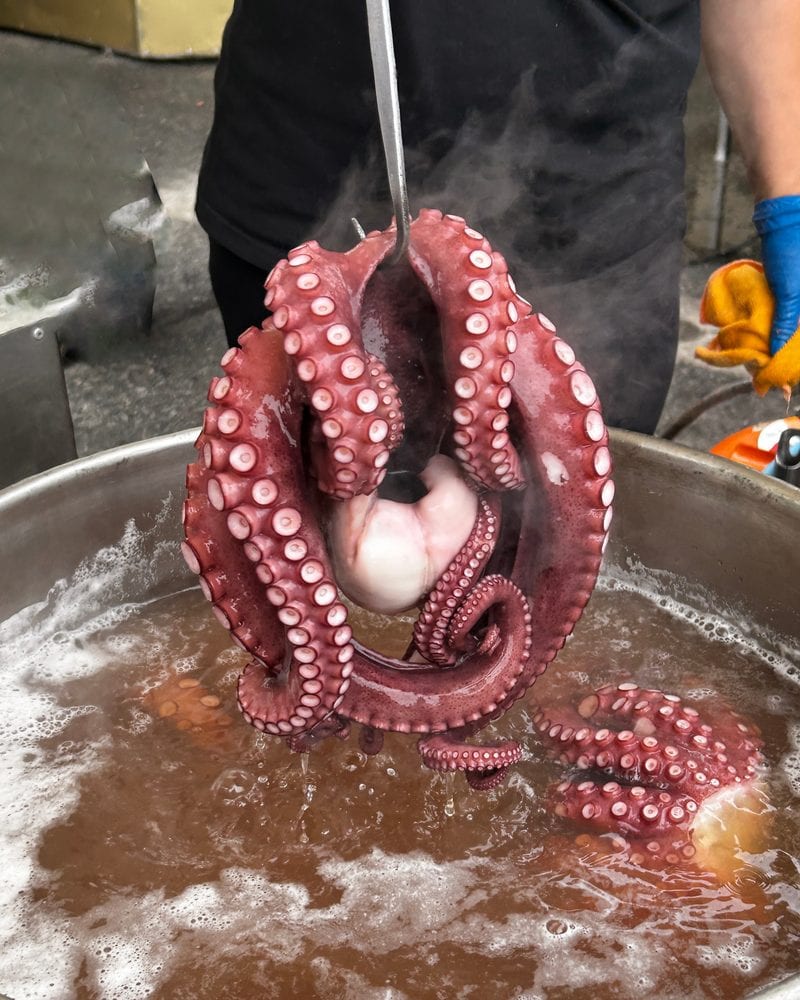
4Simmer by weight, then test
Keep the water at a lively simmer, not a violent boil. Cook about 15 minutes per kg (see the timing chart). Start testing 5 minutes early: push a wooden skewer into the thickest part of a tentacle, where it meets the head. It should go in with light resistance, like a cooked potato. If it bounces back, keep going and test every 5 minutes.
5Salt the water and let it rest
Turn off the heat, add a tablespoon of salt, and leave the octopus in the hot water for 15 to 20 minutes. This is the step most recipes skip. The octopus finishes cooking gently and the skin settles, so it slices cleanly instead of peeling off.
6Cook the potatoes
Lift out the octopus and bring the cooking water back to a boil. Add the peeled potatoes, whole or halved, and cook 20 to 25 minutes until a knife slides in. They’ll turn a pale pink and pick up a lot of flavor. If you’d rather keep them golden, cook them in a separate pot of salted water. Slice them about ½ inch thick.
7Cut the tentacles with scissors
Cut off the tentacles and snip them into rounds about ½ inch (1 to 1.5 cm) thick, letting them fall straight onto the potatoes. Kitchen scissors are the traditional tool and much easier than a knife. The head is edible; chop it and add it to the plate or save it for a salad.
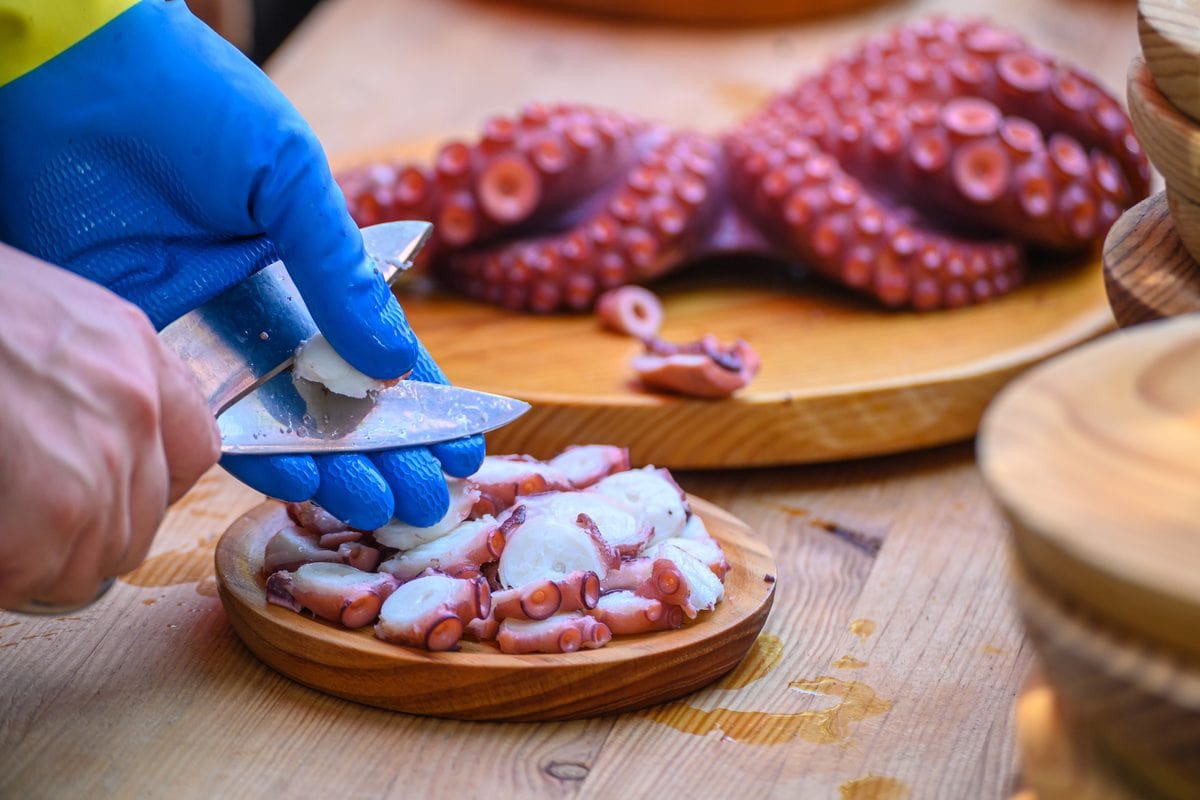
8Dress it in the right order
Coarse salt first, then pimentón (sweet with a little hot, through a small sieve or shaker so it falls evenly), then olive oil last. If the oil goes on first, the paprika clumps instead of coating. Serve right away, while the octopus is still warm.
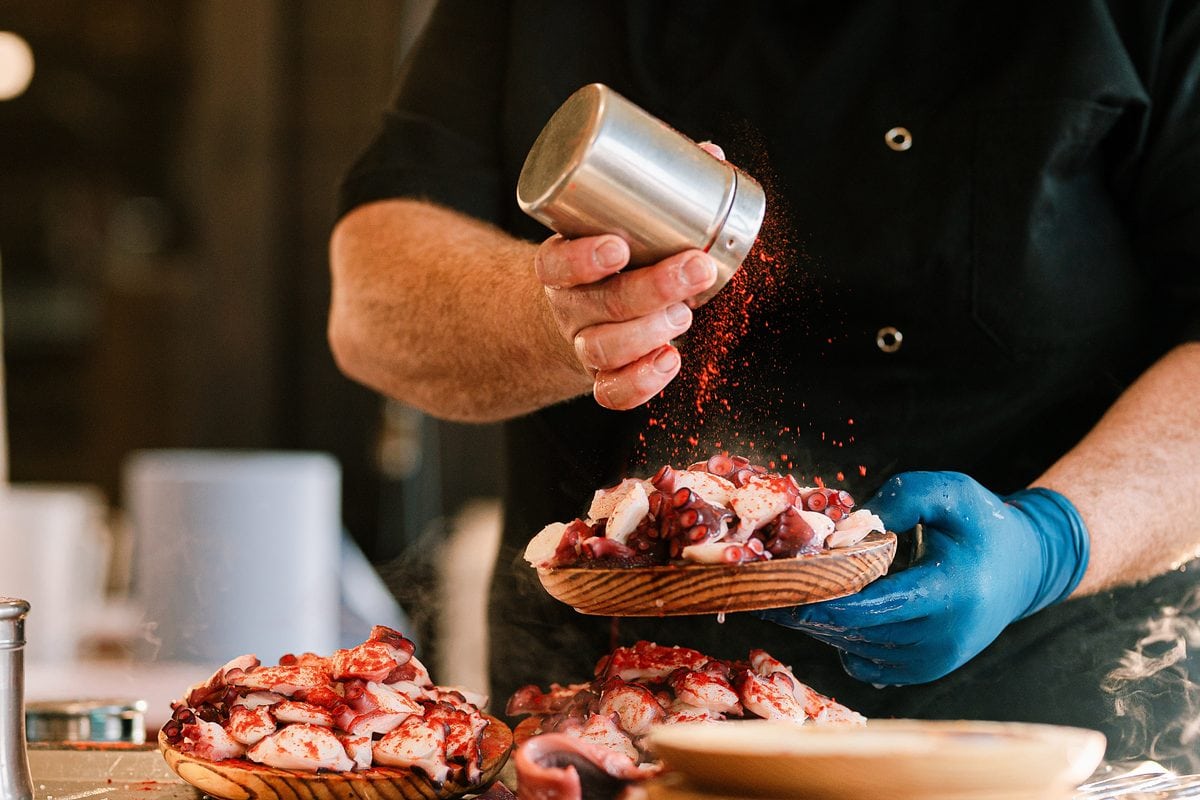
How Long to Boil Octopus: Timing Chart
Size is everything. Times below are for a thawed octopus at a steady simmer, counted after the three dips. Always confirm with a skewer, because thickness varies.
| Octopus weight | Simmer | Rest off heat | Pressure cooker (approx.) |
|---|---|---|---|
| 1 kg (2.2 lb) | 20–25 min | 10–15 min | 8–10 min |
| 1.5 kg (3.3 lb) | 25–30 min | 15 min | 10–12 min |
| 2 kg (4.4 lb) | 30–40 min | 15–20 min | 12–15 min |
| 2.5–3 kg (5.5–6.6 lb) | 40–50 min | 20 min | 15–18 min |
For the pressure cooker, do the three dips in an open pot, then cook at high pressure with just enough water to cover the octopus by an inch, and let the pressure release naturally. Pressure-cooked octopus is a touch softer than the simmered kind.
7 Secrets of Great Pulpo a la Gallega
- Buy big. A 2 kg-plus octopus has thick, juicy tentacles; small ones dry out and are hard to time.
- Freeze it. At least 48 hours for fresh octopus. This replaces the old habit of pounding it.
- Do the three dips. It keeps the skin and suckers on, which is where much of the flavor and the classic look are.
- Simmer, don’t boil hard. A gentle simmer gives an even texture all the way through.
- Rest it in the water. 15 to 20 minutes off the heat is what makes it tender and easy to slice.
- Season in order: salt, pimentón, oil. Never the reverse.
- Serve it warm on wood. A wooden plate soaks up the excess water so the olive oil stays on top.
How to Serve Pulpo a la Gallega Like a Galician Pulpería
In Galicia, pulpo is a sharing dish. It comes to the middle of the table on a round wooden plate (prato de madeira) with a fistful of toothpicks stuck in, and everyone eats straight from it. Bread is essential for mopping up the red oil.

Want the full experience at home? Wooden pulpo plates are inexpensive and make a big difference to the look. Then build a Galician spread around it:
Pimientos de Padrón, blistered and salted, and a slab of empanada gallega.
Creamy tetilla cheese and, in winter, a bowl of caldo gallego.
A slice of tarta de Santiago, then a flaming pot of queimada.
Young Mencía red, the old fair pairing, or a chilled Albariño or Ribeiro white.
For a mixed tapas night, pair it with gambas al ajillo and patatas bravas, or add it to a Spanish tapas board.
Easy Variations
- Pulpo a la plancha: Boil and rest the octopus as above, then sear whole tentacles in a very hot, lightly oiled skillet for 2 to 3 minutes per side until charred at the edges. Finish with the same salt, pimentón and oil.
- Quick weeknight version: Use pre-cooked octopus tentacles. Warm them in simmering water for 3 to 5 minutes, slice and dress.
- Pantry tapa: Good Spanish octopus in olive oil from a tin, warmed and spooned over hot potato slices with pimentón, makes a five-minute version.
- Without potatoes: Serve it the fair way, octopus alone on the plate, with bread on the side.
Pulpo a la Gallega Recipe
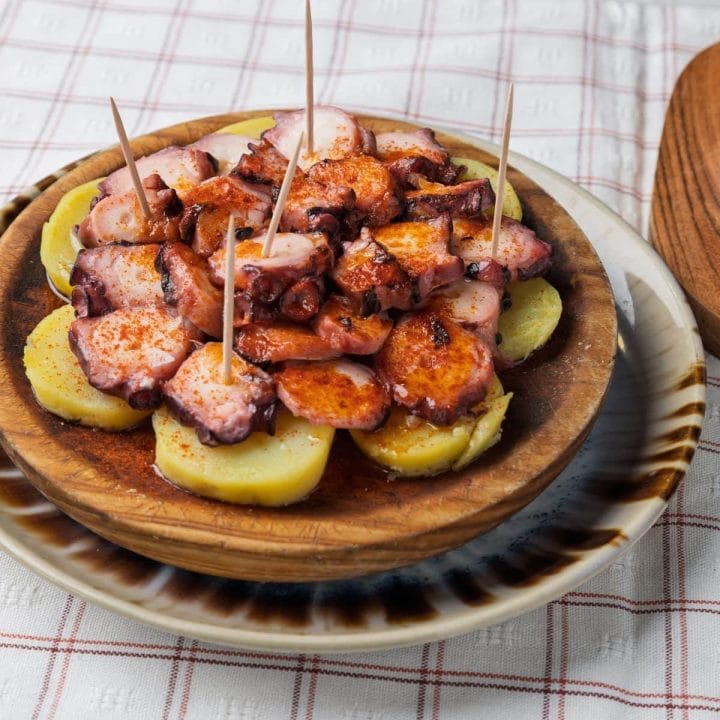
Pulpo a la Gallega (Galician Octopus with Potatoes)
Authentic pulpo a la gallega, the Galician way: tender boiled octopus cut into thick coins over potatoes, finished with coarse salt, sweet and hot pimentón and extra virgin olive oil.
Ingredients
- 1 whole octopus, 2 to 2.5 kg (4½ to 5½ lb), frozen and thawed
- 1½ lb (700 g) waxy potatoes, such as Yukon Gold, peeled
- 1 bay leaf (optional)
- 1 tablespoon salt, for the cooking water
- 1 to 1½ teaspoons coarse or flaky sea salt, for finishing
- 2 teaspoons sweet pimentón (Spanish paprika)
- ½ teaspoon hot pimentón, or to taste
- ⅓ cup (80 ml) extra virgin olive oil
- Crusty bread, for serving
Instructions
- Thaw the octopus. Thaw frozen octopus in the fridge for 24 to 36 hours. (If it is fresh, freeze it for at least 48 hours first, then thaw.) Rinse well. If the head has not been cleaned, turn it inside out and remove the innards, eyes and beak.
- Boil the water. Bring a large pot (at least 8 quarts) of unsalted water to a rolling boil, with the bay leaf if using.
- Scare the octopus. Holding the octopus by the head with tongs, dip it into the boiling water for 2 to 3 seconds and lift it out. Repeat 3 times, until the tentacles curl. On the third dip, leave it in.
- Simmer. Return to a steady simmer and cook about 15 minutes per kg: 30 to 40 minutes for a 2 kg (4.4 lb) octopus. It is done when a wooden skewer slides into the thickest part of a tentacle with light resistance.
- Rest. Turn off the heat, stir in 1 tablespoon of salt and leave the octopus in the hot water for 15 to 20 minutes. Lift it out onto a board.
- Cook the potatoes. Bring the cooking water back to a boil, add the peeled potatoes and cook 20 to 25 minutes, until tender. (Use a separate pot of salted water if you want them golden instead of pink.) Drain and slice about ½ inch thick.
- Cut the octopus. Arrange the potato slices on a wooden board or platter. Cut off the tentacles and snip them with kitchen scissors into ½-inch rounds, letting them fall over the potatoes.
- Season and serve. Sprinkle with coarse sea salt, then dust with the sweet and hot pimentón through a small sieve, then drizzle generously with olive oil. Serve warm with toothpicks and crusty bread.
Notes
- Timing by weight: 1 kg (2.2 lb) 20 to 25 min; 1.5 kg (3.3 lb) 25 to 30 min; 2 kg (4.4 lb) 30 to 40 min; 2.5 to 3 kg 40 to 50 min. Always test with a skewer.
- Rubbery octopus is almost always undercooked. Give it more time.
- Season in order: salt, then pimentón, then oil, so the paprika coats instead of clumping.
- Pressure cooker: after the three dips, cook a 2 kg octopus 12 to 15 minutes at high pressure, natural release.
- Shortcut: use ready-cooked octopus tentacles; warm them in simmering water 3 to 5 minutes, then slice and dress.
- Leftovers keep 2 to 3 days in the fridge. Reheat in simmering water, not the microwave.
Storing and Reheating Leftovers
Pulpo a la gallega is best eaten right away. Leftover cooked octopus keeps 2 to 3 days in an airtight container in the fridge; store it unsliced and undressed if you can. To reheat, drop it into simmering water for 2 to 3 minutes (the microwave makes it tough), then slice and season. Cold leftovers are excellent chopped into a salad with tomato, onion, olive oil and vinegar, like a Galician salpicón de pulpo.
You can also freeze cooked octopus for up to 2 months. Thaw it in the fridge and warm it in hot water.
Pulpo a la Gallega FAQ
What are the ingredients in pulpo a la gallega?
Just octopus, potatoes, Spanish paprika (pimentón), coarse sea salt and extra virgin olive oil. Some cooks add a bay leaf or half an onion to the cooking water.
What does pulpo a la gallega taste like?
Mild, sweet and briny, a bit like lobster or tender squid, with smoky or sweet warmth from the paprika and a fruity, peppery finish from the olive oil. The potatoes soak up all of it.
Do you have to freeze octopus before cooking it?
If it’s fresh, yes, for at least 48 hours. Freezing breaks down the connective tissue and does the job pounding used to do. Octopus sold frozen is already tenderized this way, so just thaw it.
Why do you dip the octopus three times?
It’s called asustar el pulpo, “scaring the octopus.” The quick dips curl the tentacles and tighten the skin so it doesn’t tear off during cooking, which keeps the dish juicy and gives it its classic look.
Is pulpo a la gallega the same as pulpo a feira?
Yes. Polbo á feira is the Galician name and means “fair-style octopus.” Pulpo a la gallega is what the rest of Spain calls it. At fairs it’s often served without potatoes; elsewhere it usually comes on a bed of sliced potatoes.
Should I use smoked or sweet paprika?
In Galicia, most pulpeiras use sweet and hot unsmoked pimentón. Smoked pimentón de la Vera gives a deeper, campfire flavor and is just as authentic in many Spanish homes. A mix of mostly sweet with a pinch of hot is the safest bet.
Is pulpo a la gallega served hot or cold?
Warm. It’s cut and dressed the moment it comes out of the water. Cold octopus is used in salads instead.
How much octopus do I need per person?
Octopus loses about half its weight when it cooks. A 2 kg (4.4 lb) raw octopus serves about 4 as a main dish or 6 to 8 as tapas.
More Spanish Seafood and Galician Recipes
If you love this, explore our full roundup of Spanish seafood dishes, browse every Spanish seafood recipe on one page, or try more classic Spanish tapas. For the pantry basics, start with our guide to essential Spanish ingredients, and for everything else, visit our Spanish Foods hub.
Stocking up? Our Spanish pantry list on Amazon has the pimentón, olive oil and conservas we reach for most.
As an Amazon Associate, AmigoFoods earns from qualifying purchases. Links to Amazon in this article may earn us a small commission at no extra cost to you.
More Spanish Foods
See all →
Jorge Garcia is the founder of AmigoFoods, where he has spent over 20 years helping readers discover authentic Latin American and Spanish cuisine. Raised in a Cuban-American household, Jorge learned to cook at the hands of his mother and grandmother, carrying forward generations of family recipes. That heritage, backed by his family’s four-generation history in the Latin food industry, inspired him to launch AmigoFoods in 2003. With more than 1,000 published articles on recipes, ingredients, and food culture, Jorge’s mission is simple: make authentic Latin cooking approachable for home cooks everywhere while honoring the traditions behind every dish.