

On this page
Fugazzeta (also spelled fugazetta) is Argentina’s cheese-stuffed pizza: two layers of soft, olive-oil dough sealed around a thick layer of mozzarella, then covered in sweet sliced onions, oregano and Parmesan and baked until the onion tips brown. There is no tomato sauce. It is one of the signature pizzas of Buenos Aires.
Fugazzeta at a Glance
AmigoFoods may earn a commission from qualifying Amazon purchases made through links on this page.
What is fugazzeta?
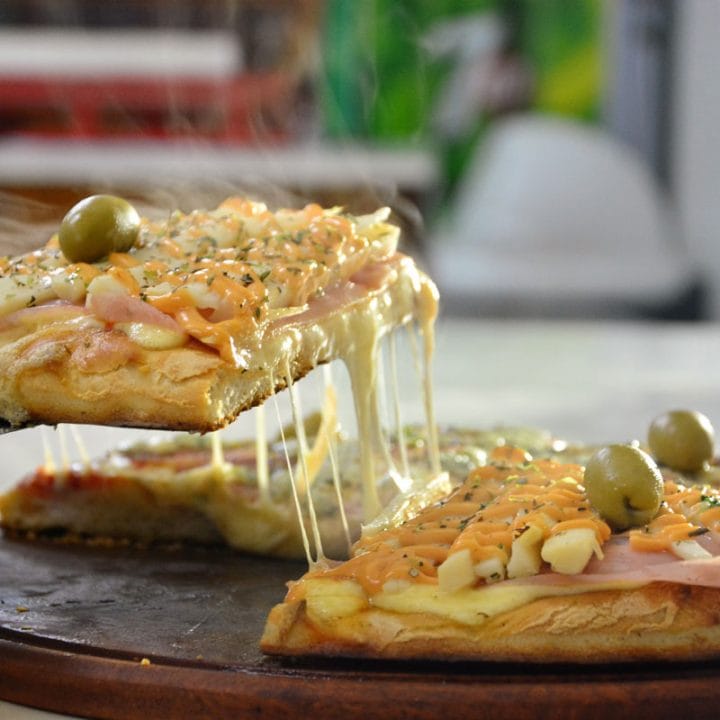
Fugazzeta is a thick, pan-baked pizza from Buenos Aires that hides its cheese inside. A round of dough lines an oiled pan, a heavy layer of mozzarella goes on top, and a second round of dough seals it in like a lid. The top crust is then covered edge to edge with thinly sliced onions.
When you cut a wedge, the cheese runs out from between the crusts. That is why Argentines often call it fugazzeta rellena, or stuffed fugazzeta.

In English it is usually described as an Argentine stuffed pizza or cheese-stuffed onion pizza. It sits somewhere between a deep-dish pizza and a focaccia sandwich, and it is one of the dishes in our guide to Argentine food.
Fugazza vs. fugazzeta
The names are close, and pizzerias in Buenos Aires do not always use them the same way. This is how most Argentines tell them apart:
| Name | What it is | Cheese |
|---|---|---|
| Fugazza | A single thick crust topped with onions, oregano and olive oil, a close cousin of focaccia | None |
| Fugazza con queso | The same onion pizza with mozzarella melted on top, under or with the onions | On top |
| Fugazzeta (rellena) | Two crusts sealed around a thick layer of cheese, with onions on top | Inside |
The shortest way to remember it: fugazza is onion bread, fugazza con queso is onion pizza, and fugazzeta is the stuffed one. This recipe makes the stuffed fugazzeta.
Where fugazzeta comes from
Fugazzeta is a product of the huge wave of Italian immigration to Argentina. The name comes from fugassa, the word for focaccia in the dialect of Genoa, and the dish took shape in La Boca, the port neighborhood where many Genoese families settled.
- 1893: Agustín Banchero, a baker from Genoa, opens a bakery in La Boca. His son Juan is credited with turning Genoese focaccia into fugazza, an onion-topped bread sold by the slice.
- 1932: Juan Banchero and his sons open the Banchero pizzeria. Its fugazza con queso becomes so popular that Juan is nicknamed the emperor of fugazza con queso.
- Later: Buenos Aires pizzerias begin sealing the cheese between two crusts. That stuffed version is the fugazzeta, and it is now on almost every pizzeria menu in the city.
The story is part of a bigger one. Pizza, pasta, milanesa and gelato all arrived with the same immigrants, which we cover in our look at the Italian roots of Argentine cuisine.
How Buenos Aires eats it
Fugazzeta belongs to pizza de molde, the thick, spongy pan pizza that most Buenos Aires pizzerias serve. Argentine pizza dough uses more yeast and water than a Neapolitan crust, so it bakes up tall and soft inside with a crisp, oily bottom.

Locals often eat it standing at the counter, by the slice, with a glass of beer or moscato. Many order it a caballo, with a wedge of fainá, a thin chickpea flatbread, laid right on top of the pizza. It is also a classic late-night order and one of the city’s best-loved Argentine street foods.
Ingredients for fugazzeta
- Flour: bread flour gives a chewier, sturdier crust that holds the cheese. All-purpose flour works and makes a softer crumb.
- Yeast, sugar and salt: instant or active dry yeast both work. The sugar helps it get going and helps the crust brown.
- Olive oil: it goes into the dough, the pan and over the top, so use one you like the taste of, such as Colavita extra-virgin olive oil. The oiled pan is what fries the bottom crust crisp.
- Mozzarella: use low-moisture whole-milk mozzarella, the kind sold in blocks, not fresh mozzarella packed in water. Fresh mozzarella releases liquid and makes the inside soggy.
- Provolone: a few slices under the mozzarella add a sharper, more Argentine flavor. In Argentina the filling is often mozzarella or a soft fresh cheese called cuartirolo, which is hard to find in the US.
- Onions: white or sweet onions, sliced as thin as you can. They are the whole topping, so do not skimp.
- Oregano and Parmesan: dried oregano is traditional. A light dusting of Parmesan on top browns with the onions.
How to make fugazzeta
Here is the method with the reasons behind each step. Exact amounts are in the recipe card below.
1. Make a soft, oily dough
Proof the yeast with the sugar in lukewarm water, then mix in the flour, salt and olive oil. Knead for 8 to 10 minutes until the dough is smooth and springs back. Let it rise, covered, until doubled, about 1 to 1½ hours.
2. Soak the onions in salted ice water
While the dough rises, slice the onions thin and soak them in salted ice water for at least 30 minutes. This is the step Argentine cooks swear by. It softens the raw bite, so the onions bake sweet instead of sharp. Drain them and dry them very well in a towel.
3. Line the pan with the bottom crust
Oil a 12-inch cast-iron skillet generously. Stretch half the dough into a round slightly bigger than the pan and press it in so it comes about ½ inch up the sides.
4. Add the cheese and seal
Lay down the provolone, then pile on the mozzarella, leaving a 1-inch border. Stretch the second half of the dough over the top, fold the bottom edge up over it and pinch it closed all the way around. A good seal keeps the cheese inside.
5. Vent, rest and top
Prick the top crust with a fork so steam can escape, then let it rise for 30 minutes while the oven heats to 450°F. Brush with olive oil, cover with the onions all the way to the edge, and finish with oregano, Parmesan and another drizzle of oil.
6. Bake on a low rack and rest
Bake on the lower third of the oven for 25 to 30 minutes, until the crust is deep gold and the onion tips are browned. Let it rest for 10 minutes before slicing so the cheese sets just enough to stay in each wedge.
Tips for the best fugazzeta
- Dry the onions completely. Wet onions steam and turn gray. Roll them in a towel and squeeze.
- Use cold, low-moisture cheese. Shred it yourself from a block if you can. Pre-shredded cheese works, but it melts less smoothly.
- Do not overfill the edge. Keep the cheese 1 inch from the rim, or it will leak through the seal and burn.
- Bake low in the oven. The bottom crust needs the most heat. A rack in the lower third browns the bottom before the onions burn.
- Use cast iron if you have it. A 12-inch Lodge cast-iron skillet holds heat and fries the oiled bottom crust. The handle gets very hot, so slip on a silicone handle holder when you take it out.
- Rest before cutting. Cut too soon and all the cheese pours out onto the board.
Fugazzeta variations

- Fugazzeta con jamón: add thin slices of cooked ham over the cheese before you seal it, or on top with the onions. Many pizzerias finish it with green olives.
- Fugazzeta de verdura: mix sautéed spinach or chard, squeezed dry, into the cheese filling.
- Milanesa a la fugazzeta: a breaded milanesa topped with melted mozzarella and onions, a popular way to get the same flavors without the dough.
- Fugazzeta empanadas: the same mozzarella and onion filling folded into empanada dough.
- Plain fugazza: skip the cheese and the top crust and bake one thick crust with onions, oregano and olive oil.
Storing and reheating
Wrap leftover fugazzeta or keep it in a covered container in the fridge for up to 3 days. Reheat slices in a 375°F oven or a covered skillet over medium-low heat for 8 to 10 minutes, which keeps the bottom crisp. The microwave works but softens the crust.
To freeze, wrap cooled slices tightly and freeze for up to 2 months. Reheat from frozen in a 375°F oven for about 15 minutes.
Fugazzeta FAQ
What is fugazzeta in English?
There is no direct English word for it. It is usually described as an Argentine stuffed pizza or cheese-stuffed onion pizza: two crusts with cheese sealed inside and onions on top.
What is the difference between fugazza and fugazzeta?
Fugazza is a single thick crust topped with onions and no cheese. Fugazzeta has cheese, and in its classic stuffed form the cheese is sealed between two layers of dough.
Is fugazza the same as focaccia?
They are related. The name comes from fugassa, the Genoese word for focaccia, but Argentine fugazza is softer and thicker and is always topped with onions.
What cheese is used in fugazzeta?
Mozzarella is the standard. In Argentina some pizzerias use a soft fresh cheese called cuartirolo. In the US, low-moisture mozzarella with a few slices of provolone is the best match.
Can I make fugazzeta without a cast-iron skillet?
Yes. Use an oiled 12-inch round cake pan or deep-dish pizza pan and bake it on the lowest rack so the bottom crust browns.
Why do you soak the onions?
Soaking thin-sliced onions in salted ice water removes some of their harsh bite, so they bake sweet and tender on top of the pizza.
Fugazzeta Recipe
Fugazzeta (Argentine Cheese-Stuffed Onion Pizza)
A Buenos Aires-style double-crust pizza: two layers of olive-oil dough sealed around mozzarella and provolone, topped with sweet soaked onions, oregano and Parmesan, and baked in a cast-iron skillet until golden.
Ingredients
For the dough
- 4 cups (500 g) bread flour or all-purpose flour, plus more for dusting
- 1⅓ cups (320 ml) lukewarm water (about 100°F / 38°C)
- 2¼ teaspoons (1 packet, 7 g) instant or active dry yeast
- 1 teaspoon sugar
- 1½ teaspoons fine salt
- 3 tablespoons extra-virgin olive oil, plus more for the bowl and pan
For the filling
- 1 pound (450 g) low-moisture whole-milk mozzarella, shredded
- 4 ounces (115 g) sliced provolone
- ½ teaspoon dried oregano
For the onion topping
- 2 large white or sweet onions (about 1 pound / 450 g), halved and very thinly sliced
- 4 cups ice-cold water and 2 teaspoons salt, for soaking
- 1 teaspoon dried oregano
- ⅓ cup (30 g) finely grated Parmesan
- 2 tablespoons extra-virgin olive oil
- Pinch of red pepper flakes (optional)
Instructions
- Make the dough. In a large bowl, stir the yeast and sugar into the lukewarm water and let stand 5 minutes, until foamy. Add the flour, salt and 3 tablespoons olive oil and mix into a shaggy dough. Knead on a lightly floured counter for 8 to 10 minutes (or 6 minutes in a stand mixer with the dough hook), until smooth and elastic.
- Let it rise. Place the dough in an oiled bowl, turn to coat, cover and let rise in a warm spot for 1 to 1½ hours, until doubled.
- Soak the onions. While the dough rises, stir 2 teaspoons salt into 4 cups ice-cold water. Add the sliced onions and soak for at least 30 minutes. Drain, squeeze, and dry them thoroughly in a clean kitchen towel. Toss with 1 teaspoon oregano.
- Shape the bottom crust. Coat a 12-inch cast-iron skillet with 2 tablespoons olive oil. Divide the dough in half. Stretch one half into a 13-inch round and press it into the skillet so it covers the bottom and comes about ½ inch up the sides.
- Add the cheese. Lay the provolone over the dough, then pile on the mozzarella, leaving a 1-inch border around the edge. Sprinkle with ½ teaspoon oregano.
- Seal it. Stretch the second piece of dough into a 12-inch round and lay it over the cheese. Fold the bottom edge up over the top edge and pinch firmly all the way around to seal. Prick the top 8 to 10 times with a fork. Cover and let rise 30 minutes. Meanwhile, heat the oven to 450°F (230°C) with a rack in the lower third.
- Top it. Brush the top with 1 tablespoon olive oil. Spread the onions all the way to the edges, sprinkle with the Parmesan and red pepper flakes, and drizzle with the remaining 1 tablespoon olive oil.
- Bake. Bake 25 to 30 minutes, until the crust is deep golden, the bottom is crisp, and the onion tips are browned. If the onions darken too fast, tent loosely with foil for the last 10 minutes.
- Rest and slice. Let the fugazzeta rest in the pan for 10 minutes so the cheese sets slightly. Run a spatula around the edge, slide it onto a board, and cut into 6 to 8 wedges. Serve hot.
Notes
Cheese: In Buenos Aires the filling is usually mozzarella or a soft fresh cheese such as cuartirolo. Low-moisture whole-milk mozzarella plus provolone is the closest supermarket match. Avoid fresh mozzarella packed in water; it makes the filling watery.
Onions: Soaking in salted ice water takes away the raw bite so the onions bake sweet. Dry them well or they will steam instead of browning.
No cast iron: Use an oiled 12-inch round cake pan or deep-dish pizza pan and bake on the lowest rack.
Make ahead: After kneading, the dough can rest in the fridge, covered, for up to 24 hours. Let it warm at room temperature for 1 hour before shaping.
Leftovers: Refrigerate, covered, for up to 3 days. Reheat slices in a 375°F oven or a covered skillet for 8 to 10 minutes.
More Argentine recipes
Serve fugazzeta with a wedge of fainá on top the way Buenos Aires pizzerias do, or keep going with the rest of our Argentine street food. For the full picture, see our guide to Argentine food, and save room for Argentine desserts.
More Argentine Foods
See all →
Jorge Garcia is the founder of AmigoFoods, where he has spent over 20 years helping readers discover authentic Latin American and Spanish cuisine. Raised in a Cuban-American household, Jorge learned to cook at the hands of his mother and grandmother, carrying forward generations of family recipes. That heritage, backed by his family’s four-generation history in the Latin food industry, inspired him to launch AmigoFoods in 2003. With more than 1,000 published articles on recipes, ingredients, and food culture, Jorge’s mission is simple: make authentic Latin cooking approachable for home cooks everywhere while honoring the traditions behind every dish.