

Empanada dough is a simple pastry of flour, salt, fat and liquid, rolled into thin circles, filled, folded into half-moons and then baked or fried. This homemade version uses cold butter, one egg, ice water and a splash of vinegar, so it stays tender but strong enough to roll thin and seal tight. It takes about 15 minutes to mix and makes 15 five-inch discs.
Empanada Dough at a Glance
AmigoFoods may earn a commission from qualifying Amazon purchases made through links on this page.
What is empanada dough?
Empanada dough, called masa para empanadas in Spanish, is the pastry used to wrap empanadas. The word comes from empanar, to wrap in bread, and the idea traveled from Spain and Portugal to every corner of Latin America.
Most wheat versions use the same five building blocks: flour, salt, a fat (butter, lard, beef fat or oil), a little egg, and water or milk. What changes from country to country is the fat, the thickness, and whether the empanadas are baked or fried.
Compared with pie crust, empanada dough has less fat and more water. That makes it sturdier and more elastic, so it can be rolled thin, folded without cracking, and handled as street food. Pie dough is flakier but tears easily and leaks when you fold it into a half-moon.
Some empanadas are not made with wheat at all. Colombian and Venezuelan empanadas use a corn dough made from precooked corn flour, and Ecuador’s empanadas de morocho are made with cracked white corn. This guide covers the classic wheat dough, with notes on the corn versions further down.
Ingredients for homemade empanada dough
You need seven pantry staples. Each one has a job, which makes it easy to adjust the dough once you know what it does.
- All-purpose flour. The right amount of gluten for a dough that is strong but not chewy. Bread flour works, but the dough fights back when you roll it and bakes up tougher.
- Cold unsalted butter. Gives flavor and a tender, slightly flaky bite. Keep it cold so it stays in small pieces.
- One egg. Adds richness and color and makes the dough more pliable, so it seals well.
- Ice water. Brings the dough together without melting the butter.
- White vinegar. A small amount of acid keeps the dough tender and easy to roll. You will not taste it.
- Salt and a pinch of sugar. Salt for flavor; the optional sugar helps the crust brown.
Which fat should you use?
The fat decides the texture more than anything else. Here is how the common choices compare:
| Fat | Texture | Best for |
|---|---|---|
| Butter | Tender, a little flaky, rich flavor | Baked empanadas; all-round use |
| Lard or beef fat (grasa) | Crisp, short and light | Frying; Argentine and Chilean-style empanadas |
| Vegetable shortening | Crisp, neutral flavor | Frying; a dairy-free swap for lard |
| Neutral oil | Soft, pliable, less flaky | Vegan dough; quick dough with no cutting-in |
| Half butter, half lard | Flavor of butter, crunch of lard | Bakers who want the best of both |
How to make empanada dough
You can make the dough by hand or in a food processor. Both take about 10 minutes of work, plus a short rest in the fridge. Full amounts are in the recipe card.
1Cut the butter into the flour
Whisk the flour, salt and sugar. Add the cold butter cubes and rub them in with your fingertips, or pulse 8 to 10 times in a food processor. Stop when the mix looks like coarse crumbs with a few pea-size pieces of butter left.
2Add the egg, water and vinegar
Beat the egg with the ice water and vinegar, pour it over the flour, and stir with a fork until shaggy clumps form. If dry flour stays at the bottom of the bowl, add more water 1 tablespoon at a time. The dough should hold together when you squeeze it, without feeling sticky.
3Knead briefly and chill
Knead the dough on the counter 6 to 8 times, just until it looks smooth. Flatten it into a disk, wrap it, and refrigerate for at least 30 minutes. The rest relaxes the gluten so the circles do not shrink back when you roll them.
4Roll and cut the discs

Divide the dough into 15 pieces of about 45 g and roll each into a ball. On a lightly floured counter, roll each ball into a 5-inch circle about ⅛ inch (3 mm) thick.
For perfectly round discs, roll all the dough out at once and cut circles with a 5-inch cutter or a small bowl. Gather the scraps, press them together, rest them for 5 minutes and roll once more.

Tools that make it easier
- A long French rolling pin rolls thin, even circles.
- A cast-iron tortilla press flattens dough balls into discs in seconds (press them between two squares of parchment).
- An empanada dough press set folds, seals and crimps in one squeeze, handy for big batches.
5Fill and seal

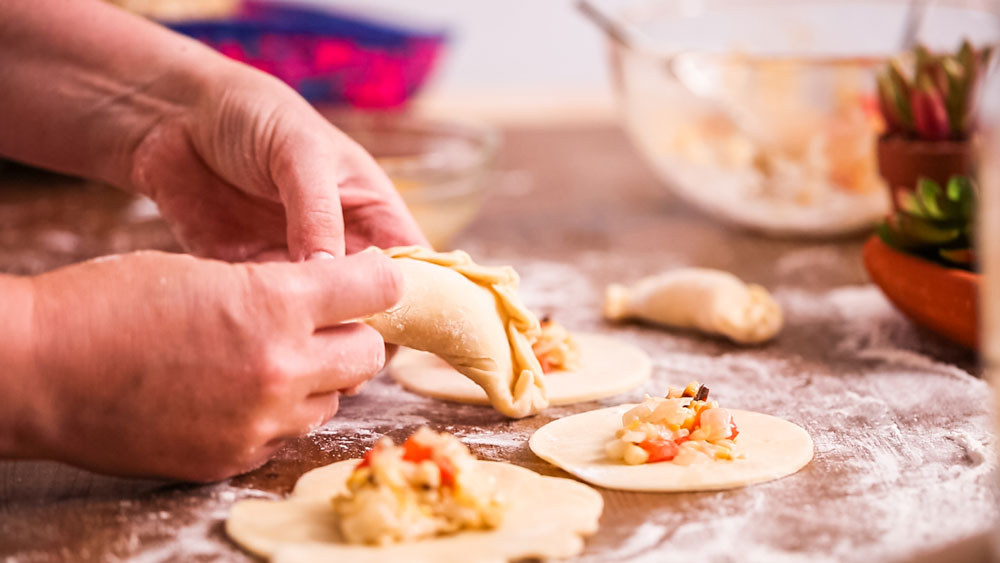
Put about 2 tablespoons of cooled filling on one half of each disc, leaving a ½-inch border. Brush the edge with water, fold the dough over, and press out any air as you seal.
Crimp the edge with a fork, or make a repulgue, the twisted rope edge used in Argentina: pinch a small piece of the edge, fold it over itself, and repeat all the way around.
6Bake or fry
Chill the filled empanadas for 15 minutes if you can; cold dough holds its shape better. Then bake them with an egg wash or fry them in hot oil, as explained below.
Empanada disc sizes and thickness
This dough makes about 680 g (1½ lb). Use this chart to scale it to the size you want:
| Disc size | Dough per disc | Filling | Makes |
|---|---|---|---|
| 3½-inch (cocktail) | about 25 g | 2 teaspoons | 26 to 28 |
| 5-inch (classic) | about 45 g | 2 tablespoons | 15 |
| 6-inch (large) | about 65 g | 3 tablespoons | 10 to 11 |
Roll the dough about ⅛ inch (3 mm) thick for baking. For frying, go a little thinner, closer to 2 mm, so the crust cooks through before the outside gets too dark.
Baked, fried or air-fried empanadas
The same empanada dough works for every cooking method. Here is how to get each one right.
Baked empanadas

Heat the oven to 400°F (200°C). Place the empanadas on a parchment-lined sheet, brush them with an egg yolk beaten with a spoonful of milk, and bake for 18 to 22 minutes, until deep golden. Butter or butter-and-lard dough is best here.
Fried empanadas

For empanada dough for frying, swap the butter for lard or shortening and roll it a little thinner. Heat 2 inches of oil to 350°F (175°C) and fry 2 or 3 at a time for 2 to 3 minutes per side. Drain them on a rack instead of paper towels so the bottoms stay crisp.
Want the bubbly, blistered crust of Puerto Rican pastelillos or Ecuadorian empanadas de viento? Add ½ teaspoon baking powder to the flour.
Air-fryer empanadas
Brush the empanadas with egg wash or oil and cook them at 375°F (190°C) for 8 to 10 minutes in a single layer, until golden. Most baskets hold 4 to 6 at a time.
Empanada dough variations
Once you have the basic dough down, small changes give you a dough for almost any filling or diet.
- Flaky empanada dough: roll the chilled dough into a rectangle, fold it in thirds like a letter, turn it and repeat twice, then chill before rolling. The layers puff in the oven, close to the hojaldre (puff) discs sold in Argentina.
- Argentine masa criolla: many Argentine cooks melt beef fat or lard into warm salted water and work it into the flour, with no egg. The dough is lean, elastic and crisp.
- Annatto (achiote) dough: add 1 teaspoon ground annatto to the flour for the orange-gold color of many Caribbean and Colombian-style empanadas.
- Sweet empanada dough: add 2 tablespoons sugar and a pinch of cinnamon for guava, fruit or dulce de leche fillings. Brush with egg wash and sprinkle with sugar before baking.
- Vegan empanada dough: replace the butter with 6 tablespoons neutral oil, skip the egg and add 2 to 3 tablespoons more water. Brush with oil instead of egg wash.
- Gluten-free empanada dough: use a cup-for-cup gluten-free flour blend that contains xanthan gum, add 1 extra egg yolk, and roll the dough between sheets of plastic wrap. It is more fragile, so fold gently and patch any cracks with a damp finger. Corn-dough empanadas, below, are naturally gluten-free.
Empanada dough by country
Every country that makes empanadas has its own dough. Here is how the best-known styles differ.
Argentina and Uruguay
Argentine empanadas are small, baked or fried, and sealed with the repulgue. The dough is usually made with beef fat or lard and warm salted water, and many families buy ready-made discs for baking (criolla) or puff-style discs (hojaldre). Try them with our baked beef empanadas or chicken empanadas, and read the history of Argentinian empanadas.
Chile

Chilean empanadas de pino are big, baked turnovers filled with beef, onion, egg and olives. The dough is often enriched with warm milk and lard, and it is folded into a square-shouldered rectangle rather than a half-moon.
Colombia and Venezuela
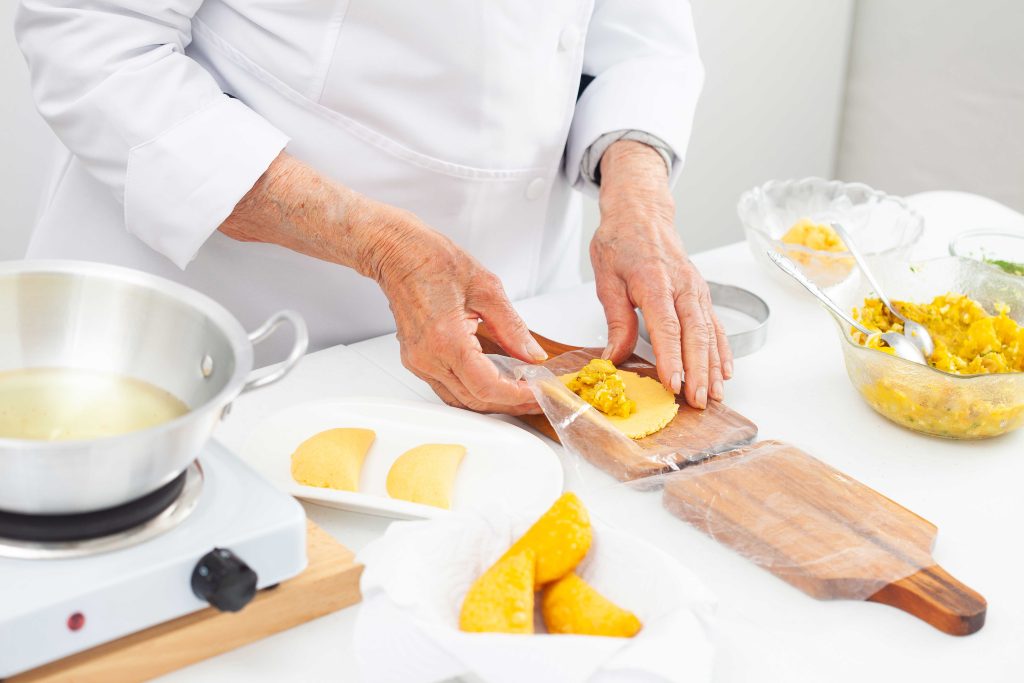
Here the dough is made from precooked yellow corn flour such as Harina P.A.N., water and salt, and the empanadas are always fried until crunchy. Get the details in our Colombian empanadas and Venezuelan empanadas recipes.
Puerto Rico and the Dominican Republic

Puerto Rican pastelillos and empanadillas and Dominican pastelitos use a thin wheat dough that is fried until it blisters. Some cooks color it with annatto oil or sazón. Use the lard version of this recipe, roll it thin, and add ½ teaspoon baking powder.
Ecuador and Bolivia

Ecuador’s empanadas de viento are puffed, fried cheese empanadas dusted with sugar. Bolivia’s salteñas use a sweeter, egg-rich dough, often tinted with annatto, that bakes around a soupy filling.
Spain and the Philippines

In Spain, empanada gallega is one large pie with a bread-like crust, often made with a little yeast and the oil from the sofrito. In the Philippines, the Ilocos empanada is fried in a crisp, orange rice-flour shell colored with annatto, while other Filipino empanadas use a slightly sweet wheat dough.
Store-bought empanada discs
Frozen empanada dough discs are a good shortcut on a busy night. You will find them in the freezer section of Latin markets and many US supermarkets.
- Goya Discos: Goya sells separate discs for baking and for frying, plus a flaky puff-style disc. The baking discs brown well with an egg wash; the frying discs blister like pastelillos.
- La Salteña: the Argentine brand, with traditional criolla discs and flaky hojaldre discs.
- Other brands: check the package, which tells you whether the discs are made for baking (para hornear) or frying (para freír). Frying discs puff and crack in the oven.
Thaw frozen discs overnight in the fridge, keep them covered while you work so the edges do not dry out, and peel them apart gently. Homemade dough is richer and more flavorful, and it costs a fraction of the price.
Empanada dough troubleshooting
| Problem | Why it happens | Fix |
|---|---|---|
| Cracks when you fold it | Too dry or too cold | Let the discs sit 5 minutes at room temperature, or knead in 1 teaspoon water. |
| Shrinks back when rolled | Gluten has not relaxed | Cover and rest the dough 10 to 15 minutes, then roll again. |
| Tough or chewy crust | Overkneaded, or too much flour added | Knead just until smooth and use as little flour on the counter as you can. |
| Empanadas open or leak | Overfilled, warm filling, or floury edges | Use less filling, cool it completely, brush the edge with water, and chill before cooking. |
| Soggy bottoms | Wet filling | Drain the filling well and bake on the lowest oven rack. |
| Pale when baked | No egg wash, or oven too cool | Brush with egg wash and bake at a full 400°F (200°C). |
| Greasy when fried | Oil not hot enough | Keep the oil at 350°F (175°C) and fry in small batches. |
How to store and freeze empanada dough
- Fridge: wrapped tightly, the dough keeps for up to 2 days. Let it sit 10 minutes before rolling.
- Freezer (discs): stack rolled discs with a square of parchment between each, wrap them well, and freeze for up to 3 months. Thaw overnight in the fridge.
- Freezer (filled): freeze filled, unbaked empanadas on a tray until firm, then bag them. Bake them straight from frozen, adding 5 to 8 minutes.
- Cooked empanadas: refrigerate for up to 3 days and reheat at 350°F (175°C) for 10 minutes to re-crisp the crust.
What to fill your empanadas with

This dough works with any filling that is cooked, cooled and not too wet. Some favorites from around the site:
- Beef picadillo: ground beef, onion, cumin, paprika, olives and egg, as in our baked beef empanadas. A shake of Goya Adobo seasons the meat fast.
- Chicken: shredded chicken with peppers and onion, from our chicken empanadas.
- Cheese: mozzarella or queso fresco, alone or with ham, or the sugar-dusted Ecuadorian empanadas de viento.
- Sweet: guava paste with cream cheese, dulce de leche, or spiced apple, using the sweet dough variation.
For more ideas, browse our guide to empanadas from across Latin America and our tips for making the most delicious empanadas. Serve them with chimichurri or Chilean pebre for dipping.
Empanada dough FAQ
What is empanada dough made of?
Flour, salt, a fat such as butter, lard or oil, and a liquid, usually water with an egg. Some recipes add milk, vinegar or a little sugar.
Which dough is best for empanadas?
For baking, a butter dough with an egg, like this one, gives the best flavor and color. For frying, a lard or shortening dough is crisper. Corn dough is best for Colombian and Venezuelan empanadas.
Is empanada dough the same as pie crust?
No. Pie crust has more fat and less water, so it is flakier but tears and leaks when folded. Empanada dough is sturdier and more elastic, which is why pie crust is a poor substitute.
Is empanada dough the same as tortilla dough?
No. Flour tortillas are cooked on a griddle before they are filled, while empanada dough is filled raw and then baked or fried. Corn empanadas use a corn dough similar to arepa dough.
Does empanada dough have eggs or dairy?
Many recipes, including this one, use butter and one egg. Traditional Argentine dough often uses beef fat and water with no egg or dairy, and the oil variation above is fully vegan.
How thick should empanada dough be?
About ⅛ inch (3 mm) for baked empanadas and slightly thinner, around 2 mm, for fried ones.
Can I use bread flour for empanada dough?
You can, but the higher protein makes the dough springy and the crust chewier. All-purpose flour gives a more tender result.
How long does empanada dough last in the fridge?
Up to 2 days, tightly wrapped. Frozen discs keep for 3 months.
Can you air fry empanada dough?
Yes. Brush with egg wash or oil and air fry at 375°F (190°C) for 8 to 10 minutes, until golden.
What is empanada dough called in Spanish?
Masa para empanadas. Ready-made discs are called tapas or discos.
Empanada Dough Recipe
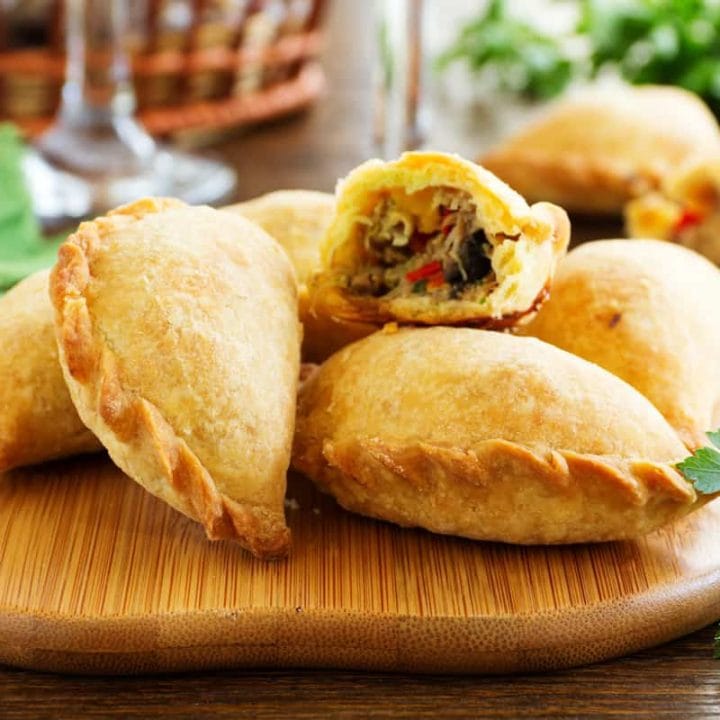
Empanada Dough (Homemade Masa para Empanadas)
A tender, sturdy homemade empanada dough made with flour, cold butter, egg and ice water. It rolls thin without tearing, seals tight, and works for baked or fried empanadas. Makes about 15 five-inch discs.
Ingredients
For the dough
- 3 cups (375 g) all-purpose flour, plus more for rolling
- 1 teaspoon fine salt
- 1 teaspoon sugar (optional, helps browning)
- 8 tablespoons (113 g) cold unsalted butter, cut into ½-inch cubes
- 1 large egg
- ½ cup (120 ml) ice-cold water, plus 1 to 3 tablespoons more as needed
- 1 tablespoon white vinegar
To fill and finish
- About 2 cups cooled filling of your choice (2 tablespoons per empanada)
- 1 egg yolk beaten with 1 tablespoon milk or water, for baking
- Neutral oil, for frying (optional)
Instructions
- Whisk the flour, salt and sugar in a large bowl (or pulse them in a food processor).
- Add the cold butter cubes and rub them into the flour with your fingertips (or pulse 8 to 10 times) until the mixture looks like coarse crumbs with a few pea-size pieces of butter.
- Beat the egg with the ice water and vinegar. Pour it over the flour and stir with a fork until shaggy clumps form. Add more water 1 tablespoon at a time only if dry flour remains in the bottom of the bowl.
- Turn the dough onto the counter and knead 6 to 8 times, just until smooth. Flatten it into a disk, wrap it, and refrigerate for at least 30 minutes or up to 2 days.
- Divide the dough into 15 equal pieces (about 45 g each) and roll each into a ball. On a lightly floured surface, roll each ball into a 5-inch (13 cm) circle about ⅛ inch (3 mm) thick. Or roll the whole dough out and cut circles with a 5-inch cutter or small bowl, re-rolling the scraps once.
- Place about 2 tablespoons of cooled filling on one half of each disc. Brush the edge with water, fold the dough over, press out the air, and seal with a fork or a twisted repulgue edge. If you have time, chill the filled empanadas for 15 minutes.
- To bake: heat the oven to 400°F (200°C). Arrange the empanadas on a parchment-lined baking sheet, brush with the egg wash, and bake for 18 to 22 minutes, until deep golden.
- To fry: heat 2 inches of oil to 350°F (175°C). Fry 2 or 3 empanadas at a time for 2 to 3 minutes per side, until golden and blistered, and drain on a rack. Skip the egg wash for frying.
Notes
Keep everything cold. Cold butter and ice water give a tender, slightly flaky crust. Let the filling cool completely before you fill the discs; warm filling melts the butter and tears the dough.
Lard or shortening: swap the butter 1 for 1 for a crisper, more traditional crust, especially for frying.
Dairy-free or vegan: use 6 tablespoons neutral oil instead of the butter, leave out the egg, and add 2 to 3 tablespoons more water. Bake with an oil brush instead of egg wash.
Annatto dough: add 1 teaspoon ground annatto (achiote) to the flour for the orange color of many Caribbean and Colombian-style empanadas.
Sweet dough: add 2 tablespoons sugar and a pinch of cinnamon for fruit, guava or dulce de leche fillings.
Air fryer: brush with egg wash or oil and cook at 375°F (190°C) for 8 to 10 minutes in a single layer, until golden.
Make ahead and freeze: refrigerate the dough for up to 2 days. Freeze rolled discs stacked between squares of parchment for up to 3 months and thaw them overnight in the fridge. Freeze filled, unbaked empanadas on a tray, then bag them; bake them straight from frozen, adding 5 to 8 minutes.
Timing: the total time includes 30 minutes of chilling the dough. Cook time is for baking; frying takes about 5 minutes per batch.
More empanada recipes
Put your dough to work with baked beef empanadas, chicken empanadas, Chilean empanadas de pino or Bolivian salteñas. Brazil’s version of a fried pastry is the pastel, whose dough gets its shatter-crisp crust from a spoonful of cachaça. For a party spread, see our Latin appetizers and the classics in Argentine food.
More Argentine Foods
See all →
Jorge Garcia is the founder of AmigoFoods, where he has spent over 20 years helping readers discover authentic Latin American and Spanish cuisine. Raised in a Cuban-American household, Jorge learned to cook at the hands of his mother and grandmother, carrying forward generations of family recipes. That heritage, backed by his family’s four-generation history in the Latin food industry, inspired him to launch AmigoFoods in 2003. With more than 1,000 published articles on recipes, ingredients, and food culture, Jorge’s mission is simple: make authentic Latin cooking approachable for home cooks everywhere while honoring the traditions behind every dish.