

Feijão preto is a Brazilian staple of tender black beans in a rich broth, often spooned over rice. This meatless stovetop recipe finishes the beans with sautéed onion, garlic and a little mashed bean to make the broth cling to every spoonful.
Feijão Preto at a Glance
What Feijão Preto Is

Feijão preto is the black turtle bean, Phaseolus vulgaris — the same species as kidney, pinto and cannellini, just a different cultivar. It is small, matte black, and it holds its shape while the cooking liquid around it turns dark and faintly syrupy.
That broth is the point. A well-cooked pot of black beans produces something closer to a sauce than to bean water, and it carries smoke and salt from whatever pork went in with it. Other beans do not do this in the same way, which is why the swap is so noticeable.
Beans are Indigenous to the Americas and were domesticated here long before contact. What Brazil did was marry them to Portuguese pork cookery.
The Feijoada Story, and Why It Is Wrong

The story most people have heard is that enslaved people invented feijoada by adding the pork scraps their enslavers discarded — ears, feet, tails — to their ration of beans.
Feijoada’s precise origins remain debated. European bean-and-meat stews influenced its development, but describing the Brazilian dish as simply imported is too definite. A historical study of nineteenth-century Rio de Janeiro documents early feijoada advertisements and discusses competing origin accounts; the familiar discarded-scraps story should not be presented as established fact.
The other problem with the story is economic: offal and trotters were not cheap throwaway items, and feijoada appears in nineteenth-century Rio as restaurant food.
None of this diminishes the African contribution to Brazilian cooking, which is enormous and sits in plain view in moqueca, acarajé and everything built on dendê. It just means feijoada is not the place to look for it. Worth knowing, because the myth gets repeated as fact almost everywhere.
Black Beans Are Not Universal

This is the thing most foreign recipes get wrong. Brazil is not a black-bean country; Rio is a black-bean city.
Across Minas Gerais, São Paulo, the centre-west and much of the northeast, the default is feijão carioca — a speckled brown bean with a lighter, milder broth. In Bahia there are brown and white beans. In Ceará and the sertão the everyday bean is often the cowpea, feijão-de-corda, which goes into baião de dois. In the south, black returns. A feijoada made with black beans in parts of Minas would read as a Rio dish being served to you, not as dinner.
So when a Brazilian recipe just says feijão, it means whichever bean that state cooks. Feijão tropeiro and tutu de feijão are both mineiro dishes and both traditionally use carioca, not black.
Cooking Them
Soaking
Soak in the refrigerator overnight, or for at least six hours, then drain and rinse. Soaking can shorten cooking time; unsoaked beans can also be cooked with a longer schedule.
The pot
Brazilians almost universally use a pressure cooker, and it is the right tool: twenty to thirty minutes against an hour and a half or more. In an open pot, keep it at a bare simmer. A rolling boil breaks the skins and you end up with mush in grey water.
Salt is optional early; add acid after softening
Salt can be added during soaking or cooking; it does not have the same effect as acid. Utah State University Extension explains that salt can help beans hydrate evenly. Wait until the beans are tender before adding acidic ingredients such as tomato, vinegar or wine. Adjust the final salt after any salted meat or broth has been added.

The fat, and the mash
The finish that makes the difference: take a ladle of cooked beans, mash them, fry the mash briefly in oil with garlic, and stir it back into the pot. The starch thickens the broth into something that clings to rice. This is what separates good home beans from watery ones, and almost no English-language recipe mentions it.
For salted meats — charque, carne seca, salt-cured ribs — soak them separately in the refrigerator with several changes of water first, or the whole pot is inedibly salty.
Feijão Preto Recipe
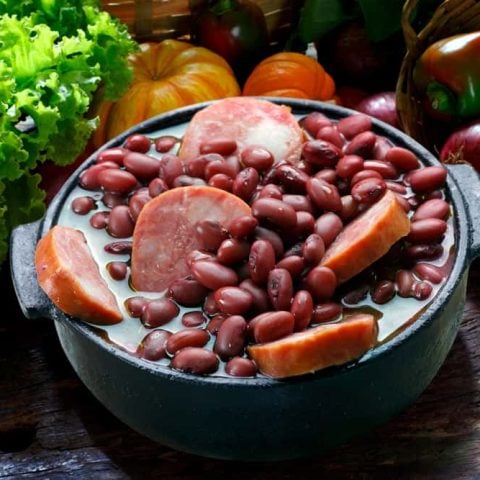
Feijão Preto (Brazilian Black Beans)
Tender black beans in a rich, garlicky broth—perfect spooned over rice.
Ingredients
- 1 lb (454 g) dried black beans, rinsed and sorted
- 6 cups water, plus more as needed
- 2 tablespoons olive oil
- 1 medium onion, finely chopped
- 4 garlic cloves, minced
- Salt and black pepper, to taste
Instructions
- Soak: Cover beans generously with water. Soak in the refrigerator for 6–8 hours or overnight, then drain and rinse.
- Simmer: Place beans in a large pot with 6 cups fresh water. Bring to a boil, then reduce to a gentle simmer. Cook partially covered for 1½–2 hours, until tender, adding water as needed to keep beans submerged.
- Sauté: Heat oil in a skillet over medium heat. Cook onion until softened, about 5 minutes. Add garlic and cook for 30 seconds.
- Thicken: Mash a ladleful of cooked beans. Add to the skillet and cook, stirring, for 1–2 minutes. Stir the mixture back into the pot.
- Finish: Simmer for 5–10 minutes, until the broth thickens. Season with salt and pepper; add a little water if needed.
Notes
Serve with white rice and a sprinkle of toasted cassava flour. Soak for 6–8 hours; cooking time varies with the age of the beans. The time fields allow 8 hours for soaking and approximately 2 hours for cooking.
What They Go Into

Feijoada is the showpiece: black beans with a range of fresh and cured pork, served with rice, collard greens sliced thin and flashed in garlic, orange segments, farofa and often a pork crackling. The orange is not a garnish — it cuts the fat, and the meal is unbalanced without it.
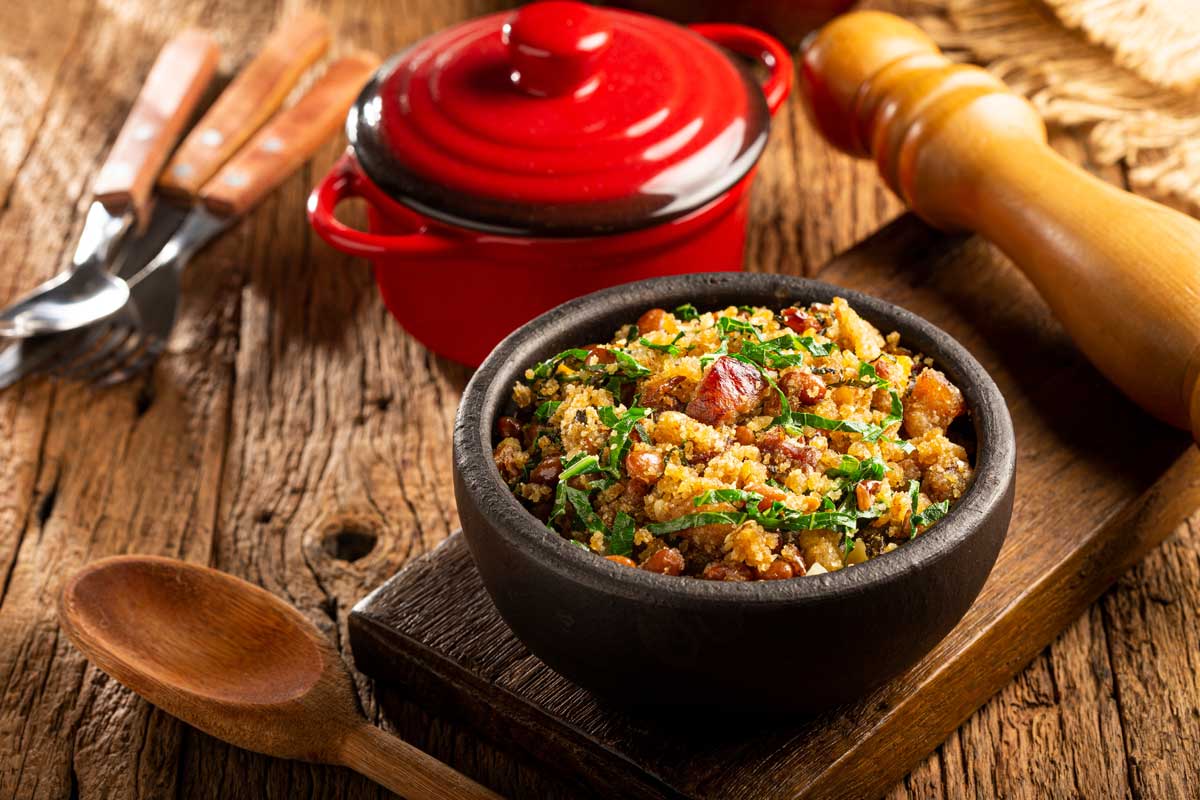
Arroz e feijão is the reality: beans ladled over rice at lunch, seasoned with a simple garlic-and-onion refogado, eaten with farinha de mandioca sprinkled on top.
Caldinho de feijão is the leftover broth blended smooth and drunk from a small glass, usually at a bar with a beer.
Beans also anchor a good share of the Brazilian side-dish repertoire, and turn up in the arroz carreteiro of the south.
Buying and Keeping
Use dried beans for the recipe below and its long-simmered broth. Canned beans are a useful shortcut for a separate, shorter preparation: season them with sautéed aromatics and mash a few to thicken the liquid. Do not apply the dried-bean cooking time to canned beans.
Age matters more than people expect: beans more than a year or two old take much longer to soften and sometimes never fully do, no matter how long you soak them. Buy from somewhere with turnover, and store them sealed, cool and dark.
Dried black beans are easy to find, and a bag goes a long way.
Questions About Feijão Preto
Are Brazilian black beans the same as Mexican black beans?
The same type of black bean can be used in either cuisine. Brazilian preparations often use garlic and onion, with pork in some versions; the recipe here is meatless. Mexican preparations include whole brothy beans as well as mashed and refried versions.
Do all Brazilians eat black beans?
No. Black beans are the standard in Rio, the southeast and the south. Much of the rest of the country cooks carioca beans, which are speckled brown and milder.
Do I have to soak black beans?
Soaking is optional, but this recipe is timed for soaked beans. Unsoaked beans need a different cooking schedule; age and water quality also affect how quickly they soften. Soak in the refrigerator and drain before cooking.
Why are my beans still hard?
Older beans, hard water and acidic ingredients can make softening difficult. Keep simmering with enough water and check several beans for a tender center. Salt is not the same as acid and need not be withheld until the end.
Did enslaved people invent feijoada?
Its exact origin and first cooks are not established. The often-repeated story about discarded pork scraps is disputed, and Portuguese influences alone do not identify a single inventor or explain every stage of the dish’s development.
Why is feijoada served with orange?
To cut the richness. Feijoada is a heavy, fatty dish, and the acidity of orange segments resets the palate between bites. It is part of the meal, not decoration.
Black beans are one of the fourteen essential Brazilian ingredients. For the rest, see the Brazilian ingredients hub or everything we have written about Brazilian food.
More Brazilian Foods
See all →
Jorge Garcia is the founder of AmigoFoods, where he has spent over 20 years helping readers discover authentic Latin American and Spanish cuisine. Raised in a Cuban-American household, Jorge learned to cook at the hands of his mother and grandmother, carrying forward generations of family recipes. That heritage, backed by his family’s four-generation history in the Latin food industry, inspired him to launch AmigoFoods in 2003. With more than 1,000 published articles on recipes, ingredients, and food culture, Jorge’s mission is simple: make authentic Latin cooking approachable for home cooks everywhere while honoring the traditions behind every dish.