

On this page
Chistorra (txistorra in Basque) is a long, skinny, quick-cured pork sausage from Navarra in northern Spain, seasoned with pimentón, garlic and salt. It is only dried for a few days, so you always cook it, usually pan-fried whole until the casing blisters, then cut into bites for pintxos, eggs and bocadillos.
Chistorra Frita at a Glance
AmigoFoods may earn a commission from qualifying Amazon purchases made through links on this page.
What Is Chistorra?
Chistorra is a thin fresh-cured sausage made from minced pork meat and pork fat, seasoned with pimentón (Spanish paprika), garlic and salt, and stuffed into a narrow lamb casing or an edible collagen one. It is sold in long coils or links that are only about ¾ inch (17 to 25 mm) across.
The key word is quick. Chorizo for slicing hangs for weeks or months. Chistorra is aired for a minimum of two days and then sold. It stays soft, pink inside and juicy, which is why Spaniards fry or grill it rather than slicing it raw onto a board.
Since October 2024 the name Chistorra de Navarra (also labeled Txistorra de Navarra or Nafarroako Txistorra) has been an EU Protected Geographical Indication. Only chistorra made and labeled in Navarra, under the official specification, can carry that seal.
- FromNavarra and the Basque Country, Spain
- Made ofPork meat and pork fat; some regional versions add beef
- SeasoningPimentón, garlic and salt
- Thickness17 to 25 mm, about ¾ inch
- CureAired at least 2 days; semi-cured
- Eat itCooked: fried, grilled, baked

What Is Chistorra in English? (And How to Say It)
There is no English word for chistorra. On American menus and labels you will see it described as Basque sausage, Spanish chistorra sausage or thin Basque-style chorizo. All three point to the same thing.
Say it chees-TOR-rah, with a rolled double R. The Basque spelling txistorra sounds the same, because “tx” in Basque is pronounced “ch.” The word comes from txistor, Basque for this kind of sausage. In the Aragonese Pyrenees, a coarser cousin made with offal goes by birika or berica.
Chistorra vs. Chorizo: What’s the Difference?
Chistorra is part of the chorizo family. It uses the same pork, pimentón and garlic, but it is thinner, fattier and barely cured, so it cooks in minutes and must be cooked. Here is how it lines up against Spanish and Mexican chorizo.
| Chistorra | Spanish chorizo | Mexican chorizo | |
|---|---|---|---|
| Shape | Long, skinny coil, about ¾ in thick | Thicker links or a horseshoe | Soft links or loose bulk |
| Cure | Aired 2+ days, semi-cured | Fresco (to cook) or curado (fully cured) | Fresh and raw |
| Fat | High; renders a lot of orange fat | Medium | Varies by maker |
| Seasoning | Pimentón, garlic, salt | Pimentón, garlic, sometimes oregano or wine | Dried chiles, vinegar, spices |
| Raw or cooked? | Always cooked | Curado sliced as is; fresco cooked | Always cooked |
| How it’s cooked | Fried or grilled whole, then cut | Sliced for tapas; simmered in stews | Removed from casing and crumbled |
| Best for | Pintxos, eggs, bocadillos | Tapas boards, lentejas, paella-style rice | Tacos, eggs, queso fundido |
The practical takeaway: chistorra behaves like fresh Spanish chorizo, not like the cured chorizo you slice for a board. If you are cooking a dish that calls for chistorra and can only find cured chorizo, see the substitutes below. For a wider look at the family, read our guide to the difference between chorizo and sausage.

How to Cook Chistorra (4 Ways)
Chistorra is fatty and thin, so it cooks fast and bastes itself. You do not need much oil, and you do not need to prick the casing. Cook it whole or in 3-inch pieces, then cut it after it comes off the heat so the juices stay inside.
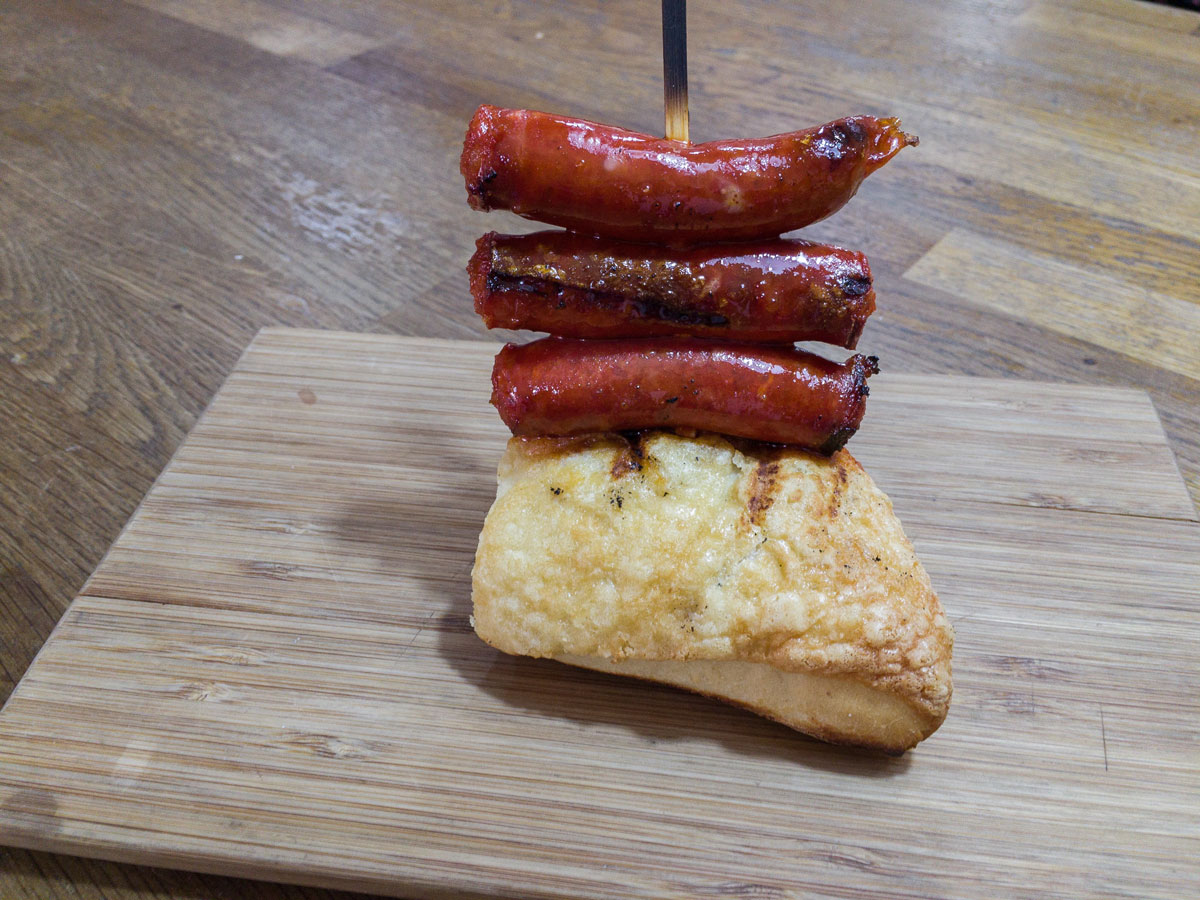
- Pan-fried (chistorra frita)The classic. Start in a teaspoon of olive oil and turn every couple of minutes until the casing blisters and browns. Toast bread in the leftover fat.
- Grilled (a la parrilla)Push two skewers crosswise through a coil so it turns as one piece. Move it off direct heat if the dripping fat flares up.
- Oven-bakedBest for a crowd. Lay pieces on a rack over a foil-lined sheet pan and turn once halfway through.
- Air fryerCoil pieces in one layer and shake the basket halfway. Line the bottom drawer; it collects a lot of fat.
How to tell it’s done: the casing is blistered and browned, the fat runs clear orange, and the center reads 160°F (71°C) on an instant-read thermometer with no pink left. Rest it for a minute before cutting.
Want to simmer it instead? Chistorra takes beautifully to a quick braise in red wine or Spanish cider. Use the method in our chorizo al vino and chorizo a la sidra recipes, cutting the time by about a third because chistorra is so much thinner.
How to Eat Chistorra: 8 Classic Ways
In Navarra and the Basque Country, chistorra shows up at breakfast, at the bar, at street fairs. These are the ways you will see it most.
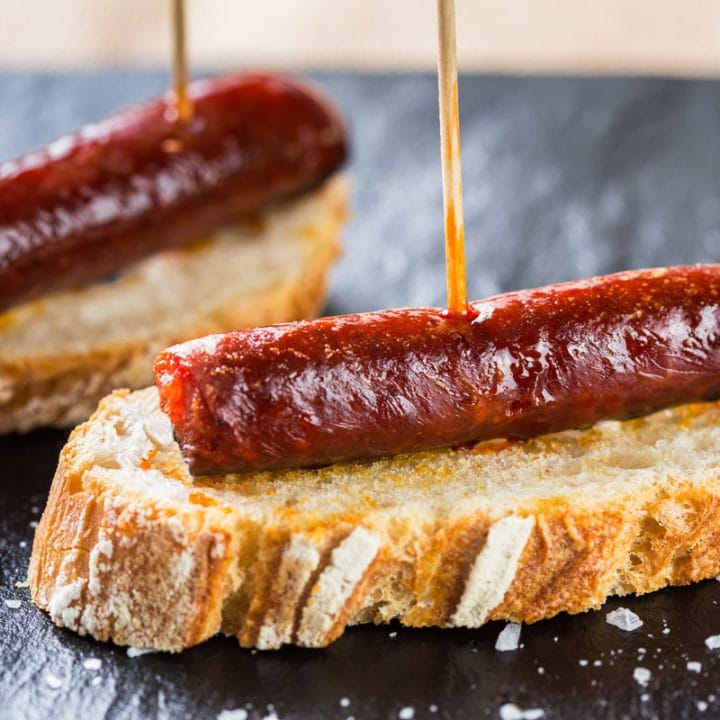
- Pintxo de chistorra. A piece of fried chistorra on bread toasted in its own fat, pinned with a toothpick. It is the recipe in the card below.
- Huevos rotos con chistorra. Fried potatoes and runny fried eggs, broken over the top with chopped chistorra. Follow our huevos rotos recipe and swap the jamón for fried chistorra.
- Bocadillo de chistorra. A whole fried coil folded into a split bocadillo roll. Nothing else needed.
- Talo con chistorra. A thin Basque corn flatbread wrapped around chistorra, the traditional street food of the Santo Tomás fair on December 21 in San Sebastián and Bilbao, served with cider.
- Chistorra a la sidra. Simmered in Basque cider until the sauce turns sticky.
- Migas con chistorra. Crumbled fried chistorra stirred through Spanish migas, the shepherd’s dish of fried bread crumbs.
- Tortilla con chistorra. Pieces folded into a potato tortilla española or a simple French omelet.
- Croissant preñado. A croissant baked around a length of chistorra, sold in bakeries across northern Spain as breakfast on the go.

For a full Spanish breakfast spread, chistorra with fried eggs and potatoes sits right alongside the dishes in our guide to Spanish breakfast foods.

Chistorra in Mexico
If you grew up in Mexico, you may know chistorra as a grocery-store sausage rather than a Basque specialty. Today Mexican supermarkets and carnicerías sell it in long, thin coils. It goes on the grill at carne asadas, into tacos, and into queso fundido con chistorra.
Mexican chistorra varies by brand. Some taste much like the Spanish original. Others lean toward Mexican chorizo, with dried chile in place of some of the pimentón. Check the label: if chile comes before paprika in the ingredients, expect a softer, spicier sausage that still cooks the same way.
Where Chistorra Comes From
Chistorra belongs to Navarra first, with deep roots across the neighboring Basque Country and Aragón. Navarra’s government dates its place in local cooking to at least the early 1800s, and Navarrese producers now sell more than 1.5 million kilos a year in Navarra alone.
It grew out of the winter matanza, the family pig slaughter. Lean cuts went into hams and long-cured chorizos meant to last the year. The fattier trimmings went into a thin sausage that dried in days and was eaten within weeks. That is still the logic of chistorra: a quick, fatty, everyday sausage, not a keeper.
It is also a festival food. The village of Arbizu in Navarra holds an annual Txistor Eguna, or chistorra day, and the Santo Tomás fair every December 21 fills San Sebastián and Bilbao with stalls of talo con chistorra and cider. After years of work by Navarra’s producers and butchers, the European Union registered Chistorra de Navarra as a Protected Geographical Indication in October 2024. For the rest of Spain’s sausage family, see our guide to Latin American and Spanish cured meats.
Where to Buy Chistorra in the US
Most chistorra sold in the United States is made here by Spanish-style producers, and certified Chistorra de Navarra is hard to find outside Spain. Good options:
- Spanish specialty shops and online importers. California’s La Española Meats makes a classic chistorra, and Spanish food sites ship it frozen.
- Butcher-style online retailers. Wild Fork sells a Spanish-style chistorra in its frozen sausage range.
- Mexican and Latin supermarkets. Look in the refrigerated chorizo section for Mexican-style chistorra in long coils.
- Amazon. You can shop chistorra on Amazon; check that it ships refrigerated or frozen.
Good chistorra should look uniformly brick red, feel firm but not hard, and show distinct specks of fat through the casing. Avoid packs with gray patches or a lot of liquid.
Making the pintxos or your own chistorra-style sausage? These pantry staples are worth having:
- La Dalia smoked paprika, DOP Pimentón de la Vera, the same style of pimentón that colors chistorra. Read more in our pimentón guide.
- La Chinata sweet smoked paprika, a milder tin for eggs and potatoes.
- Fresh Press Farms cold-pressed Spanish extra-virgin olive oil for starting the pan and frying the potatoes for huevos rotos.

Chistorra Substitutes and How to Store It
If you can’t find chistorra, choose a fresh sausage over a fully cured one. Ranked from closest to furthest:
- Fresh Spanish chorizo (chorizo fresco or “cooking” chorizo). Same seasoning, same cooking. Cut it lengthwise into thin strips so it cooks as fast.
- Fresh longaniza or Portuguese linguiça. Mild and thin, with a little less paprika.
- Cured Spanish chorizo, sliced thin and crisped for a minute or two. Saltier and drier, but the flavor is right.
- Mexican chorizo. A last resort for eggs and tacos. It crumbles instead of holding its shape.
Storage: keep vacuum-packed chistorra in the fridge until its use-by date, and use an opened pack within 3 to 4 days. It freezes well for 1 to 2 months; wrap it tightly and thaw it in the fridge overnight. Cooked chistorra keeps 3 to 4 days in the fridge and reheats in a dry skillet in 2 minutes.
Chistorra Frita Recipe (Pan-Fried Chistorra Pintxos)
This is how most people in Navarra first eat chistorra: fried whole, cut into bites and set on bread that has been toasted in the paprika-red fat. A splash of sidra at the end gives it a glossy glaze, but plain is just as traditional.
Chistorra Frita (Pan-Fried Chistorra Pintxos)
Chistorra fried whole until the casing blisters, then cut into bites and set on bread toasted in the paprika-red fat. The simplest and most classic way to eat Basque-Navarrese chistorra, ready in 15 minutes.
Ingredients
- 1 lb (450 g) chistorra, one coil or 2 to 3 links
- 1 teaspoon extra-virgin olive oil
- 12 slices baguette or Spanish barra, cut ½ inch thick on the bias
- ¼ cup (60 ml) Spanish sidra (hard cider) or dry white wine, optional
- Piparras or padrón peppers, to serve, optional
Instructions
- Cut the chistorra. Cut the chistorra into 3-inch (8 cm) pieces, or leave the coil whole if your skillet is big enough. There is no need to prick the casing.
- Fry it slowly. Heat the olive oil in a large skillet over medium heat. Add the chistorra in a single layer and cook for 6 to 8 minutes, turning with tongs every couple of minutes, until the casing is blistered and browned and the fat runs orange. It is done when the center reaches 160°F (71°C) and shows no pink.
- Glaze with cider (optional). Pour in the sidra, let it bubble for 1 to 2 minutes until it turns syrupy and coats the sausage, then move the chistorra to a cutting board.
- Toast the bread in the fat. Lay the bread slices in the same skillet and toast them in the rendered fat for 30 to 60 seconds per side, until golden at the edges.
- Assemble the pintxos. Cut the chistorra into pieces the width of the bread, set one on each slice and pin it with a toothpick. Serve hot, with the piparras or padrón peppers on the side if using.
Notes
No sidra? Use a dry white wine such as txakoli, or skip the glaze; plain fried chistorra is just as traditional.
Keep the fat. The orange fat left in the pan is excellent for frying eggs or potatoes, which is how huevos rotos con chistorra starts.
Substitute: fresh (cooking) Spanish chorizo cut into thin lengths works best if you cannot find chistorra.
Chistorra FAQ
Do you have to cook chistorra?
Yes. Chistorra is only aired for a few days, so the pork inside is not cured enough to eat raw. Fry, grill or bake it until the center reaches 160°F (71°C).
Is chistorra spicy?
Usually not. Most chistorra is made with sweet or bittersweet pimentón, so it is smoky and garlicky rather than hot. Some brands sell a picante version, and some Mexican chistorra carries more chile heat.
What does chistorra taste like?
Rich, juicy and porky, with paprika, garlic and a light tang from the short cure. It is softer and fattier than cured chorizo, with a crisp, snappy casing once fried.
Is chistorra the same as chorizo?
It is a type of chorizo, but not the same thing. Chistorra is much thinner, fattier and only semi-cured, so it must be cooked, while cured chorizo can be sliced and eaten as is.
Is chistorra gluten-free?
The traditional recipe is just pork, fat, pimentón, garlic and salt, and the Navarra specification follows it. Some commercial brands add fillers or dextrose, so check the label if you avoid gluten.
Can you eat chistorra cold?
Only after it has been cooked. Leftover fried chistorra is good cold in a bocadillo the next day, but never eat it straight from the pack.
More Spanish Sausages and Cured Meats
Chistorra is one corner of Spain’s huge charcuterie tradition. Keep going with morcilla, Spain’s blood sausage; salchichón, the peppery cured sausage; and jamón ibérico. Our list of essential Spanish ingredients and our roundup of Spanish foods to try cover the rest of the pantry.
Sources
- Spain’s Ministry of Agriculture, Fisheries and Food: EU registers the new PGI Chistorra de Navarra (October 2024)
- National Library of Medicine: Raw-cured Spanish traditional meat product “Chistorra de Navarra”: sensory and composition quality standards
- USDA Food Safety and Inspection Service: Safe minimum internal temperature chart
More Spanish Foods
See all →
Jorge Garcia is the founder of AmigoFoods, where he has spent over 20 years helping readers discover authentic Latin American and Spanish cuisine. Raised in a Cuban-American household, Jorge learned to cook at the hands of his mother and grandmother, carrying forward generations of family recipes. That heritage, backed by his family’s four-generation history in the Latin food industry, inspired him to launch AmigoFoods in 2003. With more than 1,000 published articles on recipes, ingredients, and food culture, Jorge’s mission is simple: make authentic Latin cooking approachable for home cooks everywhere while honoring the traditions behind every dish.