

Longaniza is a long, thin, garlicky pork sausage that came from Spain and was remade in every Spanish-speaking country it reached: red with chile in Mexico, bright with sour orange and fried crisp in the Dominican Republic, cured with anise in Argentina, and grilled by the coil at Chilean asados. It has no English name (US labels just say “pork sausage”), and it is not chorizo, though the two are close cousins.
Below I cover how the types differ, how to tell longaniza from chorizo, how to cook store-bought links, and my recipe for homemade longaniza.
Homemade Longaniza at a Glance
What Is Longaniza?
Longaniza is a cased sausage of coarsely chopped or ground pork and pork fat, seasoned hard with garlic and black pepper. Depending on where it is made, it also gets paprika or dried chile, oregano, vinegar, citrus juice or anise. It is usually longer and thinner than chorizo and is often sold as one long rope or coil rather than short links.
It comes two ways. Fresh longaniza is raw and has to be cooked. Cured or dried longaniza has been air-dried until firm, and some of it is meant to be sliced and eaten as is. The package tells you which: only links labeled fully cooked or ready to eat go straight onto a board; everything else gets cooked to 160°F (71°C).

- MeatMostly pork and pork fat; beef, chicken and turkey versions exist
- TextureCoarse, with visible bits of fat
- ShapeLong and thin, sold in ropes, coils or links
- Fresh or curedBoth, depending on the country and maker
What does longaniza mean in English?
There is no English translation; in English it is simply called longaniza or, on US packaging, pork sausage. The word comes from the Latin lucanica, a sausage Roman soldiers picked up in Lucania in southern Italy. The same root gave Portuguese linguiça and Italian luganega. Over time the Spanish form was likely nudged by the Latin longus, “long,” which suits a sausage that can run several feet.
The Philippines has its own branch of the family, longganisa (also spelled longanisa), which I cover in the country section below.
Longaniza vs. Chorizo: What’s the Difference?
Longaniza and chorizo are both Spanish-born pork sausages, so they get confused constantly. The short answer: chorizo is defined by its red seasoning (pimentón in Spain, chile in Mexico); longaniza is defined by its long, thin shape and is usually milder, more garlicky and coarser. The details change by country.
| Longaniza | Chorizo | |
|---|---|---|
| Shape | Long and thin; ropes or coils | Shorter, thicker links |
| Grind | Coarse | Coarse in Spain, often fine and soft in Mexico |
| Defining seasoning | Garlic and black pepper; paprika, chile, citrus or anise vary by country | Pimentón (Spain) or dried chiles and vinegar (Mexico) |
| Color | White, pink or red | Always red |
| Fresh or cured | Both | Spain: mostly cured. Mexico: mostly fresh |
| How it’s cooked | Whole or in chunks; grilled, fried or sliced | Spain: sliced or cooked into dishes. Mexico: squeezed out of the casing and crumbled |
In Spain, pimentón is what makes a chorizo a chorizo. Longaniza can be red with paprika, but plenty is white, seasoned only with garlic, black pepper and spices, and it tends to be thinner.
In Mexico, chorizo is soft, chile-heavy and almost always crumbled out of its casing. Longaniza is coarser and longer, sold in ropes, and cooked in pieces; it is usually less spiced, though heat varies by maker and some regional longanizas are hotter than chorizo.
In the Caribbean, longaniza is the everyday sausage. “Chorizo” there usually means a cured, Spanish-style link.
Want to taste the difference? Cook a fresh longaniza next to a slice of cured Spanish chorizo, such as Redondo Iglesias Pamplona-style chorizo. For how chorizo compares with other sausages, see my guide to chorizo vs. sausage, and if you want to make the Spanish kind, here is how to make Spanish chorizo.
Types of Longaniza by Country
Every country that took longaniza from Spain changed the seasoning, and several changed how it is preserved. Here is the quick map, then the details.
| Country | Fresh or cured | Signature flavor | Classic use |
|---|---|---|---|
| Mexico | Mostly fresh; smoked in Yucatán | Dried chile, vinegar, garlic | Tacos, eggs, potatoes |
| Dominican Republic | Fresh or briefly dried | Sour orange, garlic, oregano | Longaniza frita, locrio |
| Puerto Rico | Fresh | Annatto, garlic, oregano | Arroz con longaniza |
| Spain | Fresh or cured | Black pepper, garlic; paprika in red versions | Grilled, migas, cured slices |
| Chile | Fresh, often smoked | Paprika, cumin, garlic, oregano | Asados, choripán |
| Argentina & Uruguay | Cured and dried | Anise | Sliced for picada |
| Philippines | Fresh | Sweet (hamonado) or garlicky (de recado) | Breakfast with rice and eggs |
Mexican longaniza
- Style: fresh, in long ropes
- Tastes like: chile, garlic, vinegar
- Cook it: in pieces or crumbled
Mexican longaniza is a fresh pork sausage colored with dried red chiles and sharpened with vinegar, sold in long ropes at carnicerías. It is cut into chunks or squeezed out of its casing and fried for tacos, scrambled eggs and potatoes (longaniza con papas).
The best-known regional version is longaniza de Valladolid from Yucatán, colored red with achiote and smoked over charcoal. Its classic use is chopped and scrambled with eggs. More Mexican pantry staples are in my guide to Mexican ingredients.
Dominican longaniza (longaniza dominicana)
- Style: fresh or air-dried a few days
- Tastes like: sour orange, garlic, oregano
- Cook it: simmer, then fry crisp

Dominican longaniza is pork seasoned with naranja agria (sour orange), garlic and oregano, traditionally hung to dry for a few days before cooking. Good longaniza dominicana runs about 70% lean to 30% fat, so it fries in its own fat until the casing blisters. You will find it fried at fritura stands with tostones and yuca, on picadera platters, and cooked into locrio de longaniza, the sausage version of Dominican rice. More street-food context is in my guide to Dominican street food.
Puerto Rican longaniza
- Style: fresh
- Tastes like: annatto, garlic, oregano
- Cook it: browned, then into rice
Puerto Rican longaniza is colored a deep orange-red with achiote (annatto) and seasoned with garlic, oregano and sofrito-style aromatics. Its signature dish is arroz con longaniza, rice cooked with the browned sausage, and it shows up at breakfast too; see my roundup of Puerto Rican breakfast foods.
Spanish longaniza
- Style: fresh or cured
- Tastes like: black pepper, garlic, spices
- Cook it: grilled, or sliced if cured

In Spain longaniza is often white, seasoned with black pepper, garlic and spices rather than pimentón, and sold fresh for the grill or cured for slicing. Aragón is known for its fresh longaniza, Valencia for the thin dried longanizas de Pascua eaten at Easter, and in Catalonia the cured llonganissa is a close relative of salchichón. Fried longaniza goes with Spanish migas, and the cured kinds belong on a tapas board. For the whole family of Spanish embutidos, see my guide to Latin American and Spanish cured meats.
Chilean longaniza
- Style: fresh, often smoked
- Tastes like: paprika, cumin, garlic
- Cook it: on the grill

Longaniza is the sausage of the Chilean asado, seasoned with paprika, cumin, garlic and oregano and often lightly smoked. The city of Chillán is so identified with it that longaniza de Chillán carries a denomination of origin, and the town throws a Fiesta de la Longaniza every August. Around the September 18 Fiestas Patrias it is grilled by the kilo and tucked into choripán with pebre. More on the Chilean pantry is in my guide to Chilean ingredients, and the sandwich itself is in Chilean street food.
Argentine and Uruguayan longaniza
- Style: cured and dried
- Tastes like: anise, garlic, pork
- Cook it: rarely; slice it

In the Río de la Plata, longaniza is a very long, thin, dry-cured pork sausage whose signature is ground anise seed. It is almost never cooked: it is sliced for the picada alongside salame and cheese (see my list of Argentine appetizers). Butchers also sell a fresh longaniza parrillera for the grill, but the fresh sausage at an Argentine asado or Uruguayan asado is usually chorizo.
Colombian and Central American longaniza
- Style: fresh
- Tastes like: garlic, cumin, herbs
- Cook it: fried or grilled

In Colombia, fresh longaniza is cut into rounds and grilled or fried for fritanga and picada platters, eaten with arepas, potatoes and ají. In Guatemala it is fried for breakfast and is one of the cold cuts layered into fiambre, the cold-cut salad Guatemalan families make for All Saints’ Day on November 1.
Filipino longganisa
- Style: fresh
- Tastes like: sweet or very garlicky
- Cook it: pan-fried
The Philippines inherited longaniza from Spain and turned it into longganisa (or longanisa), a family of small, often skinless sausages. They split into two camps: hamonado, sweet with sugar, and de recado, savory and loaded with garlic. Both are pan-fried and eaten for breakfast with garlic rice and a fried egg. If a recipe or package says longanisa, check which country it means, because a sweet Filipino longanisa and a Mexican longaniza are not interchangeable.
How to Cook Longaniza
Fresh longaniza is raw pork, so whatever method you use, it is done when the thickest piece reads 160°F (71°C) in the center (165°F if it is made with chicken or turkey). Cured, ready-to-eat longaniza only needs slicing, or a minute in a hot pan to wake up the fat. Leave the casing whole while it cooks so the fat stays inside.
| Method | How | Time | Best for |
|---|---|---|---|
| Simmer, then fry | Covered skillet with 1/2 cup water, then uncovered in its own fat | 15 to 18 min | Fresh links; Dominican-style frita |
| Crumbled | Casing off, broken up in a dry skillet over medium heat | 8 to 10 min | Tacos, eggs, potatoes |
| Grill | Medium heat, turning often; move to the cool side if it flares | 12 to 15 min | Asados, choripán |
| Oven | 400°F (200°C) on a rack over a sheet pan, turned once | 20 to 25 min | Big batches |
| Air fryer | 375°F (190°C) in one layer, turned halfway | 12 to 15 min | 2 to 4 links |
| Cured, sliced | Slice thin; sear 30 to 60 seconds a side if you like | 1 to 2 min | Picada, tapas boards |
The simmer-then-fry method (best for fresh links)
This is how Dominican cooks make longaniza frita, and it is the most reliable way to cook any fresh longaniza: the water cooks the center gently, then the rendered fat crisps the outside.
- Lay the links or 3-inch pieces in a large skillet, preferably cast iron like a Lodge 13-inch skillet, and add 1/2 cup water.
- Cover and simmer over medium heat for 8 to 10 minutes, turning once.
- Uncover and let the water boil off. The fat will start to render.
- Fry in that fat, turning, for 6 to 8 minutes until the casing is browned and blistered.
- Check the center with an instant-read thermometer such as the TempPro TempSwift; pull it at 160°F. Squeeze lime over the top and serve.
Longaniza with eggs (huevos con longaniza)
Squeeze about 8 ounces of fresh longaniza out of its casing and cook it in a skillet over medium heat for 8 to 10 minutes, breaking it up, until browned and cooked through. Pour off all but a tablespoon of fat, add 6 beaten eggs and stir gently until just set. Serve with warm tortillas, refried beans and salsa. In Yucatán the same dish is made with smoked longaniza de Valladolid.
Longaniza tacos
Brown longaniza in chunks or crumbles until crisp at the edges, then pile it into warm corn tortillas with chopped white onion, cilantro, a squeeze of lime and salsa verde. A few cubes of fried potato make them tacos de longaniza con papa. For more fillings, see my guide to tacos.
Homemade Longaniza Recipe
Homemade longaniza is worth the afternoon: you control the fat, the salt and the heat, and the texture is coarser and juicier than most supermarket links. My recipe is Mexican-style, red with guajillo and sharp with cider vinegar, and the notes in the card show how to turn it Dominican or Puerto Rican.
Four things decide whether it comes out juicy or crumbly:
- Keep everything near freezing. Warm fat smears instead of staying in distinct bits, and the sausage turns mealy.
- Aim for about 25 to 30% fat. Pork shoulder alone is a little lean; the extra fatback gets you there.
- Use a coarse plate. Longaniza should look rustic. A fine grind makes it taste like chorizo.
- Fry a test patty. It is the only way to check the salt before the mix goes into casings.
If you have a stand mixer, the KitchenAid food grinder attachment grinds the pork and comes with sausage-stuffing tubes. You will also want natural hog casings, or skip them and roll skinless logs in plastic wrap.
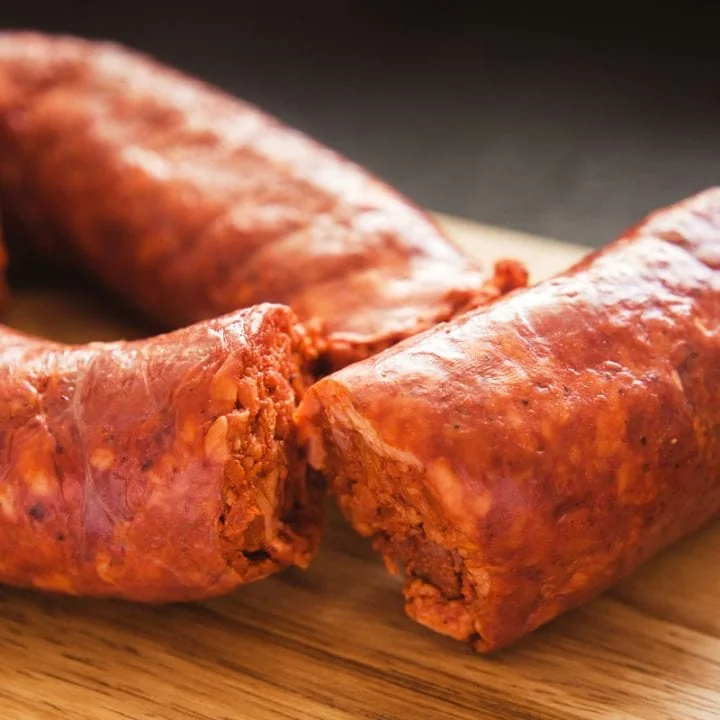
Homemade Longaniza
Coarse, garlicky Mexican-style pork longaniza seasoned with guajillo chile, cider vinegar and Mexican oregano. Stuff it into casings or roll it skinless, rest it overnight, then simmer and fry it in its own fat.
Ingredients
- 2 lb (900 g) boneless pork shoulder (Boston butt), cut into 1-inch cubes and well chilled
- 4 oz (115 g) pork fatback or fatty pork belly, cubed and well chilled
- 3 dried guajillo chiles, stemmed and seeded
- 1/3 cup (80 ml) apple cider vinegar
- 6 garlic cloves, peeled
- 15 g kosher salt (1 3/4 tablespoons Diamond Crystal or 1 tablespoon Morton)
- 2 teaspoons dried Mexican oregano
- 1 1/2 teaspoons freshly ground black pepper
- 1 teaspoon sweet paprika
- 1/2 teaspoon ground cumin
- 1/8 teaspoon ground cloves
- 1 tablespoon ice water, only if needed
- About 6 feet (2 m) natural hog casings (32 to 35 mm), rinsed and soaked (optional)
- 1/2 cup (120 ml) water, for cooking
Instructions
- Soften the chiles. Toast the guajillos in a dry skillet over medium heat for 20 to 30 seconds per side, just until fragrant. Cover with hot water and soak for 15 minutes, then drain.
- Make the seasoning paste. Blend the chiles, vinegar, garlic, salt, oregano, black pepper, paprika, cumin and cloves until smooth. Refrigerate the paste until cold.
- Grind the pork. Chill the grinder parts in the freezer for 30 minutes. Grind the cold pork and fatback through a coarse plate (3/8 inch / 10 mm) into a bowl set over ice. No grinder: ask the butcher for coarse-ground pork shoulder, or pulse very cold cubes in a food processor in small batches until pea-sized.
- Mix. Add the paste and mix with your hands or a stand-mixer paddle for 1 to 2 minutes, until the meat turns sticky and clings to itself. Add the ice water only if the mixture feels stiff.
- Test the seasoning. Fry a teaspoon-sized patty until cooked through, taste it, and adjust the salt or chile in the raw mixture.
- Shape the links. Stuff the mixture into the soaked casings without leaving air pockets and twist into 6-inch links; prick any trapped air bubbles with a clean pin. For skinless longaniza, roll 1/3-cup portions tightly in plastic wrap into 6-inch logs.
- Rest overnight. Cover and refrigerate for 8 to 24 hours so the flavors develop and the links firm up. Unwrap skinless logs before cooking.
- Cook. Put the links in a large skillet with 1/2 cup water. Cover and simmer over medium heat for 8 to 10 minutes, turning once. Uncover, let the water cook off, then fry the links in their own rendered fat, turning, for 6 to 8 minutes until browned and 160°F (71°C) in the center.
Notes
Storage: raw links keep 1 to 2 days in the refrigerator or 1 to 2 months well wrapped in the freezer; cooked longaniza keeps 3 to 4 days refrigerated. This is a fresh sausage, not a cured one, so never leave it out to dry.
Heat: for a hotter longaniza, blend 1 or 2 chiles de árbol with the guajillos.
Dominican-style: skip the guajillos, paprika, cumin and cloves, use 1/3 cup sour orange juice instead of the vinegar, and double the oregano.
Puerto Rican-style: add 1 teaspoon ground annatto (achiote) to the paste for the classic red color.
What to Make With Longaniza
Once you have good longaniza, these are the dishes it was born for, from Santo Domingo to Santiago.

Locrio de longaniza
Dominican rice cooked with browned longaniza. The method is the same as my locrio de pollo; just swap in sliced sausage.
Longaniza frita
Fried until blistered and served with tostones, fried yuca and lime, as at any Dominican fritura or on a picadera.
Mangú for breakfast
Fry longaniza in place of the salami in mangú con los tres golpes for a heartier plate.
Sancocho
One of the meats in Dominican sancocho de siete carnes.
Choripán
Grilled longaniza in a split roll with pebre, the Chilean asado sandwich.
Fritanga and picada
Colombian platters of grilled sausages, chicharrón and potatoes; see fritanga.
Migas
Spanish fried breadcrumbs with garlic and chunks of longaniza; see Spanish migas.
Fiambre
Guatemala’s All Saints’ Day salad of cold cuts and pickled vegetables; see fiambre.
Where to Buy Longaniza
Look in the refrigerated meat case of any Mexican, Dominican or Central American grocery, and in the Latin section of large supermarkets in cities with big Latino communities. Mexican brands such as El Mexicano, Reynaldo’s and El Popular are the easiest to find in the US; Dominican shops carry Induveca. Cured Argentine and Chilean longaniza mostly comes through specialty importers, and Filipino longanisa is sold frozen at Asian markets.
Read the label before you buy:
- Raw or cooked? Most US longaniza is raw and must be cooked to 160°F. Only eat it uncooked if the package says fully cooked or ready to eat.
- Which country’s style? A recipe calling for Dominican longaniza will taste wrong with a sweet Filipino longanisa.
- Fat you can see. Visible flecks of fat and a coarse grind are good signs; a uniform pink paste usually means a cheaper, finer product.
Longaniza and gear on Amazon
- El Popular Longaniza: Mexican-style fresh pork longaniza, shipped cold.
- KitchenAid food grinder attachment: grinds the pork and stuffs the links if you make your own.
- TempPro TempSwift instant-read thermometer: the 160°F check in one second.
- Lodge 13.25-inch cast iron skillet: room for a whole coil of longaniza.
- La Parmesana chimichurri: a ready-made herb sauce for longaniza choripán.
As an Amazon Associate I earn from qualifying purchases.
Longaniza FAQ
Is longaniza the same as chorizo?
No. They are related Spanish-born pork sausages, but chorizo is defined by its red pimentón or chile seasoning, while longaniza is defined by its long, thin shape and is usually coarser and more garlicky. Some longaniza is red, but much of it is not.
What is longaniza in English?
There is no English word for it. It is called longaniza in English too, and US packages often add “pork sausage.” The name comes from the Latin lucanica, a Roman sausage from Lucania in southern Italy.
What kind of meat is longaniza?
Almost always pork and pork fat. Some makers sell beef, chicken or turkey longaniza; cook those poultry versions to 165°F.
Is longanisa Mexican or Filipino?
Both words come from Spanish longaniza. “Longaniza” usually means the Latin American or Spanish sausage, while “longganisa” or “longanisa” usually means the sweeter or very garlicky Filipino breakfast sausage.
Can you eat longaniza raw?
Not fresh longaniza, which is raw pork. Cured longaniza labeled ready to eat, such as Argentine dry longaniza, can be sliced and eaten without cooking.
Is longaniza spicy?
Usually only mildly. Mexican longaniza has some chile heat that varies by brand; Dominican, Puerto Rican, Spanish and Chilean longaniza are savory rather than hot.
How long does longaniza last?
Raw fresh longaniza keeps 1 to 2 days in the refrigerator, or until the use-by date on a sealed package, and 1 to 2 months in the freezer. Cooked longaniza keeps 3 to 4 days refrigerated.
What is the difference between longaniza and linguiça?
They share the same Latin root. Linguiça is the Portuguese and Brazilian version, typically smoked and seasoned with garlic and paprika; longaniza is the Spanish and Latin American family, which varies far more from country to country.
Sources
- Wikipedia: Longaniza (etymology and regional styles)
- Yucatán Tourism: The Longaniza of Valladolid
- 24horas.cl: Fiesta de la Longaniza de Chillán (Spanish)
More Latin Favorites
See all →
Jorge Garcia is the founder of AmigoFoods, where he has spent over 20 years helping readers discover authentic Latin American and Spanish cuisine. Raised in a Cuban-American household, Jorge learned to cook at the hands of his mother and grandmother, carrying forward generations of family recipes. That heritage, backed by his family’s four-generation history in the Latin food industry, inspired him to launch AmigoFoods in 2003. With more than 1,000 published articles on recipes, ingredients, and food culture, Jorge’s mission is simple: make authentic Latin cooking approachable for home cooks everywhere while honoring the traditions behind every dish.