

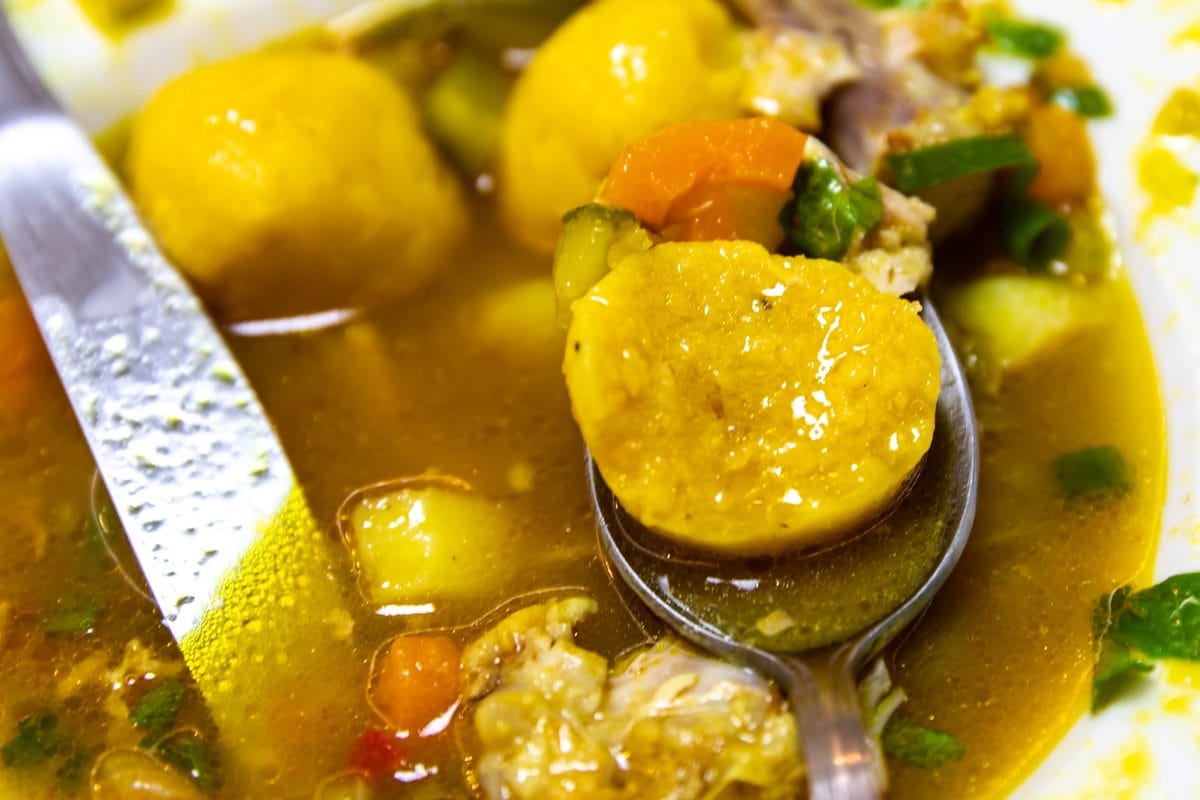
Vori vori is a Paraguayan chicken soup filled with small cornmeal-and-cheese dumplings. This version builds a golden broth with vegetables and herbs, then gently simmers the dumplings until tender for six comforting bowls.
Vori Vori at a Glance
What the Name Means
“Vorí” comes from the Spanish word bolita, “little ball.” In Guaraní, the language most Paraguayans speak alongside Spanish, it became borita and was then shortened to vorí. Guaraní often repeats a word to show abundance, so vori vori means roughly “lots of little balls.” You will also see it spelled bori bori.
Where It Comes From
Like much of Paraguayan cooking, vori vori brings together the corn of the Guaraní people with the chickens, cheese and cooking methods the Spanish brought in the 16th century. Some historians also point to Sephardic Jewish settlers and see the balls as a corn-based cousin of matzo balls. Whatever the exact origin, the dish has been a Paraguayan winter staple for centuries.
The Two Key Ingredients
Fine cornmeal
The balls are made from fine yellow cornmeal, rather than a direct substitution of precooked arepa flour, which absorbs liquid differently. The same cornmeal goes into sopa paraguaya and many other Paraguayan dishes.
Queso Paraguay
Queso Paraguay is a fresh, salty, slightly tangy cow’s-milk cheese that melts softly. It is hard to find outside South America. A good stand-in is a mix of queso fresco for the salty tang and a little shredded muenster or low-moisture mozzarella so the balls hold together. Read more in our guide to Paraguayan ingredients.
How It’s Made
The chicken is browned, then set aside while onion, bell pepper and garlic soften in the same pot. Tomatoes cook down into the mix, the chicken goes back in with carrot, bay leaf, oregano, green onion and hot water, and the pot simmers for 40 to 45 minutes, until the chicken is tender and reaches 165°F (74°C) away from the bone.
Meanwhile, the cornmeal and cheese are mixed and hot broth is stirred in gradually, then the mixture is cooled enough to handle and kneaded into a soft dough. It is rolled into balls about the size of a hazelnut and dropped into the gently simmering soup. After about 10 to 15 minutes they float; cut one open to check that the center is tender and cooked through, simmering longer if needed. Parsley and more green onion go in at the end.
Variations
- Vori vori de gallina: made with a stewing hen, which needs one and a half to two hours.
- With squash: cubes of pumpkin or squash cook alongside the balls.
- Vori vori blanco: a paler version with milk, squash and rice.
- Tu’i rupi’a: “parakeet eggs,” very tiny balls, a favorite with children.
Many families serve it with boiled cassava (mandioca) and a wedge of lime on the side.
Vori Vori FAQ
Can I use arepa flour for the balls?
This recipe is written for fine yellow cornmeal. Some Paraguayan cooks use precooked corn flour such as Harina P.A.N. in other recipes, but the hydration differs, so do not substitute it directly here.
Why do my balls fall apart?
Either the dough was too dry or the soup boiled too hard. Add the broth a little at a time until the dough holds together without cracking, and keep the soup at a gentle simmer. Don’t stir for the first 5 minutes after adding the balls.
Can I make the balls ahead?
Yes, shape them and keep them covered in the fridge for a few hours. Don’t freeze them; the texture suffers.
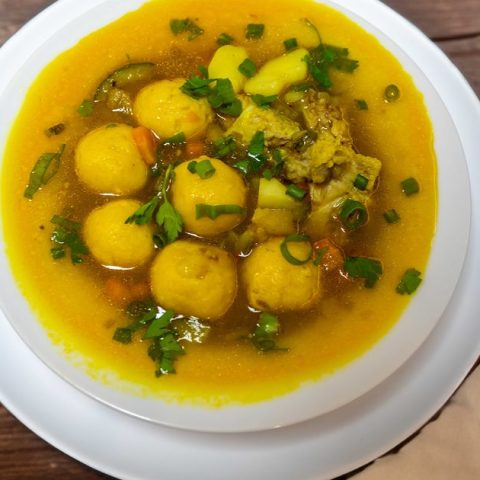
Vori Vori (Paraguayan Chicken Soup with Cornmeal Balls)
Paraguay's comfort soup: chicken broth full of tender little balls of cornmeal and cheese.
Ingredients
For the soup
- 1 whole chicken (about 2½ to 3 lb), cut into pieces
- 2 tablespoons vegetable oil
- 1 large onion, diced
- 1 red bell pepper, diced
- 2 garlic cloves, minced
- 2 medium tomatoes, diced
- 1 medium carrot, sliced
- 1 bay leaf
- 1 teaspoon dried oregano
- 1½ teaspoons salt
- ½ teaspoon black pepper
- 3 green onions, chopped, divided
- 9 cups hot water
- 2 tablespoons chopped fresh parsley
For the balls
- 2 cups (300 g) fine yellow cornmeal
- 1¼ cups (150 g) crumbled queso Paraguay (or 100 g queso fresco plus 50 g shredded muenster)
- ⅔ to ¾ cup hot broth from the pot
Instructions
- Heat the oil in a large pot over medium-high heat. Brown the chicken for 8 to 10 minutes, then set it aside.
- In the same pot, cook the onion, bell pepper and garlic for 5 minutes. Add the tomatoes and cook 3 to 4 minutes, until they break down.
- Return the chicken to the pot. Add the carrot, bay leaf, oregano, salt, pepper, half the green onions and the hot water. Cover and simmer for 40 to 45 minutes, until the chicken is tender and reaches 165°F (74°C) in the thickest part, away from bone. Remove the bay leaf.
- In a bowl, mix the cornmeal and cheese. Stir in hot broth a little at a time, then let the mixture cool enough to handle before kneading into a soft dough that holds together without cracking. Roll into balls about ¾ inch across.
- Keep the soup at a gentle simmer and drop in the balls one at a time. Do not stir for the first 5 minutes. Cook for 10 to 15 minutes, until the balls float and are tender inside. Cut one open to check for a fully cooked center, and simmer longer if still gritty or firm.
- Stir in the parsley and the remaining green onions, adjust the salt and serve hot.
Notes
Cornmeal: this version uses fine yellow cornmeal. Other recipes use precooked corn flour, but they require different hydration; do not substitute it directly here.
Hen: for vori vori de gallina, simmer a stewing hen for 1½ to 2 hours before adding the balls.
Shape the balls up to a few hours ahead and keep them covered in the fridge. Do not freeze them.
Keep Cooking Paraguayan
Serve vori vori with a square of sopa paraguaya or warm chipa. For another Paraguayan soup, try pira caldo. For a main course, follow it with bife koygua, beef braised under a blanket of onions, and cool off afterward with tereré. See the full roundup of Paraguayan food, or browse everything on the Paraguayan food hub.
More Paraguayan Foods
See all →
Jorge Garcia is the founder of AmigoFoods, where he has spent over 20 years helping readers discover authentic Latin American and Spanish cuisine. Raised in a Cuban-American household, Jorge learned to cook at the hands of his mother and grandmother, carrying forward generations of family recipes. That heritage, backed by his family’s four-generation history in the Latin food industry, inspired him to launch AmigoFoods in 2003. With more than 1,000 published articles on recipes, ingredients, and food culture, Jorge’s mission is simple: make authentic Latin cooking approachable for home cooks everywhere while honoring the traditions behind every dish.