
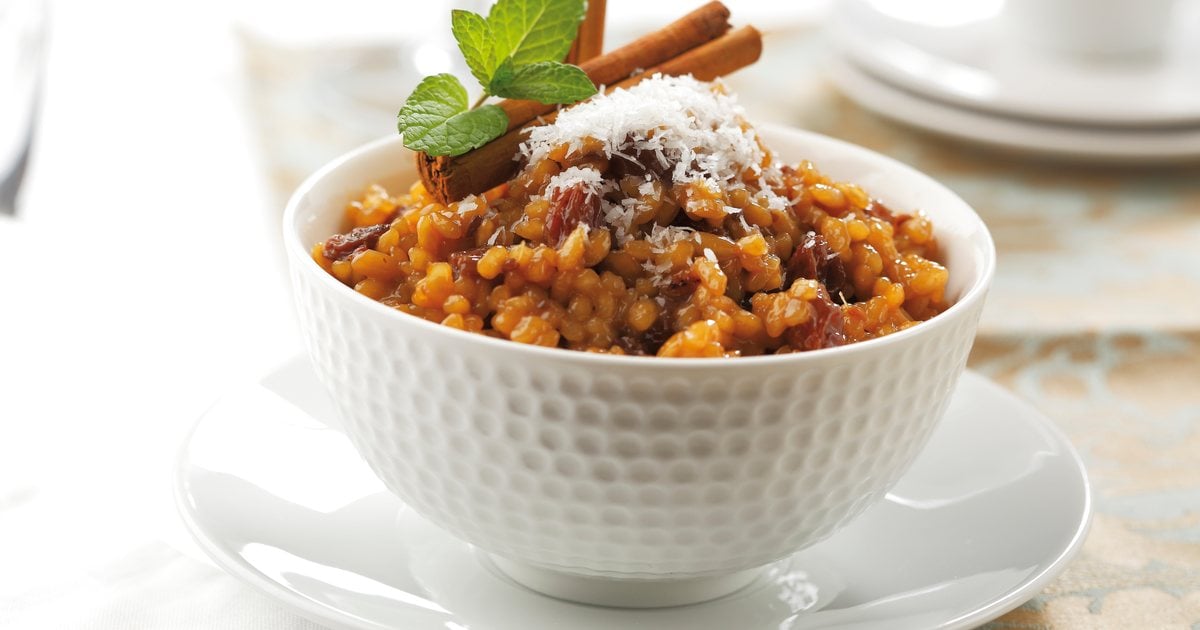
Arroz zambito is Lima’s dark rice pudding, sweetened with chancaca for a caramel-and-molasses flavor. Cinnamon, cloves, coconut, raisins and toasted pecans add warmth and texture; make it creamy with evaporated milk or choose the older milk-free style.
Arroz Zambito at a Glance
What Is Arroz Zambito?
Arroz zambito (ah-ROHS sahm-BEE-toh) is a Peruvian rice pudding from Lima. The rice is simmered with whole spices until soft, then cooked again in a syrup made from melted chancaca.
That syrup is the whole story. Chancaca is sugarcane juice boiled down and set into hard brown blocks, the Peruvian equivalent of panela or piloncillo. It carries minerals and molasses that refined sugar has stripped out, so the pudding comes out darker, less sweet-tasting at the same sugar level, and noticeably more complex.
The texture is also different from most rice puddings. Classic arroz zambito is grain-forward and glossy rather than soupy, with each grain of rice coated in syrup. Modern Lima cooks often add evaporated milk, which makes it creamier and a lighter tan color.
Why Is It Called Arroz Zambito?
The name refers to the dessert’s color. Zambito is the diminutive of zambo, a term from colonial Spanish America’s caste vocabulary for people of mixed African and Indigenous ancestry. Limeños used it to set the dark, chancaca-sweetened pudding apart from the white arroz con leche it grew out of.
The word is still the everyday name of the dish in Peru, and you will see it on menus and dessert stands across Lima. It is worth knowing where it comes from: the caste labels of the colonial era were a system of racial ranking, and the pudding’s name is a trace of that history as much as a description of its color.
Arroz con leche arrived with the Spanish. Arroz zambito is what Lima’s Afro-Peruvian cooks made of it with chancaca, the brown sugar of Peru’s coastal cane fields.
The History of Arroz Zambito
Rice pudding came to Peru with the Spanish, a dish Spain owed in part to centuries of Moorish rule. In colonial Lima it was made in convent and household kitchens with refined white sugar.
Arroz zambito belongs to a different Lima: the street. In the 19th century it was sold around the city by street vendors, generally Afro-Peruvian women, who carried trays of sweets and called out their wares in sung street cries known as pregones.
Chancaca made sense for them. It was cheaper than white sugar and came from the sugar haciendas of Peru’s coast, plantations worked for centuries by enslaved Africans. The dessert that resulted is part of a wider Afro-Peruvian sweet tradition that also gave Lima picarones with chancaca syrup, turrón de Doña Pepa and the frejol colado of Chincha and Cañete.
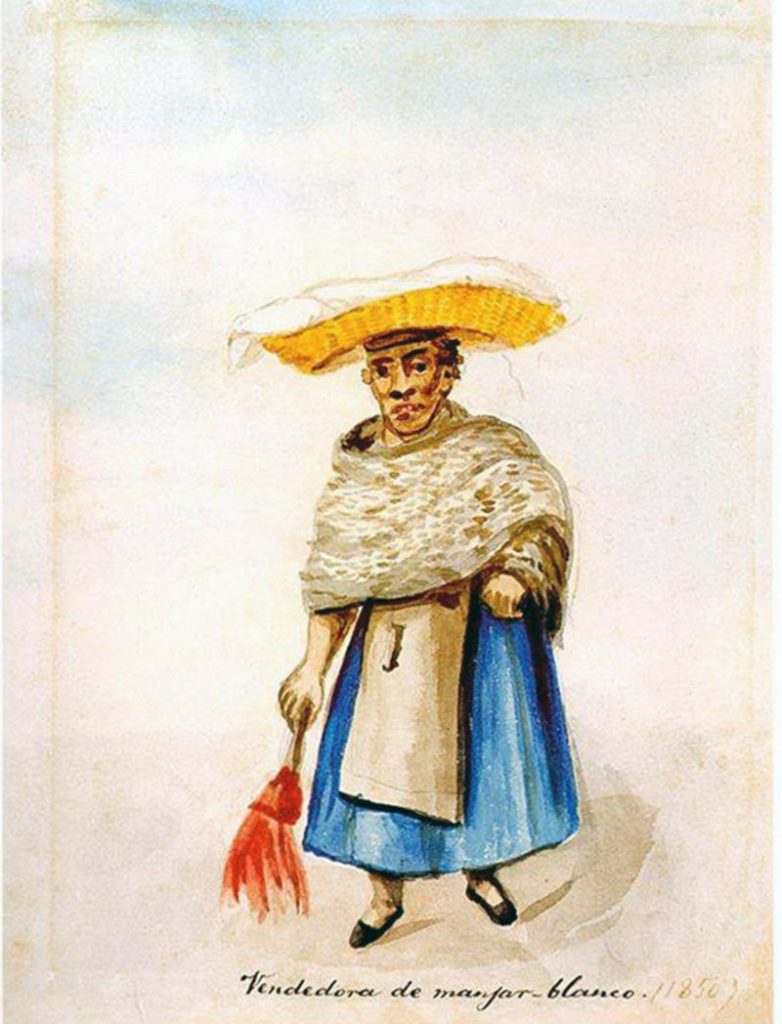
Lima’s painter of everyday life, Pancho Fierro, recorded these vendors again and again in his watercolors of the mid-1800s. His sweet sellers carry their trays on their heads, and they are the best picture we have of how desserts like arroz zambito were once bought: by the cup, from a woman who made it that morning.
Arroz Zambito vs. Arroz con Leche
Both start with rice, water and whole spices, and a Peruvian cook makes them almost the same way up to the moment the sweetener goes in. After that they part company.
| Arroz zambito | Arroz con leche | |
|---|---|---|
| Sweetener | Chancaca syrup | White sugar, often condensed milk |
| Color | Caramel to dark brown | Creamy white |
| Flavor | Toffee, molasses, clove | Milk, vanilla, cinnamon |
| Milk | Optional | Essential |
| Add-ins | Coconut, raisins, pecans | Raisins, sometimes orange peel |
| Texture | Glossy, grain-forward, sticky | Loose and creamy |
| Roots | Afro-Peruvian Lima | Spain, across all of Latin America |
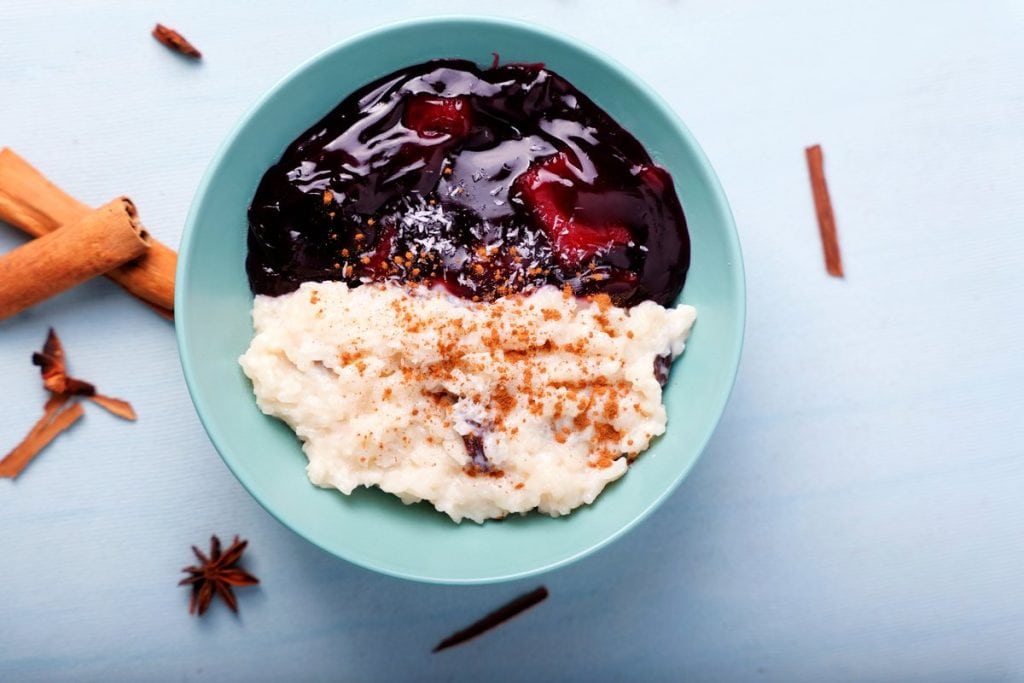
In Lima the white pudding is best known as half of the combinado, spooned into the same bowl as mazamorra morada. Arroz zambito is usually eaten on its own, though nothing stops you pairing it the same way.
The Ingredients and What Each One Does
Arroz zambito uses pantry staples, with one ingredient that needs a little hunting. Here is the role each one plays.
Chancaca
The sweetener and the color
Unrefined cane sugar, melted into syrup. It supplies the brown color, the molasses depth and all of the sweetness.
White rice
The body
Short or medium grain releases the starch that makes it creamy. Arborio works well. Do not rinse it.
Cinnamon and cloves
The perfume
Simmered whole in the cooking water, then removed. A little aniseed is traditional in many Lima homes.
Coconut
Texture and richness
Unsweetened shredded coconut is cooked into the pudding and scattered on top.
Raisins
Bursts of fruit
Golden or dark. They plump in the syrup. Some cooks soak them first in a splash of sweet wine.
Pecans
Crunch
Called pecanas in Peru. Toast them first. Walnuts, or the tiny Chilean palm nuts called coquitos, are also traditional.
Evaporated milk
Optional creaminess
The modern Lima addition. Leave it out for the older, glossier, dairy-free style.
Butter and salt
The finish
A pinch of salt sharpens the chancaca. A spoon of butter at the end adds gloss.
What Is Chancaca, and What Can You Use Instead?
Chancaca is Peru’s unrefined whole cane sugar. Cane juice is boiled until thick, then poured into molds, where it sets into dense brown blocks, cakes or cones. It is the same family of product as Colombian panela, Mexican piloncillo and Indian jaggery.

The blocks are hard, so chop them with a heavy knife or grate them before melting. Because chancaca is made in open kettles, the syrup can hold a few specks of cane fiber, which is why Peruvian recipes strain it. If you can’t find chancaca, these all work:
| Substitute | How much for 8 oz (225 g) chancaca | Result |
|---|---|---|
| Panela | 8 oz (225 g) | Nearly identical |
| Piloncillo | 8 oz (225 g) | Nearly identical, sold in Mexican groceries |
| Jaggery | 8 oz (225 g) | Very close, slightly more caramel |
| Muscovado sugar | 1 packed cup | Close in flavor, dissolves faster |
| Dark brown sugar + molasses | 1 packed cup + 1 tbsp molasses | Good pantry fallback |
Chancaca and panela are easy to find online. Look for Peruvian chancaca on Amazon, or use panela, which is more widely stocked. Our guide to chancaca covers how it’s made and how to store it.
How to Make Arroz Zambito
The full ingredient list and exact steps are in the recipe card below. This is the method at a glance, with what to watch for at each stage.
- Infuse the water. Simmer water with cinnamon sticks, cloves and a little aniseed for five minutes. This is where most of the spice flavor comes from, so don’t skip it.
- Cook the rice soft. Add the rice and simmer, covered, until the grains are tender and just starting to split. Sugar can slow the softening of rice, so let the grains become tender before adding the syrup.
- Melt the chancaca. While the rice cooks, melt chopped chancaca with a little water into a thin syrup, then strain it.
- Cook the rice in the syrup. Fish out the whole spices, pour in the syrup with the raisins and coconut, and simmer, stirring, until the rice turns glossy and brown.
- Choose your finish. Add evaporated milk for the creamy Lima style, or leave it out for the classic glossy one.
- Stop while it’s loose. Stir in butter and pecans off the heat. It thickens a lot as it cools, so take it off when it still looks a little too runny.
Milk or No Milk? The Two Styles of Arroz Zambito
Ask two Lima families how they make arroz zambito and you may get two answers. One grandmother’s version has no milk at all; her daughter’s has a can of evaporated milk. Both are traditional, and the recipe below works either way.
The older style
No milk
Rice cooked in spiced water, then in chancaca syrup, until every grain is coated and glossy.
Tastes: deeper, darker, more toffee.
Looks: dark brown, grains distinct.
Bonus: dairy-free if you finish with coconut oil instead of butter.
The modern Lima style
With evaporated milk
The same pudding, loosened with a can of evaporated milk in the last ten minutes.
Tastes: rounder and creamier, like dulce de leche.
Looks: lighter tan, spoonable.
Bonus: milder, and the easier first taste for kids.
Tips for the Best Arroz Zambito
Use a heavy-bottomed pot. Chancaca syrup scorches faster than white sugar. A thin pot will catch on the bottom and turn bitter.
Taste after the syrup goes in. Chancaca blocks vary in sweetness. If yours is mild, add a spoon of brown sugar; if it’s strong, hold back some syrup.
Always strain the syrup. It takes ten seconds and catches cane fiber and grit that would otherwise end up in your teeth.
Toast the pecans. Five minutes in a dry skillet makes them taste twice as nutty and keeps them crisp against the soft rice.
Don’t rinse the rice. The surface starch is what thickens the pudding. Rinsing it off gives you rice in syrup instead of pudding.
Keep a little liquid in reserve. If it tightens up as it sits, stir in a splash of hot water or milk just before serving.
How to Serve Arroz Zambito
In Lima it is spooned into small glasses or cups and finished with a pinch of ground cinnamon, a little coconut and a few pecans. It is eaten both ways: warm from the pot on a gray Lima winter afternoon, or chilled from the fridge in summer.
It makes a good end to a heavy Peruvian meal like lomo saltado or ají de gallina, and it sits well on a dessert table beside suspiro limeño and mazamorra morada. For a Lima-style two-tone bowl, spoon it next to mazamorra morada the way the combinado is served.
How to Store and Reheat It
Fridge: Keep it covered for up to 4 days. Press plastic wrap onto the surface to stop a skin forming.
Reheating: It sets firm when cold. Warm it gently in a pan or the microwave with a splash of water or milk, stirring until it loosens.
Freezing: Not recommended. The rice turns grainy and the syrup weeps when it thaws.
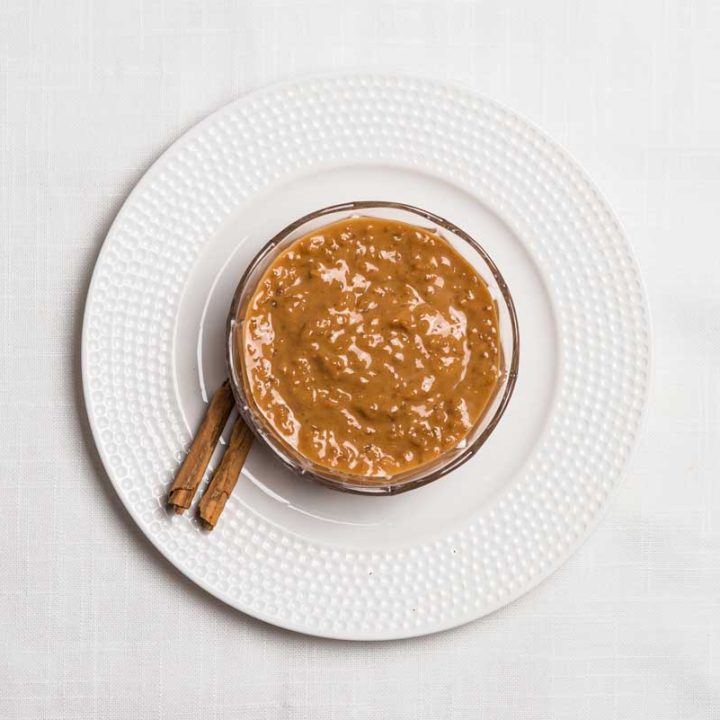
Arroz Zambito (Peruvian Chancaca Rice Pudding)
Arroz zambito is Lima’s Afro-Peruvian rice pudding, sweetened with chancaca (unrefined cane sugar) and cooked with cinnamon, cloves, coconut and raisins, then topped with toasted pecans. Make it creamy with evaporated milk or leave the milk out for the older, glossier style.
Ingredients
- 1 cup (200 g) white rice, short or medium grain (Arborio works)
- 4 cups (950 ml) water
- 2 cinnamon sticks
- 6 whole cloves
- 1/2 teaspoon aniseed (optional)
- Pinch of salt
- 8 oz (225 g) chancaca, chopped (or panela or piloncillo)
- 1/2 cup (120 ml) water, for the syrup
- 1/2 cup (75 g) raisins, golden or dark
- 1/2 cup (40 g) unsweetened shredded coconut, plus more to finish
- 1 can (12 oz / 354 ml) evaporated milk (optional, for the creamy style)
- 1 tablespoon butter
- 1/2 cup (55 g) pecans, toasted and chopped
- Ground cinnamon, to finish
Instructions
- Infuse the water. In a heavy-bottomed pot, bring 4 cups water to a boil with the cinnamon sticks, cloves and aniseed (put the aniseed in a tea ball or cheesecloth if you want to remove it later). Lower the heat and simmer 5 minutes.
- Cook the rice. Stir in the rice (unrinsed) and the salt. Cover and simmer on low for about 20 minutes, until the grains are soft and starting to split and most of the water is absorbed.
- Make the chancaca syrup. While the rice cooks, put the chopped chancaca and 1/2 cup water in a small saucepan over medium heat. Stir for 5 to 8 minutes, until fully melted into a thin syrup. Strain it through a fine sieve.
- Sweeten the rice. Remove the cinnamon sticks, cloves and aniseed. Pour the syrup into the rice and add the raisins and coconut. Simmer uncovered on low, stirring often, for about 10 minutes, until the rice is glossy and deep brown. Taste and add a little brown sugar if needed.
- Finish with or without milk. For the creamy Lima style, stir in the evaporated milk and simmer 8 to 10 minutes more, stirring, until it looks like loose oatmeal. For the classic no-milk style, skip the milk and cook until the syrup coats every grain.
- Add the butter and nuts. Take the pot off the heat and stir in the butter and half the pecans. Stop while it still looks slightly runny; it thickens a lot as it cools.
- Serve. Spoon into small bowls or glasses and top with the remaining pecans, a little coconut and a pinch of ground cinnamon. Serve warm, at room temperature or chilled.
Notes
Chancaca substitutes: use 8 oz panela or piloncillo, or 1 packed cup dark brown sugar plus 1 tablespoon molasses.
Dairy-free: skip the evaporated milk and finish with coconut oil instead of butter.
Storage: refrigerate, covered, up to 4 days. It sets firm when cold; loosen with a splash of water or milk when reheating. Freezing is not recommended.
Frequently Asked Questions About Arroz Zambito
What is arroz zambito made of?
Rice, water, chancaca (unrefined cane sugar), cinnamon, cloves, coconut, raisins and pecans or walnuts. Many modern versions also add evaporated milk, and some add aniseed, butter or a splash of sweet wine.
What is the difference between arroz zambito and arroz con leche?
The sweetener. Arroz con leche uses white sugar and lots of milk and stays white; arroz zambito is sweetened with chancaca syrup, which turns it brown and gives it a toffee flavor. Zambito also usually carries coconut and nuts.
Why is it called arroz zambito?
Because of its dark color. “Zambito” is the diminutive of “zambo,” a colonial-era caste term for people of mixed African and Indigenous ancestry, used to distinguish the brown pudding from white arroz con leche.
Can I make arroz zambito with brown sugar?
Yes. Use panela, piloncillo or muscovado for the closest match, or dark brown sugar with a tablespoon of molasses. Plain light brown sugar works but tastes flatter.
Is arroz zambito served hot or cold?
Both. In Lima it is eaten warm, at room temperature and chilled. It thickens as it cools, so loosen it with a little water or milk if you serve it cold.
Does arroz zambito have milk?
Not necessarily. The older style is made without milk, and many modern recipes add evaporated milk for creaminess. Both are considered traditional.
What kind of rice is best for arroz zambito?
Short or medium-grain white rice, including Arborio, gives the creamiest result. Long-grain rice works too, with more distinct grains, and is what many Peruvian home cooks use.
More Peruvian Desserts
PicaronesSquash doughnuts in chancaca syrup
Suspiro LimeñoManjar blanco under port meringue
Turrón de Doña PepaOctober’s anise-and-honey bars
Arroz con LecheThe white rice pudding, Latin style
Custards & PuddingsCountry-by-country guide
See all of them in our roundup of Peruvian desserts, or browse every sweet on our Peruvian dessert recipes page.
Sources
Gastón Acurio, Peru: The Cookbook (Phaidon, 2015); Wikipedia, “Arroz zambito” (English and Spanish editions); Pancho Fierro, La vendedora de manjar blanco (c. 1850), Colección Ricardo Palma, Municipalidad Metropolitana de Lima, via Wikimedia Commons.
More Peruvian Foods
See all →
Jorge Garcia is the founder of AmigoFoods, where he has spent over 20 years helping readers discover authentic Latin American and Spanish cuisine. Raised in a Cuban-American household, Jorge learned to cook at the hands of his mother and grandmother, carrying forward generations of family recipes. That heritage, backed by his family’s four-generation history in the Latin food industry, inspired him to launch AmigoFoods in 2003. With more than 1,000 published articles on recipes, ingredients, and food culture, Jorge’s mission is simple: make authentic Latin cooking approachable for home cooks everywhere while honoring the traditions behind every dish.