

Empada is Brazil’s little baked pie: a cup of crumbly, butter-rich pastry called massa podre, filled with something creamy (most often shredded chicken) and sealed with a golden lid. The bite-size version is an empadinha, the family-size pie is an empadão, and you will find all three in bakeries, snack bars and birthday parties across the country. Below: how empadas differ from empanadas, the classic fillings, and a tested recipe for empadinhas de frango.
Empada at a Glance
AmigoFoods may earn a commission from qualifying Amazon purchases made through links on this page.
What is an empada?
An empada is a small savory pie baked in a straight-sided metal tin. The pastry lines the tin like a cup, the filling goes in, and a thin round of the same dough goes on top.
It holds its shape coming out of the oven, but the crust gives way the moment you bite it. Brazilians say a good empada derrete na boca: it melts in your mouth.

It belongs to the family of salgados, the savory snacks at the heart of Brazilian food, alongside coxinha, kibe and pastel. Unlike those three, an empada is baked, never fried.
Most are eaten in two or three bites, standing at a bakery counter with a cafezinho or a cold guaraná.
Empada vs. empadinha vs. empadão
Same dough, same fillings. What changes is the size, and with it the occasion.
| Name | Size | Baked in | When it’s eaten |
|---|---|---|---|
| Empadinha | 1½ to 2½ inches, two or three bites | Small empada tins or a mini muffin tin | Party trays, snack with coffee |
| Empada | 3 to 4 inches, one serving | Larger individual tins | Bakeries and snack bars, a quick lunch |
| Empadão | A whole pie, sliced to serve | Pie dish, springform or baking dish | Family lunch or dinner with salad and rice |
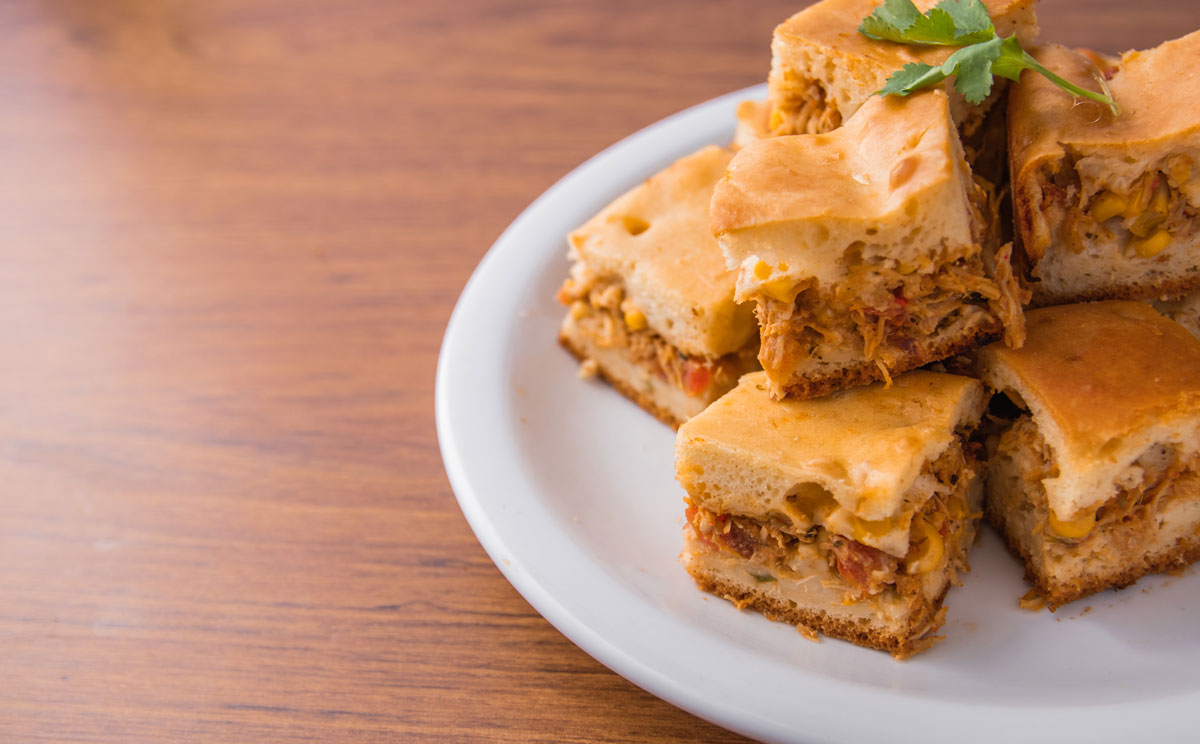
Empada vs. empanada: not the same pastry
The names are one letter apart, and both come from the Iberian idea of wrapping a filling in bread (from the Latin panis), so English-language menus mix them up constantly. On the plate they have little in common.
| Empada (Brazil) | Empanada (Spanish-speaking Latin America) | |
|---|---|---|
| Dough | Short, crumbly massa podre with lots of butter and egg yolk | Firm, foldable dough with some chew |
| Shape | Round cup with a flat lid, baked in a tin | Half-moon turnover with a crimped edge |
| Cooking | Always baked | Baked or fried, depending on the country |
| Typical fillings | Creamy chicken, hearts of palm, shrimp, cheese | Spiced beef, chicken, cheese and ham; egg and olives in Chile |
| Size | Usually bite-size | Hand-size, often a meal |
If it is the folded kind you are after, start with our guide to empanada dough or Chile’s empanadas de pino.
Where empadas come from
The empada came to Brazil from Portugal. It most likely descends from the Portuguese pastelões, large savory pies with medieval roots, and by the 19th century the small individual versions were known as empadas de caixa, “box pies,” after the tins they baked in.
Portuguese accounts also tie their popularity to the Catholic days of abstinence from beef and pork, when a chicken or seafood pie made a suitable meal. Portugal still loves them: chicken empadas are a fixture of its cafés and pastry shops.
Brazil made the empada its own with its own pantry: hearts of palm, shrimp from a long coastline and, above all, requeijão, the spoonable fresh cheese that turned a plain chicken pie into empada de frango com Catupiry.
The dough: why massa podre melts in your mouth
Massa podre literally means “rotten dough,” which sounds alarming and only means short. There is so much fat in it that the flour cannot form long gluten strands, so the baked crust crumbles instead of flaking like an American pie crust or stretching like bread.
The classic ratio is roughly two parts flour to one part fat by weight, bound with egg yolks and little or no water. Butter gives the best flavor; many Brazilian bakeries use margarine, and some home cooks add a little lard for an even more tender bite.

The most popular empada fillings
Brazilian bakery cases rarely stray far from this lineup:
- Frango (chicken): shredded chicken in a tomato and onion sauce, usually with a green olive and a spoonful of Catupiry. It is the classic, and the one in our recipe.
- Palmito (hearts of palm): sliced palm hearts in a creamy sauce, the go-to meatless empada. Canned hearts of palm work perfectly.
- Camarão (shrimp): small shrimp in a light tomato sauce, often finished with requeijão.
- Queijo (cheese): requeijão or fresh queijo minas, sometimes with ham or a pinch of oregano.
- Carne-seca com Catupiry: shredded dried beef with creamy cheese.
- Bacalhau: salt cod, a nod to Portugal.

The finishing touch is often a single green olive tucked into the filling (sometimes with the pit still in, so warn your guests) or a small ball of dough pressed onto the lid. The olive matters so much that a azeitona da empada, “the olive in the empada,” is Brazilian slang for the special touch that makes something complete.
For the creamy part, Brazilians reach for Catupiry, the requeijão first made in Minas Gerais in 1911. You can find Catupiry on Amazon, and softened cream cheese is a fair stand-in.
How to make empadas at home
Empadas take a little time but no special skill. The whole method comes down to five moves:
- Poach and shred the chicken. Shred it fine; big chunks tear the delicate shells.
- Make the dough cold. Rub butter into flour, bind with yolks, chill 20 to 30 minutes.
- Cook the filling and let it cool. It should be creamy, not runny. Hot filling melts the butter in a raw shell.
- Line, fill and lid. Press thin shells into the tins, add a spoonful of filling and a dab of requeijão, then seal a pastry round on top.
- Glaze and bake. Brush with egg yolk and bake at 375°F (190°C) until deep gold.
Full measurements and timings are in the recipe card below. No empada tins? A set of mini tart pans or an ordinary mini muffin tin does the same job.
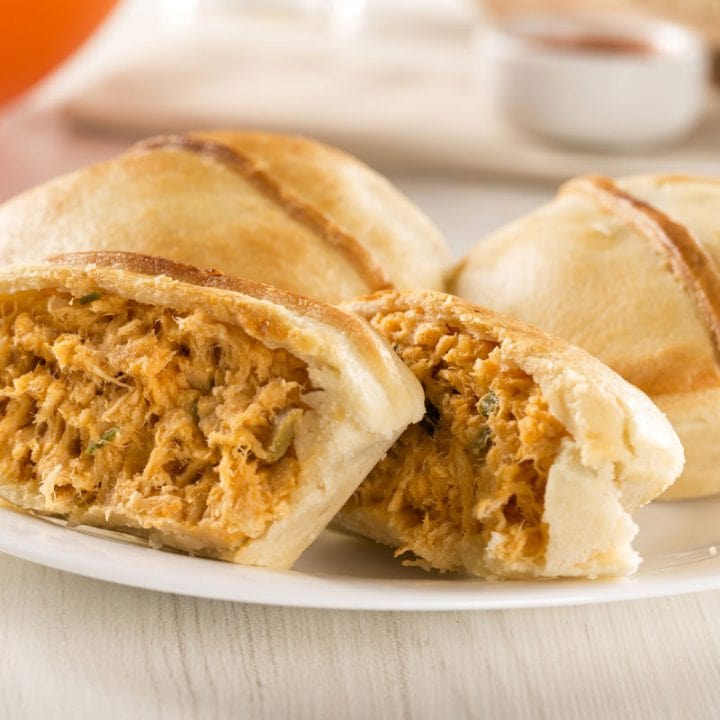
Empadinhas de Frango (Brazilian Chicken Empadas)
Bite-size Brazilian chicken pies with a crumbly, butter-rich massa podre crust and a creamy filling of shredded chicken, tomato, green olives and requeijão. These are the empadinhas Brazilians eat at birthday parties, bakery counters and corner snack bars.
Ingredients
For the dough (massa podre)
- 3 cups (375 g) all-purpose flour
- 1 cup (2 sticks / 226 g) cold unsalted butter, cubed
- 2 large egg yolks
- 1 teaspoon fine salt
- 1 to 3 tablespoons ice water, only if needed
For the chicken filling
- 1 lb (450 g) boneless, skinless chicken breasts
- 1 bay leaf
- 2 tablespoons olive oil
- 1 small yellow onion, finely chopped
- 2 garlic cloves, minced
- 2 Roma tomatoes, seeded and finely chopped
- 1 tablespoon tomato paste
- 1 cup (240 ml) reserved chicken poaching broth
- ½ cup (120 ml) whole milk
- 1½ tablespoons all-purpose flour
- ⅓ cup (50 g) pitted green olives, chopped
- 2 tablespoons chopped parsley and scallions (cheiro-verde)
- Salt and black pepper, to taste
- ½ cup (120 g) requeijão cremoso or Catupiry (or softened cream cheese)
To finish
- 1 egg yolk
- 1 teaspoon milk or water
Instructions
- Poach the chicken. Put the chicken breasts and bay leaf in a medium saucepan, cover with water by 1 inch and add 1 teaspoon salt. Bring to a gentle simmer and cook 15 to 18 minutes, until the thickest part reads 165°F (74°C). Save 1 cup of the broth, then shred the chicken very finely with two forks.
- Make the massa podre. Whisk the flour and salt in a large bowl. Add the cold butter and rub it in with your fingertips until the mixture looks like coarse, damp sand. Add the egg yolks and press the dough together with your hands. Squeeze a handful: if it holds, stop. If it crumbles, add ice water 1 tablespoon at a time. Do not knead. Flatten into a disc, wrap and chill 20 to 30 minutes.
- Cook the filling. Heat the olive oil in a large skillet over medium heat. Cook the onion 4 minutes until soft, add the garlic for 30 seconds, then the tomatoes and tomato paste for 3 to 4 minutes. Stir in the shredded chicken and the reserved broth and simmer 3 minutes.
- Thicken it. Whisk the milk with the 1½ tablespoons flour, pour it into the skillet and cook, stirring, about 2 minutes until the filling is creamy and holds a line when you drag a spoon through it. Off the heat, stir in the olives and cheiro-verde and season with salt and pepper. Spread on a plate and let it cool completely, about 15 minutes.
- Heat the oven. Set a rack in the center and heat the oven to 375°F (190°C). There is no need to grease the tins; the butter in the dough keeps the empadas from sticking.
- Line the tins. Set aside about one third of the dough for the lids. Pinch off walnut-size pieces (about 20 g) of the rest and press each into a tin with your thumb, about ⅛ inch thick, evenly up the sides to the rim. Set the tins on a sheet pan.
- Fill. Spoon a heaping tablespoon of cooled filling into each shell and top with a teaspoon of requeijão. Stop just below the rim so the lids can seal.
- Add the lids. Roll the reserved dough between two sheets of parchment to ⅛ inch and cut rounds the size of the tin rims. Lay one on each empada and press around the edge to seal, pinching off any excess against the rim. Add a small ball of dough to the center if you like the classic look.
- Glaze and bake. Beat the egg yolk with the milk and brush it over the lids. Bake 25 to 30 minutes, until the tops are a deep, even gold.
- Unmold and serve. Let the empadas rest in the tins for 10 minutes, then tip them out. Serve warm or at room temperature.
Notes
No empada tins? A 24-cup mini muffin tin works the same way. A standard 12-cup muffin tin makes 12 larger empadas; bake them 30 to 35 minutes.
Empadão (one big pie): Press two thirds of the dough into a 9-inch pie dish or springform pan, add all of the filling and the requeijão, cover with the remaining dough and bake at 375°F (190°C) for 40 to 45 minutes. Rest 15 minutes before slicing.
Other fillings: For empada de palmito, swap the chicken for two 14-ounce cans of hearts of palm, drained and sliced, and use vegetable broth. For empada de camarão, use 1 lb small peeled shrimp and simmer them only 2 minutes so they stay tender.
Make ahead and freeze: The dough and the filling each keep 2 days in the refrigerator. Freeze unbaked empadas in their tins, then pop them out and store in a freezer bag up to 3 months. Bake straight from frozen, adding 8 to 10 minutes.
Empada troubleshooting
How to freeze and reheat empadas
Empadas are one of the best snacks to keep in the freezer, and unbaked is the way to do it. Freeze them in their tins until firm, pop them out and store them in a freezer bag for up to 3 months.
Bake straight from frozen at 375°F (190°C), adding 8 to 10 minutes to the time. Wrapping each one in plastic before bagging keeps off freezer burn and stops them sticking together.
Baked empadas keep 3 days in the refrigerator and also freeze well, though the crust loses a little of its crumble. Reheat them in a 350°F (175°C) oven for 10 to 12 minutes, or in an air fryer at 325°F (165°C) for 6 to 8 minutes. The microwave makes the pastry soft.
Where to eat empadas in Brazil
Look in the glass case of any padaria (bakery) or lanchonete (snack bar), where empadas sit next to coxinhas and pão de queijo. They are also sold at supermarkets, cafés and sports stadiums.
At birthday parties, empadinhas arrive with the rest of the salgadinhos: trays of mini savory snacks that Brazilians order from caterers by the hundred, the cento.

The large empadão is more of a home dish, baked for Sunday lunch or a family gathering and served by the slice with a green salad.
More Brazilian snacks to try
If you like empadas, these are the next stops on the salgados tray:
- Coxinha: teardrop-shaped chicken croquettes, fried until crisp.
- Pastel: thin, blistered fried pastries from the street-market stalls.
- Kibe: bulgur and beef croquettes brought by Lebanese and Syrian immigrants.
- Bolinho de bacalhau: salt cod fritters, another Portuguese inheritance.
- Casquinha de siri: creamy crab baked in its shell.
For the full lineup, see our Brazilian appetizers roundup, the best Brazilian street food, or browse every Brazilian appetizer recipe on the site.
Empada FAQ
What is an empada made of?
A shortcrust pastry called massa podre (flour, plenty of butter or margarine, egg yolks and salt) wrapped around a savory filling. The most common filling is shredded chicken in tomato sauce with requeijão and an olive.
What is the difference between an empada and an empadinha?
Only size. An empadinha is a bite-size empada served at parties and with coffee, while an empada is a single larger serving. A whole pie made the same way is an empadão.
Is an empada the same as an empanada?
No. An empada is a round, lidded pie with a crumbly crust that is always baked in a tin. An empanada is a folded half-moon turnover with a firmer dough that can be baked or fried.
What does massa podre mean?
It translates as “rotten dough,” but it simply means a short, high-fat pastry that crumbles when you bite it. It is the Brazilian and Portuguese equivalent of a French pâte brisée, only richer.
Can I make empadas in a muffin tin?
Yes. A mini muffin tin gives you about 24 empadinhas, and a standard muffin tin makes 12 larger empadas. There is no need to grease either one.
Are empadas eaten hot or cold?
Both. They are at their best warm, about 10 minutes out of the oven, but bakeries sell them at room temperature all day and they hold up well on a party table.
Sources
- 30Seconds: Easy Brazilian Empada Dough Recipe With a Savory Ground Beef Filling
- DelightedCooking: What is an Empada
- Authentic Brazilian Cuisine: Empadinha
- Olivacuisine: Hearts of Palm Hand Pies (Empadinhas de Palmito)
- SABOR BRASIL: Empadinha (SAVORY MINI PIES)
- Gram: Brazilian Empadas Are What You Need in Your Life
- Educalingo: Empada
- Wikipédia: Empada
- Jornal Opção: O sabor do Cerrado, empadão goiano
More Brazilian Foods
See all →
Jorge Garcia is the founder of AmigoFoods, where he has spent over 20 years helping readers discover authentic Latin American and Spanish cuisine. Raised in a Cuban-American household, Jorge learned to cook at the hands of his mother and grandmother, carrying forward generations of family recipes. That heritage, backed by his family’s four-generation history in the Latin food industry, inspired him to launch AmigoFoods in 2003. With more than 1,000 published articles on recipes, ingredients, and food culture, Jorge’s mission is simple: make authentic Latin cooking approachable for home cooks everywhere while honoring the traditions behind every dish.