

Brazilian pastel is a thin, crisp pastry filled with seasoned beef or cheese and fried until its surface blisters. A favorite at São Paulo street markets, it is best eaten hot with sugarcane juice. This homemade version makes 16 pastéis with a simple cachaça dough.
Brazilian Pastel at a Glance
What Is a Brazilian Pastel?
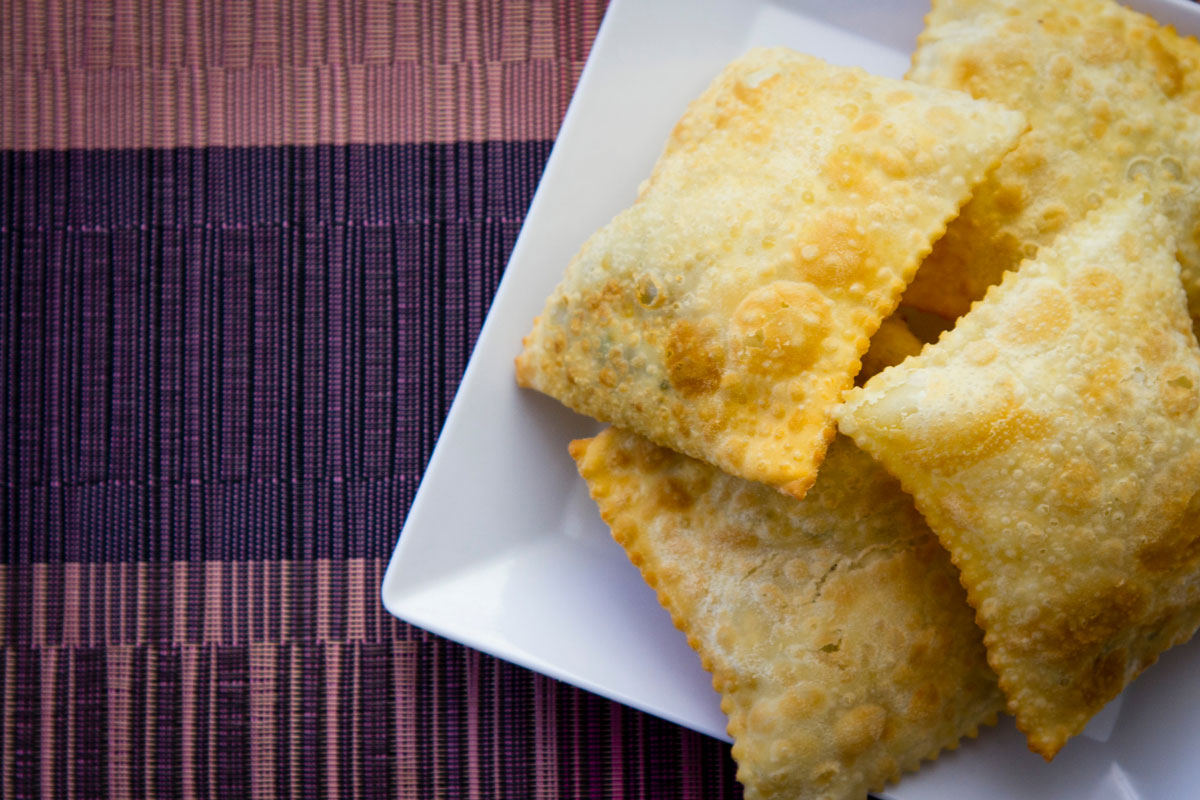
A pastel is a fried turnover, but the dough is what sets it apart. It’s a lean wheat dough of flour, water, a little oil and salt, rolled almost translucent. When it hits hot oil, it doesn’t brown evenly the way a pie crust would. It bubbles up into a shell of tiny blisters that shatters when you bite it, with a soft, slightly chewy layer just inside.
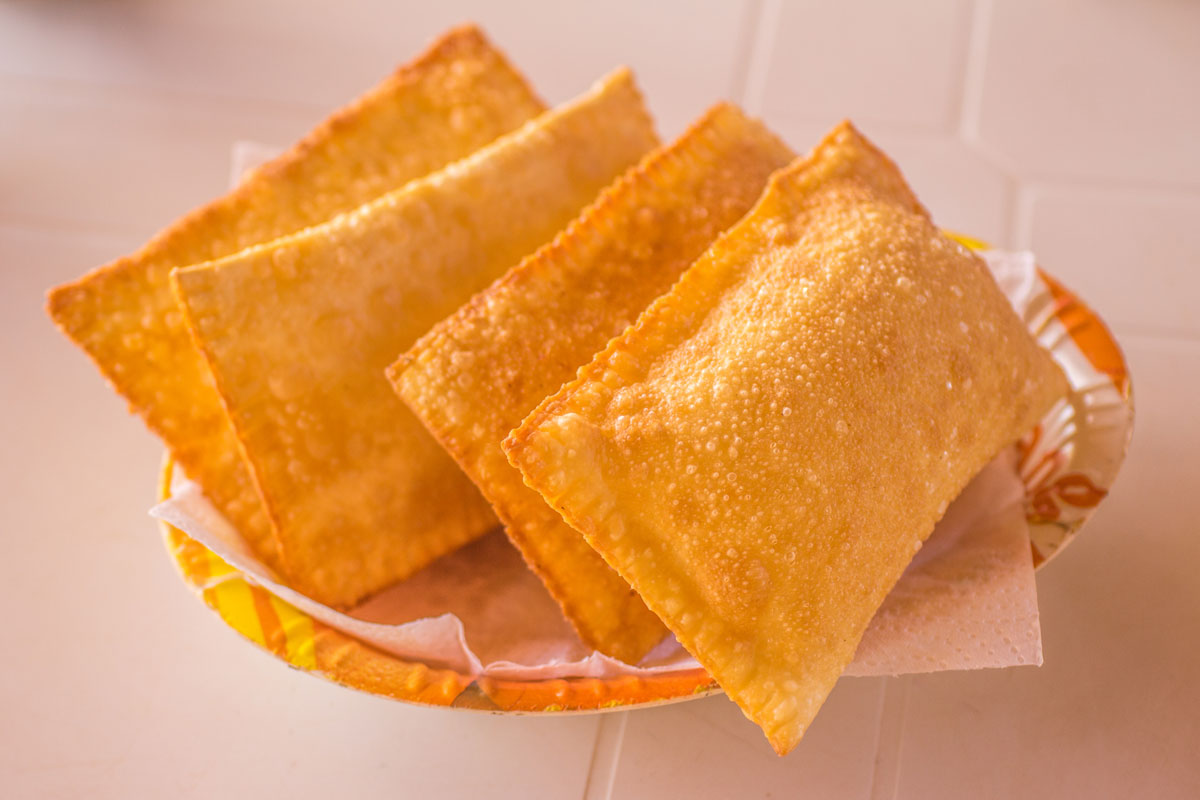
Brazilians classify pastel as a salgado, the family of savory snacks that includes coxinha, empadinha and kibe. Street versions are big, flat rectangles, often longer than your hand. Bars and parties serve bite-size half-moons called pastelzinhos.

Brazilian Pastel vs. Empanada (and Pastel de Nata)
English-language menus sometimes call pastel a “Brazilian empanada.” The two are cousins, but anyone who has eaten both can tell them apart in one bite.
| Brazilian pastel | Empanada | |
|---|---|---|
| Dough | Lean: flour, water, oil, salt, often cachaça or vinegar | Richer: usually made with butter, lard or shortening |
| Thickness | Paper-thin, about 1/16 inch | Thicker and sturdier, about 1/8 inch |
| Shape | Rectangle or half-moon, fork-sealed edges | Half-moon, often with a braided repulgue edge |
| Cooking | Always deep-fried | Baked or fried, depending on the country |
| Texture | Blistered, shattering, light | Flaky or bready, more filling-forward |
| Origin | São Paulo, mid-1900s | Spain and Portugal, spread across Latin America |
If you want the empanada side of the comparison, our guide to empanada dough walks through the fats and folds.
Where Brazilian Pastel Comes From
Pastel is a São Paulo invention, and most food historians tie it to two immigrant communities rather than to Portugal.
- The Chinese spring roll. The most widely accepted story is that Chinese immigrants who arrived through the port of Santos adapted fried spring rolls to Brazilian fillings and sold them in and around São Paulo.
- Japanese pasteleiros. During World War II, Brazil sided with the Allies, and Japanese immigrants in São Paulo faced heavy restrictions, including a ban on speaking Japanese in public. Many of them already worked the city’s farms and street markets. Some opened pastel stands and presented themselves as Chinese to avoid the hostility, and they made pastel the market staple it is today.
The feiras livres (open-air markets) were the perfect stage. São Paulo made its street markets official in 1914, and each neighborhood still has its weekly feira. Walk past a pastel stall today and you’ll often see a Japanese family name on the banner.
Pastel has become so tied to everyday Brazil that eating one at a feira is now a campaign ritual. Brazilians joke that election season is “pastel season,” when every candidate gets photographed biting into one.

Pastel de Feira: The Street-Market Ritual
“Pastel de feira” means market pastel, and it’s the version people mean when they get nostalgic. The routine rarely changes. You shop for produce, then stop at the pastel stand, order a big rectangle, and eat it standing up with a cup of caldo de cana, the cold, grassy-sweet juice pressed from sugarcane right next to the fryer. On weekend mornings, whole families eat lunch under the stall’s tent.
A few things set a good stall apart:
- Fried to order. Regulars ask for theirs assembled and fried after they order, never pulled from a stack.
- Squeeze bottles on the counter. Every stand has hot sauce, often made with malagueta pepper, plus a tub of vinagrete.
- No “pastel de vento.” A pastel de vento (“wind pastel”) is one with almost nothing inside. Brazilians use the phrase to complain about a stingy stall.
The most famous pastel in São Paulo isn’t at a feira at all. At the Mercado Municipal, the city’s grand downtown market, Hocca Bar has served an overstuffed pastel de bacalhau (salt-cod pastel) since the 1950s, and the city has recognized it as one of São Paulo’s food symbols.
The Most Popular Pastel Fillings
Almost anything can go in a pastel, and stalls compete on how much they stuff in. These are the fillings you’ll see on nearly every menu board in Brazil.
Carne
Seasoned ground beef
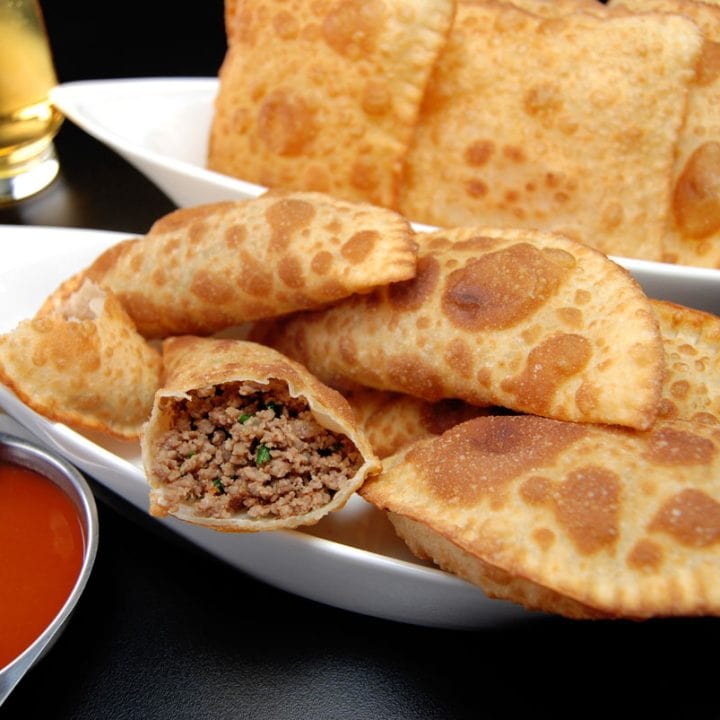
The best seller. Beef cooked with onion and garlic, often with green olives or chopped boiled egg.
Queijo
Cheese
Mozzarella that melts into long strings. Simple, and the one kids order.
Frango com Catupiry
Chicken with Catupiry cheese
Shredded chicken with Brazil’s soft, creamy requeijão-style cheese.
Palmito
Hearts of palm
Hearts of palm in a creamy tomato sauce, the classic meat-free choice.
Pizza
Cheese, tomato, oregano
Mozzarella, tomato and oregano, sometimes with ham. Pizza flavor in a pastel shell.
Bacalhau
Salt cod
Flaked cod with olive oil and onion. The Mercado Municipal specialty.
Camarão
Shrimp
Small shrimp, often in a creamy sauce or with Catupiry. A beach-kiosk favorite.
Carne seca
Shredded dried beef
Salty jerked beef, usually paired with Catupiry or queijo coalho.
Romeu e Julieta
Guava paste and cheese
Goiabada with white cheese, Brazil’s favorite sweet-salty pairing, better known as Romeu e Julieta.
Banana com canela
Banana with cinnamon
Sliced banana with sugar and cinnamon, sometimes with chocolate.
Chocolate
Chocolate or brigadeiro
Melted chocolate or brigadeiro, the fudge of every Brazilian birthday party.
Doce de leite
Milk caramel
Thick caramel, often dusted with sugar once it comes out of the oil.
Outside Brazil, Catupiry, hearts of palm and goiabada are easy to find online: look for Catupiry, canned hearts of palm and goiabada.

How to Make Brazilian Pastel at Home
The full measurements are in the recipe card below. Here’s the method, with the reasons behind each step.
1. Make a lean, stiff dough
Pastel dough is just flour, warm water, oil, salt, and two quiet helpers: cachaça and a splash of vinegar. Knead it for 8 to 10 minutes, until it’s smooth and stops sticking to your hands, then let it rest for 30 minutes so the gluten relaxes enough to roll thin.
2. Roll it thinner than feels right
Aim for about 1/16 inch (1 to 2 mm), thin enough that you can see your hand through it. A pasta machine on its second-thinnest setting does this in minutes. With a rolling pin, work one quarter of the dough at a time and keep the rest covered.
3. Fill lightly and seal hard
Cut rectangles about 4 by 8 inches, spoon the filling onto one half, and leave a ½-inch border. Brush the edge with water, fold, press out any trapped air, and crimp with a fork. Air pockets and wet fillings are what make pastéis burst in the oil, so let any cooked filling cool completely first.
4. Fry hot and fast
Heat 2 inches of neutral oil to 375°F (190°C) and fry one or two at a time. Spoon hot oil over the top as it cooks, which encourages the blisters, and flip once. Each side takes about a minute. A deep-fry thermometer removes the guesswork. Drain on a wire rack, not paper towels, so the bottom stays crisp.

Pastel Problems and How to Fix Them
| Problem | Likely cause | Fix |
|---|---|---|
| No bubbles | Dough too thick, oil not hot enough, or no alcohol | Roll to 1/16 inch, keep oil at 375°F, add the cachaça |
| Greasy crust | Oil temperature dropped | Fry only 1–2 at a time and let the oil recover between batches |
| Burst open in the oil | Air pocket, overfilling, or a wet edge | Press out air, use 2 tablespoons of filling, seal with a fork |
| Soggy inside | Filling was warm or watery | Cook the filling until the pan is dry, then cool it fully |
| Tough or chewy | Dough didn’t rest, or too much flour while rolling | Rest at least 30 minutes, dust the counter lightly |
| Dark outside, cold inside | Oil too hot for frozen pastéis | Fry frozen ones at 340°F so the center heats through |
Shortcuts: Store-Bought Dough, Air Fryer and Oven
- Store-bought dough. Brazilian markets in the US sell massa para pastel, pre-rolled sheets sold in rolls, which is what most Brazilian home cooks use. Large wonton or egg-roll wrappers are the closest supermarket swap. Frozen empanada discs work but fry up thicker and less bubbly.
- Air fryer. Brush the pastéis on both sides with oil and air-fry at 360°F (180°C) for about 10 to 12 minutes, turning once. They’ll be crisp and golden but smoother than fried ones, since the blisters need hot oil to form.
- Oven. Brush with oil and bake at 425°F (220°C) on a parchment-lined sheet for 15 to 18 minutes. Expect a texture closer to a cracker than to a market pastel.
Make Ahead, Freezing and Reheating
- Dough: wrap tightly and refrigerate for up to 2 days. Let it sit at room temperature for 20 minutes before rolling.
- Filling: make it up to 3 days ahead and keep it chilled.
- Freeze raw pastéis: freeze them in a single layer on a parchment-lined sheet, then bag them for up to 3 months. Fry straight from frozen at 340°F (170°C), a minute or two longer per side.
- Reheat fried pastéis: 5 minutes in a 375°F air fryer or 8 minutes in a 400°F oven. Never microwave them, because the crust turns leathery.
What to Serve With Brazilian Pastel
- Vinagrete. Brazil’s chopped tomato, onion and bell-pepper salsa in vinegar and oil. Spoon it into the pastel after each bite.
- Hot sauce. A few drops of malagueta pepper sauce is the standard.
- Caldo de cana. Fresh sugarcane juice, usually with lime, is the classic feira pairing.
- Something cold. Guaraná soda or an ice-cold beer at a bar. More options in our roundup of Brazilian drinks.
- Other salgados. For a party spread, add coxinhas, bolinhos de bacalhau and pão de queijo.


Where to Eat Pastel in Brazil
Pastel is everywhere in São Paulo state and easy to find across Brazil. Look for it at:
- Feiras livres, the weekly neighborhood markets. Go mid-morning, when the fryers are busiest and the oil is freshest.
- Pastelarias, shops that sell little besides pastel and juice, from tiny storefronts to mall food courts.
- Beach kiosks, especially for shrimp pastéis.
- The Mercado Municipal de São Paulo, for the oversized salt-cod pastel.
- Bars and botecos, where mini pastéis come by the portion with beer.
For the rest of what you’ll find on the street, see our guide to the best Brazilian street food.

Brazilian Pastel Recipe (Pastel de Feira)
This recipe makes 16 street-size pastéis. The beef filling is enough for all 16. For a mix, halve the beef and use the cheese for the other 8.
Brazilian Pastel (Pastel de Feira)
Crispy, blistered Brazilian pastel the way São Paulo street markets make it: a paper-thin cachaça dough folded around seasoned ground beef or melty cheese and fried until it shatters.
Ingredients
Dough
- 4 cups (500 g) all-purpose flour, plus more for dusting
- 1 1/2 teaspoons kosher salt
- 1 cup (240 ml) warm water
- 2 tablespoons vegetable oil
- 1 tablespoon cachaça or vodka
- 1 teaspoon white vinegar
Beef filling
- 1 tablespoon vegetable oil
- 1 small onion, finely chopped
- 2 garlic cloves, minced
- 1 pound (450 g) ground beef, 85% lean
- 1 tablespoon tomato paste
- 1 teaspoon kosher salt
- 1/2 teaspoon black pepper
- 1/3 cup chopped green olives
- 2 tablespoons chopped fresh parsley
- 2 green onions, thinly sliced
- 1 hard-boiled egg, chopped (optional)
Cheese filling (optional)
- 8 ounces (225 g) low-moisture mozzarella, sliced or shredded
- 1/2 teaspoon dried oregano (optional)
For frying
- 6 cups (1.5 L) vegetable or canola oil
Instructions
Make the dough
- Whisk the flour and salt in a large bowl. Add the warm water, oil, cachaça and vinegar and stir with a fork until shaggy.
- Turn out onto a lightly floured counter and knead 8 to 10 minutes, until smooth, elastic and no longer sticky. Wrap and rest 30 minutes at room temperature (or refrigerate up to 2 days).
Make the beef filling
- Heat the oil in a skillet over medium-high heat. Cook the onion 3 minutes, then add the garlic for 30 seconds.
- Add the beef and cook, breaking it up, until browned and the pan is dry, 8 to 10 minutes. Stir in the tomato paste, salt and pepper and cook 1 minute.
- Off the heat, stir in the olives, parsley, green onions and egg, if using. Spread on a plate and cool completely.
Shape and fry
- Cut the dough into 4 pieces. Roll one piece about 1/16 inch (1 to 2 mm) thick, thin enough to see your hand through, keeping the rest covered. A pasta machine on its second-thinnest setting works well.
- Cut into 4 x 8-inch (10 x 20 cm) rectangles. Place 2 tablespoons of beef filling (or a few slices of cheese and a pinch of oregano) on one half, leaving a 1/2-inch border. Brush the edges with water, fold over, press out any air and seal firmly with a fork. Repeat with the remaining dough, re-rolling scraps once.
- Heat 2 inches of oil in a heavy pot to 375°F (190°C). Fry 1 or 2 pastéis at a time, spooning oil over the top, about 1 minute per side, until blistered and deep golden.
- Drain on a wire rack and serve immediately with hot sauce and vinagrete.
Notes
- No cachaça: use vodka, or add 1 extra teaspoon of vinegar. The crust stays crisp with fewer bubbles.
- Mixed batch: the beef filling fills all 16. For 8 beef and 8 cheese, halve the beef filling.
- Shortcut dough: Brazilian pre-rolled massa para pastel or large egg-roll wrappers.
- Air fryer: brush with oil and cook at 360°F (180°C) for 10 to 12 minutes, turning once.
- To freeze: freeze unfried pastéis in one layer, then bag for up to 3 months. Fry from frozen at 340°F (170°C), a minute or two longer per side.
Brazilian Pastel FAQ
What is Brazilian pastel made of?
The dough is wheat flour, warm water, a little oil and salt, usually with a spoonful of cachaça or vinegar for crispness. It’s rolled very thin, filled with ground beef, cheese, chicken, hearts of palm or a sweet filling, then deep-fried.
What are Brazilian empanadas called?
The closest thing is the pastel. Brazil also has empadas and empadinhas, which are small baked pies in a crumbly shortcrust, closer to a pot pie than to an empanada.
What’s the difference between a pastel and an empanada?
Pastel dough is leaner and much thinner, and pastel is always deep-fried, so the crust blisters and shatters. Empanada dough usually contains fat, is thicker, and can be baked or fried.
Why does pastel dough bubble?
Thin dough plus very hot oil makes moisture and alcohol in the dough flash into vapor, which lifts the surface into blisters. Cachaça boosts the effect because alcohol evaporates faster than water.
Can I make pastel without cachaça?
Yes. Use vodka in the same amount, or replace it with an extra teaspoon of white vinegar. The crust will still be crisp, with slightly fewer bubbles.
What does “pastel de vento” mean?
Literally “wind pastel”: a pastel with almost no filling. Brazilians use it to tease a stall that skimps on the stuffing.
Is Brazilian pastel healthy?
It’s a deep-fried snack, so it’s a treat rather than everyday food. Frying at the right temperature keeps oil absorption down, and the air-fryer version above uses only a brush of oil.
What do you drink with pastel?
Caldo de cana, fresh sugarcane juice, is the traditional match at street markets. Guaraná and cold beer are the other common choices.
More Brazilian Snacks and Street Food
- CoxinhaTeardrop chicken croquettes
- EmpadinhaBite-size shortcrust pies
- KibeBeef and bulgur croquettes
- Bolinho de BacalhauSalt-cod fritters
- Brazilian Appetizer RecipesEvery salgado in one place
- Brazilian Street Food RecipesMake the feira at home
- Fried Brazilian DishesThe crispiest of the cuisine
- Brazilian FoodThe dishes to try first
Stocking a Brazilian pantry? Browse our Brazilian food list on Amazon, or start with our guide to Brazilian ingredients.
More Brazilian Foods
See all →
Jorge Garcia is the founder of AmigoFoods, where he has spent over 20 years helping readers discover authentic Latin American and Spanish cuisine. Raised in a Cuban-American household, Jorge learned to cook at the hands of his mother and grandmother, carrying forward generations of family recipes. That heritage, backed by his family’s four-generation history in the Latin food industry, inspired him to launch AmigoFoods in 2003. With more than 1,000 published articles on recipes, ingredients, and food culture, Jorge’s mission is simple: make authentic Latin cooking approachable for home cooks everywhere while honoring the traditions behind every dish.