
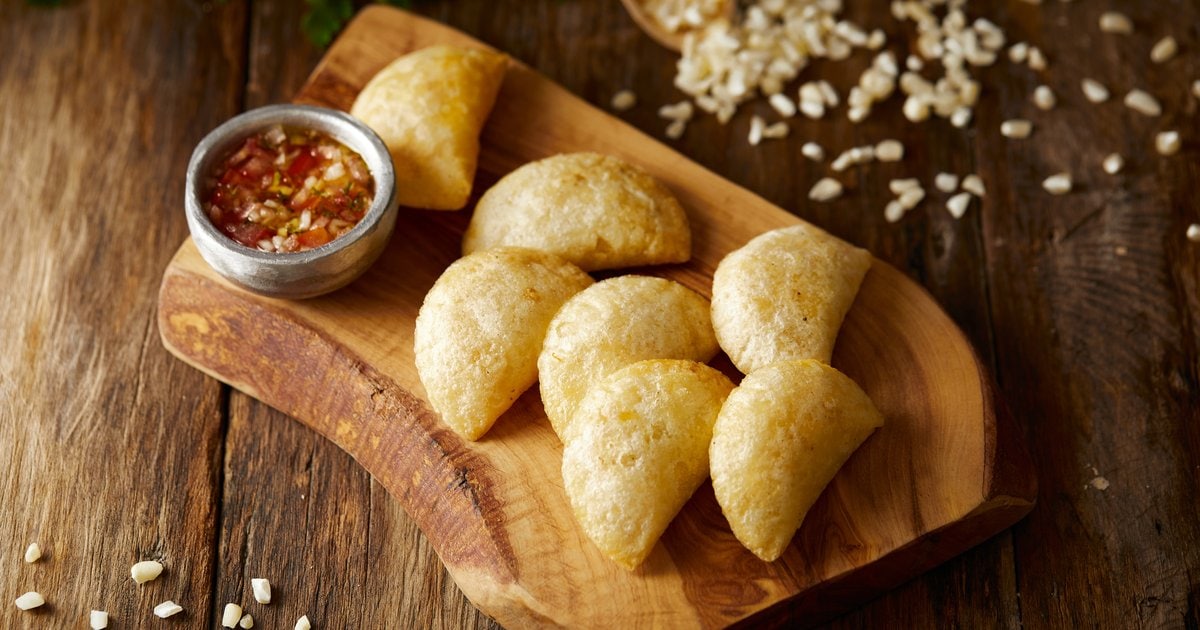
Empanadas de morocho are Ecuador’s crunchy corn empanadas. The dough is cracked white morocho corn that has been soaked, cooked and ground, and it is wrapped around a filling of pork, rice, peas and achiote, then fried until the shell crackles. In Quito they are a street-corner and teatime classic, eaten hot with a spoonful of ají.
This recipe makes about 20 and follows the way Quito cooks do it, from the 24-hour soak to the plastic-bag trick for shaping. Start the corn the day before you want to eat.
Empanadas de Morocho at a Glance
What Are Empanadas de Morocho?
Most empanadas start with a wheat dough. Empanadas de morocho are made from corn, and not from cornmeal or flour but from whole cracked kernels that are cooked until soft and then ground into a dough. That gives them a shell that is thin, blistered and audibly crunchy, with a toasty corn flavor you will not get from a flour empanada.
They belong to the Ecuadorian Sierra, the Andean highlands around Quito, Ambato and Ibarra. The classic filling is a refrito of onion, garlic, cumin and achiote cooked with ground pork or beef, then bulked out with white rice, peas and carrot. Street vendors sell them in two sizes: bite-sized ones by the bagful, and giant half-moons as long as your forearm.

Ecuador makes several empanadas, and they are easy to mix up. Here is how morocho compares with the other two you will see everywhere.
| Empanada | Dough | Usual filling | Texture |
|---|---|---|---|
| De morocho | Cooked, ground cracked white corn | Pork or beef with rice, peas and carrot | Thin, crunchy, savory |
| De viento | Wheat flour | Fresh cheese and onion, dusted with sugar | Puffed, hollow, sweet-salty |
| De verde | Mashed green plantain | Cheese, or shrimp on the coast | Dense and crisp-edged |
What Is Morocho? (Morocho in English)
Morocho is the name of the corn itself. It is a hard, white Andean flint-type corn (the word comes from the Kichwa muruchu), and in Ecuador it is sold dried and cracked into small pieces as morocho partido or morocho trillado. There is no exact English name; “cracked white corn” is the closest description.
It is not hominy. Hominy is treated with lime or lye (nixtamalized), while morocho is simply dried, hulled and cracked. That is why canned hominy or masa harina will not give you the same dough.
The same grain shows up all over Ecuadorian cooking: in sopa de morocho, and above all in morocho, the thick, sweet drink of cracked corn simmered with milk, cinnamon and raisins. Ask for “morocho con empanadas” at a Quito café in the afternoon and you will get a mug of the drink with an empanada beside it.

Ingredients for Empanadas de Morocho
The full measurements are in the recipe card. This is what each part does and what you can swap.
The dough
- Morocho partido. Cracked dried white corn. One pound makes about 20 empanadas.
- Lard. Makes the dough supple and the shell crisper. Shortening or oil works.
- Salt. Half in the cooking water, half in the dough.
- Egg white (optional). Some cooks knead it in to help a crumbly dough hold together.
The filling
- Ground pork. The classic. Ground beef or shredded chicken also work.
- Achiote and cumin. The red color and earthy flavor of every Ecuadorian refrito.
- Rice, peas and carrot. Cooked, so they stretch the meat and keep the filling dry.
- Scallion and cilantro. Fresh green flavor stirred in at the end.
To serve
- Ají. Ecuador’s fresh hot sauce. Tree-tomato ají is the Quito favorite.
- Something warm to drink. Morocho, coffee or hot chocolate.
How to Make Empanadas de Morocho
The method has three stages: cook the corn until it is very soft, grind it into a smooth dough, and shape it inside plastic so the thin dough never tears. Here is what to watch for at each step.
1. Soak the morocho for a full day
Rinse the cracked corn and cover it with plenty of cold water, then leave it in the refrigerator for 24 hours. Skipping or shortening the soak is the most common reason the dough turns out gritty, because the hard grain never softens all the way.
2. Cook it until it crushes between your fingers
Simmer the drained corn in fresh salted water for 1 1/2 to 2 hours, adding hot water to keep it covered. Test a grain by pinching it: it should squash completely, with no chalky center. A pressure cooker cuts this to about 30 minutes at high pressure. Drain it well and let the steam escape on a tray, since waterlogged corn makes a sticky dough.
3. Grind twice, then knead
Grind the corn while it is still warm. A food processor in small batches works well, and a grain mill or meat grinder with a fine plate is even better. Grind once until it clumps, then a second time until it is fine. Knead in the lard and salt until the dough feels like smooth play dough.
4. Cook the filling and let it go cold
Soften the onion, garlic and cumin in achiote oil, brown the pork until the pan is dry, then fold in the rice, vegetables and herbs. Spread it on a plate to cool. Warm or wet filling is what makes morocho empanadas burst in the oil.
5. Shape them inside a plastic bag
Morocho dough has no gluten, so it cannot be stretched or picked up when thin. The trick every Ecuadorian cook uses is a zip-top bag with the side seams cut open and lightly oiled. Press a ball of dough between the plastic into a thin round, add the filling, then use the plastic to fold the dough over and seal the edges. Peel the plastic away and the empanada comes off intact.

Shaping is easier to see than to describe. For a visual walkthrough, here is the Ecuadorian cooking channel Muy Criollo’s episode on empanadas de morocho:
6. Fry hot, a few at a time
Fry at 350°F (175°C) in at least 2 inches of oil, three or four at a time, for 4 to 5 minutes. Crowding the pot drops the temperature and the shells soak up oil. For the extra-crunchy, blistered shell you get from Quito street stands, finish them for a minute at 375°F. Drain them on a rack rather than paper so the bottoms stay crisp.
Want to try a wheat-dough empanada next? Our empanada dough guide covers baked and fried versions.
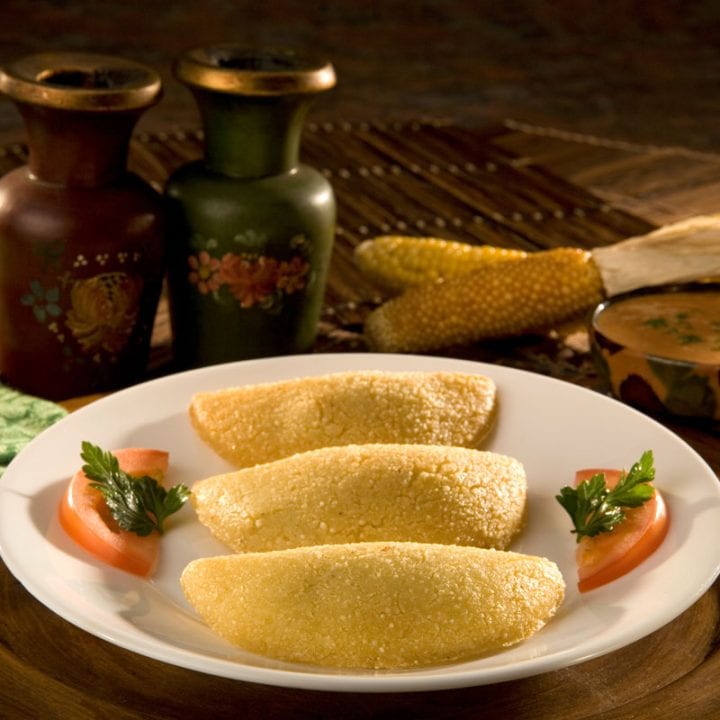
Empanadas de Morocho (Ecuadorian Corn Empanadas)
Crunchy Ecuadorian empanadas made with a dough of soaked, cooked and ground morocho corn, filled with pork, rice, peas and achiote, and fried until golden. Serve hot with ají.
Ingredients
For the morocho dough
- 1 lb (454 g) morocho partido (cracked white morocho corn)
- Water, for soaking and cooking
- 2 teaspoons fine salt, divided
- 2 tablespoons lard or vegetable shortening, softened
- 1 egg white, only if the dough cracks (optional)
For the pork filling
- 2 tablespoons achiote oil, or 2 tablespoons vegetable oil plus 1 teaspoon ground annatto
- 1 small white onion, finely chopped (about 1 cup)
- 3 scallions, whites and greens chopped separately
- 3 garlic cloves, minced
- 1 teaspoon ground cumin
- 12 oz (340 g) ground pork or ground beef
- 1/2 teaspoon salt, plus more to taste
- 1/4 teaspoon black pepper
- 1/2 cup cooked white rice
- 1 medium carrot, cooked and finely diced (about 1/2 cup)
- 1/2 cup cooked green peas
- 2 tablespoons chopped cilantro
To fry and serve
- Vegetable oil, for frying (about 6 cups)
- Ají criollo or ají de tomate de árbol, for serving
Instructions
- Soak the corn. Rinse the morocho, cover it with 3 inches of cold water and soak in the refrigerator for 24 hours. Drain and rinse.
- Cook until very soft. Cover the corn with fresh water by 3 inches, add 1 teaspoon salt and simmer, partly covered, for 1 1/2 to 2 hours, topping up with hot water as needed. It is ready when a grain crushes easily between your fingers with no hard center (in a pressure cooker, about 30 minutes at high pressure). Drain very well and spread on a tray for 15 to 20 minutes to steam off.
- Grind and knead the dough. While the corn is still warm, grind it in batches in a food processor (or a grain mill or meat grinder with a fine plate) until it clumps, then grind it a second time. Knead in the lard and the remaining 1 teaspoon salt until the dough is smooth and pliable, like play dough. If it cracks when you press a ball flat, knead in the egg white or a spoonful of hot water. Cover and let it cool to room temperature.
- Make the filling. Heat the achiote oil in a large skillet over medium heat. Add the onion, scallion whites, garlic and cumin and cook for 4 to 5 minutes, until soft. Add the pork, 1/2 teaspoon salt and the pepper and cook for 8 to 10 minutes, breaking it up, until no pink remains and the pan is dry. Stir in the rice, carrot, peas, scallion greens and cilantro. Taste for salt, then cool completely (chill it if you can).
- Shape the empanadas. Cut open the side seams of a gallon zip-top bag and lightly oil the inside. Roll 1 1/2 ounces (45 g) of dough into a ball, set it on one half of the plastic, fold the other half over and press with a flat-bottomed plate or a tortilla press into a 4 1/2-inch round about 1/8 inch thick. Peel back the top sheet, add a heaping tablespoon of cold filling, then lift the plastic to fold the dough into a half-moon. Press the edges through the plastic to seal, peel it away and crimp with a fork if you like. Keep the shaped empanadas covered while you make the rest.
- Fry. Heat 2 inches of oil in a heavy pot to 350°F (175°C). Fry 3 or 4 empanadas at a time for 4 to 5 minutes, turning once, until deep golden and crisp. For an extra-crunchy shell, raise the heat and give them a final minute at 375°F (190°C). Drain on a rack and serve hot with ají.
Notes
Buying morocho: look for bags labeled morocho partido or morocho trillado (cracked white corn). Most US bags are 12 to 14 ounces, so you will need two.
Make ahead: the dough sours if it sits out, so shape the empanadas the day you grind it. Shaped, unfried empanadas freeze well: freeze on a tray, then bag them for up to 3 months and fry from frozen at 340°F for 6 to 7 minutes.
Reheat: re-crisp fried empanadas in a 375°F oven or air fryer for 8 to 10 minutes. The microwave makes the shell chewy.
Baking or air frying: brush shaped empanadas with oil and bake at 400°F for about 20 minutes, or air fry at 375°F for 12 to 14 minutes, turning halfway. They will be crisp but drier and paler than fried ones.
Gluten-free: the dough is pure corn, so the empanadas are gluten-free as long as your filling, seasonings and frying oil are too.
What to Serve With Empanadas de Morocho
In Ecuador these are a snack or a light supper, not a main course with sides. What matters is the sauce and the drink.
Ají de tomate de árbol
Ají is the fresh hot sauce on every Ecuadorian table, and the version made with tree tomato (tamarillo) is the one Quito pairs with morocho empanadas. Its tart fruitiness cuts through the fried shell.

Other good matches are ají de maní (a creamy peanut ají), or a chunky ají with lupini beans (chochos), which is how some Quito restaurants serve them.
A warm drink
The traditional pairing is a cup of morocho, the sweet corn drink described above. Coffee or hot chocolate are just as common at the afternoon merienda, and in December many families serve them alongside colada morada. For a bigger spread of Quito street food, add empanadas de viento and bolón de verde.
Empanadas de Morocho Troubleshooting
| Problem | Why it happens | Fix |
|---|---|---|
| Dough cracks when folded | Too dry, or ground too coarse | Grind again, then knead in hot water or egg white a spoonful at a time |
| Dough is sticky and soft | Corn was not drained, or was still too hot | Spread it out to cool and dry, or chill the dough for 30 minutes |
| Gritty texture | Short soak or undercooked corn | Soak a full 24 hours and cook until every grain crushes |
| Empanadas burst in the oil | Wet or warm filling, overfilling, weak seal | Use cold, dry filling, about a heaping tablespoon, and press the edges firmly |
| Greasy shells | Oil too cool or pot crowded | Keep the oil at 350°F and fry 3 or 4 at a time |
| Pale or soft shells | Pulled too early | Fry until deep golden, then a final minute at 375°F |
Make Ahead, Freeze and Reheat
- The filling keeps for 3 days in the refrigerator, so make it a day ahead.
- The dough is best used the day you grind it. Freshly ground morocho starts to sour at room temperature; if you must hold it, wrap it tightly and refrigerate it overnight.
- Shaped, unfried empanadas freeze very well. Freeze them on a tray, then bag them for up to 3 months. Fry straight from frozen at 340°F for 6 to 7 minutes.
- Leftover fried empanadas re-crisp in a 375°F oven or air fryer in 8 to 10 minutes. Avoid the microwave, which turns the shell chewy.
Where to Eat Empanadas de Morocho in Quito
If you are traveling to Ecuador, these three are worth the trip.
Empanadas de Morocho Ulloa
Alicia Quinteros started out frying empanadas on the sidewalk of Calle Ulloa and has been at it since 1985. She later moved to the La Gasca neighborhood but kept “Ulloa” in the name. Her empanadas are famously huge, often longer than 30 centimeters.
Calle La Ronda
The cobbled street in Quito’s historic center is lined with stands selling regular and giant morocho and viento empanadas from mid-afternoon, usually for a few dollars each.
Campo Viejo
This chain began in 1984 as a country restaurant in the Valle de los Chillos whose specialty was empanadas de morocho. It now has more than a dozen locations around Quito and sells frozen empanadas to take home.
Where to Buy Morocho in the US
Look for bags labeled morocho partido or morocho trillado in Ecuadorian, Peruvian and Andean grocery stores, especially around New York, New Jersey and Chicago. Most bags hold 12 to 14 ounces, so buy two for this recipe.
Mama Tere Morocho Partido
Cracked white morocho from an Ecuadorian brand, sold as a two-pack of 12-ounce bags.
Valles Andinos Morocho Partido
Another Andean brand of cracked white corn, in a two-pack of 14-ounce bags.
Hamilton Beach Stack & Snap Food Processor
A 12-cup processor is big enough to grind the cooked corn in two or three batches without straining the motor.
As an Amazon Associate, AmigoFoods earns from qualifying purchases.
Empanadas de Morocho FAQ
What are empanadas de morocho made of?
The dough is cracked white morocho corn that is soaked, cooked and ground, then kneaded with lard and salt. The filling is usually ground pork or beef cooked with onion, garlic, cumin and achiote, mixed with rice, peas and carrot.
Why are they called empanadas de morocho?
They are named for the corn in the dough. Morocho is the hard white Andean corn used for the dough, the drink called morocho and sopa de morocho.
What is morocho in English?
There is no single English word for it. Morocho is a hard white flint-type corn, sold dried and cracked, so “cracked white corn” is the best description. It is not the same as hominy, which is treated with lime.
How do you make the dough for empanadas de morocho?
Soak cracked morocho for 24 hours, simmer it until a grain crushes easily, drain it well, grind it twice while warm, and knead it with lard and salt until smooth. Shape it the same day.
Can I use masa harina or canned hominy instead?
Not for an authentic result. Masa harina and hominy are nixtamalized and taste like tortillas, and canned hominy is too wet to grind into a workable dough. Precooked white corn meal is the closest shortcut.
Are empanadas de morocho gluten-free?
Yes, the dough is pure corn. Just check the filling ingredients and avoid oil that has been used to fry wheat products.
Can you bake empanadas de morocho?
You can. Brush them with oil and bake at 400°F for about 20 minutes, or air fry at 375°F for 12 to 14 minutes. They will be crisp but drier and paler than the fried original.
Explore more of the country’s cooking in our guide to 25 traditional Ecuadorian dishes, the best Ecuadorian street foods, or our roundup of must-try empanadas from across Latin America.
Sources
- Expreso: Empanadas de viento, morocho y gourmet in Quito
- Primicias: The best empanadas in Quito
- Wikipedia: Ecuador maize varieties
More Ecuadorian Foods
See all →
Jorge Garcia is the founder of AmigoFoods, where he has spent over 20 years helping readers discover authentic Latin American and Spanish cuisine. Raised in a Cuban-American household, Jorge learned to cook at the hands of his mother and grandmother, carrying forward generations of family recipes. That heritage, backed by his family’s four-generation history in the Latin food industry, inspired him to launch AmigoFoods in 2003. With more than 1,000 published articles on recipes, ingredients, and food culture, Jorge’s mission is simple: make authentic Latin cooking approachable for home cooks everywhere while honoring the traditions behind every dish.