

Fiambre is Guatemala’s festive cold salad for All Saints’ Day and Day of the Dead gatherings: a generous platter of vegetables, meats, seafood, eggs and cheese dressed with a tangy caldillo. Every family’s version differs; this one serves a crowd and is prepared over several days.
Fiambre at a Glance
On All Saints’ Day, fiambre shares the table with torrejas, molletes and fruit in syrup. Find them all in our guide to Guatemalan desserts.
What Is Fiambre?

Fiambre is a traditional Guatemalan salad that is most often prepared to celebrate the Day of the Dead and All Saints Day. It contains many ingredients, and they all combine to make a delicious cold salad with a little something from every food group.
Fiambre recipes vary from family to family because families have passed down their own unique fiambre recipes from generation to generation.
Different kinds of fiambre include:
There is not one fiambre. There are several, and Guatemalan families are particular about which one is theirs. What separates them is almost always the caldillo — the vinegar dressing that everything gets soaked in.
| Type | What makes it different |
|---|---|
| Fiambre rojo | The most common version. Beets go into the caldillo and stain the whole platter a deep magenta. If someone says fiambre without qualifying it, this is usually what they mean. |
| Fiambre blanco | Same ingredients, no beets. The platter stays pale, so you can actually see the individual components. Families who want the colors of the vegetables to show make this one. |
| Fiambre verde | Named for the color of its caldillo, not for leaving out the meat. It is a green dressing, and the fiambre still carries the full range of sausages and cold cuts. |
| Fiambre dulce | The caldillo is built on agua de panela instead of leaning hard on vinegar, which gives the whole dish a sweeter edge. Less common, and worth trying if you find it. |
| Vegetariano / vegano | Newer versions. The meat is swapped for mushrooms, tofu, or plant-based sausage, and the vegetable and pickle side of the platter carries the dish. |
You will also hear about fiambre desarmado. That is not a different recipe — it is a way of serving. Instead of tossing everything together, the components go out in separate bowls and each person builds their own plate. It is a kind thing to do when you are feeding people who do not eat pork, or seafood, or beets.
This dish is a cold salad that most Guatemalans eat for Dia de Los Muertos, which is on November 2nd, and Dia de Todos Los Santos, which is on November 1st.
In Guatemala, people celebrate these holidays with fireworks, flying kites in cemeteries, and sharing food with loved ones, often at burial places.
Although there are many different recipes, a typical fiambre contains many ingredients, typically around 50.
Fiambre History

One story of fiambre’s origin is that it emerged around 1770 when a series of natural disasters in Guatemala led to food shortages.
As the story goes, a Spanish commission visited Guatemala, and the cook didn’t have any prepared dishes to offer because of food shortages.
Then, the cook decided to mix all the ingredients they could find in the kitchen and served it cold as a salad.
The commission liked it, and thus, fiambre was born.
The recipe spread throughout the country, and more and more families adopted it until it became a traditional dish.
Now, Fiambre is an offering to saints, and many people bring it to cemeteries along with flowers, fruits, and incense.
Since it has a little bit of everything, the saints can choose their favorites.
All Saints Day is celebrated across Latin America, but fiambre is a uniquely Guatemalan dish.
Another theory of fiambre’s origin explains the dish’s association with All Saints Day.
According to this story, when families brought their food to the gravesites, they would share their food with neighboring families.
This food would combine into one giant dish with many ingredients: fiambre.
Fiambre is usually served with a traditional Guatemalan dessert called “Dulce de Ayote.”
The Caldillo: The Part That Actually Matters
If you take one thing from this article, take this. The caldillo is the vinegar dressing that every single component of the fiambre gets marinated in, and it is the dish. Fifty ingredients on a platter is just a cold cut tray. The caldillo is what turns it into fiambre.
It is also the thing that separates one family fiambre from another. The meats are the meats. The caldillo is where the recipe lives, and it is the part that gets guarded and handed down.
Here is a working version to start from:
- 1 quart (946 ml) white vinegar
- 1 pint (473 ml) olive oil
- 6 tablespoons (85 g) mustard
- A generous bunch of parsley
- 4 bay leaves
- Thyme and oregano
- A few dashes of Worcestershire sauce
- A grating of nutmeg
- Salt and pepper
Blend the dressing ingredients except the oil and bay leaves until smooth, then stream the oil in. Add the bay leaves whole and remove them before serving. Let it sit overnight in the refrigerator before it touches any food — the herbs need that time to give up their flavor, and a caldillo you use the same day tastes thin and raw.
Two things worth knowing before you start. First, make more than you think you need. Everything drinks it, and running short halfway through assembly is miserable. Second, taste it before you commit — it should be aggressively sharp on a spoon, because fifty ingredients are about to dilute it considerably.
Want the red version? Add cooked beets to the caldillo, not just to the platter. That is what makes fiambre rojo red all the way through.
How To Make Fiambre

There are many different ways to make fiambre, and every Guatemalan family will most likely have a different way of making it.
However, you should keep in mind that you should begin preparation 2-3 days in advance.
Here is a basic recipe:
The 4-Day Plan
Plan three preparation days, with shopping an additional day ahead if useful. Soak the dried beans on the evening before cooking; keep cooked components refrigerated throughout.
| When | What you are doing | Roughly |
|---|---|---|
| Day 1 (Oct 29) |
Shop. This is the hard day and it deserves its own slot. Hit the Latin market for the sausages, cheeses and pacaya first, because that is where you will come up short, then fill in at the regular supermarket. Order anything you are buying online at least a week before this. | 3 hrs |
| Day 2 (Oct 30) |
Make the caldillo and refrigerate it overnight. Boil and shred the chicken. Boil the sausages. Hard-boil the eggs. Everything cooked today goes into the refrigerator in its own separate container. | 2 hrs |
| Day 3 (Oct 31) |
Cook the vegetables in batches — do not crowd them, and stop while they still have some bite, because they will soften overnight in the caldillo. Pour the caldillo over the vegetables and refrigerate. Slice the cold cuts and cheeses. Cook the seafood. | 2.5 hrs |
| Day 4 (Nov 1) |
Assemble. Vegetables down first, then the meats and cheeses, then decorate with eggs, olives, asparagus and cheese. Serve cold, straight from the refrigerator. | 45 min |
The reason for the staging is not just spreading out the labor. Marinated vegetables genuinely improve overnight, and cold cuts sliced the day before dry out at the edges. Doing it in this order gets you a better platter, not just an easier week.
Refrigerator space is the constraint nobody warns you about. You are going to have a large bowl of marinating vegetables, a pot of caldillo, and a dozen containers of cooked components all needing cold storage at the same time. Clear a shelf on Day 1.
Ingredients
Remember how I said that there are a lot of ingredients in this dish?
Well, here’s the proof.
This is what you will need to make a basic fiambre recipe:
| Category | Ingredients |
| Vegetables |
|
| Meats |
|
| Seafood |
|
| Eggs and Dairy |
|
| Miscellaneous/Garnish |
|

Instructions
Yield: 25–30 main-course servings. Plan about 3 days, with 5 hours of preparation and cooking spread across them.
- Soak the dried red, white and fava beans overnight in separate containers in the refrigerator. Discard the soaking water. Cook each kind separately in fresh water until fully tender; if using red or white kidney beans, boil vigorously for at least 30 minutes before simmering. Drain and refrigerate promptly.
- Blend vinegar, mustard, parsley, thyme, oregano, Worcestershire sauce, nutmeg, salt and pepper; slowly add the oil. Add bay leaves whole and refrigerate the caldillo overnight. Remove the bay leaves before serving.
- Cook chicken to 165°F (74°C), then shred. Cook fresh pork or beef sausages to 160°F (71°C), or poultry sausages to 165°F (74°C). Use ready-to-eat cured meats and fully cooked tongue; follow package directions for any products requiring cooking. Slice and refrigerate in separate shallow containers.
- Cook raw shrimp until pearly and opaque, then chill. Drain the canned mussels and sardines; these are already cooked. Hard-boil the eggs until yolks and whites are firm, cool and refrigerate.
- Boil beets separately until tender, peel and dice. For fiambre rojo, blend half into the caldillo and reserve half for garnishing; omit for blanco. Cook asparagus, carrots, green beans, cauliflower, brussels sprouts, peas and corn separately until tender but not mushy. Drain and chill.
- Wash and shred the cabbage. Drain jarred pacaya, hearts of palm, pickled corn, pickled onions, chickpeas, capers, olives and pimentos. If using fresh pacaya, cook it until tender first. Wash and dry the lettuce and refrigerate it separately.
- Combine chilled vegetables, cabbage, cooked beans and drained jarred ingredients with the caldillo in a large covered container. Reserve some olives and asparagus for garnish. Refrigerate overnight. Keep meats, seafood, eggs and cheeses chilled separately.
- On serving day, line platters with lettuce. Lift marinated vegetables out with a slotted spoon, add the meats, sausages, seafood and cubed cheeses, then garnish with cut eggs, reserved beets, olives and asparagus. Spoon a little caldillo over the top.
- Serve cold in small batches, keeping the remainder refrigerated at 40°F (4°C) or below. Refrigerate perishable food within 2 hours, or 1 hour above 90°F (32°C). Use within 3–4 days of the earliest cooked perishable ingredient, or sooner if its label requires; assembly does not restart the storage clock.
Because fiambre contains so many ingredients, you’ll always have a lot of it.
Be prepared to feed a small army.
Making fiambre is a relatively time-consuming process, so make sure you’re ready to shop for, prepare, and mix nearly fifty ingredients before you embark on this venture.
You’ll need to store all of these ingredients separately as you work through the preparation process.
I recommend using these Ziploc Quart Food Storage Bags (available on Amazon.com).
I like these bags because the triple seal system keeps food fresh for days.
Additionally, the bags are durable so that you can use them more than once.
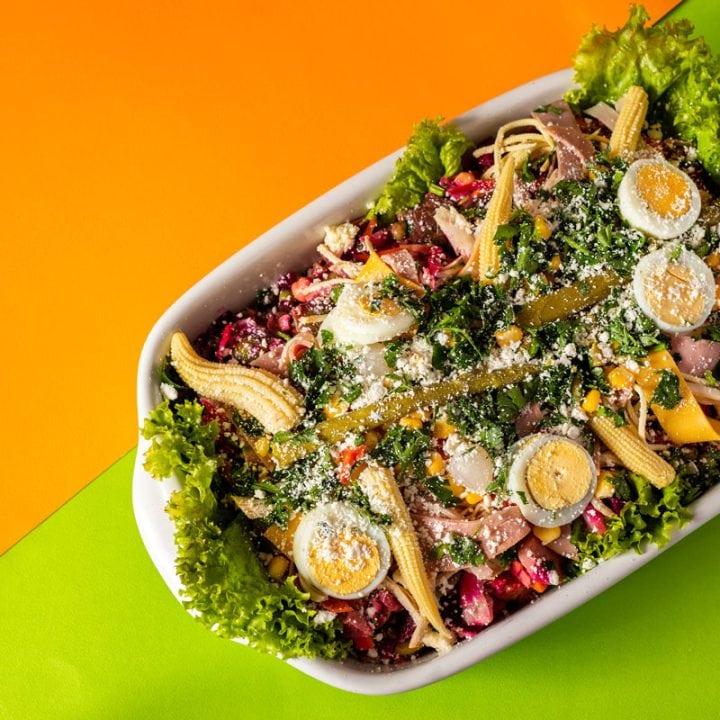
Guatemalan Fiambre
The traditional Guatemalan cold salad served for Dia de Todos los Santos on November 1, built from around fifty ingredients bound together by a sharp vinegar caldillo. Make it over three days and serve it cold.
Ingredients
- For the Caldillo (the dressing)
- 1 quart (946 ml) white vinegar
- 1 pint (473 ml) olive oil
- 6 tablespoons (85 g) mustard
- 1 large bunch parsley
- 4 bay leaves
- 1 teaspoon dried thyme
- 1 teaspoon dried oregano
- 2 tablespoons Worcestershire sauce
- 1/4 teaspoon freshly grated nutmeg
- Salt and freshly ground black pepper, to taste
- For the Vegetables
- 1/2 pound (230 g) asparagus
- 6 beets (leave out for fiambre blanco)
- 6 carrots
- 4 cups (640 g) green beans
- 1 head cauliflower
- 1 head cabbage
- 1 pound (450 g) brussels sprouts
- 2 cups (320 g) corn
- 25 pacayas, or two 32-ounce jars pacaya in brine, drained
- 1 jar hearts of palm, drained
- 1 jar pickled corn, drained
- 1 jar pickled onions, drained
- 1/2 pound (230 g) dried red beans
- 1/2 pound (230 g) dried white beans
- 1 pound (450 g) dried fava beans
- 1 can chickpeas, drained
- 4 cups (640 g) peas
- 1/4 pound (115 g) capers, drained
- 1/4 pound (115 g) green olives
- 1/4 pound (115 g) black olives
- 1 can pimentos, drained
- 2 heads lettuce
- For the Meats
- 1/2 pound (230 g) butifarra
- 1/2 pound (230 g) cecina
- 1 pound (450 g) chicken
- 1 pound (450 g) chorizo colorado
- 1 pound (450 g) chorizo negro
- 1 pound (450 g) chorizo amarillo
- 1/2 pound (230 g) hot dogs
- 1 pound (450 g) ham
- 1/2 pound (230 g) longaniza
- 1 pound (450 g) mortadella
- 1 pound (450 g) salami
- 1/2 pound (230 g) salted cow tongue
- For the Seafood
- 1 can sardines, drained
- 1 can mussels, drained
- 1 cup shrimp
- For the Eggs and Cheese
- 4 eggs
- 1/2 pound (230 g) yellow cheese
- 1/2 pound (230 g) queso Zacapa
- 4 ounces (115 g) mozzarella
Instructions
- Soak the dried red, white and fava beans overnight in separate containers in the refrigerator. Discard the soaking water. Cook each kind separately in fresh water until fully tender; if using red or white kidney beans, boil vigorously for at least 30 minutes before simmering. Drain and refrigerate promptly.
- Blend vinegar, mustard, parsley, thyme, oregano, Worcestershire sauce, nutmeg, salt and pepper; slowly add the oil. Add bay leaves whole and refrigerate the caldillo overnight. Remove the bay leaves before serving.
- Cook chicken to 165°F (74°C), then shred. Cook fresh pork or beef sausages to 160°F (71°C), or poultry sausages to 165°F (74°C). Use ready-to-eat cured meats and fully cooked tongue; follow package directions for any products requiring cooking. Slice and refrigerate in separate shallow containers.
- Cook raw shrimp until pearly and opaque, then chill. Drain the canned mussels and sardines; these are already cooked. Hard-boil the eggs until yolks and whites are firm, cool and refrigerate.
- Boil beets separately until tender, peel and dice. For fiambre rojo, blend half into the caldillo and reserve half for garnishing; omit for blanco. Cook asparagus, carrots, green beans, cauliflower, brussels sprouts, peas and corn separately until tender but not mushy. Drain and chill.
- Wash and shred the cabbage. Drain jarred pacaya, hearts of palm, pickled corn, pickled onions, chickpeas, capers, olives and pimentos. If using fresh pacaya, cook it until tender first. Wash and dry the lettuce and refrigerate it separately.
- Combine chilled vegetables, cabbage, cooked beans and drained jarred ingredients with the caldillo in a large covered container. Reserve some olives and asparagus for garnish. Refrigerate overnight. Keep meats, seafood, eggs and cheeses chilled separately.
- On serving day, line platters with lettuce. Lift marinated vegetables out with a slotted spoon, add the meats, sausages, seafood and cubed cheeses, then garnish with cut eggs, reserved beets, olives and asparagus. Spoon a little caldillo over the top.
- Serve cold in small batches, keeping the remainder refrigerated at 40°F (4°C) or below. Refrigerate perishable food within 2 hours, or 1 hour above 90°F (32°C). Use within 3–4 days of the earliest cooked perishable ingredient, or sooner if its label requires; assembly does not restart the storage clock.
Notes
Plan about 3 calendar days, with roughly 5 hours of preparation and cooking spread across them. The card allows 1 1/2 hours preparation, 3 1/2 hours cooking and 2 days for soaking, chilling and marinating; tasks overlap. Shopping can be done an extra day ahead. Start the beans and caldillo first, cook the remaining components and marinate the vegetables next, then assemble on serving day.
This version uses dried beans; canned beans are a shortcut but their drained weight is not interchangeable with dry weight. Use jarred pacaya as listed or cook fresh pacaya separately. All meats and seafood must be fully cooked or labeled ready to eat before chilling and assembly.
Keep everything refrigerated in shallow containers. Count the 3–4 day refrigerated storage limit from the earliest cooked perishable ingredient, not from assembly. Freezing harms the vegetables and dressing. Serve cold.
What to Buy When You Cannot Find the Real Thing
Half the ingredient list above assumes you are standing in a Guatemalan market. If you are not, here is what to reach for instead. None of these are perfect, but each one gets you close enough that the platter still tastes like fiambre.
| Called for | What it is | Use instead |
|---|---|---|
| Pacaya | Palm flower, pickled. Faintly bitter, almost like baby corn with an artichoke edge. | Jarred pacaya (see below). If you cannot get it, hearts of palm plus a few pickled baby corn — you will lose the bitterness, which is a real loss but not a fatal one. |
| Butifarra | Mild white pork sausage, cooked. | Spanish butifarra from a Latin market, or a good mild bratwurst. |
| Cecina | Salted, air-dried beef. | Bresaola is the closest. Thin-sliced dried beef works in a pinch. |
| Chorizo colorado | Red, paprika-forward, firm. | Spanish cured chorizo — the dry kind you slice, not the fresh Mexican kind you crumble. |
| Chorizo negro | Blood sausage, dark and rich. | Morcilla or Spanish blood sausage. Skip it rather than substitute badly. |
| Chorizo amarillo | Yellow from achiote. | Any achiote-colored fresh sausage, or plain fresh chorizo with a little achiote paste. |
| Longaniza | Long, thin, well-spiced pork sausage. | Widely available at Latin markets now. Sweet Italian sausage is a distant third choice. |
| Queso Zacapa | Firm, salty, aged Guatemalan cheese. | Cotija for the salt, or a young Manchego for the texture. Queso fresco is too mild on its own here. |
| Salted cow tongue | Cured and sliced thin. | Leave it out, or use more mortadella. Nothing else stands in for it honestly. |
| Ayote | The squash for the dessert that follows. | Any firm winter squash. See dulce de calabaza. |
One rule if you are substituting heavily: keep the ratio of sharp to rich. The pickles, capers, olives and vinegar are doing the work of cutting through eight pounds of cured meat. Drop the sour side and the platter turns heavy fast.
Where to Find the Hard Ones
Almost everything on the list is a normal supermarket trip. Two things are not.
Pacaya is the one that stops people. Fresh palm flower essentially does not exist in American markets, and the jarred version moves in and out of stock, especially in October when every Guatemalan household in the US is looking for it. The one that stays in stock most reliably is La Fe Guatemalan Pacaya Palm in Brine, sold as a two-jar pack (available on Amazon.com). Two 32-ounce jars is the right amount for a full-size fiambre with some left over, and it is ready to eat straight from the brine. Buy it in September. It sells out.
The sausages and cheeses are worth a trip rather than a click. A Guatemalan or Salvadoran market will have chorizo colorado, longaniza and Zacapa cheese sitting together in one case, at better prices and better quality than anything shipped to you. Call ahead in late October and ask them to hold what you need — they know exactly why you are calling, and most of them will do it.
Serving, Leftovers, and Keeping It Safe
Fiambre is served cold, and it is meant to sit out while people come and go. That is the tradition, and it is also where the food-safety question comes in, because a platter with seafood, cooked chicken and fresh cheese on it is not something to leave on a table all afternoon.
The practical answer Guatemalan families use: put out a portion, keep the rest cold, and refill. Two hours on the table is the working limit — one hour if the temperature exceeds 90°F (32°C). The vinegar in the caldillo helps, but it is not a preservative and it will not save chicken that has been sitting at room temperature since noon.
Keep leftovers refrigerated at 40°F (4°C) or below. Use them within 3–4 days of the earliest cooked perishable ingredient, or sooner if its label requires. Assembly does not restart the storage clock. Do not freeze it; the vegetables collapse and the caldillo separates. And never reheat it. This is a cold dish, start to finish.
If you are taking fiambre to a cemetery or a gathering, as most families do, pack it over ice and assemble the decorative top layer when you arrive rather than letting it slide around in the car.
Fiambre Questions I Get Asked
Why does fiambre have so many ingredients?
Because it was never meant to be one family dish. The oldest explanation is that families brought food to the graves and shared it, and everything combined into one platter. Fifty ingredients is the point, not an excess.
Is fiambre eaten anywhere besides Guatemala?
It is specifically Guatemalan. All Saints Day is observed across Latin America, but this dish belongs to Guatemala — and to Guatemalan families abroad, who go to real trouble to make it every November.
Can I make a smaller fiambre?
Yes. Scale the ingredient list to a third and you will feed eight to ten people. Keep the variety even as you cut the quantity — a fiambre with fifteen ingredients in small amounts is far more convincing than one with five in large amounts.
What do you serve with fiambre?
Bread to mop the caldillo, and dulce de ayote afterward. That is the traditional close to the meal.
How far ahead can I make it?
Assemble the day you are serving, but start three or four days out. The plan above breaks it down.
Conclusion

Fiambre is truly a fascinating Guatemalan food.
It typically is made using a wide array of ingredients, but the time to prepare the dish is certainly worth it.
The dish is deeply rooted in Guatemalan history and tradition, and it will likely be enjoyed on All Saints Day and Day of the Dead for many years to come.
Sources
- Wikipedia: Fiambre
- 196 Flavors: Fiambre
- Chocolates and Chiles: Fiambre-A History of Guatemala’s Most Famous Dish
- Antiguena Spanish Academy: Fiambre Guatemalan Dish Recipe and Story
More Guatemalan Foods
See all →
Jorge Garcia is the founder of AmigoFoods, where he has spent over 20 years helping readers discover authentic Latin American and Spanish cuisine. Raised in a Cuban-American household, Jorge learned to cook at the hands of his mother and grandmother, carrying forward generations of family recipes. That heritage, backed by his family’s four-generation history in the Latin food industry, inspired him to launch AmigoFoods in 2003. With more than 1,000 published articles on recipes, ingredients, and food culture, Jorge’s mission is simple: make authentic Latin cooking approachable for home cooks everywhere while honoring the traditions behind every dish.