

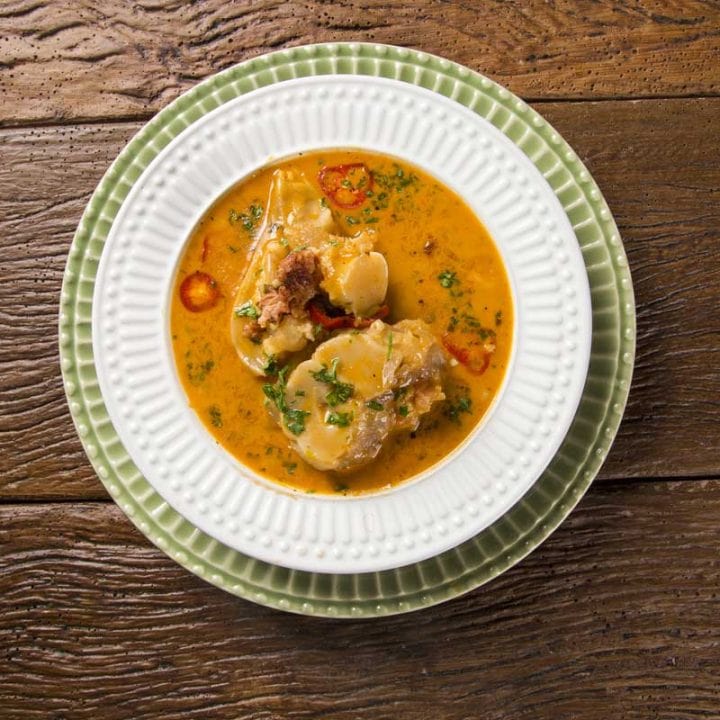
Mocotó is Brazil’s slow-simmered cow’s foot stew. Beef feet cook for hours until the skin, tendons and meat turn soft and sticky, then finish in a golden broth of garlic, tomato and colorau, usually with white beans or cassava. It is thick, rich, cheap to make, and the dish one of São Paulo’s most famous restaurants is named after.
Mocotó at a Glance
AmigoFoods may earn a commission from qualifying Amazon purchases made through links on this page.
What is mocotó?
Mocotó is both an ingredient and a dish. The word means the foot of a cow, below the shin: mostly skin, tendon, cartilage and a little meat wrapped around the bone. In the kitchen, “mocotó” means the stew made from it.
The feet are simmered for hours until everything that was tough turns tender and gelatinous. The meat is picked from the bones and finished in a seasoned broth. Home cooks across Brazil add white beans, cassava, potatoes or carrots; bars and lunch counters serve a smoother, soupier version called caldo de mocotó.
You will often see it written mocoto, without the accent. It is the same dish, pronounced moh-koh-TAW, with the stress on the last syllable. In Spanish the ingredient is pata de res; in Portugal it is mão de vaca.
What does mocotó taste like?
Mocotó tastes deeply beefy and savory, a bit like the richest pot roast gravy you have ever had. The real draw is texture. The collagen in the feet melts into the broth, so it coats your lips and turns almost silky, while the pieces of skin and tendon are soft and slightly chewy, like the best part of oxtail.
The seasoning keeps it from feeling heavy: garlic, onion and tomato, a little cumin, colorau for color, plenty of cilantro and a squeeze of lime at the end. Many Brazilians add heat at the table with malagueta pepper.
Is it a soup or a stew? Both, depending on who makes it. Mocotó served at home with beans and rice is a thick stew you can eat with a fork. Caldo de mocotó, the bar version, is a smooth soup you drink from a cup or a small bowl.

Where mocotó comes from
Most sources trace the word to mbokotó in Kimbundu, a Bantu language of Angola. Like many Brazilian dishes, mocotó grew out of the Atlantic world that linked Angola, Portugal and Brazil. Portugal still eats a close cousin, mão de vaca com grão, cow’s foot stewed with chickpeas.
In Brazil, mocotó became food of the Northeast and the dry backlands called the sertão. Nothing on the animal went to waste there, and a pot of feet simmering all day fed a family cheaply. When millions of northeasterners moved south to São Paulo in the twentieth century, the dish came with them.
It changed along the way. In Rio Grande do Sul, in the cold far south, mocotó gaúcho adds tripe (dobradinha) to the pot, turning it into a hearty winter dish closer to mondongo.
Caldo de mocotó and São Paulo’s Mocotó restaurant
Caldo de mocotó is the dish’s bar-counter form: the same long-cooked feet, but the vegetables are blended into the broth, so it comes out smooth, thick and golden. Brazilians drink it hot in little bowls or cups, especially late at night and on cold days, and it has a long reputation as a hangover cure.
No place made it more famous than Mocotó, in Vila Medeiros in São Paulo’s working-class North Zone. José Oliveira de Almeida, known as Seu Zé, came from the sertão of Pernambuco and, with his brothers, first sold mocofava (fava beans in mocotó broth). He opened the restaurant in 1973, and its caldo de mocotó drew customers from across the city.
His son, chef Rodrigo Oliveira, took over the kitchen in the 2000s and turned Mocotó into one of Brazil’s most celebrated restaurants without moving it out of the neighborhood. One of his changes to the signature caldo: thickening it with cassava instead of the traditional cornmeal or wheat flour, for a lighter, cleaner broth. The recipe below borrows that idea.
Mocotó vs. similar dishes
Almost every cuisine that raises cattle has a cow’s foot or tripe stew. Here is how mocotó compares with the ones it is most often confused with.
| Dish | Where | Main cut | What makes it different |
|---|---|---|---|
| Mocotó | Brazil | Cow’s feet | Thick stew with garlic, tomato and colorau, often white beans or cassava |
| Caldo de mocotó | Brazil | Cow’s feet | Smooth, blended soup served in bars and lunch counters |
| Mocofava | Northeast Brazil | Cow’s feet | Mocotó cooked with fava beans |
| Dobradinha | Brazil (dobrada in Portugal) | Tripe | Tripe stewed with white beans and sausage; added to mocotó gaúcho |
| Mão de vaca com grão | Portugal | Cow’s feet | Cow’s foot stewed with chickpeas |
| Mondongo | Latin America | Tripe | Tripe soup with vegetables; cow’s feet sometimes added |
| Menudo | Mexico | Tripe | Red chile broth with hominy |
| Cow foot soup | Jamaica, Caribbean | Cow’s feet | Brothy soup with butter beans, dumplings and Scotch bonnet |
Ingredients for mocotó
The full list with amounts is in the recipe card below. Here is what each ingredient does and what you can swap.
- Beef feet (cow’s feet). Look for them labeled “beef feet”, “cow feet” or “cow heel” at Latin, Caribbean and Asian butchers, often frozen and already cut. You want 2-inch rounds with plenty of skin. Pig’s feet work in the same method and cook a little faster.
- Lime and vinegar. For cleaning and a quick blanch, which removes the bone dust and any off smell before the long simmer.
- Onion, garlic, bell pepper and tomato. The refogado, Brazil’s version of a sofrito, that seasons the finished stew.
- Colorau. Ground annatto, often cut with a little cornmeal, used across Brazil for its warm orange color. Plain ground annatto or sweet paprika works the same way.
- Cassava (yuca). It softens into the broth and thickens it naturally, the Mocotó-restaurant trick. Fresh or frozen yuca both work; potatoes are the easy substitute.
- White beans. Common in São Paulo home cooking. Canned cannellini or navy beans keep the recipe simple; leave them out for caldo.
- Malagueta pepper, cilantro and scallions. Heat and freshness at the end. A bottled Sabor Mineiro pimenta malagueta on the table is very Brazilian.

How to make mocotó
The method has two stages: a long, quiet simmer that makes the feet tender, then a short finish where you build the flavor. Here is the shape of it; the exact amounts and timings are in the recipe card.
- Clean and blanch the feet. Scrub them, rub them with lime, then boil them for 10 minutes in water with a splash of vinegar and throw that water away. This step is what gives you a clean-tasting broth.
- Simmer until completely tender. Cover the feet with fresh water, add bay leaves, half an onion and salt, and simmer gently for 3½ to 4 hours. They are ready when the skin is translucent and the tendons slide off the bone.
- Pick the meat and save the broth. Let the feet cool, strain the broth, then pull off the meat, skin and tendon, discard the bones and cut everything into small pieces.
- Build the refogado. Soften onion in oil, then add garlic, bell pepper, tomatoes, colorau and cumin and cook until jammy.
- Finish the stew. Add the meat, cassava and broth and simmer until the cassava is soft. Mash a few pieces to thicken, stir in white beans, then finish with lime, salt and herbs.
Pressure cooker mocotó
Many Brazilian home cooks make mocotó in a panela de pressão, and it cuts the long simmer to a little over an hour. After blanching, cook the feet with the water, bay leaves, onion and salt at high pressure for 75 minutes, then let the pressure release naturally. Finish the stew on the stove exactly as in the recipe.
An electric multicooker like the Instant Pot Duo 6-quart works the same way; do not fill it more than two-thirds full, and add a few more minutes if your feet are thick. In a slow cooker, cook the blanched feet on low for 9 to 10 hours.
How to serve mocotó
Mocotó is a meal on its own, but in Brazil it rarely arrives alone.
- White ricePlain white rice to soak up the broth, the everyday partner.
- FarofaToasted cassava flour sprinkled on top for crunch. Make your own farofa or use ready-made Yoki farofa pronta.
- Lime and malaguetaLime wedges and a bottle of malagueta pepper sauce for each diner to adjust.
- A cold drinkIn São Paulo bars, a cold beer or a shot of cachaça; at home, a caipirinha.
Tips for the best mocotó
- Do not skip the blanch. It is the difference between a clean, beefy broth and a murky one.
- Simmer, do not boil. A hard boil makes the broth cloudy and the skin tough. Small, lazy bubbles are what you want.
- Judge by texture, not the clock. Feet vary in size. Keep cooking until a tendon pulls away from the bone with no effort.
- Skim the fat if you like. Chill the broth and lift off the layer of fat, or simply spoon it off the hot broth.
- Season at the end. The broth reduces as it simmers, so add the final salt and lime only once the stew is finished.
Storing and reheating mocotó
Cool mocotó quickly and refrigerate it in a covered container for up to 4 days. Do not be alarmed when it sets into a firm jelly: that is the collagen, and it melts back into broth as soon as it is warm. Reheat gently on the stove with a splash of water, stirring so the beans do not catch on the bottom.
Mocotó freezes well for up to 3 months. If you plan to freeze it, leave out the cassava and add fresh when you reheat, since cassava can turn grainy after freezing.
Mocotó FAQ
What kind of meat is in mocotó?
Mocotó is made from beef feet, the part of the leg below the shin. It is mostly skin, tendon and cartilage around the bone, with a little meat. Some regional versions also add tripe or sausage.
What is mocotó in English?
Mocotó translates as cow’s foot or beef foot, and the dish is usually called Brazilian cow’s foot stew or cow’s foot soup. In Spanish the cut is pata de res or pata de vaca.
Is mocotó a soup or a stew?
It can be either. Home-style mocotó with beans is a thick stew; caldo de mocotó is a smooth soup. Both use the same long-simmered feet.
Where can I buy cow’s feet?
Latin American, Caribbean and Asian markets carry them, usually labeled beef feet or cow feet. Many supermarket butcher counters will order them for you if you ask a few days ahead.
Can I make mocotó with pig’s feet?
Yes. Pig’s feet give a slightly sweeter, lighter broth and cook in about 3 hours on the stove. Brazilians also make mocotó de porco.
What is geleia de mocotó?
Geleia de mocotó is a sweet Brazilian gelatin made from the same collagen, flavored with sugar, wine or fruit. It is a dessert and has nothing in common with the stew except the cut it starts from. Doce de mocotó, a fluffy marshmallow-like sweet, is another relative.
Why does mocotó turn to jelly in the fridge?
The feet are full of collagen, which turns into gelatin as it simmers. When the stew cools, the gelatin sets. Warm it up and it becomes broth again.
Mocotó Recipe
Mocotó (Brazilian Cow’s Foot Stew)
Brazil’s slow-simmered cow’s foot stew: tender, collagen-rich meat in a golden broth of garlic, tomato and colorau, finished with cassava and white beans. Serve it with rice, farofa and malagueta.
Ingredients
- 3 lb (1.4 kg) beef feet (cow’s feet), cut crosswise into 2-inch rounds by the butcher
- 2 limes, divided
- 2 tablespoons white vinegar
- 12 cups water, plus more as needed
- 2 bay leaves
- 2 medium white onions (1 halved, 1 finely chopped)
- 2 teaspoons kosher salt, plus more to taste
- 3 tablespoons olive oil or vegetable oil
- 6 garlic cloves, minced
- 1 green bell pepper, seeded and chopped
- 1 malagueta pepper or other small fresh chile, minced (optional)
- 2 ripe tomatoes, seeded and chopped
- 1 tablespoon colorau (ground annatto) or sweet paprika
- 1 teaspoon ground cumin
- 12 oz (340 g) cassava (yuca), peeled and cut into 1-inch chunks, or 2 medium potatoes
- 1 can (15 oz) white beans (cannellini or navy), drained and rinsed
- 1/2 teaspoon freshly ground black pepper
- 1/4 cup chopped cilantro or parsley
- 3 scallions, thinly sliced
- White rice, farofa, lime wedges and malagueta hot sauce, to serve
Instructions
- Clean the feet. Rinse the beef feet under cold running water, scraping off any hair or bone dust with the back of a knife. Rub them all over with the cut halves of 1 lime, then rinse again.
- Blanch. Put the feet in a large pot (at least 8 quarts), cover with cold water by 2 inches and add the vinegar. Bring to a boil and boil for 10 minutes. Drain, discard the water and rinse the feet and the pot.
- Simmer until tender. Return the feet to the pot with the 12 cups of water, the bay leaves, the halved onion and 2 teaspoons of salt. Bring to a boil and skim off the gray foam, then partially cover and simmer gently for 3½ to 4 hours, until the skin and tendons are soft and translucent and pull away from the bones with no resistance. Top up with hot water whenever the level drops below the feet. (Pressure cooker: cook at high pressure for 75 minutes and let the pressure release naturally.)
- Pick the meat. Lift the feet out with a slotted spoon and let them cool for 15 minutes. Strain the broth and keep it; you need about 8 cups (add water if you are short). Pull the meat, skin and tendons off the bones, discard the bones and any hard knuckle cartilage, and cut everything into ½-inch pieces.
- Make the sofrito. Heat the oil in the cleaned pot over medium heat. Add the chopped onion and cook for 5 minutes, until soft. Add the garlic, bell pepper and malagueta and cook for 2 minutes. Add the tomatoes, colorau and cumin and cook for 5 minutes, until the tomatoes collapse.
- Simmer the stew. Add the chopped meat, the cassava and 8 cups of the reserved broth. Simmer uncovered for 25 to 30 minutes, stirring now and then, until the cassava is tender. Mash a few pieces of cassava against the side of the pot to thicken the broth.
- Add the beans. Stir in the white beans and black pepper and simmer for 10 minutes more. Squeeze in the juice of the second lime and add salt to taste.
- Serve. Ladle into deep bowls, scatter with cilantro and scallions, and serve with white rice, farofa, lime wedges and malagueta hot sauce.
Notes
Buying beef feet: Latin, Caribbean and Asian butchers sell them as "beef feet", "cow feet" or "cow heel", often already cut. Ask for 2-inch rounds; a home knife will not cut through the bone. Frozen feet work well; thaw them overnight in the fridge.
Caldo de mocotó (bar-style): Skip the beans. After step 6, blend the sofrito, cassava and 2 cups of broth until smooth, then return it to the pot with the meat for a velvety, spoonable caldo.
Make ahead: Mocotó tastes better the next day. The broth sets into a firm jelly in the fridge because of the collagen; it melts back as soon as it is warm. Keeps 4 days refrigerated or 3 months frozen.
Substitutions: Pig’s feet work in the same method and cook in about 3 hours. Sweet paprika can replace colorau, and potatoes can replace cassava.
More Brazilian soups and stews
If mocotó is your kind of food, Brazil has plenty more slow-cooked comfort to try:
- Feijoada, the black bean and pork stew Brazilians eat on Saturdays
- Caldo de kenga, a chicken and cassava soup
- Moqueca baiana, fish stew with coconut milk and dendê oil
- Tutu de feijão, the mashed bean dish of Minas Gerais
- Baião de dois, rice and beans from the Northeast
Or browse every Brazilian soup and stew recipe, see our roundup of the best Brazilian soups and stews, and get to know the Brazilian ingredients behind them.
More Brazilian Foods
See all →
Jorge Garcia is the founder of AmigoFoods, where he has spent over 20 years helping readers discover authentic Latin American and Spanish cuisine. Raised in a Cuban-American household, Jorge learned to cook at the hands of his mother and grandmother, carrying forward generations of family recipes. That heritage, backed by his family’s four-generation history in the Latin food industry, inspired him to launch AmigoFoods in 2003. With more than 1,000 published articles on recipes, ingredients, and food culture, Jorge’s mission is simple: make authentic Latin cooking approachable for home cooks everywhere while honoring the traditions behind every dish.