

On this page
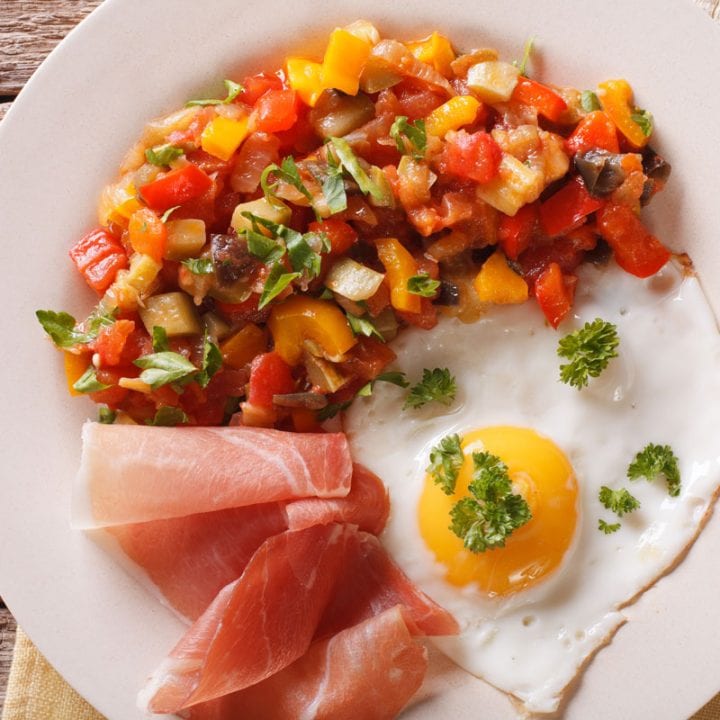
Pisto is Spain’s classic vegetable stew: onions, peppers and zucchini cooked slowly in olive oil, then simmered in tomato until thick and jammy. The best-known version is pisto manchego, from La Mancha, and it’s often called Spanish ratatouille. Serve it warm with crusty bread, or top it with a fried egg and call it dinner.
Pisto at a Glance
What Is Pisto?
Pisto is a slow-cooked mix of chopped summer vegetables in olive oil and tomato. It’s a home-cooking dish, born as a way to use up what the garden produced.
The texture sits between a stew and a chunky sauce. You should still see each vegetable, but they should be soft and glossy, with no watery liquid in the pan.

In Spain, you’ll find it as a first course, a side for grilled meat or fish, a tapa on toast, or a filling for empanadillas. It’s usually eaten warm, though it’s just as good at room temperature.
The word comes from the Latin pistus, meaning “crushed,” which fits a dish of finely chopped vegetables cooked down together. In English, you can call it Spanish vegetable stew.
Pisto Manchego and Other Regional Versions
Pisto manchego is the version most people mean. “Manchego” here means “from La Mancha,” not the cheese. Tomatoes and peppers are the two things nearly every cook agrees on. Beyond that, every family has its own view.
If you like Spanish vegetables with more smoke, try escalivada, the Catalan dish of fire-roasted eggplant and peppers. It’s roasted and dressed rather than stewed.
Pisto vs. Ratatouille: What’s the Difference?
Pisto gets called Spanish ratatouille for good reason, since both are vegetable stews built on tomato and olive oil. They eat quite differently, though.
| Pisto | Ratatouille | |
|---|---|---|
| From | Central Spain | Provence and Nice, France |
| Base | Peppers, tomato, onion, zucchini | Eggplant, zucchini, peppers, tomato, onion |
| Eggplant | Optional | Standard |
| Seasoning | Salt, olive oil, sometimes pimentón | Thyme, basil and other herbs |
| Cut and texture | Small dice, soft and saucy | Larger pieces, more separate |
| Classic topping | Fried egg | Usually none |
Pisto Ingredients
There are few ingredients, so each one matters. Here’s what to look for.
Use a generous amount of Spanish olive oil, because it’s the main seasoning here. A spoonful of sweet pimentón isn’t traditional everywhere, but it adds warmth when tomatoes are out of season.
How to Make Pisto
The one rule that matters is that vegetables go in the pan in stages, because each one cooks at its own speed. Cooked together from the start, the zucchini turns to mush before the peppers soften. Here’s the method in short, with exact amounts in the recipe card below.
- Dice everything the same size. Aim for ½-inch pieces so they cook evenly and look right on the plate.
- Melt the onions and peppers. Cook them low and slow for 15 to 18 minutes until very soft but not browned. Add the garlic for the last minute.
- Brown the eggplant and zucchini separately. Medium heat and a little space in the pan give them golden edges instead of steaming them.
- Reduce the tomato. Simmer until thick and dark, 12 to 15 minutes. This is where the flavor concentrates.
- Simmer it all together. Combine and cook gently for 12 to 15 minutes, then let it rest for 10 minutes before serving.
How to tell it’s done: Drag your spoon across the pan. If the line holds and no water runs into it, your pisto is ready. If it looks wet, keep simmering uncovered.
Pisto Manchego (Spanish Vegetable Stew)
A classic Spanish vegetable stew of onions, peppers, zucchini and eggplant, cooked in stages in olive oil and simmered in tomato until thick. This is the way to make pisto manchego at home in one pan.
Ingredients
- ⅓ cup extra-virgin olive oil, divided
- 2 medium yellow onions (about 12 oz / 340 g), cut into ½-inch dice
- 1 large green bell pepper, cut into ½-inch dice
- 1 large red bell pepper, cut into ½-inch dice
- 3 garlic cloves, minced
- 1 small eggplant (about 10 oz / 300 g), cut into ½-inch dice (optional)
- 2 medium zucchini (about 1 lb / 450 g), cut into ½-inch dice
- 1½ lb (680 g) ripe tomatoes, halved and grated, skins discarded, or 1 (14.5-oz / 411 g) can crushed tomatoes
- 1¼ teaspoons fine sea salt, divided, plus more to taste
- ¼ teaspoon black pepper
- ½ teaspoon sweet pimentón (optional)
- ½ teaspoon sugar, only if the tomatoes taste sharp
- 1 teaspoon sherry vinegar (optional)
- 4 fried eggs, to serve (optional)
- Crusty bread, to serve
Instructions
- Soften the onions and peppers. Heat 2 tablespoons of the oil in a 12-inch deep skillet or wide Dutch oven over medium-low heat. Add the onions, both peppers and ¼ teaspoon of the salt. Cook, stirring often, until very soft but not browned, 15 to 18 minutes. Add the garlic and cook 1 minute more. Scrape everything into a large bowl.
- Brown the eggplant. Raise the heat to medium and add 2 more tablespoons of oil. Add the eggplant and ¼ teaspoon of the salt. Cook, stirring occasionally, until golden and tender, 8 to 10 minutes. Add it to the bowl.
- Cook the zucchini. Add the last tablespoon of oil, the zucchini and ¼ teaspoon of the salt. Cook until just tender with golden edges, 6 to 8 minutes. Add it to the bowl.
- Reduce the tomato. Add the tomatoes, pepper, pimentón if using, and the remaining ½ teaspoon of salt to the same pan. Simmer over medium heat, stirring now and then, until thick and darker in color, 12 to 15 minutes. Taste it. If it is sharp, stir in the sugar.
- Bring it together. Return all the vegetables to the pan and lower the heat. Simmer gently, uncovered, stirring carefully, until the sauce coats the vegetables and no water pools around them, 12 to 15 minutes. Stir in the vinegar if using, and adjust the salt.
- Rest and serve. Let the pisto stand off the heat for 10 minutes. Serve warm or at room temperature, topped with a fried egg and with crusty bread alongside.
Notes
Eggplant is optional. Many cooks in La Mancha leave it out. Skip step 2 and use 2 tablespoons less oil.
Canned tomatoes work well. Out of season, use one 14.5-ounce can of good crushed tomatoes. For a saucier pisto, add a second can and give it about 5 extra minutes to reduce.
Storage. Refrigerate for up to 4 days or freeze for up to 3 months. The zucchini softens after freezing. Reheat gently, and cook eggs fresh.
Diet. The pisto is vegan and gluten-free before you add eggs or bread.
How to Serve Pisto
Pisto is one of the most flexible dishes in the Spanish kitchen. These are the classic ways to eat it.
Pisto con huevo
This is the classic. Fry an egg in plenty of olive oil until the edges are lacy, slide it on top, and break the yolk into the vegetables. For a one-pan version, make small wells in the hot pisto, crack in the eggs, cover, and cook on low until the whites set, 4 to 6 minutes.

As a tapa
Spoon room-temperature pisto over toasted bread, or serve a small dish alongside other Spanish tapas. It pairs nicely with pan con tomate and tortilla española.

What to serve with pisto
- Bread: a crusty loaf for scooping is close to essential.
- Ham: a few slices of serrano ham or jamón ibérico add salt and richness.
- Rice: plain white rice turns leftovers into dinner.
- Meat and fish: serve it beside grilled chicken, pork chops, lamb or white fish.
- Fish in the pan: stir in flaked canned tuna or salt cod, a popular variation in Spain.
- Cheese: shave some Manchego over the top. It isn’t part of the dish, but it tastes great.
For more ideas, see our guide to Spanish side dishes.
Make Ahead and Storage
Pisto is an ideal make-ahead dish, because the flavors deepen overnight.
| Where | How long | Tips |
|---|---|---|
| Fridge | Up to 4 days | Cool quickly and keep covered. |
| Freezer | Up to 3 months | Thaw overnight. The zucchini gets softer, so it works best as a sauce or filling. |
| Reheating | 5 to 10 minutes | Warm gently in a pan with a splash of water or olive oil. |
Leftovers are useful, too. Fold them into a Spanish omelet, toss them with pasta, or use them to fill empanadillas once chilled and thick.
A Short History of Pisto
Pisto as we know it can’t be very old, since tomatoes and peppers only reached Spain from the Americas in the 1500s. It’s generally described as the food of farmers and shepherds in La Mancha, who cooked what their gardens gave them.
Its roots may go back further. Spain’s alboronía takes its name from the Arabic al-būrāniyya, a family of eggplant dishes named for Būrān, the wife of the Abbasid caliph al-Ma’mūn in 9th-century Baghdad. Spanish food writer Néstor Luján called alboronía the mother of all pistos.
The likely story is that Arab-influenced vegetable stews were already part of Spanish cooking when New World crops arrived. Over time, peppers and tomatoes took over, and in La Mancha, eggplant became optional.

Pisto FAQ
What does pisto mean?
In Spanish cooking, pisto is a stew of chopped vegetables, usually peppers and tomatoes. The word has other meanings too. In El Salvador, Guatemala, Honduras and Nicaragua, pisto is slang for money, and darse pisto means to act important.
What does pisto mean in Mexican slang?
In Mexico, pisto is common slang for alcohol, and pistear means to go drinking. It has nothing to do with the vegetable dish.
Is pisto the same as pesto?
No. Pesto is a raw Italian sauce of basil, garlic, nuts, cheese and olive oil. Pisto is a cooked Spanish vegetable stew. Only the names are similar.
Does pisto manchego have Manchego cheese in it?
Not traditionally. Manchego in the name means “from La Mancha,” the same region the cheese comes from. Some cooks shave a little on top, but it isn’t part of the classic dish.
Does pisto have eggplant?
Sometimes. Many pisto manchego recipes leave it out, and others include it. This recipe treats eggplant as optional, so you can go either way.
Is pisto served hot or cold?
Usually warm, and it’s also very good at room temperature. It’s rarely served straight from the fridge, since cold olive oil dulls the flavor.
Is pisto manchego healthy?
It’s mostly vegetables and olive oil, so it fits well into a Mediterranean-style diet. It’s also naturally vegan and gluten-free before you add eggs or bread. The oil does add calories, so keep an eye on portions if that matters to you.
Sources
Real Academia Española: pisto · Wikipedia: Pisto · ¡Hola! Cocina: Pisto manchego casero · Eat Like a Sultan: Buraniyya · Wikipedia: Alboronía
More Spanish Foods
See all →
Jorge Garcia is the founder of AmigoFoods, where he has spent over 20 years helping readers discover authentic Latin American and Spanish cuisine. Raised in a Cuban-American household, Jorge learned to cook at the hands of his mother and grandmother, carrying forward generations of family recipes. That heritage, backed by his family’s four-generation history in the Latin food industry, inspired him to launch AmigoFoods in 2003. With more than 1,000 published articles on recipes, ingredients, and food culture, Jorge’s mission is simple: make authentic Latin cooking approachable for home cooks everywhere while honoring the traditions behind every dish.