

Api con pastel is Bolivia’s classic early-morning breakfast: a glass of hot, thick api morado, a sweet drink of purple corn flour spiced with cinnamon and cloves, served with a pastel de queso, a paper-thin fried pastry filled with melted cheese and dusted with powdered sugar. You dunk the salty, crackly pastel into the warm api. Here is what it is, how Bolivians eat it, and a full recipe for both halves.
Api con Pastel at a Glance
AmigoFoods may earn a commission from qualifying Amazon purchases made through links on this page.
What is api con pastel?
Api con pastel means “api with a pastry.” It is two foods sold together, usually by the same vendor, from before sunrise until mid-morning in the cities of the Bolivian highlands. The api is the drink. The pastel is the fried cheese pastry that goes with it.
The word api comes from Quechua, where it meant a corn porridge, a mazamorra. The Inca chronicler Garcilaso de la Vega described the Andean peoples eating api as a thick mush in his Comentarios Reales (1609), so the drink is far older than the wheat pastry served with it today. Over time it became a pourable drink, and the fried pastel, made with wheat flour brought by the Spanish, became its partner.

It is a breakfast for cold mornings. In La Paz, El Alto, Oruro and Potosí, which sit between about 11,900 and 13,600 feet (3,600 to 4,150 m), dawn temperatures are often near freezing, and a hot, filling glass of api is the way many people start the day. It appears on most lists of Bolivian breakfast foods, and you will find it alongside salteñas in our guide to Bolivian food.
Api morado vs. api blanco (and the two-tone glass)
When people say “api” in Bolivia they usually mean api morado, the purple version. It is not the only kind, and vendors often sell two or three side by side.
| Type | Made with | Taste and look |
|---|---|---|
| Api morado | Ground purple corn (maíz morado), cinnamon, cloves, sugar, often citrus peel | Deep violet, thick, sweet and spiced, slightly fruity. The most popular. |
| Api blanco | Ground white corn, cinnamon, sugar; some cooks add milk | Creamy white, milder and more like a hot porridge drink. |
| Api amarillo | Ground yellow corn with the same spices | Golden yellow and mild; often used in the mixed glass. |
| Mixed api | Api morado poured over api blanco or amarillo | The two-tone glass seen in markets. Order it if you cannot decide. |

A related drink, tojorí, is made from ground white corn with cinnamon and cloves and is sold in the same markets. All of them are unfermented and alcohol-free, so children drink them too.
What is a Bolivian pastel?
A Bolivian pastel de queso is a large, very thin turnover of wheat dough filled with cheese and deep-fried until the surface puffs into crisp bubbles. The dough is made by pouring hot fat and boiling water into flour, which keeps it tender and lets it be rolled almost see-through. The filling is usually a fresh, slightly salty white cheese, and the finished pastel gets a shower of powdered sugar, so every bite is salty, sweet and crunchy at once.

It is not the same as the Brazilian pastel, a rectangular fried pastry with savory fillings, or a baked Bolivian empanada. Pasteles are also not the only partner for api. Vendors sell it with buñuelos (fried dough fritters with syrup), llauchas (small baked cheese pastries from La Paz) and plain sweet breads, but the cheese pastel is the classic.
When and where Bolivians eat api con pastel
- Where: mostly the Andean departments of La Paz, Oruro, Potosí, Cochabamba and Chuquisaca (Sucre), in covered markets, at bus terminals and from street carts. Since the late 20th century it has spread to Santa Cruz, Tarija and the lowlands.
- Festivals: api is sold in huge quantities at the Alasita fair in La Paz, which opens every January 24, and its smell fills the streets at dawn during the Oruro Carnival.
- Beyond Bolivia: api is also a winter staple in northern Argentina (Jujuy, Salta and Tucumán), and in southern Peru (Arequipa, Cusco and Puno), where it is served with a fried bread called cachanga.
- How it is served: in a tall glass or mug, piping hot, with the pastel on a small plate or a square of paper. Dunking is expected.
For more early-morning stalls, see our guide to Bolivian street food.
Api vs. chicha morada (and atole)
Api and Peru’s chicha morada both get their color from the same purple corn, but they are different drinks.
| Api morado | Chicha morada | |
|---|---|---|
| Corn | Ground purple corn flour, cooked into the drink | Whole dried cobs, boiled and strained out |
| Texture | Thick, like a pourable porridge | Thin, like juice |
| Temperature | Served hot | Served cold |
| Flavorings | Cinnamon, cloves, citrus peel, sugar | Pineapple, apple, cinnamon, cloves, lime |
| Eaten with | Pasteles, buñuelos | Lunch, as a refreshment |

The closest relatives of api are Mexico’s corn-thickened atole and its chocolate version, champurrado. If you already have maíz morado in your pantry for chicha, you will need the ground flour for api.
Ingredients for api con pastel

For the api morado
- Purple corn flour: sold as harina de maíz morado, api morado or, in Ecuadorian shops, harina morada for colada morada. Any of them works. This purple corn flour is the plain kind; B&R Foods Api Morado Molido is a Bolivian mix that already contains the spices.
- Cinnamon sticks and whole cloves: simmered in the water first, then removed. Mexican canela sticks are soft and easy to find.
- Orange or lemon peel: one strip brightens the corn flavor. A few drops of lemon juice at the end keep the color bright.
- Sugar: street api is very sweet. Start with ½ cup and add more to taste.
For the pasteles de queso
- All-purpose flour, a little sugar and salt.
- Lard or vegetable shortening: melted until very hot. Lard gives the most flavor; shortening gives the flakiest blisters.
- Boiling water: it partly cooks the flour so the dough stays soft and stretchy.
- Cheese: Bolivians use a fresh, slightly salty white cheese. In the US, mix crumbled queso fresco for flavor with low-moisture mozzarella for melt.
- Vegetable oil for frying and powdered sugar for dusting.
How to make api morado
- Soak the flour. Whisk 1 cup purple corn flour into 2 cups cold water until smooth and let it sit 20 to 30 minutes. Mixing it with cold water first is what keeps the api from turning lumpy.
- Infuse the water. Boil the remaining 5 cups of water with 2 cinnamon sticks, 4 cloves and a strip of orange peel for 5 minutes.
- Whisk in the corn. Turn the heat to medium-low, stir the soaked flour again and pour it in slowly while whisking.
- Simmer and stir. Cook 15 to 20 minutes, scraping the bottom often, until it coats a spoon and no longer tastes of raw corn. Corn starch scorches easily, so do not walk away.
- Sweeten and serve. Stir in sugar to taste, pull out the spices or strain it, and keep it hot over the lowest heat until the pasteles are ready.
How to make pasteles de queso
- Scald the flour. Pour ¼ cup very hot melted lard over 2½ cups flour mixed with sugar and salt, stir until crumbly, then add ¾ cup boiling water and stir fast into a shaggy dough.
- Knead and rest. Once you can handle it, knead 2 to 3 minutes until soft and smooth. Cover and rest 20 minutes so it rolls out without shrinking back.
- Roll very thin. Divide into 12 balls and roll each into a 6- to 7-inch round or oval, thin enough that you can almost see the counter through it. Thin dough is what blisters.
- Fill and seal. Put 1½ tablespoons of cheese on one half, wet the edge, fold and press out the air. Crimp with a fork or fold the edge over itself in a rope pattern.
- Fry hot and fast. Fry one or two at a time in oil at 350 to 360°F (175 to 180°C), spooning oil over the top so it puffs, about 1 to 1½ minutes per side until pale gold.
- Sugar them. Drain on a rack, dust generously with powdered sugar and serve right away with the api.
Tips for the best api con pastel
Make ahead and storage
- Api: keeps 3 days in a covered container in the fridge. It sets thick as it cools; reheat gently on the stove with a splash of water, whisking. It is also drunk cold in summer.
- Dough: make it up to a day ahead, wrap tightly and refrigerate. Let it come to room temperature before rolling.
- Pasteles: best within an hour of frying. To re-crisp, heat in a 350°F (175°C) oven or air fryer for 3 to 4 minutes, then dust with fresh sugar. Shaped, unfried pasteles can be frozen on a tray and fried from frozen, adding about 30 seconds per side.
Api con pastel FAQ
What is Bolivian api made of?
Api morado is made from ground purple corn cooked with water, cinnamon, cloves, citrus peel and sugar until thick. Api blanco and api amarillo use white or yellow corn instead.
Is api the same as chicha morada?
No. Both use purple corn, but api is made with corn flour, is thick and is served hot, while Peruvian chicha morada is a thin, cold drink made by boiling whole cobs with fruit.
What does api con pastel taste like?
The api tastes like warm, spiced sweet corn with a fruity edge from the purple corn. The pastel is crisp, salty and cheesy under a coat of powdered sugar. Together they taste like a sweet-and-salty breakfast pastry with a hot cereal drink.
When do Bolivians eat api con pastel?
Mostly for breakfast, from around 5 a.m., and as an afternoon snack on cold days. It is especially popular in the highlands and during festivals like the Alasita fair and the Oruro Carnival.
Where can I buy purple corn flour?
Look in Latin American grocery stores for harina de maíz morado, Bolivian api mixes or Ecuadorian harina morada for colada morada, or order it online. Whole dried purple corn is a different product.
Can I make api without purple corn flour?
Yes. White corn flour or fine masa harina makes a good api blanco with the same spices. It will taste similar but will not be purple.
Is api gluten-free?
Api made only from corn, spices, water and sugar is naturally gluten-free, but check the label on packaged mixes. The pasteles are made with wheat flour and are not gluten-free.
Can you drink api cold?
Yes. Api is usually served hot, but it is also drunk chilled in warm weather. It thickens in the fridge, so stir in a little cold water before serving.
Api con Pastel Recipe
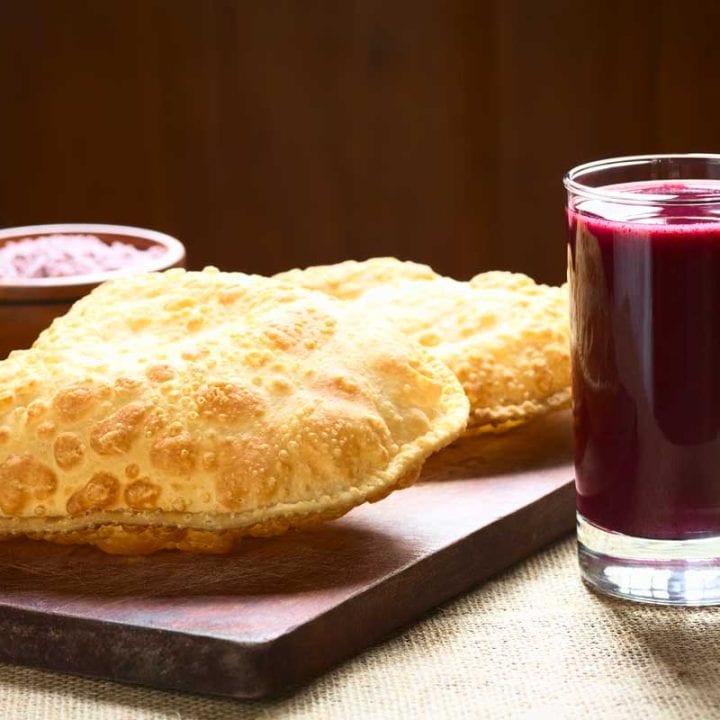
Api con Pastel (Bolivian Purple Corn Drink with Cheese Pastries)
Hot, spiced Bolivian api morado made with purple corn flour, served with thin, blistered fried pasteles filled with melted cheese and dusted with powdered sugar.
Ingredients
For the api morado
- 1 cup (130 g) purple corn flour (harina de maíz morado)
- 7 cups (1.65 L) water, divided
- 2 cinnamon sticks
- 4 whole cloves
- 1 strip orange peel (about 3 inches), white pith removed
- ½ to ⅔ cup (100 to 135 g) sugar, to taste
- 1 teaspoon fresh lemon juice (optional)
For the pasteles de queso
- 2½ cups (315 g) all-purpose flour, plus more for rolling
- 1 tablespoon sugar
- ¾ teaspoon salt
- ¼ cup (50 g) lard or vegetable shortening
- ¾ cup (180 ml) boiling water, plus 1 to 2 tablespoons if needed
- 10 oz (285 g) cheese: half crumbled queso fresco, half shredded low-moisture mozzarella
- Vegetable oil, for frying (about 1 quart)
- 2 tablespoons powdered sugar, for dusting
Instructions
- Soak the corn flour: whisk the purple corn flour into 2 cups of the cold water until no lumps remain. Let it soak for 20 to 30 minutes while you make the dough.
- Make the dough: whisk the flour, sugar and salt in a large bowl. Melt the lard until very hot, pour it over the flour and stir with a wooden spoon until crumbly. Pour in the boiling water and stir quickly into a shaggy dough.
- When the dough is cool enough to handle, knead it for 2 to 3 minutes until smooth and soft, adding 1 to 2 tablespoons more hot water if it feels dry. Cover and rest for 20 minutes.
- Infuse the water: bring the remaining 5 cups of water to a boil with the cinnamon sticks, cloves and orange peel. Boil for 5 minutes.
- Cook the api: lower the heat to medium-low. Whisk the soaked corn mixture again and pour it slowly into the pot, whisking constantly. Simmer for 15 to 20 minutes, stirring often and scraping the bottom, until it is as thick as a pourable porridge and no longer tastes of raw corn.
- Sweeten: stir in the sugar to taste, and the lemon juice if using. Remove the spices, or strain through a fine-mesh sieve for a silkier drink. Keep warm over the lowest heat, thinning with a splash of hot water if it gets too thick.
- Shape the pasteles: divide the dough into 12 balls. On a floured surface, roll each one very thin, into a round or oval about 6 to 7 inches (15 to 18 cm) across. Place about 1½ tablespoons of cheese on one half, moisten the edge with water, fold over and press to seal. Crimp the edge with a fork or by folding and twisting it.
- Fry: heat 2 inches of oil to 350 to 360°F (175 to 180°C). Fry 1 or 2 pasteles at a time, spooning hot oil over the top so the dough puffs and blisters, for 1 to 1½ minutes per side, until light golden. Drain on a wire rack.
- Serve: dust the pasteles with powdered sugar and serve right away with the hot api in glasses or mugs.
Notes
Purple corn flour: api needs ground purple corn (harina de maíz morado), not the whole dried cobs used for chicha morada. Bolivian and Ecuadorian purple corn flours both work. If you use a pre-spiced api mix, skip the cinnamon and cloves and check the sugar.
Thicker or thinner: street api is thick enough to coat a spoon. For a thinner drink add hot water a little at a time; for a thicker one simmer a few minutes longer. It thickens as it stands.
Api blanco or mixed api: make the same recipe with white corn flour, or pour api morado over api blanco in the same glass for the two-tone cup sold at Bolivian markets.
Make ahead: the api keeps for 3 days in the fridge; reheat gently with a little water. The dough can be made a day ahead, wrapped and chilled; bring it to room temperature before rolling. Pasteles are best fresh but can be re-crisped in a 350°F (175°C) oven or air fryer for 3 to 4 minutes.
More Bolivian food
Pair your api with a salteña for a full Bolivian morning, or keep going with silpancho, sonso de yuca, chairo and the fresh hot sauce llajua. Stock your pantry with our list of Bolivian ingredients, try something sweet from our Bolivian desserts, or browse every recipe on our Bolivian Foods page.
More Bolivian Foods
See all →
Jorge Garcia is the founder of AmigoFoods, where he has spent over 20 years helping readers discover authentic Latin American and Spanish cuisine. Raised in a Cuban-American household, Jorge learned to cook at the hands of his mother and grandmother, carrying forward generations of family recipes. That heritage, backed by his family’s four-generation history in the Latin food industry, inspired him to launch AmigoFoods in 2003. With more than 1,000 published articles on recipes, ingredients, and food culture, Jorge’s mission is simple: make authentic Latin cooking approachable for home cooks everywhere while honoring the traditions behind every dish.