
On this page
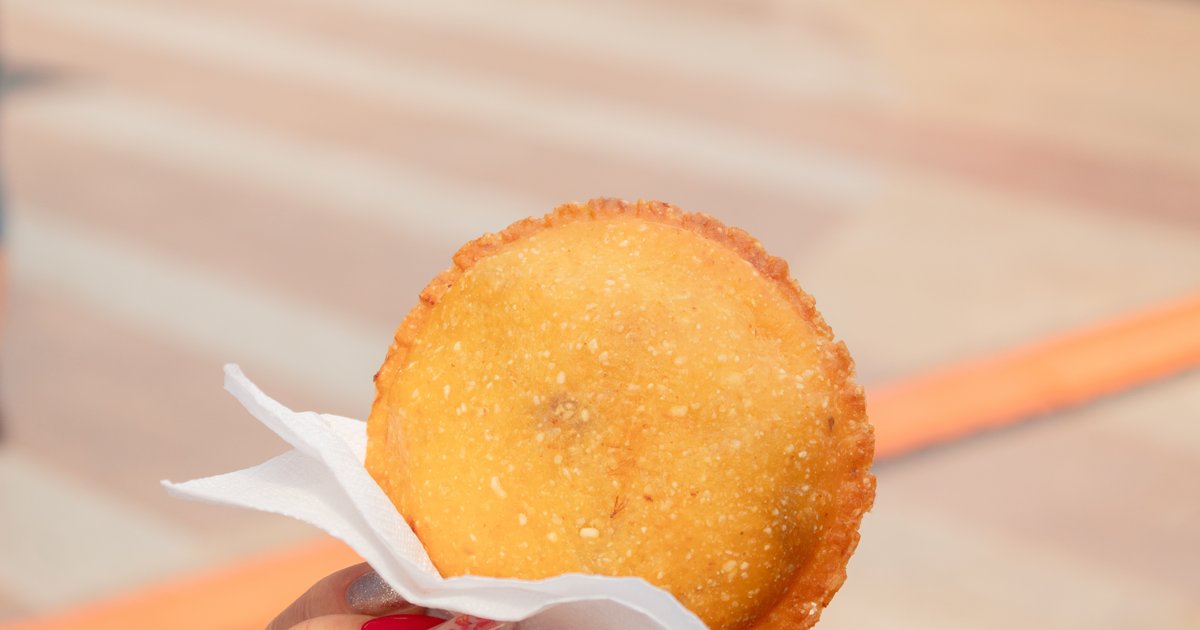
An arepa de huevo is a golden fried corn arepa with a whole egg sealed inside, the signature street food of Colombia’s Caribbean coast. The dough is fried once until it puffs up hollow, slit open, filled with a raw egg, sealed and fried again until the shell is crisp and the egg is set. This recipe makes six in about an hour.
Arepa de Huevo at a Glance
AmigoFoods may earn a commission from qualifying Amazon purchases made through links on this page.
What Is Arepa de Huevo?
Arepa de huevo, often written arepa e’ huevo the way it is said on the coast, belongs to the family of fritos, the fried snacks sold from kiosks and street stalls in Cartagena, Barranquilla and the towns of the Atlántico and Bolívar departments. It sits in the glass case next to carimañolas, empanadas and buñuelos, and it is eaten for breakfast, in the late afternoon, and after a night out.
What makes it different from every other arepa is the trick at its center. A thin disc of yellow corn dough is fried until steam inflates it like a balloon. The cook then cuts a small opening, pours in a raw egg, plugs the hole with fresh dough and fries it a second time. The finished arepa is crisp and puffed outside, soft inside, with the egg cooked in its own pocket. It is one of the regional arepas in our guide to Colombian arepas.
Luruaco: Home of the Arepa de Huevo
Ask anyone on the coast where the best arepa de huevo comes from and the answer is usually Luruaco, a small town in Atlántico on the road between Barranquilla and Cartagena. Women there have made and sold arepas de huevo for generations, and the cooks, known as matronas, formed their own association, Asopral, in 2003.
Since 1988 the town has held the Festival de la Arepa de Huevo in its main square at the end of June, with prizes for the best traditional arepa and for new fillings. The department of Atlántico declared the arepa de huevo part of its intangible cultural heritage in 2013. Coastal vendors now fill it with more than egg: ground beef, chicken and chicharrón are common additions (see variations).
Ingredients for Arepa de Huevo
- Yellow precooked corn flour. Yellow corn gives the classic golden color. White flour works too; some cooks add a pinch of achiote for color. Use Harina P.A.N. or Doñarepa, not masa harina or cornmeal (why).
- Warm water, salt and a little sugar. The sugar helps the shell brown evenly.
- Medium eggs. A medium egg fits a 5-inch arepa comfortably. With large eggs you may need to leave out a little of the white.
- Neutral oil. About 6 cups, enough for 2½ to 3 inches in a heavy pot.
- Reserved dough. Two tablespoons of the same dough, kept covered, to seal the pocket.
How to Make Arepa de Huevo
The full amounts are in the recipe card below. Read the steps once before you start; the second fry goes quickly.
1. Make the dough and reserve some
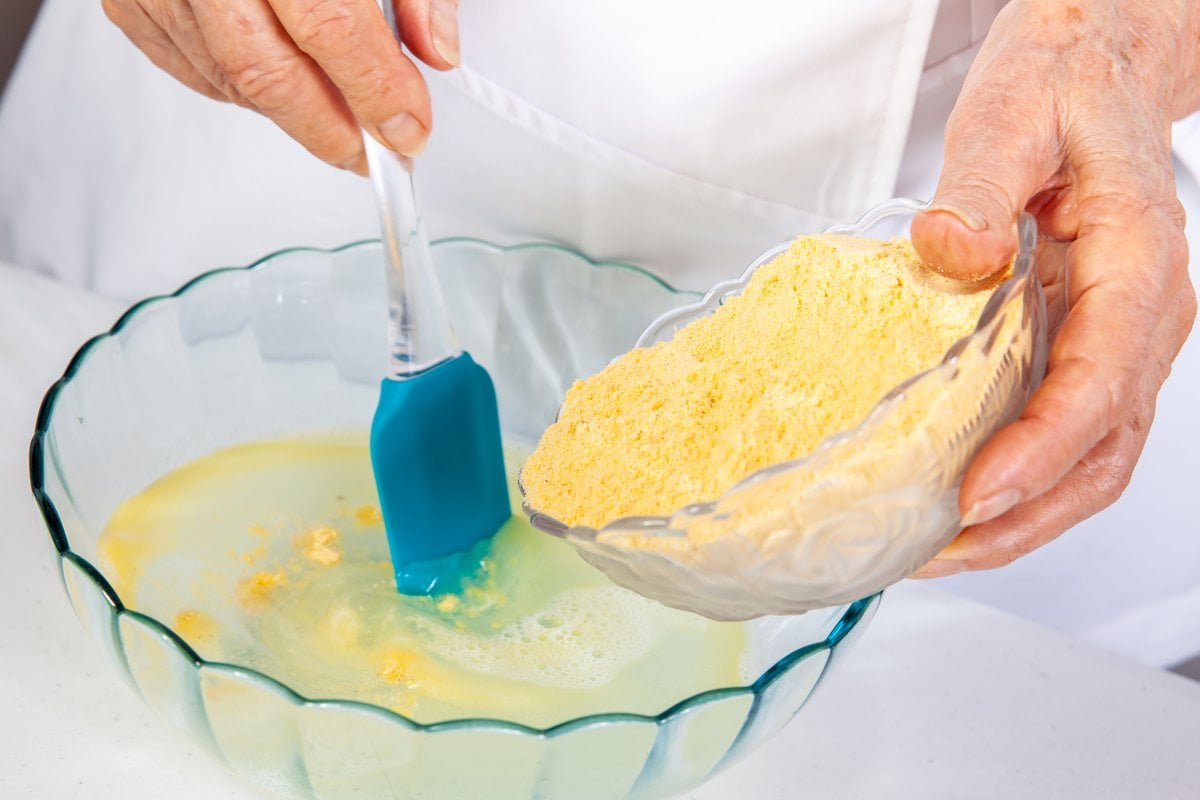
Mix the corn flour, salt and sugar, add warm water and knead for 2 minutes until smooth. Press a piece flat: if the edge cracks, knead in water a tablespoon at a time. Rest 5 minutes, then pinch off 2 tablespoons for sealing and keep it covered.
2. Press thin, even discs
Divide the dough into six balls and press each between the halves of a cut-open zip-top bag into a disc 5 inches wide and ¼ inch thick. Even thickness is what makes the arepa puff into a single hollow instead of blistering in spots. Smooth cracked edges with a damp finger.
3. First fry: make it puff
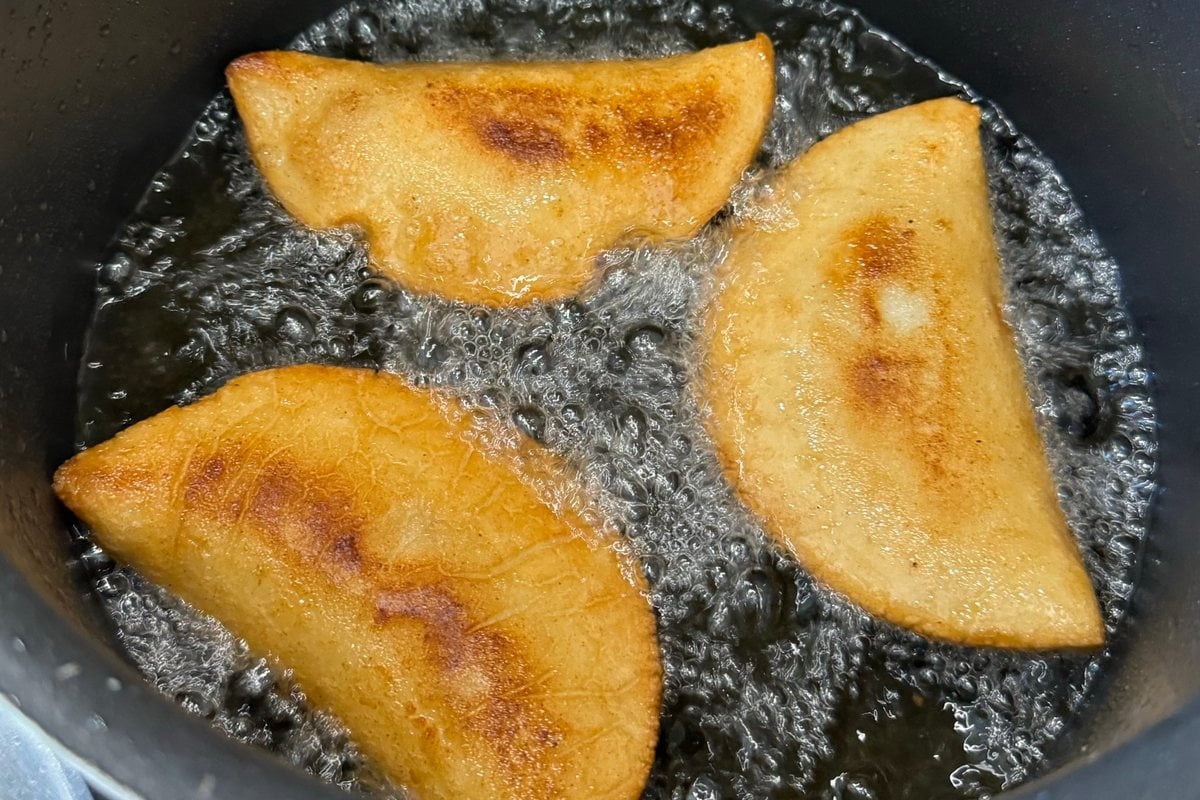
Heat the oil to 350°F. Slide in one disc. It sinks, then floats. As soon as it floats, spoon hot oil over the top again and again for 2 to 3 minutes; the steam trapped inside inflates it into a pillow. Flip, fry 1 minute more until pale gold and firm, and drain on a rack.
4. Cut the pocket
Let it cool for a minute or two. Hold the arepa flat and cut a slit 1½ to 2 inches long along one edge, sliding the knife into the hollow without piercing the bottom.
5. Add the egg
Crack an egg into a small cup, season it, and pour it into the pocket while you hold the arepa slightly tilted so the egg runs to the back.
6. Seal it
Flatten a small piece of reserved dough, dampen it and press it over the slit, pinching the edges into the arepa. A good seal keeps oil out and the egg in.
7. Second fry
Lower the arepa back into the 350°F oil seam side up and spoon oil over the seal for 2 minutes. Flip and fry 2 to 3 minutes more, until deep golden and the egg feels set when you press gently. Drain and serve hot.
Why the Arepa Puffs (and How to Make Sure It Does)
The puff is steam. When thin, moist dough hits hot oil, the surfaces set into a crust almost instantly while the water inside turns to steam and pushes the two sides apart. Three things make it work: the oil must be at 350°F, the disc must be thin and even, and you must keep basting the top with hot oil so both sides set at the same time. Thick spots and cool oil let the steam escape before the shell can hold it.
Arepa de Huevo Fixes
| Problem | Cause and fix |
|---|---|
| Did not puff | Oil too cool or disc too thick or uneven. Check the thermometer, press to an even ¼ inch, and baste the top nonstop. |
| Puffed only in spots | Uneven thickness. Press between plastic for a flat, level disc. |
| Egg leaked out in the oil | Weak seal or slit too long. Keep the cut under 2 inches and press the dough patch firmly. |
| Knife went through the bottom | The hollow was small. Cut shallow and close to the edge; patch any hole with reserved dough. |
| Greasy | Oil below 350°F. Fry one at a time so the temperature recovers between arepas. |
Arepa de Huevo Variations
How to Serve Arepa de Huevo
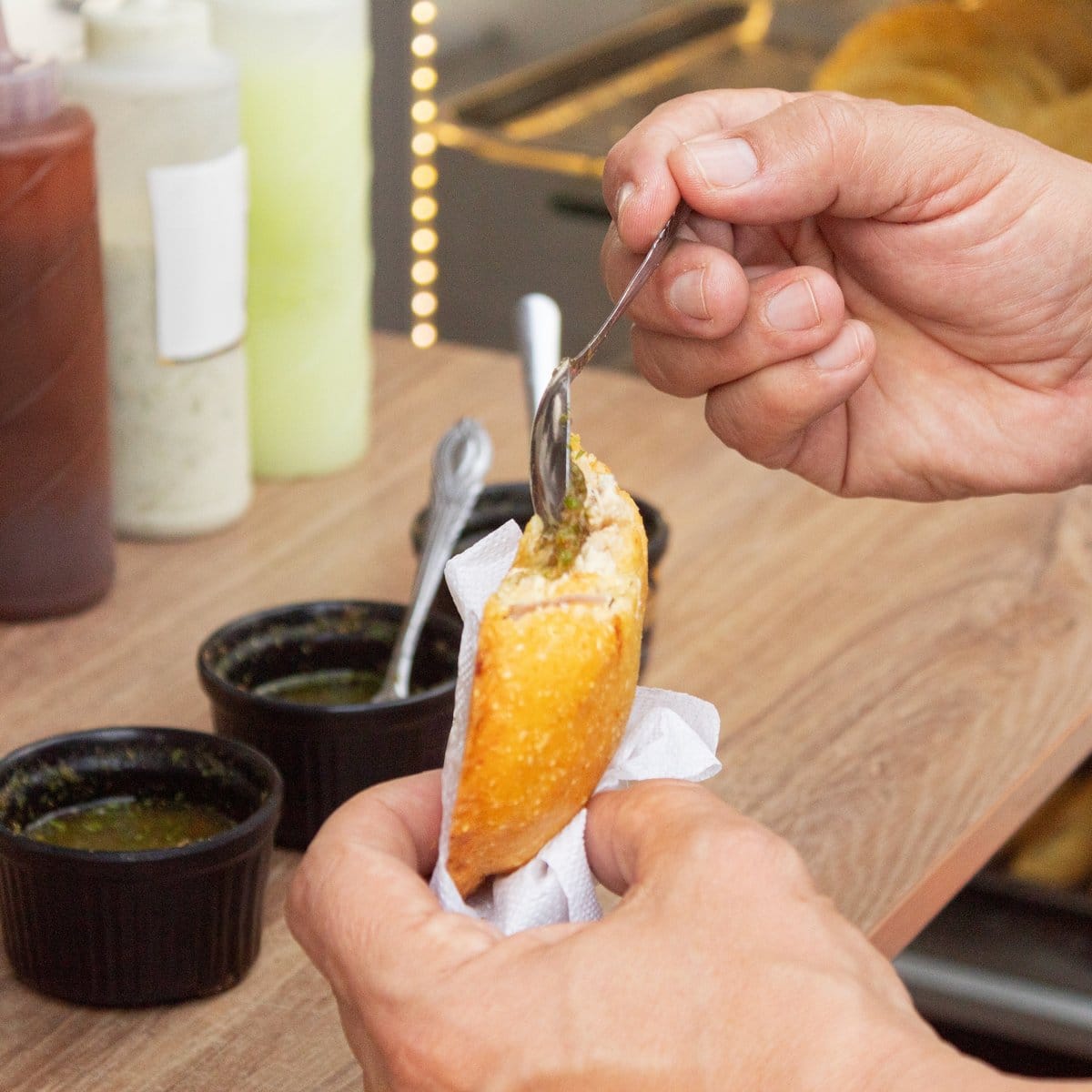
On the coast it is eaten out of hand, wrapped in a napkin, with a squeeze bottle of ají picante, a vinegary hot sauce of chiles, onion and cilantro, or with a spoonful of suero costeño, the region’s tangy cultured cream. For breakfast it comes with coffee or fresh juice. For a full spread of coastal fritos, serve it alongside carimañolas and empanadas.

Equipment That Helps
Make Ahead and Reheating
- Do the first fry ahead: puff the arepas up to 2 hours early and keep them at room temperature. Fill and do the second fry just before serving.
- Leftovers: refrigerate up to 2 days once the egg is cooked.
- Reheat: in a 375°F oven or air fryer for 6 to 8 minutes, until hot and crisp. The microwave makes the shell soggy.
Arepa de Huevo FAQ
Where does arepa de huevo come from?
Colombia’s Caribbean coast. The town of Luruaco in Atlántico is considered its home and holds a festival for it every June.
Is the yolk runny?
Most coastal vendors cook it until set. For a softer yolk, shorten the second fry to about 3 minutes in total, but make sure the white is completely set.
Can I bake or air-fry arepa de huevo?
No. The arepa only puffs into a hollow in hot oil, so it has to be deep-fried. You can use the oven or air fryer to reheat it.
What is the difference between arepa de huevo and arepa con huevo?
Arepa de huevo has the egg fried inside it. “Arepa con huevo” usually means an everyday arepa served with eggs on top or beside it, such as huevos pericos.
Can I use white corn flour?
Yes. It tastes the same; it is just paler. Add a pinch of ground achiote or turmeric to the water for color.
Why did my egg leak out?
The opening was too long or the dough patch was not pressed in firmly. Keep the slit under 2 inches and fry the seam side up first so the patch sets.
Arepa de Huevo (Colombian Egg-Stuffed Arepa)
The fried street-food arepa of Colombia's Caribbean coast: yellow corn dough fried until it puffs, filled with a raw egg, sealed and fried again until crisp.
Ingredients
- 2 cups (260 g) yellow precooked corn flour, such as Harina P.A.N.
- 1 teaspoon fine salt
- 1 teaspoon sugar
- 2 cups (475 ml) warm water, plus 1 to 2 tablespoons as needed
- 6 medium eggs
- Salt and black pepper, for the eggs
- About 6 cups (1.4 L) neutral oil, for deep-frying
- Ají picante or hot sauce, to serve
Instructions
- Make the dough. Mix the corn flour, salt and sugar in a bowl. Add the warm water and knead for 2 minutes into a smooth dough that does not crack at the edges when pressed. Add water a tablespoon at a time if it does. Cover and rest 5 minutes. Pinch off about 2 tablespoons of dough, cover it and set it aside for sealing.
- Shape. Divide the rest into 6 balls. Press each one between two pieces of plastic (a cut-open zip-top bag works) into a disc about 5 inches wide and ¼ inch thick. Keep the thickness even and smooth any cracks at the edge with a damp finger.
- Heat the oil. Pour oil 2½ to 3 inches deep into a heavy 4- to 5-quart pot and heat to 350°F.
- First fry. Lower one disc into the oil. When it floats, spoon hot oil over the top continuously for 2 to 3 minutes until it puffs up like a pillow. Flip and fry 1 minute more, until pale golden and firm. Drain on a rack. Repeat with the rest.
- Cut the pocket. When the arepas are cool enough to handle, cut a slit 1½ to 2 inches long along the edge of each one, into the hollow, without piercing the other side.
- Add the egg. Crack an egg into a small cup, season it with salt and pepper and slide it into the pocket.
- Seal. Press a small piece of the reserved dough, moistened with a little water, over the slit and pinch it firmly closed.
- Second fry. Return the arepa to the 350°F oil seam side up and fry for 2 minutes, spooning oil over the seal. Flip and fry 2 to 3 minutes more, until deep golden and the egg feels set when pressed gently. Drain and repeat.
- Serve. Serve hot with ají picante or hot sauce.
Notes
Eggs: medium eggs fit the pocket best. Large eggs work if the arepa puffs well; pour in some of the white and discard the rest if it will not fit.
If it does not puff: the oil was below 350°F or the disc was uneven or thicker than ¼ inch. Keep spooning oil over the top; the steam inside is what lifts it.
Variations: add a spoonful of cooked seasoned ground beef or shredded chicken before the egg, as many coastal vendors do.
Safety: slide the arepas into the oil away from you, never fill the pot more than halfway, and keep a lid nearby.
More Colombian Street Food
- Colombian arepas con queso
- Arepa de choclo
- Carimañolas
- Colombian empanadas
- Colombian buñuelos
- Colombian street foods
- Arepas: the full guide
- Colombian breakfast foods
- Colombian cooking hub
More Colombian Foods
See all →
Jorge Garcia is the founder of AmigoFoods, where he has spent over 20 years helping readers discover authentic Latin American and Spanish cuisine. Raised in a Cuban-American household, Jorge learned to cook at the hands of his mother and grandmother, carrying forward generations of family recipes. That heritage, backed by his family’s four-generation history in the Latin food industry, inspired him to launch AmigoFoods in 2003. With more than 1,000 published articles on recipes, ingredients, and food culture, Jorge’s mission is simple: make authentic Latin cooking approachable for home cooks everywhere while honoring the traditions behind every dish.