
On this page
Colombian arepas are round corn cakes made from precooked white or yellow corn flour, water and salt, cooked on a griddle and eaten with almost every meal in Colombia. The best-known version is the arepa con queso: cheese kneaded into the dough and melted in the center, griddled until golden and finished with butter and salt. This recipe makes six in 40 minutes.
Colombian Arepas at a Glance
AmigoFoods may earn a commission from qualifying Amazon purchases made through links on this page.
What Are Colombian Arepas?
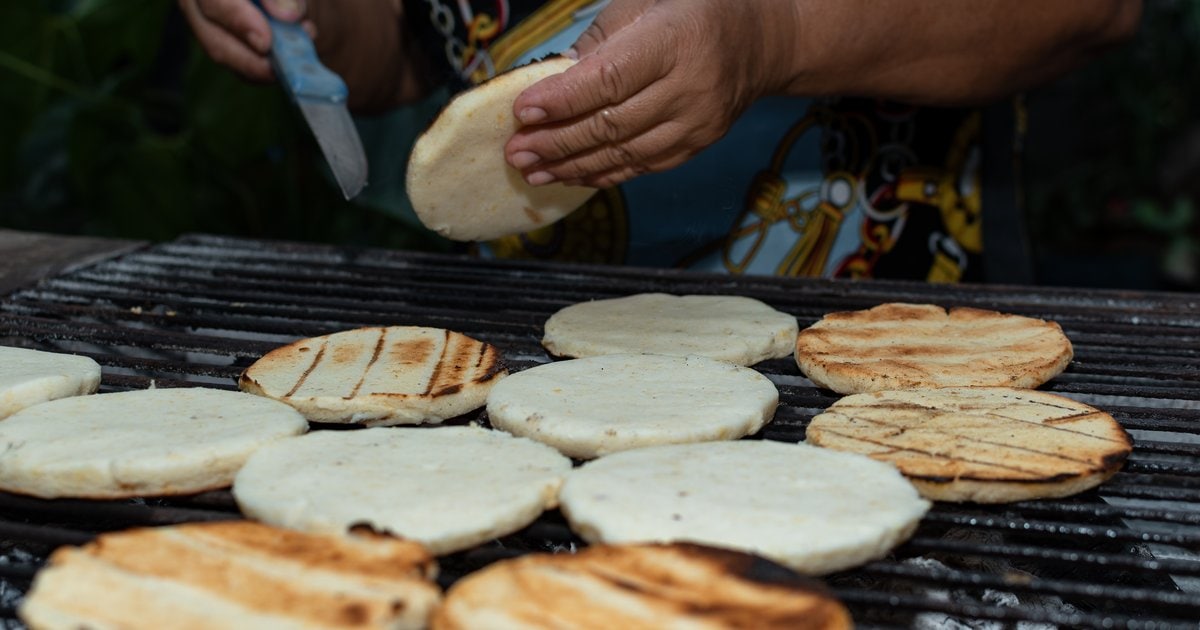
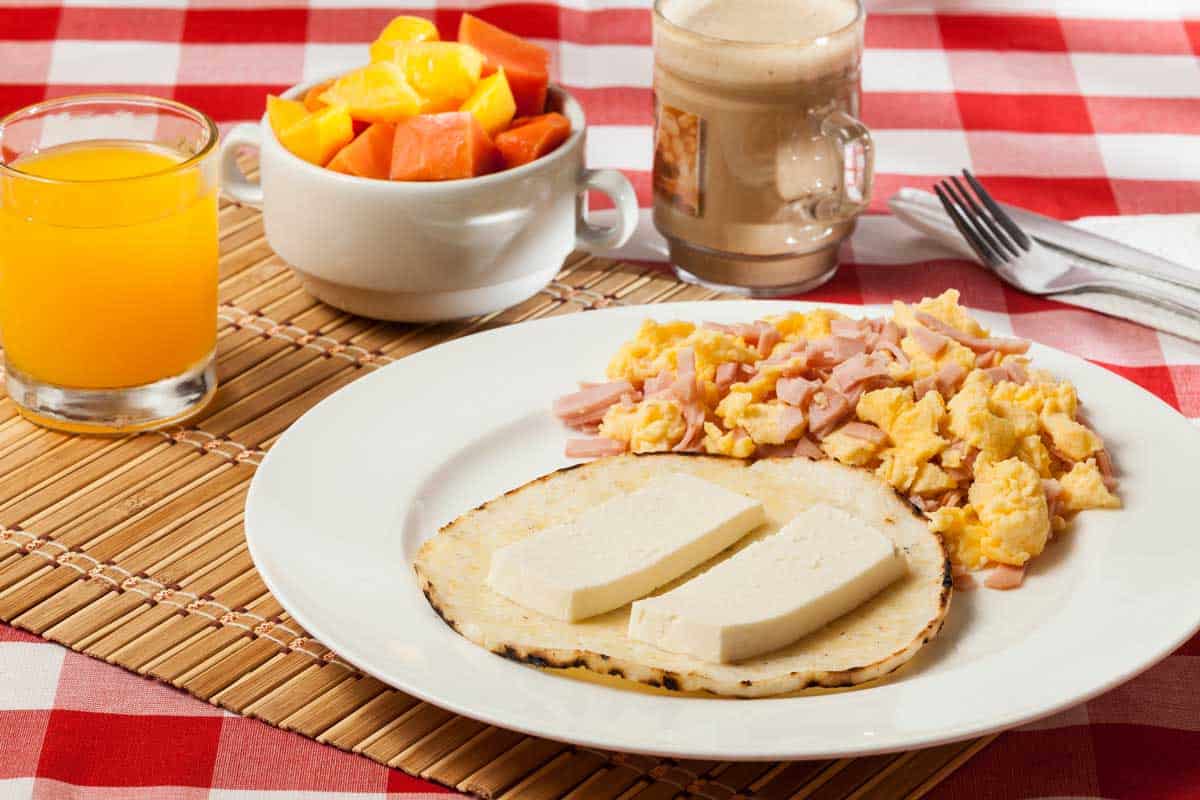
In Colombia the arepa is everyday bread. It shows up at breakfast with eggs and hot chocolate, beside a bowl of soup at lunch, on the plate of a bandeja paisa, and wrapped in paper from a street grill at night. Most Colombian arepas are eaten whole, buttered or topped, rather than split open and stuffed like a sandwich.
They are also more varied than most people expect. Colombian cooks talk about dozens of regional arepas, from thin, almost unsalted white ones in Antioquia to sweet, cheesy ones in Boyacá and egg-filled fried ones on the Caribbean coast. The one most people outside Colombia picture, and the one in the recipe below, is the arepa con queso: a thick, golden corn cake with cheese inside. It is also the arepa Julieta Madrigal cooks to heal people in Disney’s Encanto.
Before the 1960s, making arepa dough was a chore: dried corn was soaked, cooked with lime or ash to loosen the skins, then ground by hand. Precooked corn flour changed that. Harina P.A.N. launched in Venezuela in 1960, and Colombia’s Harinera del Valle followed with Doñarepa, which is now in most Colombian kitchens. Plenty of Colombians skip the dough entirely and buy fresh, ready-made arepas at the supermarket.
Are Arepas Colombian or Venezuelan?
Both. Arepas are older than either country. Indigenous peoples across the northern Andes and the Caribbean lowlands of what are now Colombia and Venezuela were grinding corn and cooking flat cakes on clay griddles long before the Spanish arrived. The word itself is often traced to erepa, a word for corn in the Cumanagoto language of eastern Venezuela. The two countries were also briefly one, as part of Gran Colombia (1819 to 1831), so the friendly argument over who owns the arepa has no real winner.
What did grow apart is how each country eats them:
| Colombian arepas | Venezuelan arepas | |
|---|---|---|
| Shape | Often thinner and wider; varies by region | Thick and puffy, about ¾ inch |
| How they are eaten | Whole, buttered or topped, as bread beside a meal | Split open and stuffed as the meal itself |
| Cheese | Mixed into the dough or melted in the center | Mostly a filling, grated or sliced |
| Classic version | Arepa con queso, arepa paisa | Reina pepiada, domino, pabellón |
For the basic three-ingredient dough and the Venezuelan stuffed style, see our main guide to how to make arepas.
Types of Colombian Arepas
Every region of Colombia has its own arepa, and some towns have several. These are the ones you will meet most often:
Arepa con queso
Nationwide
Cheese kneaded into the dough, sometimes with more melted in the center. Thick, golden and buttery. The recipe on this page.
Arepa paisa
Antioquia
Thin, white and barely salted, traditionally made from cooked and ground hominy corn. Grilled and served with nearly every meal, topped with butter or a slice of cheese.
Arepa boyacense
Boyacá
Slightly sweet and golden, made with corn, butter and a little sugar and filled with melting cuajada or fresh cheese. Crisp outside and soft inside.
Arepa de choclo
Andean region
Made from fresh sweet corn, so it is soft, sweet and almost pancake-like. Cooked on a griddle and folded or topped with white cheese and butter. Get the arepa de choclo recipe.
Arepa de huevo
Caribbean coast
Yellow corn dough fried until it puffs, slit open, filled with a raw egg, sealed and fried again. Luruaco, in Atlántico, holds a festival for it every year. Get the arepa de huevo recipe.
Arepa santandereana
Santander
Thin and crisp, with crumbled chicharrón (fried pork skin) worked into the dough, sometimes with yuca. See our Colombian chicharrón recipe.
Arepa rellena
Street food
A thicker arepa split and stuffed with shredded beef, chicken, sausage, cheese or hogao, sold from street grills in Bogotá and on the coast.
Arepa con queso costeño
Caribbean coast
Salty coastal cheese (queso costeño) mixed into yellow corn dough, griddled thin and eaten with suero, a tangy cultured cream.


Many of these turn up on the street-food carts in our guide to Colombian street foods, and at the breakfast table in Colombian breakfast foods.
Ingredients for Colombian Arepas con Queso
- White precooked corn flour. Labeled harina de maíz precocida or “pre-cooked corn meal.” Harina P.A.N. and Doñarepa are the two brands Colombians reach for. Yellow corn flour works too and gives the coastal color. Do not use masa harina or regular cornmeal; here is why Harina P.A.N. and Maseca are not interchangeable.
- Warm water. Warm tap water hydrates the flour faster and gives a smoother dough than cold water.
- Butter. Two tablespoons in the dough make the arepas tender and richer, and more goes on top at the table.
- Salt. A teaspoon for the dough. Colombians also sprinkle a pinch over the buttered arepa.
- Two cheeses. A salty fresh cheese for flavor and a melting cheese for the gooey center (see below).
- Oil. Just enough to brush the pan.

The Best Cheese for Colombian Arepas
In Colombia, arepas con queso are made with fresh white cheeses that are hard to find in the US. Here is what each one does and what to use instead:
How to Make Colombian Arepas con Queso
The full amounts are in the recipe card below. Here is the method with the details that make the difference.
1. Mix and rest the dough
Whisk the corn flour and salt, then add warm water and soft butter. Squeeze the mixture through your fingers for a minute or two until there are no dry spots. Cover the bowl and wait 5 minutes. The flour keeps absorbing water as it sits, and a rested dough cracks far less when you shape it.
2. Knead in the cheese
Add the crumbled queso fresco and most of the mozzarella and knead until evenly mixed. The dough should feel like soft play dough. Test it: roll a small ball and flatten it. Cracked edges mean it needs a spoonful more water; dough stuck to your palms needs a spoonful more flour.
3. Shape and fill
Divide the dough into six balls. Push your thumb into each one, drop in a heaping tablespoon of mozzarella, and pinch it closed. Flatten between your palms, or between two sheets of parchment with a plate, into discs about 4 inches across and ½ inch thick. Run a wet finger around the edge to seal any cracks so the cheese stays inside.
4. Cook low and slow
Heat a large nonstick or cast-iron skillet over medium heat and brush it lightly with oil. Cook three at a time, 5 to 6 minutes per side, without moving them. They are ready to flip when the bottom has a golden crust with darker spots and the arepa slides freely. If they color in less than 4 minutes, turn the heat down: the crust is done before the cheese inside has melted.

5. Butter and serve
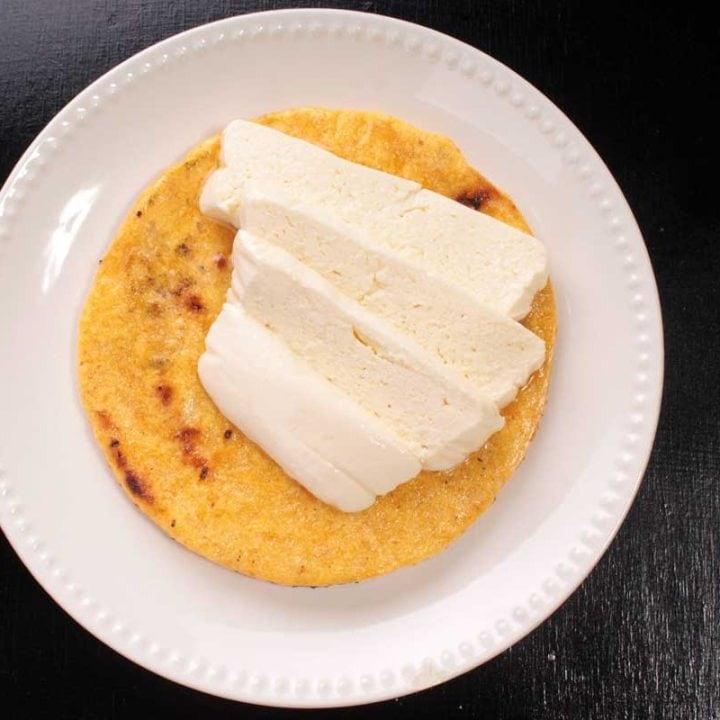
Serve them hot. In Colombia that means a pat of butter spread over the top, a pinch of salt, and often a slice of fresh cheese laid on while it is still warm.
Why Arepas Crack (and Other Fixes)
| Problem | Cause and fix |
|---|---|
| Edges crack when you flatten them | Dough is too dry. Knead in warm water a tablespoon at a time and let it rest 2 more minutes. |
| Dough sticks to your hands | Too much water. Add corn flour a tablespoon at a time, or wet your hands before shaping. |
| Cheese leaks into the pan | The seal opened or the heat was too high. Smooth the edges with a wet finger and cook over medium. |
| Burnt outside, cold inside | Heat too high. Lower it, or finish the arepas in a 375°F oven for 8 minutes. |
| Dense and heavy | Masa harina or cornmeal was used. Only precooked corn flour gives the right texture. |
4 Ways to Put Cheese in an Arepa
How Colombians Eat Arepas
An arepa is rarely the whole meal in Colombia. It is the bread that comes with everything else:
- Breakfast: with huevos pericos (eggs scrambled with tomato and scallion), calentado, or a cup of Colombian hot chocolate with cheese dropped in. A strong cup of Colombian coffee works too; we like Café Quindío.
- With hogao: topped with hogao, the slow-cooked tomato and onion sauce.
- Beside a big plate: with bandeja paisa, fritanga, lechona or a bowl of sancocho de gallina.
- As a snack: split and filled with shredded beef or chicken, or eaten plain from a street grill.

Ready-Made Arepas and Arepa Tools
In Colombia, buying arepas ready to heat is as normal as buying sliced bread. If you would rather skip the dough, or want the right flour and pan on hand, these are worth a look:
Make Ahead, Storing and Reheating
- Make ahead: shape the arepas, stack them between squares of parchment, wrap and refrigerate up to 1 day. Cook straight from the fridge.
- Freeze uncooked: freeze the shaped discs on a tray, then bag them for up to 2 months. Thaw in the fridge before cooking.
- Leftovers: cooked arepas keep 3 days in an airtight container in the fridge, or 2 months in the freezer.
- Reheat: in a dry skillet over medium-low for 3 to 4 minutes a side, in a toaster oven, or in an air fryer at 375°F for 4 to 5 minutes. Avoid the microwave, which makes them gummy.
Colombian Arepas FAQ
What is the difference between Colombian and Venezuelan arepas?
Colombian arepas are usually eaten whole, as bread beside a meal, and are often thinner with cheese in the dough. Venezuelan arepas are thicker and are split open and stuffed as the meal itself.
What cheese do you use for Colombian arepas?
In Colombia, quesito, queso campesino, cuajada or queso doble crema. In the US, mix queso fresco for flavor with low-moisture mozzarella or Oaxaca cheese for melt.
Are Colombian arepas gluten-free?
Yes. Precooked corn flour, water, salt, butter and cheese contain no wheat. If you need to avoid gluten strictly, choose a corn flour labeled gluten-free, since some are packed in plants that handle wheat.
Can I use masa harina or cornmeal?
No. Masa harina is treated with lime for tortillas, and cornmeal is raw. Neither forms the smooth, pliable arepa dough that precooked corn flour does.
What arepas are in Encanto?
Julieta Madrigal heals people with arepas con queso, the cheese arepas in this recipe.
What do you eat with Colombian arepas?
Butter and salt, fresh cheese, huevos pericos, hogao, hot chocolate or coffee at breakfast, and almost any Colombian meal, from bandeja paisa to sancocho.
Can I bake arepas instead of using a skillet?
You can sear them for 2 minutes a side to set a crust, then bake at 375°F for 12 to 15 minutes, turning once. Baking alone gives a paler, drier arepa.
Colombian Arepas con Queso
Golden Colombian corn cakes made with precooked white corn flour, butter and two cheeses, griddled until crisp outside with a melted cheese center. The everyday arepa of Colombian breakfast tables.
Ingredients
- 2 cups (260 g) white precooked corn flour, such as Harina P.A.N.
- 1 teaspoon fine salt
- 2 cups (475 ml) warm water, plus up to ¼ cup more as needed
- 2 tablespoons unsalted butter, softened, plus more for serving
- 1½ cups (6 oz / 170 g) shredded low-moisture mozzarella, divided
- ½ cup (2 oz / 60 g) crumbled queso fresco or queso campesino
- 1 tablespoon neutral oil, for the pan
Instructions
- Make the dough. In a large bowl, whisk the corn flour and salt. Add the warm water and the softened butter and mix with your hand for 1 to 2 minutes, squeezing the dough through your fingers until there are no dry pockets. Cover and let it rest for 5 minutes so the flour can hydrate.
- Knead in the cheese. Add the crumbled queso fresco and 1 cup of the mozzarella and knead until evenly mixed. The dough should feel like soft play dough. Roll a small ball and press it flat: if the edges crack, knead in more warm water 1 tablespoon at a time; if it sticks to your hands, add corn flour 1 tablespoon at a time.
- Shape and fill. Divide the dough into 6 equal balls. Press your thumb into each one to make a deep well, add a heaping tablespoon of the remaining mozzarella, and pinch the dough closed over it. Flatten each ball between your palms (or between two sheets of parchment) into a disc about 4 inches wide and ½ inch thick. Smooth any cracks around the edge with a wet fingertip.
- Cook. Heat a large nonstick or cast-iron skillet over medium heat and brush it with a little oil. Cook the arepas 3 at a time for 5 to 6 minutes per side, until a golden crust with darker spots forms and they release easily. Do not flip them early. Lower the heat if they brown faster than that, so the cheese inside has time to melt.
- Serve. Serve hot, spread with butter and sprinkled with a pinch of salt, with a slice of fresh cheese on top if you like.
Notes
Use the right flour: arepas need precooked white corn flour (harina de maíz precocida), such as Harina P.A.N. or Doñarepa. Masa harina and regular cornmeal will not hold together the same way.
Cheese: in Colombia these are made with quesito, queso campesino or cuajada. Queso fresco gives the salty, fresh flavor but does not melt, so it is paired here with low-moisture mozzarella for the melted center. Oaxaca cheese works in place of mozzarella.
Make ahead: shape the arepas, stack them between parchment and refrigerate up to 1 day, or freeze up to 2 months. Cook from chilled; thaw frozen arepas in the fridge first.
Reheat: cooked arepas keep 3 days in the fridge. Reheat in a dry skillet over medium-low, a toaster oven, or an air fryer at 375°F for 4 to 5 minutes.
More Colombian Recipes
- Arepas: the full guide
- Traditional Colombian food
- Arepa de choclo
- Arepa de huevo
- Pandebono
- Almojábanas
- Colombian snacks
- Colombian breads
- Colombian breakfast recipes
- Regional Colombian cuisine
- Colombian cooking hub
More Colombian Foods
See all →
Jorge Garcia is the founder of AmigoFoods, where he has spent over 20 years helping readers discover authentic Latin American and Spanish cuisine. Raised in a Cuban-American household, Jorge learned to cook at the hands of his mother and grandmother, carrying forward generations of family recipes. That heritage, backed by his family’s four-generation history in the Latin food industry, inspired him to launch AmigoFoods in 2003. With more than 1,000 published articles on recipes, ingredients, and food culture, Jorge’s mission is simple: make authentic Latin cooking approachable for home cooks everywhere while honoring the traditions behind every dish.