

Curtido is a tangy Salvadoran cabbage slaw made with shredded cabbage, carrot, onion and oregano, either pickled in a light vinegar brine or fermented with salt. It is the crunchy, sour pile that goes on top of hot pupusas. This recipe takes 20 minutes of work and tastes best after a night in the fridge.
Curtido at a Glance
What Is Curtido?
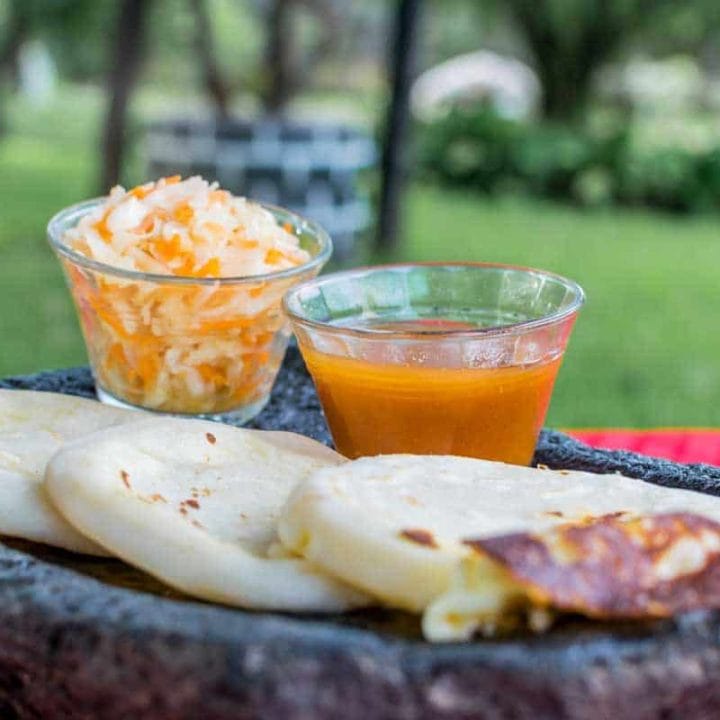
Curtido (koor-TEE-doh) is El Salvador’s everyday cabbage relish. At a pupusería it usually sits on the table in a big jar with a pair of tongs, next to a bowl of thin salsa roja, and you help yourself.
In Spanish you will see it called curtido para pupusas or curtido de repollo, cabbage curtido. Its job is contrast. Pupusas are soft, hot and rich with cheese, beans or pork. Curtido is cold, crunchy and sour, so each bite resets the last one.

What does curtido mean in English?
The closest translation is “cured” or “pickled.” The word comes from the Spanish curtir, to cure or tan, and it is a close cousin of encurtir, to pickle. Outside the kitchen, curtido describes something weathered or tanned, like skin toughened by the sun. English menus usually call the dish Salvadoran cabbage slaw or pickled cabbage.
Where does curtido come from?
Curtido is tied to El Salvador and its pupusas, though nobody has documented exactly when it began. Cabbage and vinegar both reached the Americas after the Spanish arrived, so the slaw as we know it is younger than the corn cakes it sits on. By the 1980s, English-language writers in the US were already describing it as a vinegar-based cabbage salad served with pupusas.
Is Curtido Fermented? Quick vs. Fermented Curtido
It can be both, and this is where most recipes confuse people. A curtido made with vinegar is a quick pickle. A curtido made with only salt is a true ferment, closer to sauerkraut. Salvadoran cooks make both.
| Quick curtido | Fermented curtido | |
|---|---|---|
| Sourness comes from | Vinegar | Lactic acid from fermentation |
| Ready in | 2 hours, best overnight | 5 to 7 days |
| Taste | Bright, sharp, fresh | Deeper, funkier, less sharp |
| Texture | Crisp | Softer, still with bite |
| Keeps in the fridge | Up to 1 week | At least 1 month |
| Live cultures | No | Yes, if not heated |
Most people should start with the quick version, which is the main recipe card below. If you already make sauerkraut, go straight to the fermented method.
Is curtido the same as sauerkraut, coleslaw or kimchi?
| Dish | How it differs from curtido |
|---|---|
| Coleslaw | Usually creamy and eaten fresh. Curtido has no mayo and tastes better after it sits. |
| Sauerkraut | Cabbage and salt only, fermented longer. Fermented curtido is similar but has carrot, onion and oregano. |
| Kimchi | Fermented with chile paste, garlic, ginger and often fish sauce, so it is much bolder. |
| Pikliz | Haiti’s cabbage relish is built on Scotch bonnet heat. Curtido is usually mild. |
Curtido Ingredients
There are only a few, so each one shows up in the final taste.
For storage, wide-mouth jars make it easy to press the slaw into its brine. An airtight glass jar like the Bormioli Rocco Fido works well in the fridge. As an Amazon Associate, AmigoFoods earns from qualifying purchases.
How to Make Curtido
Here is what matters at each stage. Exact amounts are in the recipe card.
1. Shred it thin
Aim for shreds about 1/8 inch wide. Long, fine strands soak up brine and pile neatly on a pupusa. Thick pieces stay raw-tasting.
2. Scald the cabbage
Set the cabbage in a colander and slowly pour boiling water over it, then rinse with cold water. This softens it slightly and takes off the raw cabbage bite. Then squeeze it hard. Water left in the cabbage dilutes your brine and is the main reason curtido turns out bland.
3. Toss in the vegetables and oregano
Add the carrots, onion, chile, oregano and salt, and toss with your hands so the oregano reaches every part of the bowl.
4. Add the brine and taste
Cutting the vinegar with water keeps the slaw sour without making it harsh. Taste now, since this is your best chance to adjust.
5. Pack and chill
Press the slaw into jars so it sits in the brine. It is good after 2 hours and much better the next day, once the cabbage has turned pale and the flavors have run together.
How to fix your curtido
| Problem | Fix |
|---|---|
| Too sharp | Stir in a splash of cold water and a pinch of sugar, then wait an hour. |
| Bland | Add salt first, not more vinegar. Wait 30 minutes before tasting again. |
| Too soft | Scald faster next time, or use the salt method above. |
| Too watery | Drain it before serving and squeeze the cabbage harder next time. |
| Too spicy | Remove the visible chile slices and let it sit overnight. |
How to Make Fermented Curtido
Fermented curtido uses no vinegar and no scalding, only salt and time. Salt is the part to get right. Use 2 to 2.5% of the vegetables’ weight, which is the same range used for sauerkraut. For a typical batch of 2 1/2 pounds of vegetables, that is about 25 grams.
The steps are simple: massage the salted vegetables until they release brine, pack them tightly into a jar and hold them under the liquid with a weight. Keep the jar at 68 to 72°F with a loose lid or airlock so gas can escape. You should see bubbles within a couple of days. Start tasting on day 3 and move it to the fridge when you like it, usually after 5 to 7 days.
Go to the fermented curtido recipe ↓
How to Serve Curtido
In El Salvador, you eat pupusas with your hands. Tear off a piece, or lay a forkful of lightly drained curtido on top with a spoonful of salsa roja. Add more as you go. Keep the jar nearby, because one helping is rarely enough.

Pupusas are so central to Salvadoran life that the country’s Legislative Assembly declared a National Pupusa Day in 2005, held on the second Sunday of November. For the full picture, see our guide to how to make pupusas.
What to eat with curtido

How Long Does Curtido Last?
| Type | Where | How long |
|---|---|---|
| Quick (vinegar) curtido | Covered in the fridge | Up to 1 week; crunchiest in the first 4 days |
| Fermented curtido | Sealed in the fridge | At least 1 month, kept under the brine |
| Quick curtido | On the counter | Do not leave it out; this version is not a ferment |
| Either version | Freezer | Not recommended; the cabbage thaws limp |
Use a clean fork or tongs every time. This recipe has not been tested for water-bath canning, so keep it in the fridge. Discard any batch that shows mold or smells off.
Other Dishes Called Curtido
This article is about the Salvadoran cabbage slaw, but the word travels. Some of these are different dishes, and others are close relatives of this slaw.
| Where | What it is |
|---|---|
| Ecuador | Curtido de cebolla y tomate, a lime-dressed onion and tomato salad. |
| Guatemala | Encurtido, mixed pickled vegetables, often with beets. |
| Honduras | Encurtido, pickled vegetables and chiles served as a table condiment. |
| Nicaragua | The vinegary cabbage salad on vigorón, the closest cousin to Salvadoran curtido. |
| Belize | A fiery relish of onions and habaneros in vinegar, spooned over salbutes and garnaches. |
Curtido FAQ
What is curtido made of?
Cabbage, carrots, onion, dried oregano, salt and usually vinegar, with an optional jalapeño or serrano.
Is curtido spicy?
Usually not. Most Salvadoran curtido is mild, with a little heat at most. Add more chile if you want it hot.
What is the best vinegar for curtido?
Any vinegar with 5% acidity. White vinegar tastes cleaner and sharper; apple cider vinegar is a little rounder and sweeter. Both are common.
Is curtido healthy?
It is mostly vegetables and very low in calories, at roughly 20 to 25 per half cup. It does carry sodium from the salt. Only the unheated fermented version contains live cultures, so the vinegar version is not a probiotic food.
How long does curtido take to ferment?
Usually 5 to 7 days at 68 to 72°F. Warmer kitchens go faster and cooler ones slower, so go by taste.
Cómo hacer curtido para pupusas: the short version
Para hacer curtido salvadoreño, shred the repollo (cabbage), scald it with boiling water and squeeze it dry. Toss it with zanahoria (carrot), cebolla (onion), orégano and salt, then add vinegar and a little water. Chill it for at least 2 hours.
Is curtido Mexican?
No, this cabbage slaw is Salvadoran. Mexico has its own pickled cabbage toppings and pickled chiles, and you will sometimes see curtido on menus at Mexican restaurants, but it is the signature of Salvadoran pupuserías.
Sources: Barry Popik on early English citations of curtido; University of California Cooperative Extension sauerkraut guidance (salt ratio and temperature); Wikipedia on Decree 655 and National Pupusa Day.
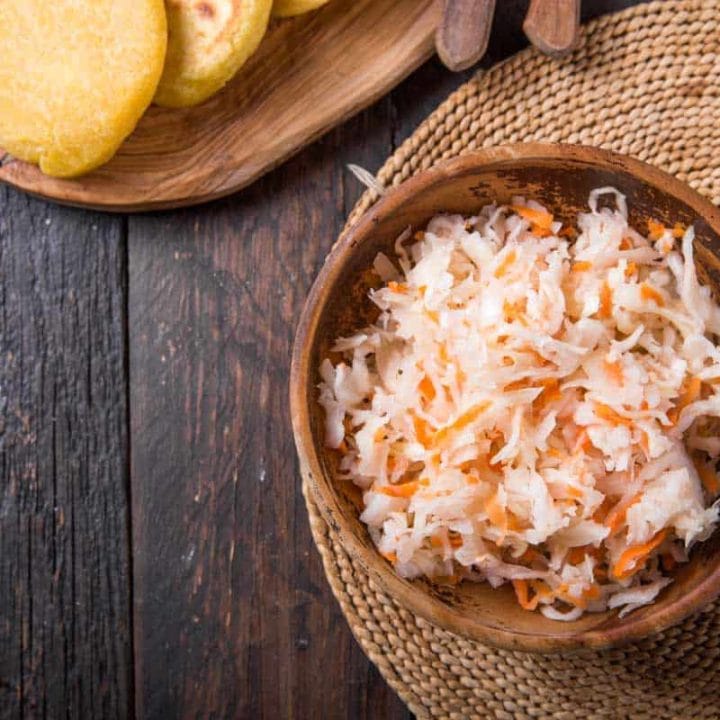
Curtido (Salvadoran Cabbage Slaw)
A tangy Salvadoran cabbage slaw with carrot, onion and oregano in a light vinegar brine. Pile it on hot pupusas, tacos or anything rich.
Ingredients
- 1 medium green cabbage (about 2 lb), cored and finely shredded
- 4 cups boiling water, for scalding the cabbage
- 2 medium carrots, peeled and coarsely grated
- 1/2 medium white onion, very thinly sliced
- 1 jalapeño or serrano, thinly sliced, optional
- 1 1/2 teaspoons dried oregano, preferably Mexican
- 2 teaspoons kosher salt, plus more to taste
- 1 cup white or apple cider vinegar (5% acidity)
- 1/2 cup cold water
- 1 teaspoon sugar, optional
Instructions
- Remove the outer cabbage leaves and the core. Shred the cabbage as thin as you can with a sharp knife or mandoline.
- Put the cabbage in a colander in the sink and slowly pour the boiling water over it. Rinse with cold water until cool, then squeeze out as much water as you can with clean hands.
- In a large nonreactive bowl, toss the cabbage with the carrots, onion, chile (if using), oregano and salt.
- Stir the vinegar, cold water and sugar (if using) together, pour over the vegetables and toss well. Taste and adjust the salt and vinegar.
- Pack into clean jars or a covered container, pressing down so the vegetables sit in the brine. Refrigerate for at least 2 hours, or overnight for the best flavor. Serve cold with tongs or a fork, lightly drained.
Notes
For more crunch, skip the boiling water: toss the cabbage with 1 teaspoon salt, let it sit 30 minutes, rinse, squeeze dry and reduce the salt in the recipe to 1 teaspoon.
This is a refrigerator slaw, not a ferment or a canning recipe. Keep it covered in the fridge and use within 1 week, with clean utensils. It is at its crunchiest in the first 4 days.
Fermented Curtido
The slow version of Salvadoran curtido: cabbage, carrot, onion and oregano soured with nothing but salt and time.
Ingredients
- 1 medium green cabbage (about 2 lb), cored and finely shredded
- 2 medium carrots, peeled and coarsely grated
- 1/2 medium white onion, thinly sliced
- 1 jalapeño or serrano, thinly sliced, optional
- 1 1/2 teaspoons dried oregano, preferably Mexican
- About 25 g non-iodized salt (2 to 2.5% of the vegetable weight; roughly 1 1/2 tablespoons fine sea salt)
Instructions
- Weigh a large bowl on a kitchen scale, then add the shredded cabbage, carrots, onion and chile. Multiply the weight of the vegetables by 0.02 to 0.025 to get the salt (about 25 g for 2 1/2 lb).
- Add the salt and oregano and massage with clean hands for 3 to 5 minutes. Let stand 30 minutes, until the bowl holds a pool of brine.
- Pack the vegetables and brine into a clean 2-quart jar, pressing down hard, and leave at least 1 inch of space at the top. If the brine does not cover the vegetables, top up with salt water (3/4 teaspoon fine salt per cup of water).
- Weigh the vegetables down under the brine with a fermentation weight or a clean small jar filled with water. Cover loosely or use an airlock lid so gas can escape.
- Ferment at 68 to 72°F, out of direct sun. Press the vegetables back under the brine once a day and start tasting on day 3.
- When it is as sour as you like, usually after 5 to 7 days, seal the jar and refrigerate.
Notes
Weigh the salt if you can. Kosher salts differ a lot by volume, and too much salt slows fermentation and leaves the batch unpleasantly salty.
Discard the batch if you see fuzzy mold or it smells rotten or feels slimy. Use clean utensils and keep the vegetables under the brine. Refrigerated, it keeps for at least 1 month.
More Salvadoran Foods
See all →
Jorge Garcia is the founder of AmigoFoods, where he has spent over 20 years helping readers discover authentic Latin American and Spanish cuisine. Raised in a Cuban-American household, Jorge learned to cook at the hands of his mother and grandmother, carrying forward generations of family recipes. That heritage, backed by his family’s four-generation history in the Latin food industry, inspired him to launch AmigoFoods in 2003. With more than 1,000 published articles on recipes, ingredients, and food culture, Jorge’s mission is simple: make authentic Latin cooking approachable for home cooks everywhere while honoring the traditions behind every dish.