

There is no perfect occasion or day to eat a taco. If you’re feeling like eating a taco, pretty much any day can be a “taco day.”
And if you want to make the tacos unique, there are quite a few varieties to indulge in even without visiting Mexico.
Taco is a popular Mexican dish consisting of a wheat or corn tortilla stuffed with fillings, primarily containing meat. The bread is folded when eaten, a tacos trademark. Make sure the tortilla is malleable to be folded. Besides being fun to eat, you can get quite creative with the fillings.

If making tacos sounds fun, keep reading to learn how to make one of the popular variants.
Before that, get to know tacos in some more detail.
Tacos – A Brief Overview
Tacos is essentially a tortilla, fillings, salsa, and garnishments methodically put together.
Except for the garnishments and perhaps the tortilla, the stuffing and even the salsa take planning, ingredients, time, and effort to make.
Therefore, despite being a relatively simple-looking dish, a taco is special and, no doubt, delicious.
Different Types of Tacos

The fillings for tacos could consist of varied items.
As the fillings form the crux of a taco, experiment with them can give your tacos an utterly new taste profile and even a changed identity.
The following are some of the popular fillings:
- Al Pastor Tacos – Loosely translating to “shepherd-style” pork, tacos al pastor consists of pork meat marinated in a smooth paste of spices and chiles. The meat is typically topped with pineapples. (In this article, you’ll learn how to make tacos al pastor.)
- Carnitas Tacos – Pork from Michoacán simmered and then fried in lard until crisp, chopped and topped with onion, cilantro, salsa verde and lime.
- Tacos Arabes – As the name indicates, this tacos variety denotes a connection between Mexico and the Middle East. The taco employs flavor-rich pork slices from a trompo, which is quite a departure as Muslims consider pork as “haram” (forbidden).
- Barbacoa Tacos – If tacos Arabes has the Middle East connection, barbacoa references the Caribbean cooking style, particularly the Taino cooking method. Beef cheeks or head (cachete) or goat is utilized for this preparation.
- Buche Tacos – The term “Buche” denotes “pig stomach.” The meat is stewed for hours together with different kinds of chiles and spices, so the meat assumes a somewhat chewy, tender feel. Compared to the beef tripe, buche is less spongy.
- Cabeza Tacos – Cabeza uses meat from a cow’s head braised to tenderness before being placed in a tortilla. In some taquerias, the meat could be steamed. Like with the barbacoa, some tacos de Cabeza could use only the cheeks, even if the cow’s entire head is cooked.
- Suadero Tacos – Not nearly as famous as others, Suadero tacos are corn tortillas filled with suadero meat that’s been slow-cooked and then grilled before serving. They are typically topped with diced white onions, fresh cilantro, and salsa, and served with a lime wedge awaiting squeezing for the perfect finishing touch of flavor.
- Arrachera Tacos – Arrachera is marinated Mexican skirt steak which is nestled in warm corn tortillas, creating a mouthwatering combination of smoky, savory flavors. These scrumptious tacos are often garnished with a medley of fresh ingredients, such as cilantro, onion, and a zesty squeeze of lime
- Tacos Nopales – Nopales tacos are a traditional Mexican dish featuring nopales, the pads of the Opuntia cactus, also known as the prickly pear cactus. This ingredient is unique to the Mexican cuisine and has a mildly tart and somewhat refreshing flavor, with a texture similar to cooked green beans.
Campechanos tacos, carne asada tacos, carnitas tacos, Cecina tacos, birria tacos, etc., are some other popular varieties or fillings.
And those whose dietary needs are different, you can even find vegan tacos.
How To Make Tacos Al Pastor

The al pastor is a more standard and also arguably the most popular tacos type.
Ingredients Needed
The following are the ingredients needed to make the taco:
- Loin roast cut – thin slices (1½ pounds or 0.68 kg)
- Guajillo chiles (5 nos.)
- Ancho chile (1 no.)
- Garlic cloves (2 nos.)
- Small white onion (1/2)
- Bay leaves (2 nos.)
- Cloves (2 nos.)
- Apple cider vinegar (1/4 cup)
- Pineapple juice (3/4 cup)
- Pineapple slices
- Oranges (2 nos.)
- Black pepper (1 tbsp.)
- Paprika (1 tbsp.)
- Cumin (1 tbsp.)
- Thyme (1 tbsp.)
- Oregano (1 tbsp.)
- Sazon
- Vegetable oil (1 tbsp.)
- Salt (1 tbsp.)
Kindly note, sazon doesn’t have a solid reputation among the health-conscious folks.
If you are wary of the ingredient as well, substitute it with a homemade variety. Here is a video showing how to make sazon at home:
https://www.youtube.com/watch?v=2Uv3DAyD9TE
Cooking Instructions
Once the ingredients are in place, start cooking. Follow these instructions:
- Destem and deseed the guajillo chiles and ancho chile and put them all in a saucepan.
- Add the onion, cut in half, into the pan. Break the onion into more pieces by pulling at them with your fingers so that there are more than two pieces of the onion.
- Add all the garlic cloves, bay leaves, cloves, and apple cider vinegar next. Out of the three-fourth cup of pineapple juice available, add only 1/4th of it to the mix.
- Place the saucepan on a stove and set the heat to medium. Heat the pan for a few minutes or until the chiles turn soft.
Once the chiles have turned soft, turn off the stove and start working on the paste:
- Transfer the chiles from the saucepan, along with the other ingredients, to the blender.
- Follow it up with some pineapple juice (1/2 a cup), along with all the spices, including sazon, paprika, cumin, black pepper, salt, oregano, and thyme.
- Next, squeeze in some orange juice. Use both the oranges.
- Give all the ingredients a solid blend to make a paste.
After the sauce has been made, put it over the meat:
- Grab the thin meat slices and apply the paste onto them. Smear the meat with the paste on both sides.
- Place the paste-covered meat slices on a separate plate to let them marinate. The plate should be covered with thin plastic to envelop the meat.
- If there’s paste left behind, rub them all over the meat, covering all the meat slices in the process.
- Cover the meat pieces using plastic wrap. Once the meat slices are tightly wrapped, put them in the refrigerator for five hours (at least). Let the meat stay in the fridge overnight if time permits. The longer the meat stays in the fridge, the better will be the marination.
Once the meat’s marinated, start cooking the meat:
- On a frying pan or skillet, add a tablespoon of vegetable oil. Before that, place the pan on the stove and set the heat level to medium. Wait for the oil to heat.
- Once the oil is hot, add the thin slices of meat to the pan. Add as many as you can, provided the different portions are not atop each other. Each meat piece should come in direct contact with the surface of the pan.
- Let the meat cook for 3 to 4 minutes per side.
- After the meat is cooked, turn off the stove and take the slices out.
- Add some pineapple slices to the pan for some grilling action, with the stove turned off.
- Cut the fried meat slices into small pieces. Cut the pineapple slices too.
Once the meat and pineapple are ready, prepare your tacos:
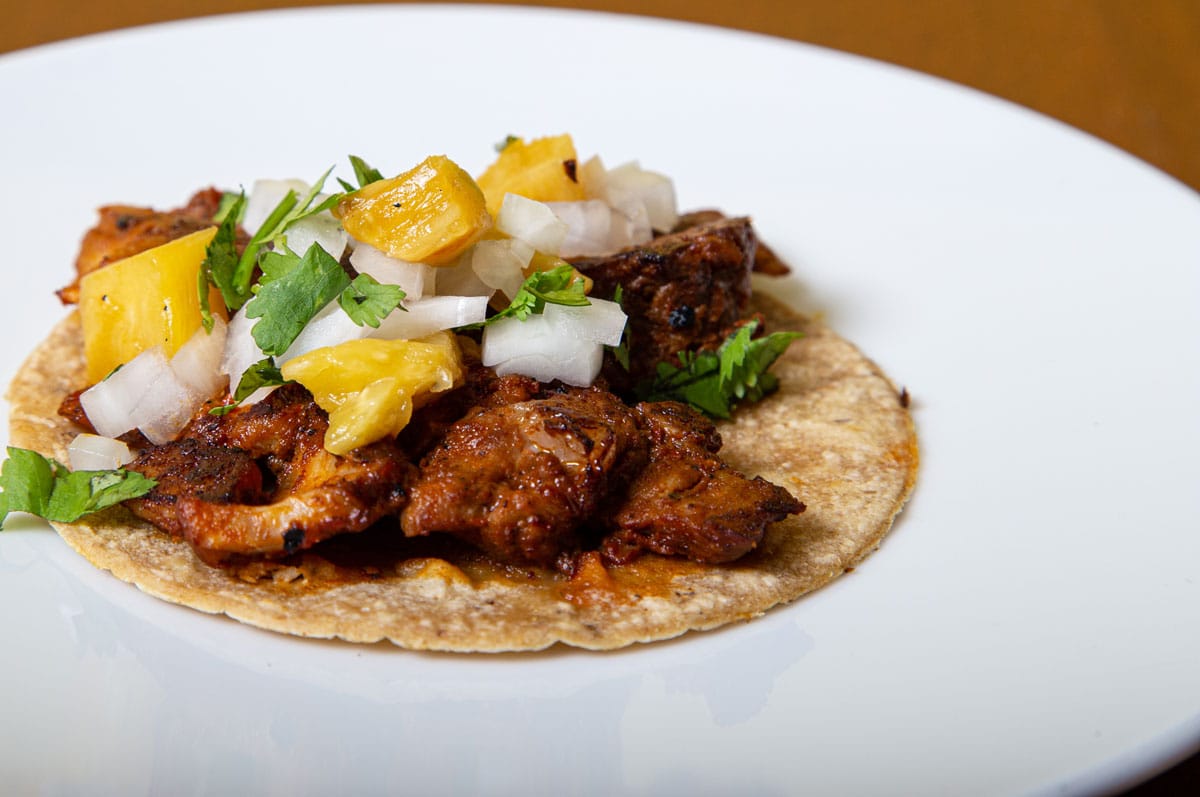
- Place generous amounts of the fried, sliced meat into the semi-circular half of the tortilla. Do not cover the entire tortilla with the meat, as you’ll then not be able to fold the tortillas.
- Add some chopped cilantro, the grilled pineapple pieces, and salsa. If you fancy a few more toppings, go ahead. But do not overload. Add some lime juice at the end for the finishing touches.
Enjoy your tacos!
Read: Tepache, Mexican Fermented Pineapple Drink
Making Tacos – Tips/Tricks

Here are a few tips and/or tricks to make your tacos al pastor cooking and savoring process a lot more exciting and enjoyable:
- Instead of the loin roast, you can use chicken breast or any meat of your choice.
- A plastic wrap is not mandatory for marination. An aluminum foil works too. Throw the meat slices into a bowl and cover the bowl with the foil at the end.
- Whether you’re using a corn or flour tortilla, make sure you warm it a bit, particularly if it’s not freshly made or coming straight out of the fridge. This will ensure the tortillas are soft yet not extremely pliable.
- Use two tortillas as the base for the filling if you fear the top tortilla could break under the fillings’ weight.
Conclusion

The major hurdle most people face when making tacos is zeroing in on the variety.
There are just too many options. And the types mentioned above only scratch the surface.
Not to mention, you can mix and match and devise your recipe also.
If you’ve never made tacos before or even tasted one before, tacos al pastor is a good and safe start.
Having relished the al pastor, you’ll feel inclined to learn more about the various taco types and how to make them.
Sources
- Allrecipes: How to Make Tacos at Home for Taco Tuesday or Any Day You Want
- Thrillist: Best Types of Tacos, Explained
- YouTube: Tacos Al Pastor | Mexican Style Pork or Chicken Tacos
More Mexican Foods
See all →
Jorge Garcia is the founder of AmigoFoods, where he has spent over 20 years helping readers discover authentic Latin American and Spanish cuisine. Raised in a Cuban-American household, Jorge learned to cook at the hands of his mother and grandmother, carrying forward generations of family recipes. That heritage, backed by his family’s four-generation history in the Latin food industry, inspired him to launch AmigoFoods in 2003. With more than 1,000 published articles on recipes, ingredients, and food culture, Jorge’s mission is simple: make authentic Latin cooking approachable for home cooks everywhere while honoring the traditions behind every dish.