

Dorada a la sal is Spain’s salt-baked sea bream: a whole fish packed in a shell of damp coarse salt and roasted until the flesh is moist, white and lightly seasoned. The crust is cracked open at the table, lifted away with the skin, and the fillets are served with good olive oil and lemon. It takes about 45 minutes and only a handful of ingredients.
Dorada a la Sal at a Glance
AmigoFoods may earn a commission from qualifying Amazon purchases made through links on this page.
What is dorada a la sal?
Dorada a la sal means “sea bream in salt.” Dorada is the Spanish name for the gilt-head bream, a silver Mediterranean fish named for the gold band between its eyes. A la sal describes the method: the whole fish is buried in coarse salt, baked, and then freed from the hardened crust.
It is one of the simplest and most theatrical dishes in Spanish cooking. Coastal restaurants bring the salt-covered fish to the table, break the shell with the back of a spoon, and fillet it in front of the diners. At home it is a weeknight-easy way to cook a whole fish with no turning, no splatter and very little cleanup.
The same method is used for lubina (sea bass), and in Spain both are often listed together as pescado a la sal. It belongs with grilled sardines and pulpo a la gallega among the country’s great no-fuss seafood dishes, and it is one of the classics in our list of Spanish seafood dishes.
Dorada vs. dorado: not the same fish
This trips up a lot of English speakers. In Spain, dorada is the gilt-head sea bream (Sparus aurata), a mild white fish usually sold whole at 1 to 1½ pounds. In the Americas, dorado usually means mahi-mahi, a large, firm ocean fish sold as steaks and fillets. They are unrelated, and mahi-mahi is far too big to salt-bake whole.
In U.S. fish markets, look for dorada under its French name, dorade or daurade, or as “royal dorade” or European sea bream. Italian menus call it orata and Greek ones tsipoura.
Why salt-baking works

The salt is not a seasoning so much as a portable oven. Packed around the fish, it hardens into a shell that traps steam, so the fish cooks gently in its own juices and stays moist even if you leave it in a few minutes too long.
- It insulates. The crust slows the heat, so the thin tail and the thick middle finish closer together.
- It seals in moisture. Nothing evaporates, which is why salt-baked fish is juicier than roasted fish.
- It seasons without oversalting. Coarse crystals dissolve slowly, and the intact skin and scales stand between the salt and the flesh.
- It holds together. Egg white binds the salt so the crust lifts off in large pieces instead of crumbling into the fish.
Because the skin is removed with the crust, the fish you eat is lean white flesh with no added fat until the olive oil goes on at the table.
Where the dish comes from
Cooking food in a salt crust is ancient and shows up around the Mediterranean, but in Spain it is tied to the coast where salt is made. Murcia, Alicante and the bay of Cádiz all have historic salt flats, and fishermen there had both the catch and the salt within reach. Salt-baked bream and sea bass became a fixture of the seaside restaurants along those coasts, and the method spread from there to the rest of the country.
No single town claims the dish, and there is no written record of who first did it. What is clear is that it suits the Spanish seafood philosophy perfectly: very fresh fish, cooked simply, finished with Spanish olive oil.
Choosing the fish

A dorada of 1¼ to 1½ pounds (570 to 680 g) is the classic single portion for two people in Spain, called a dorada de ración. Two of them feed four.
- Look for clear, bulging eyes, bright red gills, firm flesh that springs back, and a clean sea smell.
- Ask the fishmonger to gut the fish and remove the gills, but to leave the scales on. The scales are part of the protective layer.
- Farmed is fine. Most dorada sold in Spain is farmed in the Mediterranean, and it salt-bakes beautifully.
| If you can’t find dorada | Why it works |
|---|---|
| Lubina / branzino (European sea bass) | The other classic a la sal fish in Spain. Same size, slightly richer. |
| Porgy or scup | An American member of the sea bream family, similar texture and size. |
| Red snapper | Widely available whole. Choose fish under 2 lb, or add time. |
| Black sea bass | Sweet, delicate flesh that stays moist in the crust. |
Ingredients for dorada a la sal

- Whole dorada: two fish of 1¼ to 1½ lb each, gutted, gills out, scales on.
- Coarse salt: about 4½ lb (2 kg). Coarse sea salt is traditional; coarse kosher salt also works. Buy it in bulk, such as a big bag of coarse sea salt, because you will use a lot.
- Egg whites: three, to bind the salt into a crust that lifts off cleanly.
- Aromatics: lemon slices, parsley or thyme sprigs, bay leaves and a couple of garlic cloves for the cavity.
- Extra-virgin olive oil: the only “sauce” many Spaniards use. A fruity Spanish oil such as Agrosevilla extra-virgin olive oil is ideal for drizzling over the fillets.
How to make dorada a la sal
Here is the method in brief. Full quantities and timings are in the recipe card below.
1. Heat the oven and prep the fish
Heat the oven to 400°F (200°C). Rinse the cavity of each fish, pat it dry inside and out, and fill it with lemon slices, herbs, a bay leaf and a crushed garlic clove. Do not scale it.
2. Make the salt mixture
Beat the egg whites until foamy, then work them into the salt with your hands. Add water a tablespoon at a time until the salt feels like damp sand and holds its shape when you squeeze it.
3. Build the bed
Line a rimmed baking sheet with parchment. Spread about a third of the salt into two fish-shaped beds, each about ½ inch thick and a little larger than the fish.
4. Bury the fish
Lay the fish on the beds and pack the rest of the salt over them, pressing firmly so there are no cracks or gaps. The tail can poke out. Some cooks leave the head uncovered to judge doneness by the eye, which turns white when the fish is ready.
5. Bake and rest
Bake for about 25 minutes, until an instant-read thermometer pushed through the crust into the thickest part, just behind the head, reads 135°F (57°C). Let the fish rest in its crust for 5 minutes; it will keep cooking a few degrees.
Timing by weight
Bake at 400°F (200°C). Times are for each fish baked side by side, not stacked, and assume the fish starts cold from the fridge.
| Fish weight (each) | Coarse salt | Approx. time |
|---|---|---|
| 12 oz to 1 lb (350 to 450 g) | 2½ lb (1.2 kg) for two fish | 18 to 20 min |
| 1¼ to 1½ lb (570 to 680 g) | 4½ lb (2 kg) for two fish | 22 to 28 min |
| 2 lb (900 g), one fish | 3 lb (1.4 kg) | 30 to 35 min |
| 3 lb (1.4 kg), one fish | 4½ lb (2 kg) | 35 to 45 min |
How to crack and serve it
This is the fun part, so bring the baking sheet to the table.
- Tap firmly around the edge of the crust with the back of a heavy spoon or a mallet until it cracks.
- Lift the top of the crust away in large pieces. The skin usually comes off with it; if not, peel it back with a knife.
- Brush away any loose salt with a dry pastry brush. Work quickly, before the fish juices dissolve stray grains.
- Slide a fish spatula under the top fillet and lift it onto a warm plate. Pull out the backbone in one piece, starting at the tail, then lift the bottom fillet.
- Drizzle with olive oil, squeeze over lemon and serve right away.
What to serve with dorada a la sal
Keep the sides simple and let the fish lead.
- Sauces: extra-virgin olive oil and lemon is the classic. Alioli, a parsley salsa verde, or Canarian mojo verde are all common in Spanish restaurants.
- Potatoes: patatas a lo pobre, the slow-fried potatoes with peppers and onion, are the traditional partner. Small boiled potatoes with olive oil and paprika work too.
- Vegetables: a tomato and onion salad, roasted red peppers, or a plate of blistered pimientos de padrón.
- To start: pan con tomate or a few seafood tapas.
- To drink: a crisp Spanish white such as Albariño or Verdejo.
Tips and common mistakes
- Never use fine table salt. It dissolves too fast, seeps into the fish and makes it salty.
- Leave the scales on. Scaled fish absorbs more salt, and the skin is harder to lift off cleanly.
- Seal every gap. Steam escapes through cracks, and the fish dries out where the salt is thin.
- Do not reuse the salt. It has absorbed fish juices and cannot be cleaned.
- Don’t add oil before baking. It adds nothing inside the crust; save the good olive oil for the table.
- Bake the same day you buy the fish. A method this simple shows off freshness, and also its absence.
Dorada a la sal FAQ
Is dorada a la sal salty?
No. When you use coarse salt and leave the skin and scales on, the flesh is only lightly seasoned. The crust and skin are discarded, so most of the salt never reaches your plate.
How long do you bake dorada a la sal?
About 25 minutes at 400°F (200°C) for fish of 1¼ to 1½ pounds each, until the thickest part reaches 135°F (57°C). Smaller fish need about 20 minutes and a 3-pound fish up to 45.
Do you scale the fish before salt-baking?
No. In Spain the fish is gutted but not scaled. The scales and skin keep the salt away from the flesh and come off with the crust.
Can I use kosher salt instead of sea salt?
Yes, as long as it is coarse. Coarse kosher salt and coarse sea salt both work. Avoid fine table salt and flaky finishing salt.
Is dorada the same as dorado?
No. Dorada is gilt-head sea bream, a small Mediterranean fish. Dorado is the Latin American name for mahi-mahi, a much larger fish. In the U.S., dorada is usually sold as dorade.
Dorada or lubina: which is better a la sal?
Both are classic. Dorada is a little firmer and sweeter, while lubina (sea bass) is softer and slightly richer. Use whichever looks freshest.
Is dorada a la sal healthy?
Yes. The fish is cooked without fat, the skin is removed, and very little salt reaches the flesh. Sea bream is a lean source of protein; the only added fat is the olive oil you drizzle at the table.
Dorada a la Sal Recipe
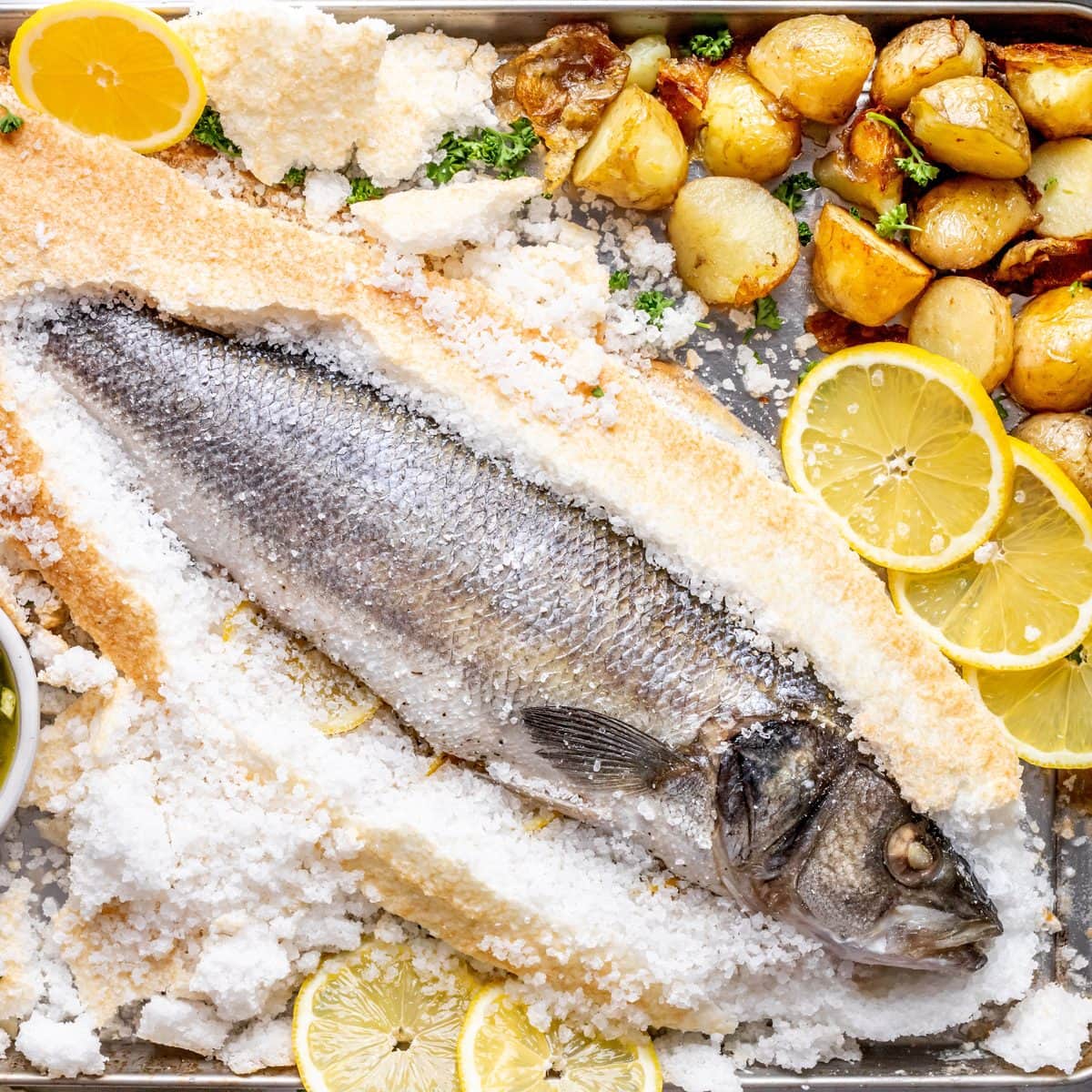
Dorada a la Sal (Spanish Salt-Baked Sea Bream)
Spanish dorada a la sal: whole sea bream baked in a crust of coarse salt and egg white, so the fish steams in its own juices and comes out moist and lightly seasoned. Crack it open at the table and serve with olive oil and lemon.
Ingredients
- 2 whole dorada (gilt-head sea bream), 1¼ to 1½ lb (570 to 680 g) each, gutted, gills removed, scales left on
- 4½ lb (2 kg) coarse sea salt or coarse kosher salt
- 3 large egg whites
- 3 to 4 tablespoons water, as needed
- 1 lemon, thinly sliced, plus lemon wedges to serve
- 6 sprigs fresh parsley or thyme
- 2 bay leaves
- 2 garlic cloves, lightly crushed
- Extra-virgin olive oil, to serve
- Freshly ground black pepper, to serve
Instructions
- Heat the oven. Heat the oven to 400°F (200°C) with a rack in the middle. Line a large rimmed baking sheet with parchment.
- Prep the fish. Rinse the cavity of each fish under cold water and pat the fish dry inside and out. Do not scale it. Fill each cavity with lemon slices, herb sprigs, a bay leaf and a crushed garlic clove.
- Make the salt crust. In a large bowl, beat the egg whites until foamy. Add the coarse salt and work it together with your hands. Add water 1 tablespoon at a time until the salt feels like damp sand and holds its shape when squeezed.
- Build the salt beds. Spread about one third of the salt on the baking sheet in two fish-shaped beds, each about ½ inch (1 cm) thick and slightly larger than the fish.
- Bury the fish. Lay a fish on each bed. Pack the remaining salt over and around them, pressing firmly so there are no cracks or gaps. The tail may stick out.
- Bake. Bake for 22 to 28 minutes, until an instant-read thermometer pushed through the crust into the thickest part of the fish, just behind the head, reads 135°F (57°C). For the USDA guideline of 145°F (63°C), bake 3 to 5 minutes longer.
- Rest. Let the fish rest in the crust for 5 minutes.
- Crack the crust. Tap around the edge of the crust with the back of a heavy spoon or a mallet, then lift the top away in large pieces. The skin usually comes away with it; peel off any that remains. Brush away loose salt with a dry pastry brush.
- Fillet and serve. Lift the top fillet onto a warm plate with a fish spatula, pull out the backbone from the tail end, and lift the bottom fillet. Drizzle with extra-virgin olive oil, add a squeeze of lemon and a little black pepper, and serve at once.
Notes
- Timing by weight (each fish, at 400°F/200°C): 12 oz to 1 lb, 18 to 20 min; 1¼ to 1½ lb, 22 to 28 min; 2 lb, 30 to 35 min; 3 lb, 35 to 45 min. Always confirm with a thermometer.
- Salt: use 1½ to 2 times the weight of the fish in coarse salt, and about 1 egg white per 1½ lb (700 g) of salt. Never use fine table salt. Do not reuse the salt.
- No dorada? Use lubina (branzino/European sea bass), porgy, black sea bass or red snapper of a similar size.
- To serve: olive oil and lemon, alioli, parsley salsa verde or mojo verde, with patatas a lo pobre or boiled potatoes and a tomato salad.
More Spanish seafood
Keep cooking from the Spanish coast with fideuà, Valencia’s seafood noodles, or bacalao a la vizcaína, Basque salt cod in red pepper sauce. Browse every fish and shellfish recipe on our Spanish seafood recipes page, or start with the classics in our guide to Spanish food.
More Spanish Foods
See all →
Jorge Garcia is the founder of AmigoFoods, where he has spent over 20 years helping readers discover authentic Latin American and Spanish cuisine. Raised in a Cuban-American household, Jorge learned to cook at the hands of his mother and grandmother, carrying forward generations of family recipes. That heritage, backed by his family’s four-generation history in the Latin food industry, inspired him to launch AmigoFoods in 2003. With more than 1,000 published articles on recipes, ingredients, and food culture, Jorge’s mission is simple: make authentic Latin cooking approachable for home cooks everywhere while honoring the traditions behind every dish.