

Fuet is a thin, dry-cured pork sausage from Catalonia, in northeastern Spain. It is seasoned with little more than salt, black pepper and garlic, stuffed into a narrow casing and air-dried for a few weeks until it is firm, sliceable and dusted with a soft white bloom. You eat it raw, in thin slices, usually as a tapa with bread and a glass of wine.
This guide covers what fuet tastes like, how it differs from chorizo and salchichón, how to peel, slice, serve and store it, where to buy it in the US, and how to make it at home if you have a curing setup.
Fuet at a Glance
What Is Fuet?
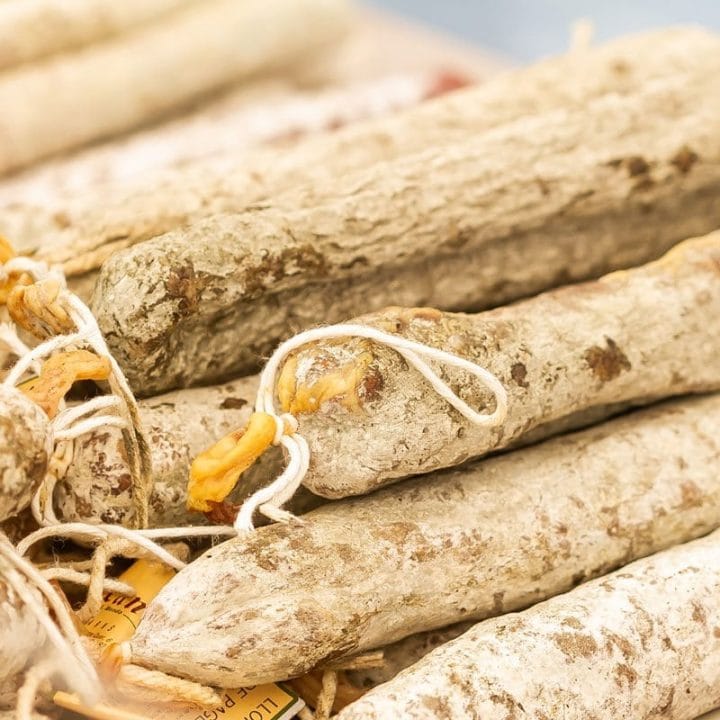
Fuet (say “foo-ETT”) is Catalonia’s everyday cured sausage. The name is Catalan for “whip,” a nod to its long, skinny shape: a typical link runs 30 to 50 cm (12 to 20 inches) long, is rarely more than 4 cm (1½ inches) across and weighs 150 to 300 g.
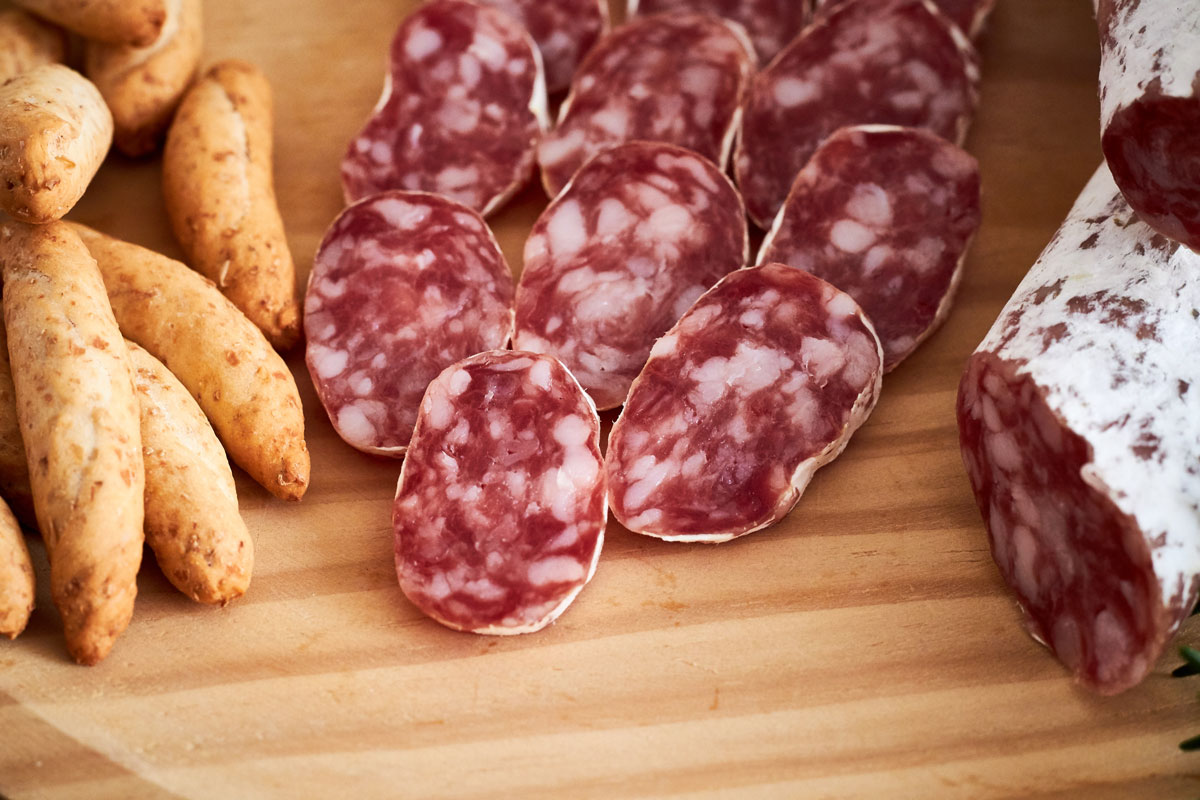
It is made from pork and pork fat, coarsely minced so you can see white flecks of fat in every slice. Classic recipes run roughly 60% lean to 40% fat. Unlike chorizo, fuet contains no paprika, so it is pink-red inside rather than brick red.
Because the casing is so thin, fuet dries fast. It can be ready in about two weeks, while a thick salchichón needs months. Most fuet is cured for somewhere between 2 weeks and 3 months, depending on how firm the maker wants it.

Fuet quick facts
| Origin | Catalonia, Spain. The best-known comes from Osona county around Vic, with a long tradition in Olot too |
|---|---|
| Meat | Pork and pork fat, about 60:40 |
| Seasoning | Salt, black pepper, garlic; sometimes a little anise or white wine. No paprika |
| Casing | Narrow natural pork casing (some brands use collagen or cellulose) |
| Size | 30 to 50 cm long, up to 4 cm thick, 150 to 300 g |
| Cure time | About 2 weeks to 3 months |
| Outside | Powdery white mold bloom (Penicillium nalgiovense) |
| How it’s eaten | Raw, thinly sliced, at room temperature |
| Also called | Espetec (same sausage, different name) |
What Does Fuet Taste Like?
Fuet tastes clean, porky and gently peppery, with a light tang from fermentation and a faint mushroomy note from the white mold. It is noticeably milder than chorizo and less salty than most Italian salami.
The texture is what makes it addictive. Because it is cured for a short time, a good fuet is firm on the outside but still slightly soft and buttery in the middle, and the fat melts as it warms in your mouth. Longer-cured fuet is harder and more concentrated; younger fuet is softer and juicier. Catalans argue about which is better.
Fuet vs. Chorizo, Salchichón and Salami
All four are dry-cured pork sausages eaten raw in slices, so they get confused. Here is how to tell them apart at a deli counter.
| Sausage | Where from | Seasoning | Size | Cure | Look |
|---|---|---|---|---|---|
| Fuet | Catalonia | Salt, black pepper, garlic | Thin, about 1 inch across | 2 weeks to 3 months | Pink-red, white bloom |
| Chorizo | All of Spain | Pimentón (smoked paprika), garlic | Thin to thick | Weeks to months | Deep red, oily |
| Salchichón | All of Spain; llonganissa in Catalonia | Black pepper, often nutmeg | Thick | Months | Darker, drier |
| Salami | Italy | Garlic, wine, fennel or pepper (varies) | Thin to very thick | Weeks to months | Varies |
Fuet vs. chorizo: the giveaway is color. Chorizo is red and smoky because it is loaded with pimentón; fuet has none. Put slices side by side, for example with a sliced Redondo Iglesias Spanish chorizo, and the difference is obvious.
Fuet vs. salchichón: same family, different size. Salchichón is fatter, cured much longer and usually drier and more intensely peppered. In Catalonia the big version is called llonganissa, and the most famous one, Llonganissa de Vic, has its own Protected Geographical Indication. Fuet is often described as its little brother.
Fuet vs. salami: fuet is a kind of salami in the broad sense: a fermented, air-dried pork sausage. Compared with most Italian salami it is thinner, milder and shorter-cured. If a recipe calls for one, the other will work.
Fuet vs. espetec: these are the same sausage. Espetec is the name used around Navarcles in central Catalonia, and it is also the trade name of Casa Tarradellas, one of the biggest fuet makers, which is why you see “Espetec” on so many supermarket packs.
Types of Fuet
The basic recipe barely changes, but you will see these versions in Spanish shops:
Is the White Mold on Fuet Safe to Eat?
Yes. The white, powdery coating on traditional fuet is a beneficial mold, mostly Penicillium nalgiovense, the same family of good molds used on cheeses like Camembert. It grows during drying, protects the sausage from unwanted molds, slows moisture loss and adds a faint earthy, mushroomy aroma.
Whether you eat it is a matter of taste. Many Catalans eat thin slices skin and all; others peel it. If the label says the casing is cellulose or plastic, always peel it.

How to Eat Fuet
Fuet is ready to eat straight from the package. A few simple habits make it taste the way it does in Barcelona:
- Let it warm up. Take it out of the fridge 20 to 30 minutes before serving so the fat softens and the flavor opens up.
- Peel if you like. Score the casing lengthwise with a knife tip and pull it off in one strip, or leave it on.
- Slice thin, on a bias. Aim for coins about ⅛ inch (3 mm) thick. Catalans also just snap it into bite-size chunks for a picnic.

Serving ideas
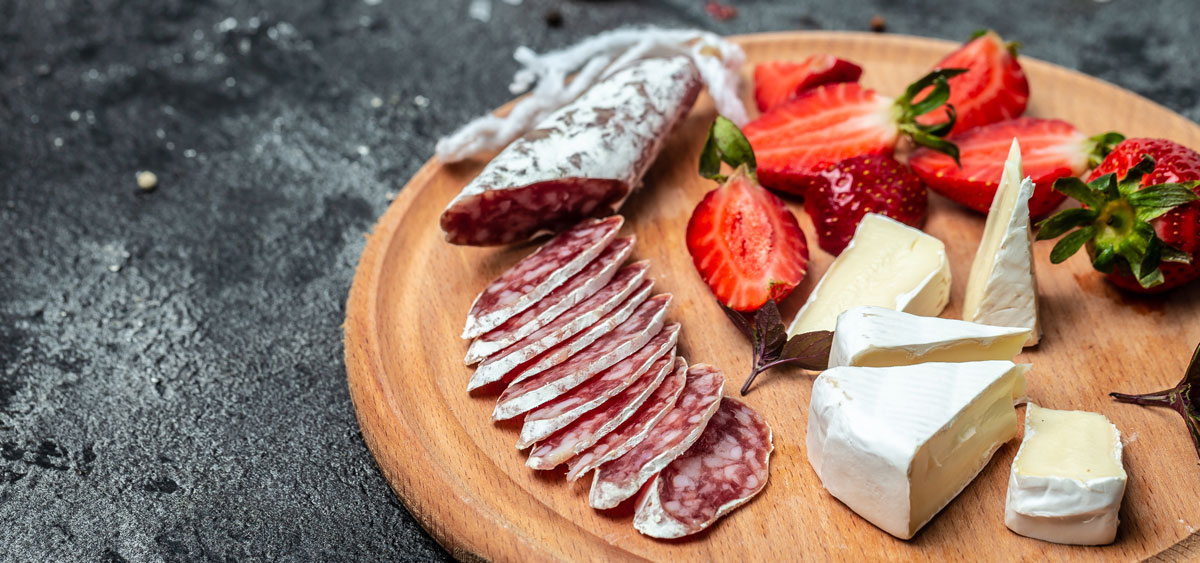
- On a tapas board with jamón, chorizo, Manchego, olives and bread. Our guide to building a Spanish tapas board shows how much to buy per person.
- With pan con tomate. Fuet laid over pan con tomate (pa amb tomàquet) is about as Catalan as a snack gets.
- In a sandwich. The bocata de fuet is a Spanish school-lunch classic: a crusty roll rubbed with tomato and olive oil, filled with fuet. See our bocadillo guide.
- With cheese. Fuet’s mild flavor pairs with almost any Spanish cheese, especially Manchego.
- With drinks. Try cava, a young red such as Garnacha or Tempranillo, a dry vermouth over ice, or a cold beer.
- Cooked. Dice it into a tortilla española, scrambled eggs, sautéed mushrooms, pasta or pizza. Add it at the end so it warms through without going hard.
- As “tartar de fuet.” A trendy bar tapa: finely chopped fuet tossed with grated tomato, a little shallot and olive oil, spooned onto toast.
How to Store Fuet
- Whole and uncut: a natural-casing fuet is shelf-stable. Many Spanish brands say it needs no refrigeration; keep it in a cool, dry, dark place and follow the date on the label. In a warm kitchen, the fridge is the safer choice.
- Vacuum-packed: follow the package. Most say to refrigerate after opening.
- Once cut: cover the cut end with plastic wrap or beeswax wrap, wrap the whole link loosely in paper and keep it in the fridge. Use it within about 2 weeks for the best texture.
- Freezing: possible, but it softens the texture. Freeze sliced fuet flat in a bag and use it in cooking.
Where to Buy Fuet in the US
Fuet used to be hard to find outside Spain, but it is now carried by Spanish import shops, many cheese counters and online grocers. Look for brands such as Casa Tarradellas (Espetec), Espuña, Noel and Casademont, or smaller producers from Vic and Olot. Imported Spanish pork products must be approved for the US market, so the selection is smaller than in Spain.
- Catalan fuet (pack): classic natural-casing fuet
- Doña Juana fuet, double pack
- See all fuet on Amazon, including mini fuet snack sticks
- Carmen & Lola Spanish cheese assortment: Manchego, Idiazábal and Mahón, with a little Ibérico ham
- Iberia Manzanilla olives stuffed with anchovies, the classic bar olive
- Cinco Jotas hand-carved jamón ibérico de bellota, 3 oz for the rest of the board
- Armolia Spanish extra virgin olive oil for pan con tomate
As an Amazon Associate, AmigoFoods earns from qualifying purchases.

How to Make Fuet at Home
Fuet is one of the friendlier dry-cured sausages for a first attempt, because its thin casing dries in weeks rather than months. It is still a real curing project, though, and it is only safe with the right setup.
What you need
- Meat: fatty pork shoulder plus pork back fat. Use the freshest pork you can get, ideally never frozen.
- Seasoning: sea salt, curing salt #2, a little dextrose to feed the culture, black pepper, garlic and dry white wine.
- Cultures: a fermentation starter culture and, if you want the white coat, a meat mold culture.
- Casings: narrow natural hog casings, 32 to 36 mm.
- Curing salt: Instacure #2 / Prague Powder #2.
1. Chill, cut and season
Cube the pork and fat separately and chill until firm at the edges. Weigh the salt (2.6% of the meat weight), curing salt #2 and dextrose, toss them with the meat and fat, and refrigerate overnight. This rest helps the sausage bind.
2. Grind and mix
Grind the lean pork and the semi-frozen fat through a 6 to 8 mm plate. Add pepper, garlic, wine and the dissolved starter culture, then mix for 1 to 2 minutes until the mass turns sticky and leaves white streaks on the bowl. Keep everything below 40°F (4°C).
3. Stuff and weigh
Stuff into the casings in 12- to 18-inch links, tie both ends, leave a hanging loop and prick out any air pockets. Weigh each link and write the starting weight on a tag. You will need it to know when the fuet is done.
4. Ferment
Hang the links somewhere warm and humid, about 70 to 75°F (21 to 24°C) and 85 to 90% humidity, for 24 to 48 hours or as your culture directs. A turned-off oven with a pan of water works. The links are ready when they turn a deeper red and smell pleasantly tangy.
5. Dry
Move them to the drying chamber at 50 to 59°F and 75 to 80% humidity. Spray on the mold culture now if you are using one. Check the links every couple of days.
6. Check for doneness
Fuet is done when it has lost 30 to 35% of its starting weight, usually after 3 to 5 weeks. It should feel firm all the way through, not just on the outside. Vacuum seal the links and refrigerate them for a week so the moisture evens out before slicing.
The full ingredient amounts and steps are in the homemade fuet recipe card below.
A Short History of Fuet
Cured sausages have been made in Catalonia since Roman times, and Roman writers praised the hams of the Pyrenees. Fuet itself belongs to the tradition of the matança, the winter pig slaughter when farm families turned a whole pig into hams, fresh sausages like butifarra and cured sausages that would last into spring.
The old Catalan saying “Per Sant Martí, mata el porc i enceta el vi” (“On Saint Martin’s Day, kill the pig and open the wine”) still marks the season: Saint Martin’s Day falls on November 11. Medieval Catalan cookbooks such as the Llibre de Sent Soví and Robert de Nola’s Libre del Coch (1520) already describe how to cut and cure the pig.
The plain of Vic, with its cold, foggy winters and dry winds, became the center of Catalan sausage making. Written references to the town’s llonganissa go back to the mid-1400s. Fuet, the thinner and quicker-drying sausage, was the one families could eat first, and it is still the cured sausage most Catalans keep in the kitchen today. Slow Food lists traditional fuet in its Ark of Taste, noting that small producers now compete with large industrial makers.
Fuet FAQ
Do you eat fuet raw?
Yes. Fuet is dry-cured, not cooked, and it is meant to be eaten as it is, in thin slices at room temperature. You can also add it to cooked dishes.
Do you peel fuet before eating?
It is up to you. The natural casing and white mold are edible, and many people eat them. Peel it if you prefer a cleaner bite or if the casing is cellulose or plastic.
Is fuet the same as chorizo?
No. Both are Spanish cured pork sausages, but chorizo is seasoned with smoked paprika, which makes it red and smoky. Fuet has no paprika and tastes of pork, pepper and garlic.
What does “fuet” mean?
Fuet means “whip” in Catalan, after the sausage’s long, thin shape.
Why is fuet so good?
Simple seasoning lets the pork come through, the short cure keeps the center soft and buttery, and the white mold adds a subtle savory depth. It is also easy to slice and share.
Is fuet the same as salami?
It is a type of salami in the broad sense, a fermented and air-dried pork sausage, but it is thinner, milder and cured for less time than most Italian salami.
Does fuet need to be refrigerated?
A whole, uncut natural-casing fuet can be kept in a cool, dry place; follow the label. Once you cut it, wrap it and refrigerate it.
Is fuet gluten-free?
Traditional fuet contains only pork, fat, salt and spices, and many Spanish brands are labeled sin gluten. Check the label, because some brands add fillers.
Can you eat fuet when pregnant?
Many health agencies advise pregnant people to avoid uncooked cured meats such as salami and chorizo, or to cook them until steaming hot first. Ask your doctor or midwife.
Homemade Fuet Recipe
Homemade Fuet (Catalan Dry-Cured Sausage)
A home version of Catalonia's thin dry-cured pork sausage: pork shoulder and back fat seasoned with salt, black pepper and a little garlic, stuffed into narrow hog casings, fermented for a day or two, then air-dried until it loses about a third of its weight.
Ingredients
- 1.5 kg (3.3 lb) boneless pork shoulder, well chilled
- 500 g (1.1 lb) pork back fat, well chilled
- 52 g fine sea salt (2.6% of the meat weight)
- 5 g curing salt #2 (Instacure #2 or Prague Powder #2)
- 8 g dextrose
- 8 g freshly ground black pepper (about 1 tablespoon)
- 2 garlic cloves, very finely minced
- 30 ml (2 tablespoons) dry white wine
- Starter culture for fermented sausage (such as Bactoferm T-SPX), dosed for 2 kg per the package
- 30 ml (2 tablespoons) distilled water, for the culture
- Optional: meat mold culture (Penicillium nalgiovense), for the white bloom
- About 10 feet (3 m) natural hog casings, 32 to 36 mm
Instructions
- Chill and cut. Cut the pork shoulder and back fat into 1-inch cubes, keeping them separate. Spread on a tray and freeze for 30 to 45 minutes, until firm at the edges. Everything that touches the meat should be cold and very clean.
- Season. Weigh the salt, curing salt #2 and dextrose on a gram scale. Toss them with the pork and fat, cover and refrigerate overnight (optional, but it helps the sausage bind). Soak the hog casings in cool water and dissolve the starter culture in the distilled water, following the package timing.
- Grind. Grind the lean pork through a 6 to 8 mm plate. Grind the semi-frozen fat through the same plate (or dice it by hand into 1/4-inch pieces) so you can see distinct white flecks when the fuet is sliced.
- Mix. Add the pepper, garlic, wine and dissolved culture. Mix with clean hands or a paddle for 1 to 2 minutes, until the mixture turns sticky and leaves white streaks on the bowl. Keep it below 40°F (4°C).
- Stuff. Stuff into the casings in links 12 to 18 inches (30 to 45 cm) long, packing firmly without air gaps. Tie both ends, leave a loop for hanging, and prick any air pockets with a sterilized needle. Weigh every link and write the weight on a tag.
- Ferment. Hang the links at about 70 to 75°F (21 to 24°C) and 85 to 90% humidity for 24 to 48 hours, or as your culture directs. A turned-off oven with a pan of water works; spritz the links with water once or twice a day. They are ready when they turn a deeper red and smell tangy.
- Dry. Move the links to a drying chamber at 50 to 59°F (10 to 15°C) and 75 to 80% humidity. If you want the traditional white coat, spray them with a meat mold culture now. Dry for 3 to 5 weeks, until each link has lost 30 to 35% of its starting weight and feels firm all the way through.
- Rest and store. Wipe off any green or blue spots with a cloth dipped in vinegar and salt; throw out any link with black or fuzzy mold. Vacuum seal the finished fuet and refrigerate for a week so the moisture evens out, then slice thin and serve at room temperature.
Notes
This is an advanced recipe. Dry-cured sausage is safe only with accurate weights, curing salt #2 (not #1), a starter culture and a controlled drying environment. Weigh everything in grams. If you are new to sausage making, start with a fresh sausage first.
Mold guide: a dry, powdery white bloom is the good mold that traditional fuet carries. Wipe off small green or blue spots. Black, fuzzy or slimy mold means the batch should be discarded.
Done test: 30 to 35% weight loss. For extra certainty, a pH meter should read 5.3 or lower after fermentation.
Yield is about 6 links, roughly 1.3 kg (3 lb) after drying, or about 20 servings.
More Spanish Cured Meats and Tapas
- Latin American & Spanish cured meats: a country-by-country guide
- Salchichón: what it is and how to eat it
- Sobrasada, Mallorca’s spreadable sausage
- Serrano ham (jamón serrano)
- Morcilla, Spanish blood sausage
- Butifarra, Catalonia’s fresh sausage
- Spanish tapas recipes
- The 15 essentials of the Spanish pantry
- 50 traditional Spanish foods to try
Sources
- Slow Food Foundation, Ark of Taste: Fuet
- Spanish Club: Fuet, the most popular sausage of Catalonia
- Hank Shaw, Hunter Angler Gardener Cook: Spanish fuet sausage
More Spanish Foods
See all →
Jorge Garcia is the founder of AmigoFoods, where he has spent over 20 years helping readers discover authentic Latin American and Spanish cuisine. Raised in a Cuban-American household, Jorge learned to cook at the hands of his mother and grandmother, carrying forward generations of family recipes. That heritage, backed by his family’s four-generation history in the Latin food industry, inspired him to launch AmigoFoods in 2003. With more than 1,000 published articles on recipes, ingredients, and food culture, Jorge’s mission is simple: make authentic Latin cooking approachable for home cooks everywhere while honoring the traditions behind every dish.