
On this page
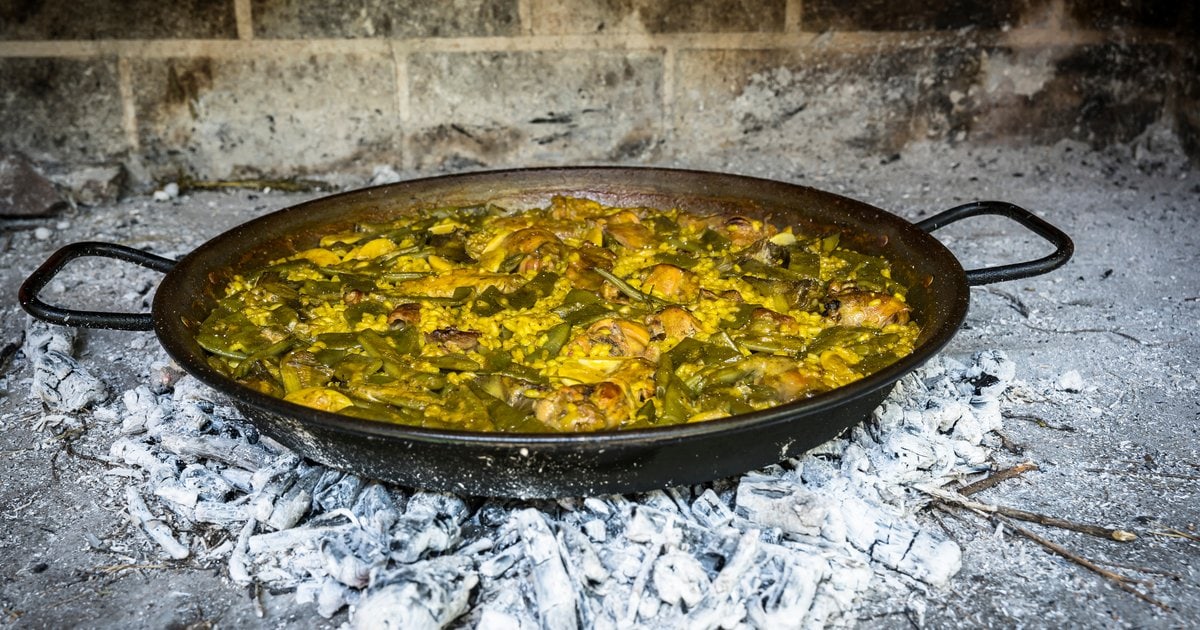
Paella should be dry. A properly cooked paella has tender, separate grains, no broth pooling in the pan, and a thin, crisp, caramelized layer of rice stuck to the bottom called socarrat. If yours comes out soupy or creamy, it either had too much liquid, got stirred, or turned into a different Spanish rice dish altogether.
Below you will find what the right texture looks, sounds and smells like, the rice-to-broth ratio that gets you there, how to build socarrat without burning it, a fix for every common paella problem, and a stovetop vegetable paella recipe built around the method.
Paella with Socarrat at a Glance
Plan ahead: have the broth hot and seasoned before the pan goes on the heat, and check that your pan is wide enough to keep the rice no deeper than about ½ inch.
AmigoFoods may earn a commission from qualifying Amazon purchases made through links on this page.
Should Paella Be Wet or Dry?
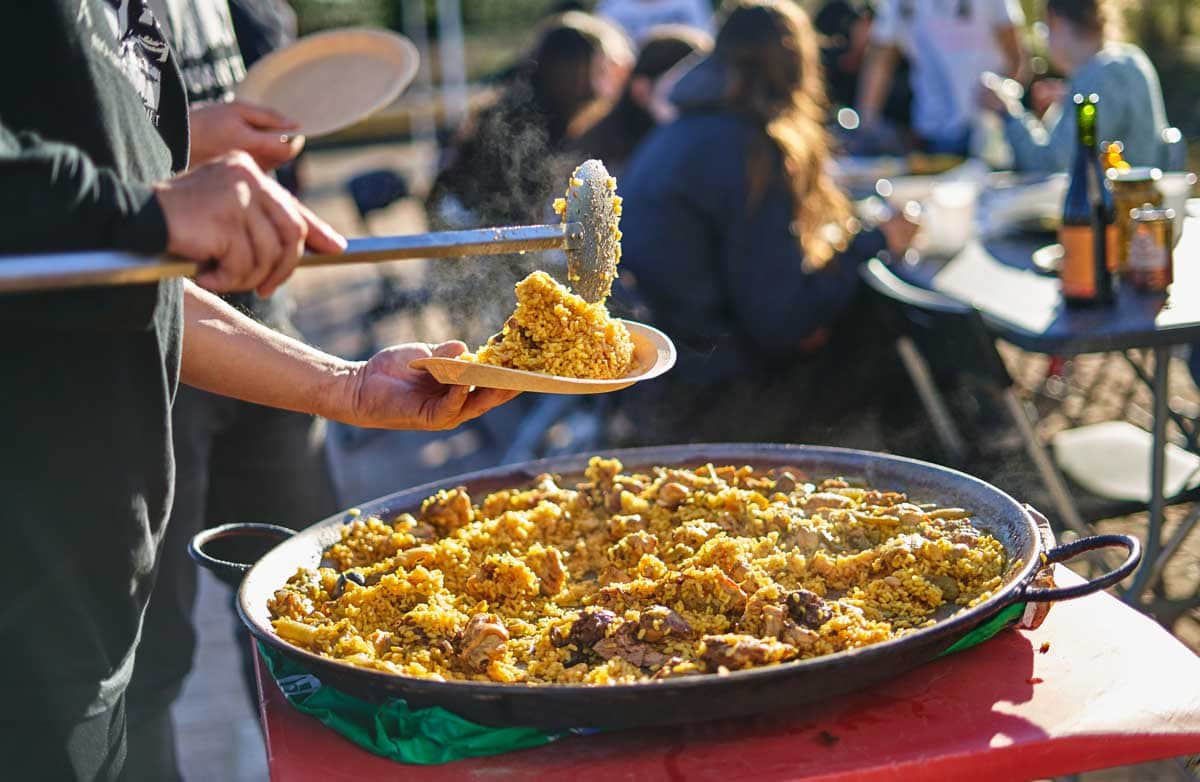
Dry. In Valencia, where paella comes from, it belongs to a family of dishes called arroz seco, or dry rice. The rice cooks in a wide, shallow pan, absorbs every drop of the broth, and is served the moment no liquid is left.
Dry does not mean dry-tasting. Each grain should be plump and glossy with olive oil and sofrito, tender with a slight bite in the center, and full of the broth it soaked up. The texture you are after is closer to a perfectly cooked pilaf than to risotto.
What a properly cooked paella looks like
- No broth pools when you tilt the pan.
- The grains are separate, not glued into a creamy mass.
- The rice layer is thin, about ½ inch, roughly a finger’s width.
- The bottom is crisp and golden brown, not black.
- The color is a warm ochre-orange from saffron and pimentón, not neon yellow.
- You see more rice than toppings.
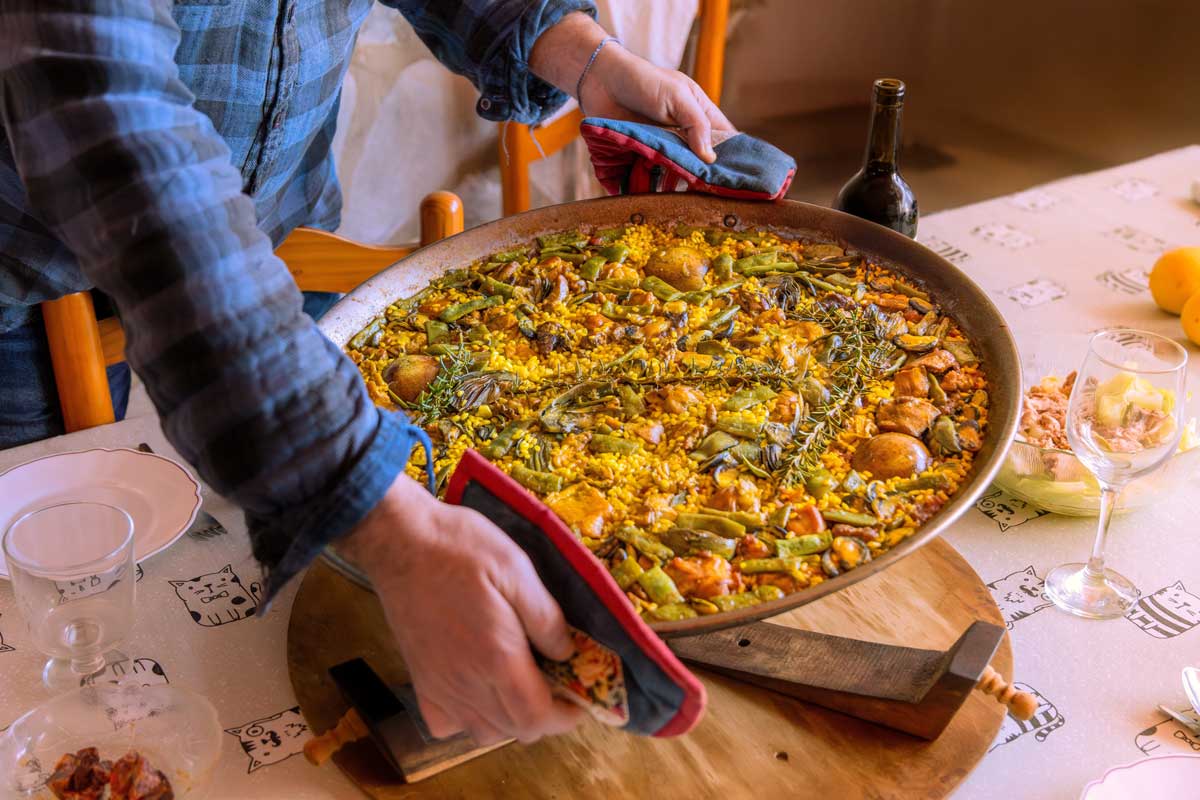
The confusion is understandable. Plenty of restaurant and home “paellas” outside Spain are cooked like a casserole or stirred like risotto, so many people have only ever eaten the wet version. Spain does make wet rice dishes on purpose; they just go by different names.
Dry, Meloso or Caldoso: Spain’s Three Rice Textures
Spanish cooks sort rice dishes by how much liquid is left in the pan at the end. Paella sits at the dry end of the scale.
| Style | Texture | Broth per cup of rice (approx.) | Cooked in | Classic examples |
|---|---|---|---|---|
| Arroz seco (dry) | All broth absorbed, separate grains, socarrat on the bottom | 3 cups | Wide, shallow paella pan | Paella valenciana, seafood paella, arroz a banda, arroz negro |
| Arroz meloso (creamy) | Loose and saucy, eaten with a spoon, like a wet risotto | About 4 cups | Deeper pan or clay cazuela | Arroz meloso de setas, arroz meloso con bogavante |
| Arroz caldoso (brothy) | Rice swimming in broth, served in bowls like soup | 5 cups or more | Pot or deep cazuela | Arroz caldoso con bogavante (lobster), arroz caldoso de marisco |
So if a “paella” arrives soupy, you were served a caldoso by accident. If you want saucy rice on purpose, make a meloso and call it that, in a deeper pan where socarrat will not form. Noodles follow the same dry rule: fideuà is cooked like paella and finished with its own crisp bottom.

What Is Socarrat?
Socarrat (pronounced so-kah-RAHT) is the thin layer of rice that toasts and caramelizes against the bottom of the paella pan in the last minutes of cooking. The name comes from the Valencian verb socarrar, to singe or scorch, and in Valencia it is the part people reach for first.
It is not burnt rice. Once the broth is gone, the bottom layer of grains starts to fry in the olive oil left in the pan. The starches and the sugars in the sofrito brown (the same Maillard reaction and caramelization that give bread its crust), and the flavor of the whole dish concentrates in that layer. The result is crunchy, nutty and deeply savory.
Good socarrat is golden to deep amber, releases from the pan with a firm scrape of a spoon, and tastes toasty, never bitter. If it is black, smells acrid or is welded to the metal, it went too far.
Is socarrat required? Most Valencian cooks treat it as the sign of a well-made paella, and a paella with only a little socarrat is still a paella. A soupy one is not.
How to Get Socarrat Without Burning It
Socarrat is built over the whole cook, not just in the final two minutes. Every step below either keeps the rice dry or protects the bottom layer so it toasts instead of scorching.
- Use enough oil. Fat is what fries the bottom layer. For a 14- to 15-inch pan serving four, use 5 to 6 tablespoons of olive oil. Lean paellas (vegetable or seafood) need the higher end; paellas with pork ribs or chorizo need less because the meat adds its own fat.
- Pick a rice that can take the broth. Bomba or Calasparra rice with three parts broth (see the ratio table below) gives you plump grains and the most room for error.
- Coat the rice, then never stir again. Stir the rice in the sofrito for a minute, spread it out, add the broth and leave it alone. Stirring releases starch, which makes paella creamy and glues the bottom so it burns instead of toasting.
- Keep the layer thin. About ½ inch of rice. A deep layer steams and stays wet; a thin one dries out evenly and crisps.
- Spread the heat. Turn the pan a quarter turn every couple of minutes, or straddle two burners, so the edges cook as fast as the center.
- Wait for the broth to disappear. You will see small craters open across the surface and the rice will taste nearly done. That is your cue.
- Turn up the heat for 1 to 2 minutes and listen. The bubbling sound changes to a dry crackle, like puffed rice cereal in milk, and the kitchen starts to smell toasty.
- Do the spoon test. Slide a spoon to the bottom near the center and near the edge. You should feel crunchy resistance and see golden-brown grains.
- Rest it for 5 minutes off the heat. Cover loosely with a clean kitchen towel. The crust firms up and releases more easily when you serve.

The Rice-to-Broth Ratio That Keeps Paella Dry
Most mushy paella comes down to too much liquid for the rice in the pan. Measure by volume and match the broth to the rice you are using:
| Rice | Broth per 1 cup rice | How it behaves |
|---|---|---|
| Bomba | 3 cups | Absorbs a lot of broth without bursting; the most forgiving for socarrat |
| Calasparra | 3 cups | Slow-grown DO rice from Murcia; behaves much like bomba |
| Senia, Bahía or Albufera | About 2½ cups | Valencian medium-grain rices; soak up flavor beautifully but turn soft faster |
| Calrose or other medium grain | About 2½ cups | A workable stand-in; cooks a few minutes faster |
| Arborio | Not recommended | Bred to release starch for risotto, so it leans creamy |
| Long grain or basmati | Not recommended | Does not absorb enough broth, so it stays bland and can turn hard |
Then adjust for evaporation. Wider pans, bigger burners and wood fires boil off more broth, so keep an extra half cup hot on the stove. If the broth is gone and the rice is still chalky, sprinkle hot broth over the underdone spots a few tablespoons at a time. Never add cold liquid, and never stir it in.
An old Valencian cue still works with a proper paella pan: fill the broth up to the rivets where the handles meet the pan. Paella pans are made shallow enough that this keeps the rice layer thin. For a closer look at each variety, see our guide to the best rice for paella.
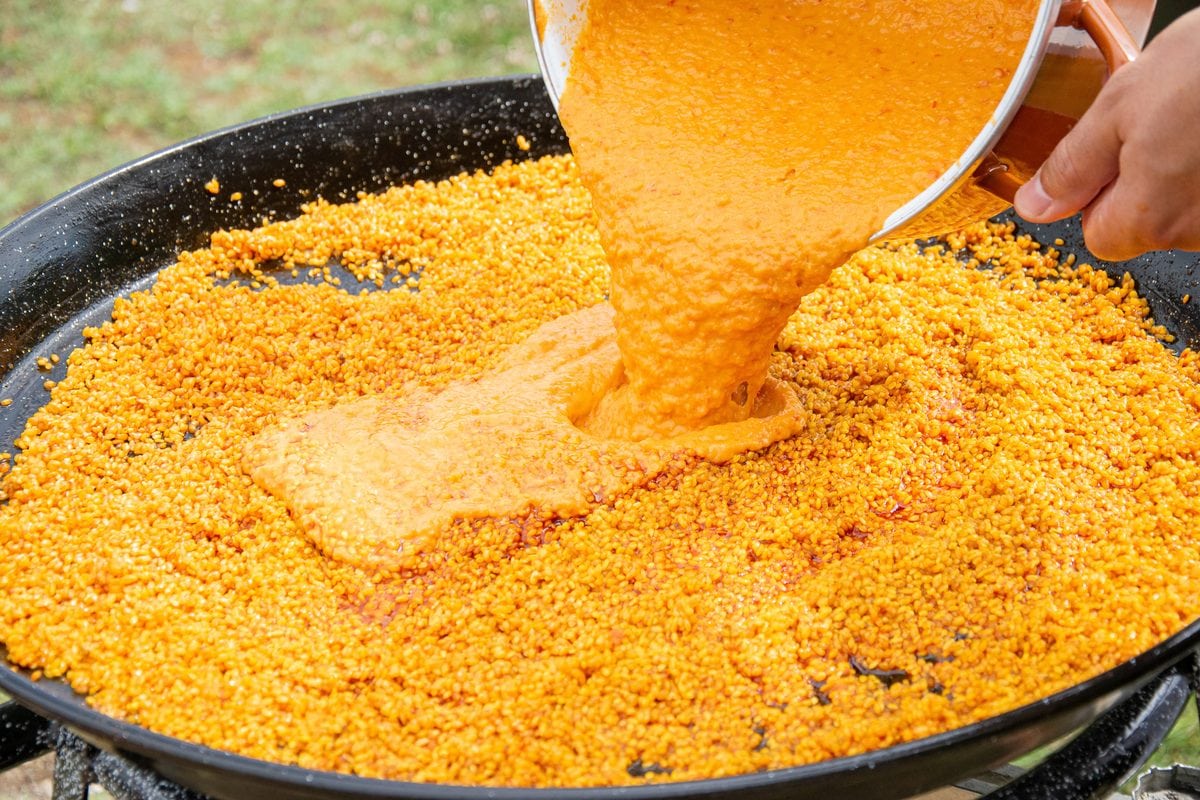
Stock the paella pantry
- Gourmanity Calasparra rice for paella: Spanish short-grain rice that takes the full 3-to-1 ratio.
- Bomba rice: the classic choice if you want the most forgiving grain.
- La Chinata smoked sweet paprika: a pinch alongside sweet pimentón gives a vegetable paella a wood-fired note. More in our pimentón guide.
- Casalbert Spanish extra-virgin olive oil: you need a generous amount, so use one that tastes good.
- Spanish saffron threads: see our saffron guide for what to look for, or our paella without saffron substitutes.
The Pan and the Heat: Why Paella Is Cooked Wide and Shallow
In Valencian, paella is the name of the pan before it is the name of the dish. Its shape is the whole point: a wide, shallow, thin pan heats quickly, lets the broth evaporate evenly, and puts as much rice as possible in direct contact with hot metal, which is where socarrat forms.
- Wood fire or a paella gas burner: the traditional setup. A ring burner or a bed of embers heats the whole base evenly.
- Gas stovetop: straddle two burners and turn the pan every couple of minutes.
- Electric or induction: use a flat-bottomed pan and keep turning it, because the hot zone is smaller than the pan.
- Oven finishing: it cooks the top evenly but will not build socarrat. Do the final crackle on the burner.
Carbon steel is the classic material (oil it after washing so it does not rust), enameled steel needs no upkeep, and stainless steel works on induction. Skip nonstick: the rice cannot grip the pan, so the crust stays weak, and scraping for socarrat damages the coating. Our paella pan buyer’s guide compares sizes and materials.
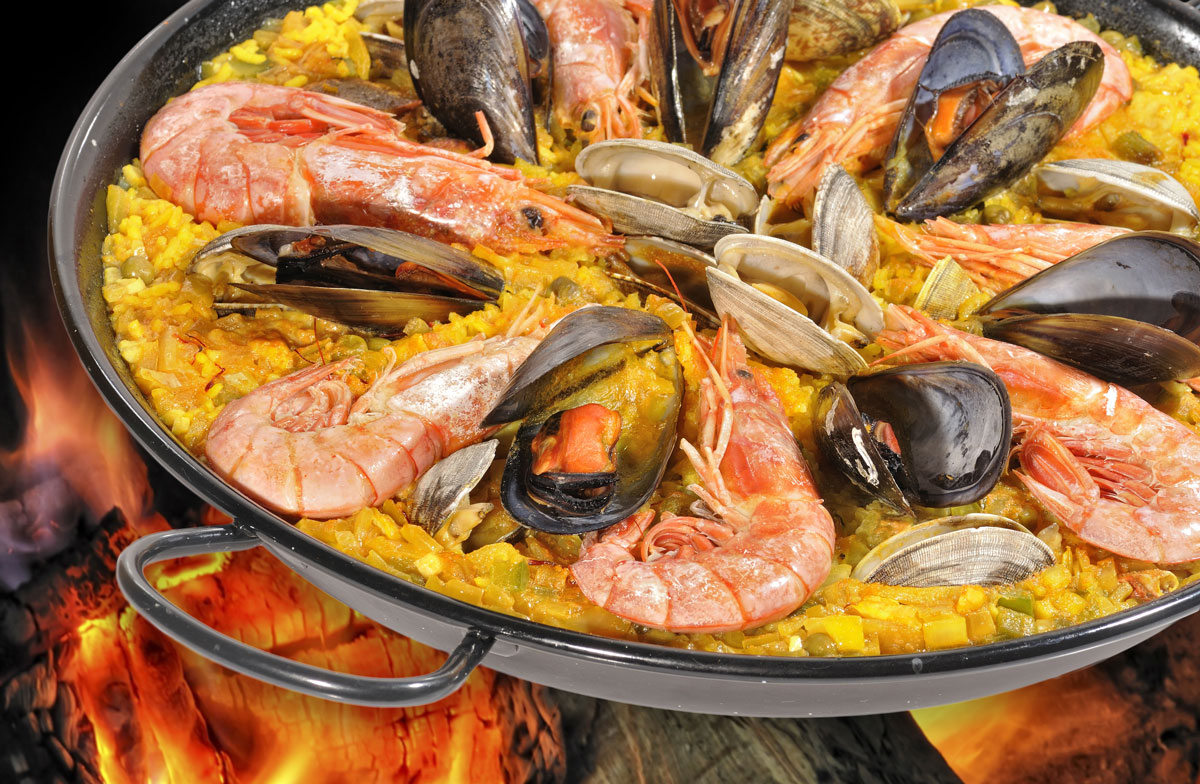
Why Is My Paella Mushy? Fixes for Every Paella Problem
Find your problem below. The middle column saves tonight’s paella; the last one keeps it from happening again.
| Problem | Likely cause | Fix it now | Next time |
|---|---|---|---|
| Mushy or soupy | Too much broth, stirring after the rice went in, risotto rice, or a pan that is too small | Keep cooking uncovered over medium heat without stirring until the liquid is gone | 3 cups broth per cup of bomba, a wider pan, and no stirring |
| Wet on top, hard grains underneath | Rice piled too deep, so the top steams while the bottom dries | Take it off the heat, cover loosely with a towel or foil and rest 5 to 10 minutes | Keep the rice layer about ½ inch deep |
| Broth gone, rice still hard | Not enough broth, or it boiled off too fast | Sprinkle a few tablespoons of hot broth over the hard spots and cook on low for 3 to 5 minutes | Keep extra hot broth ready and drop to a simmer sooner |
| Black, bitter bottom | Heat too high for too long, too little oil, or scorched sofrito | Do not scrape the black layer; serve from the top | Limit the crackle step to 1 to 2 minutes and use more oil |
| Burnt center, wet edges | Burner much smaller than the pan | Slide the pan off-center and rotate it often | Use two burners or a paella burner |
| No socarrat at all | Nonstick pan, too little oil, or skipped the final high heat | Raise the heat for 1 to 2 minutes and listen for the crackle | Carbon-steel pan, enough oil, and the crackle step |
| Sticky, clumped grains | Stirring, or a starchy rice such as Arborio | Let it rest uncovered so the surface dries | Bomba or Calasparra, and hands off once the broth is in |
How to Spot a Bad Paella at a Restaurant
A few warning signs, whether you are in Spain or at home:
- It is neon yellow. Real saffron and pimentón give a warm ochre-orange. Bright yellow usually means food coloring.
- It arrives in five minutes. A paella needs around 20 minutes once the rice goes in. One that shows up fast was cooked earlier and reheated.
- It comes on a plate. Paella is cooked and served in the pan, so most good restaurants bring the pan to the table.
- The rice is thick, creamy or wet. More than about a finger’s depth of rice, or a risotto texture, means it steamed instead of drying out.
- You cannot find the rice. A paella is a rice dish. If the toppings bury it, the cook was compensating.
- There is no socarrat. Scrape the bottom with your spoon. A good paella fights back a little.
Vegetable Paella with Socarrat (Recipe)
The easiest way to practice the method is a vegetable paella. With no meat or seafood to manage, all of your attention goes to the oil, the broth and the sound of the pan. Once you can get socarrat here, the same steps work for a meat or seafood paella. For those, see our paella valenciana with chicken and rabbit, our seafood paella, or this paella without saffron if your spice drawer is bare.
Vegetable Paella with Socarrat
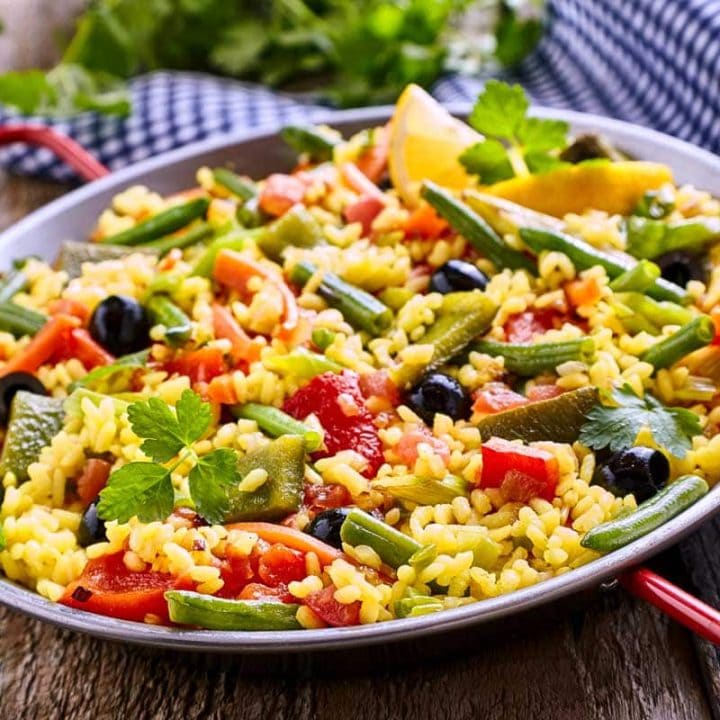
A stovetop vegetable paella built to finish dry, with a golden, crackling socarrat on the bottom: bomba rice, a jammy tomato sofrito, saffron broth, and no stirring once the rice goes in.
Ingredients
- 4 1/2 cups (1.08 liters) vegetable broth, plus 1/2 cup extra, kept hot
- 1/2 teaspoon loosely packed saffron threads (about 0.2 grams)
- 1 1/2 to 2 teaspoons kosher salt, depending on how salty the broth is
- 6 tablespoons (90 ml) Spanish extra-virgin olive oil
- 1 red bell pepper, cut into 1/2-inch strips
- 6 ounces (170 grams) flat or regular green beans, trimmed and cut into 2-inch pieces
- 1 cup small cauliflower florets
- 6 artichoke heart quarters (frozen and thawed, or jarred and drained)
- 3 garlic cloves, minced
- 1 large ripe tomato, halved and grated (about 1/2 cup pulp)
- 1 teaspoon sweet pimentón (Spanish paprika), or half sweet and half smoked
- 1 1/2 cups (300 grams) bomba or Calasparra rice
- 1 cup cooked butter beans or large lima beans, drained
- 1 sprig fresh rosemary
- Lemon wedges, for serving
Instructions
- Heat the broth. Bring the broth to a simmer in a saucepan. Crumble the saffron between your fingers into the broth and add the salt. Taste it: it should taste slightly saltier than soup, because the rice will absorb that seasoning. Keep it hot over low heat.
- Brown the vegetables. Set a 14- to 15-inch paella pan over medium-high heat, straddling two burners if you are cooking on a stove. Heat the olive oil until it shimmers. Fry the pepper strips for 3 to 4 minutes until blistered, then lift them out and set aside. Add the green beans, cauliflower and artichokes and cook for 6 to 8 minutes, turning now and then, until browned in spots.
- Make the sofrito. Push the vegetables to the edges of the pan. Add the garlic to the center and cook for 30 seconds, then add the grated tomato and cook for 4 to 5 minutes, stirring, until it darkens into a thick, jammy paste. Stir in the pimentón for 10 seconds only, because it scorches quickly.
- Add the rice (the last time you stir). Scatter the rice over the pan and stir for 1 minute so every grain is coated in oil and sofrito. Spread it into an even layer.
- Add the broth and stop stirring. Pour in 4 1/2 cups of the hot broth and add the butter beans. Nudge or gently shake the pan so the rice settles evenly, then lay the pepper strips on top. Do not stir again from this point.
- Boil, then simmer. Cook at a lively boil for 8 minutes, turning the pan a quarter turn every 2 minutes so it cooks evenly. Lower the heat to medium-low and simmer for 8 to 10 minutes more, until the broth is absorbed and small craters appear on the surface. Lay the rosemary on top for the last 3 minutes. If the liquid is gone but the rice still tastes chalky, sprinkle up to 1/2 cup more hot broth over the underdone spots.
- Make the socarrat. Raise the heat to medium-high for 1 to 2 minutes, turning the pan as you go. Listen for a dry crackle, like puffed rice cereal in milk, and smell for a toasty aroma. Slide a spoon to the bottom in two or three places: the rice should feel crisp and look golden brown. Take the pan off the heat at the first smell of scorching.
- Rest and serve. Cover the pan loosely with a clean kitchen towel and let it rest for 5 minutes. Remove the rosemary and serve straight from the pan with lemon wedges, scraping up some socarrat with every portion.
Notes
The ratio: 3 cups of broth for every cup of bomba or Calasparra rice. With a medium-grain rice such as Calrose or Senia, start with about 2 1/2 cups per cup of rice and add more only if the grains are still hard.
Pan size: this amount fits a 14- to 15-inch pan, with the rice no deeper than about 1/2 inch. In a 12-inch skillet, halve the recipe.
No paella pan? A 12-inch carbon-steel or cast-iron skillet works for half the recipe. Cast iron holds heat, so give the socarrat step only about 1 minute.
Induction or electric: use a flat-bottomed pan and keep turning it, because the hot zone is smaller than the pan.
Paella Texture FAQ
Is paella supposed to be crunchy?
Only at the bottom. The socarrat layer should be crisp and toasty, while the rice above it is tender with a slight bite. If the top grains are crunchy, the rice ran out of broth before it finished cooking.
Is paella supposed to be burnt on the bottom?
Toasted, not burnt. Socarrat should be golden to deep amber and taste nutty. Black, bitter rice means the heat was too high for too long.
Should you stir paella?
Only before the broth goes in. Stir the rice in the oil and sofrito for about a minute, spread it evenly, add the broth, and then leave it alone. Shaking or turning the pan is fine; stirring is not.
Should paella be covered while it cooks?
No. Paella cooks uncovered so the broth can evaporate. Cover it loosely with a clean towel only for the 5-minute rest at the end.
Can you fix soggy paella?
Usually. Keep cooking uncovered over medium heat without stirring until the extra liquid is gone, then raise the heat for a minute to build some socarrat. If the grains have already burst, serve it as an arroz meloso and adjust the broth next time.
What is the difference between paella and risotto texture?
Risotto is stirred constantly to pull starch out of the rice and make it creamy. Paella is left alone so the grains stay separate and the bottom can crisp. That is why paella rice and risotto rice are not interchangeable.
Can you get socarrat in a skillet or nonstick pan?
A 12-inch carbon-steel or cast-iron skillet works well for a half batch; cast iron holds heat, so keep the final step to about a minute. Nonstick pans give a weak crust and the scraping damages the coating.
How do you clean a burnt paella pan?
Fill it with hot water and a spoonful of baking soda, let it soak for 30 minutes, then scrape with a wooden spatula. Dry a carbon-steel pan over low heat right away and wipe it with a thin film of oil so it does not rust.
More Paella Guides
- Paella valenciana, the original from Valencia
- Seafood paella (paella de marisco)
- Paella without saffron and the best substitutes
- The best rice for paella
- The best paella pans
- The history of paella
- Spanish rice vs. Mexican rice
- More traditional Spanish dishes
More Spanish Foods
See all →
Jorge Garcia is the founder of AmigoFoods, where he has spent over 20 years helping readers discover authentic Latin American and Spanish cuisine. Raised in a Cuban-American household, Jorge learned to cook at the hands of his mother and grandmother, carrying forward generations of family recipes. That heritage, backed by his family’s four-generation history in the Latin food industry, inspired him to launch AmigoFoods in 2003. With more than 1,000 published articles on recipes, ingredients, and food culture, Jorge’s mission is simple: make authentic Latin cooking approachable for home cooks everywhere while honoring the traditions behind every dish.