
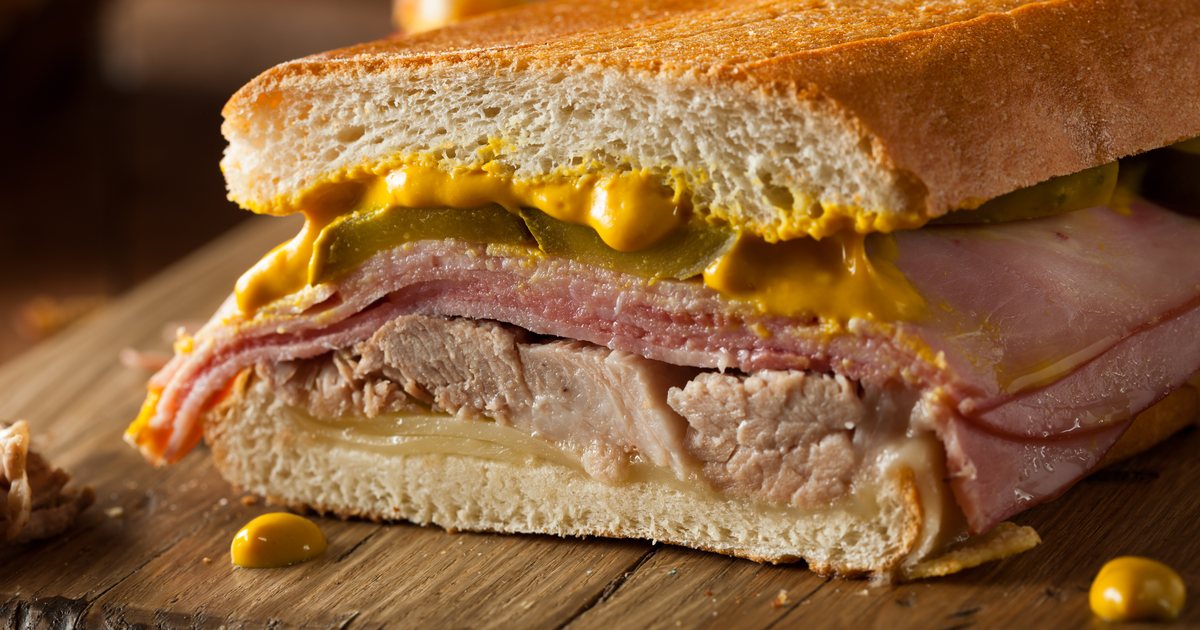
A Cuban sandwich layers mojo roast pork, ham, Swiss cheese, dill pickles and mustard on soft Cuban bread, then presses everything until crisp and melted. This recipe uses quick-roasting pork tenderloin, with optional Genoa salami for the Tampa version.
Cuban Sandwich at a Glance
What Is a Cuban Sandwich?
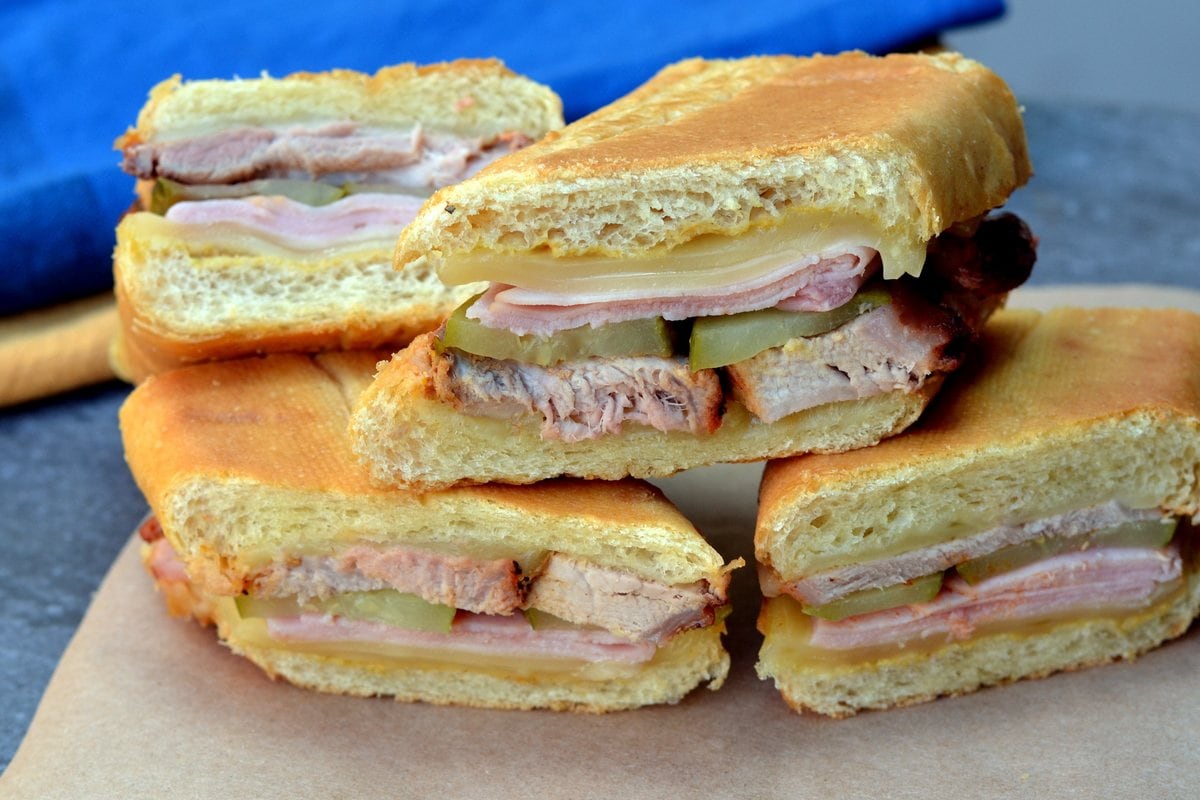
A Cuban sandwich is a pressed ham-and-pork sandwich on Cuban bread. Five fillings define it, and each one has a job: the roast pork brings garlic and citrus from its mojo marinade, the ham adds sweetness and salt, the Swiss cheese melts and glues the layers together, the pickles cut the richness with acid and crunch, and the yellow mustard ties it together with a sharp, vinegary bite. Pressing is not optional. It compresses the sandwich to about a third of its height, toasts the bread into a thin, crackly shell, and melts the cheese.
What is not on a traditional Cuban: mayonnaise, lettuce, tomato or onion. Those turn up in Key West and at chain restaurants, and most Cubans in Miami and Tampa will tell you they don’t belong.
Anatomy of a Cubano
- Cuban breadcrust buttered, pressed crisp
- Yellow mustardon both cut sides
- Dill pickle chipsone even layer
- Swiss cheesemelts into the pickles
- Genoa salamiTampa only
- Mojo roast porkthin-sliced, garlicky
- Sweet hamglazed or honey ham
- Swiss cheesesecond slice holds the base
- Yellow mustard
- Cuban breadbottom half
Cuban Sandwich Ingredients
| Ingredient | What to buy | If you can’t find it |
|---|---|---|
| Cuban bread | A long, soft white loaf with a thin crust, made with lard | Soft Italian or French bread (the supermarket kind, not a crusty baguette), or hoagie rolls |
| Roast pork | Mojo-marinated pork shoulder or leg (lechón asado), sliced thin | Pork tenderloin marinated in mojo (recipe below), or leftover pernil |
| Ham | Sweet glazed ham, sliced thin at the deli | Honey ham or any mild boiled ham |
| Cheese | Swiss, sliced thin | Emmental or Jarlsberg; avoid strong cheeses that fight the pork |
| Pickles | Dill pickle chips (sandwich-cut), patted dry | Any sour dill pickle; never sweet bread-and-butter pickles |
| Mustard | Plain yellow mustard | A mild deli mustard; Dijon is too sharp |
| Salami (Tampa) | Genoa salami, sliced thin | Leave it out for a Miami-style Cuban |
The Bread Makes the Sandwich
Cuban bread (pan cubano) looks like a baguette but eats very differently. The dough is enriched with lard, which gives it a soft, fluffy crumb and a paper-thin crust that turns glassy when it hits the press. Traditional loaves are about three feet long, and many Florida bakeries still lay a wet palmetto frond along the top before baking; it steams the surface and leaves the loaf’s signature split down the middle. In Tampa, La Segunda Central Bakery has been baking Cuban bread this way in Ybor City since 1915, and it ships loaves nationwide.

If you can’t get real Cuban bread, choose the softest long loaf you can find. A crusty artisan baguette or ciabatta is the most common mistake: it shatters and scrapes rather than pressing flat. For a closer match, brush the outside with butter before pressing, which mimics the richness of lard-based bread. Cuban bread is also what makes a proper café con leche breakfast, so buy an extra loaf.
The Pork Is the Soul
The roast pork in a Cuban sandwich is leftover lechón asado, pork shoulder marinated overnight in Cuban mojo (sour orange juice, lots of garlic, cumin and oregano) and roasted until tender. That citrus-garlic marinade is what separates a Cubano from an ordinary ham and cheese. If you roast a shoulder for Sunday dinner, the sandwiches the next day are the reward. If you are starting from scratch, a mojo-marinated pork tenderloin, as in the recipe below, gets you there in about an hour and a half.
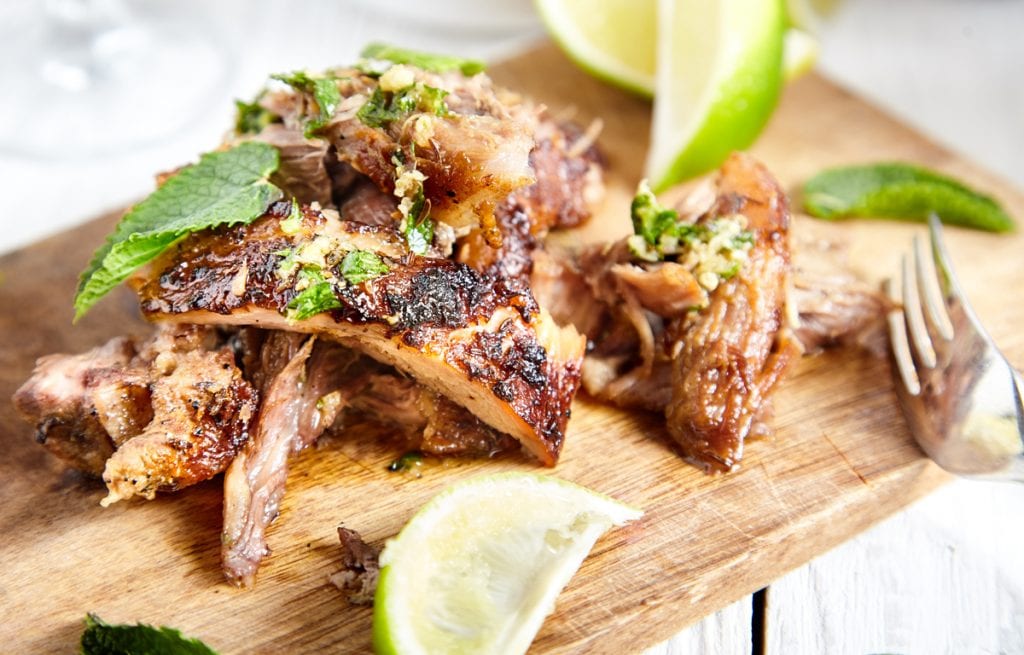
Sour orange (naranja agria) is sold bottled in Latin groceries, and Badia’s bottled sour orange is the easiest to find. Or mix equal parts orange juice and lime juice. A bottled marinade such as Goya mojo criollo works in a pinch.
How to Make a Cuban Sandwich
This method uses a quick mojo pork tenderloin, then the classic build and a hard press in a cast-iron skillet. The full recipe card with measurements and a print button follows these steps.
- Marinate the pork. Whisk sour orange juice, mashed garlic, salt, cumin, oregano, pepper and olive oil. Reserve ¼ cup in a separate container before adding the remaining mojo to the raw pork tenderloin. Refrigerate the pork for 1 to 4 hours.
- Roast and slice. Roast at 425°F for 20 to 25 minutes, until it reads 145°F inside. Rest 10 minutes, slice as thin as you can, and toss the slices with the reserved mojo.
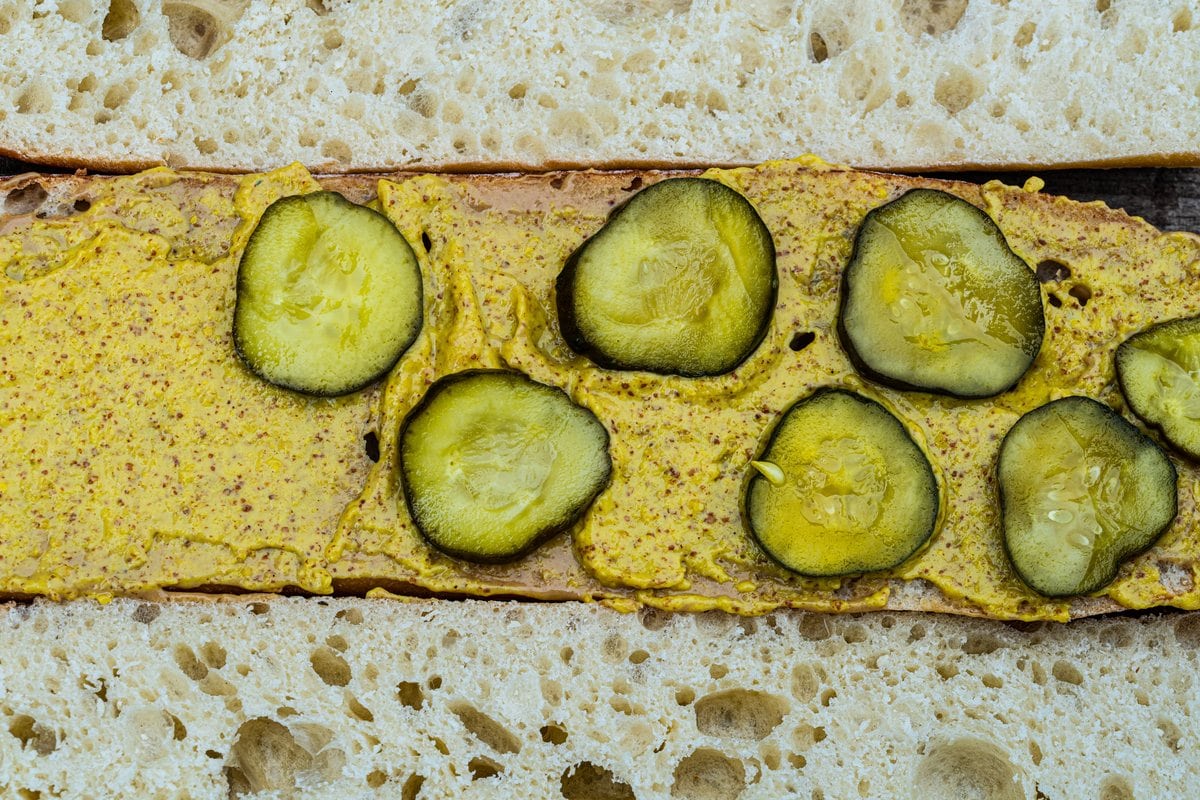
- Spread the mustard. Cut the bread into 8-inch lengths, split each one lengthwise, and spread yellow mustard on both cut sides.
- Build it. On the bottom half: a slice of Swiss, the ham, the pork, and salami if you’re making it Tampa-style. On the top half: pickle chips in one layer, then a second slice of Swiss. Close the sandwich.
- Butter the outside. Brush the top and bottom crust lightly with soft butter.
- Press. Set the sandwich in a medium-hot skillet or on a plancha, lay a second heavy skillet on top and press down. Cook 3 to 4 minutes per side, until the crust is deep golden, the sandwich is flat, and the cheese has melted.
- Cut on the diagonal and eat right away.
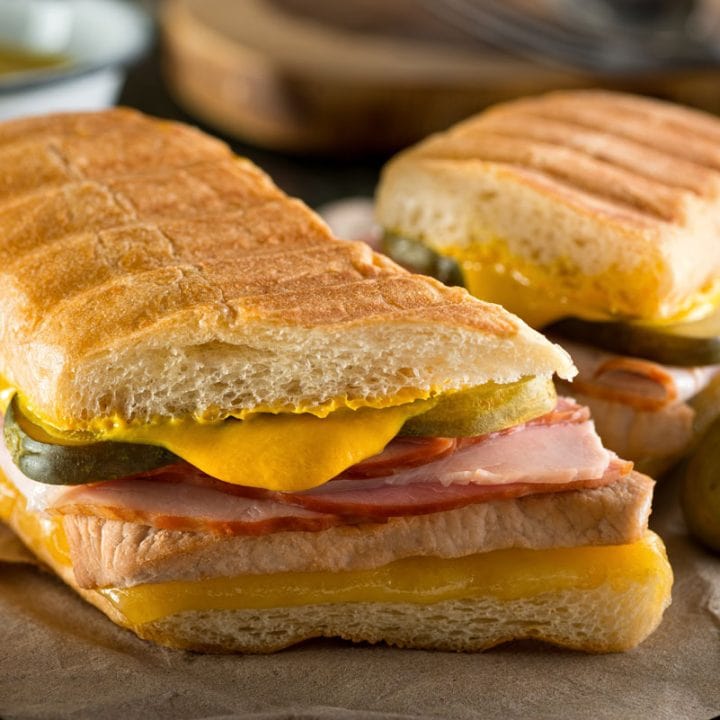
Cuban Sandwich (Cubano)
The classic Cuban sandwich: mojo-marinated roast pork, sweet ham, Swiss cheese, dill pickles and yellow mustard on Cuban bread, pressed until the crust is crisp and the cheese melts. Add Genoa salami for a Tampa-style Cuban.
Ingredients
For the mojo pork
- 1 pork tenderloin (about 1 1/4 pounds)
- 1/2 cup sour orange juice (naranja agria)
- 6 garlic cloves, mashed to a paste
- 1 teaspoon kosher salt
- 1/2 teaspoon ground cumin
- 1/2 teaspoon dried oregano
- 1/4 teaspoon black pepper
- 2 tablespoons olive oil
For the sandwiches
- 1 loaf Cuban bread (about 32 inches), or 4 soft 8-inch rolls
- 1/4 cup yellow mustard
- 8 ounces thinly sliced sweet ham
- 8 slices Swiss cheese
- 16 to 20 dill pickle chips, patted dry
- 2 ounces thinly sliced Genoa salami (optional, for Tampa style)
- 2 tablespoons unsalted butter, softened
Instructions
- Make the mojo. In a bowl, whisk the sour orange juice, garlic, salt, cumin, oregano, pepper and olive oil. Set aside 1/4 cup.
- Marinate. Put the pork in a zip-top bag, pour in the rest of the mojo, seal and refrigerate for 1 to 4 hours.
- Roast. Heat the oven to 425°F. Lift the pork out of the marinade, pat it dry and roast on a rack set in a sheet pan for 20 to 25 minutes, until it reads 145°F in the thickest part. Rest 10 minutes.
- Slice. Slice the pork as thinly as you can and toss it with the reserved 1/4 cup mojo.
- Prep the bread. Cut the bread into four 8-inch lengths and split each one lengthwise. Spread mustard on both cut sides.
- Build. On each bottom half, layer 1 slice of Swiss, a quarter of the ham, a quarter of the pork and, for Tampa style, the salami. On each top half, lay the pickle chips in one layer and cover with 1 slice of Swiss. Close the sandwiches.
- Butter. Brush the outside of each sandwich lightly with butter, top and bottom.
- Press. Heat a large cast-iron skillet or griddle over medium heat. Add two sandwiches, set a second heavy skillet on top and press down firmly. Cook 3 to 4 minutes, flip, press again and cook 3 to 4 minutes more, until the crust is deep golden, the sandwich is about a third of its original height and the cheese has melted. Repeat with the rest.
- Serve. Cut each sandwich in half on the diagonal and serve hot.
Notes
Leftover roast pork: Skip steps 1 to 4 and use about 1 pound of thinly sliced leftover lechón asado or pernil.
No sour orange? Use 1/4 cup orange juice plus 1/4 cup lime juice.
Bread: If you can't find Cuban bread, use a soft Italian or French loaf, not a crusty baguette.
Tampa or Miami: Leave out the salami for a Miami-style Cuban.
Make ahead: The sliced pork keeps 3 days in the refrigerator. Assemble the sandwiches without butter up to 4 hours ahead, wrap and chill, then press straight from the fridge, adding 1 minute per side.
How to Press a Cuban Sandwich Without a Press
Cuban cafeterias use a plancha: a flat, heavy, hinged griddle. Unlike a panini press, it has no ridges, so the whole crust toasts evenly. You don’t need one.
| Method | How | Result |
|---|---|---|
| Two skillets | Cook in a cast-iron skillet with a second heavy skillet on top; press with your hand. Flip halfway. | The closest thing to a plancha at home. |
| Grill press | Use a flat cast-iron grill press on a skillet or griddle. | Even pressure, easy to handle. Works well for two at a time. |
| Foil-wrapped brick | Wrap a clean brick in foil, set it on a small sheet pan on top of the sandwich. | Old-school and effective. |
| Panini press | Close the lid and press firmly; add a few more minutes. | Fine, but the grooves leave stripes rather than an even crust. |
| Sandwich press | A flat-plate Cuban sandwich press. | Worth it if you make Cubanos every week. |
Tips for the best Cuban sandwich
Pat the pickles dry so the bread doesn’t go soggy. Bring the fillings to room temperature for 15 minutes so the cheese melts before the crust burns. Keep the heat at medium: too hot and the outside scorches while the middle stays cold. Press hard at the start, then keep steady weight on it. And slice the meats thin: several thin layers press and melt far better than one thick slab.
Cuban Sandwich History: Born in Cuba, Raised in Florida
Nobody wrote down the first Cuban sandwich, but its story follows the cigar trade. In the late 1800s, thousands of Cuban workers moved between Havana and the cigar factories of Key West, and then to Tampa, where Vicente Martinez-Ybor built his factories and founded Ybor City in 1886. Spanish and Italian immigrants followed. By around 1900, the cafés that fed the workers of Ybor City and West Tampa were selling a long, pressed sandwich of pork, ham and cheese on Cuban bread, and those are the earliest descriptions of it we have. Tampa historian Loy Glenn Westfall put it neatly: the sandwich was “born in Cuba and educated in Key West.”
Tampa made it its own. The Italian community added Genoa salami, and by the 1930s travel writers were calling the Cuban sandwich a Tampa signature food. The wider story of Cuban food in Florida followed the same path. Columbia Restaurant, opened in Ybor City in 1905 by Cuban immigrant Casimiro Hernandez Sr., still serves a Cuban with salami and says its version may be the oldest in the country.
Miami’s turn came after 1959, when Cuban exiles arrived in large numbers. By the 1960s the sandwich was on the counter of every Cuban cafeteria and ventanita in the city, usually without salami, and it spread from there across the United States. Today you’ll find Cuban sandwiches at Florida supermarkets, in food trucks (the 2014 film Chef made a Cubano its star), and at the best Cuban restaurants in Miami.

Tampa vs. Miami vs. Key West Cuban Sandwiches
In April 2012 the Tampa City Council passed a resolution naming the “Historic Tampa Cuban Sandwich” the city’s signature sandwich, spelling out sweet ham, mojo-marinated roast pork, Genoa salami, Swiss cheese, dill pickles and mustard on Cuban bread. Miami politicians answered that salami has no place on a Cuban, and the friendly feud has been running ever since. Here is how the three styles compare.
With salami
The “Historic Tampa Cuban,” as defined by the city.
- Genoa salami with the pork and ham
- Pressed on Ybor City Cuban bread
- Columbia Restaurant and La Segunda keep the style alive
No salami
The version most of the country knows.
- Pork, ham, Swiss, pickles, mustard
- Pressed hard on a plancha
- Buttered crust is common
Dressed
The island’s looser take.
- Often adds mayonnaise
- Lettuce and tomato are common
- Traditionalists in Tampa and Miami disapprove
Which is authentic? Both Tampa and Miami have a real claim. The Tampa version is older on paper; the Miami version is what most Cubans who arrived after 1959 grew up eating. Make it both ways and decide for yourself. August 23 has become an unofficial National Cuban Sandwich Day, which is as good an excuse as any.
Cuban Sandwich vs. Medianoche and Other Cuban Sandwiches
The Cubano has a family. The closest relative is the medianoche, the “midnight” sandwich from Havana’s nightclubs, which uses the same fillings on a soft, sweet egg bread. Our side-by-side of the Cuban sandwich vs. medianoche goes into the details.
| Sandwich | Bread | Filling | How it’s served |
|---|---|---|---|
| Cuban (Cubano) | Cuban bread | Roast pork, ham, Swiss, pickles, mustard (+ salami in Tampa) | Pressed, cut on the diagonal; lunch |
| Medianoche | Sweet egg bread, shorter roll | Same as the Cuban | Pressed; late-night snack |
| Pan con lechón | Cuban bread | Roast pork, mojo, sautéed onions | Pressed or not; no ham or cheese |
| Elena Ruz | Medianoche bread | Turkey, cream cheese, strawberry jam | Toasted; a Havana classic |
| Frita cubana | Cuban roll | Seasoned beef-and-chorizo patty, shoestring potatoes | Griddled; Miami’s Cuban burger |

Pressed sandwiches are a whole tradition across Latin America. If you like the Cubano, try Puerto Rico’s plantain-bread jibarito, Peru’s pan con chicharrón or Brazil’s misto quente, and browse our guide to Latin sandwiches.
What to Serve With a Cuban Sandwich
A Cuban is a full meal on its own, but in a Miami cafeteria it rarely arrives alone. Classic sides:
- Mariquitas, thin fried plantain chips, often with a garlicky mojo for dipping
- Tostones or sweet maduros
- Cuban black bean soup for a heartier lunch
- Yuca con mojo or yuca fries
- More ideas in our Cuban side dishes roundup

To drink, grab an ice-cold Materva or Jupiña from our list of Latin sodas or another pick from our Cuban drinks guide, and finish with a cortadito or a shot of Cuban coffee.
Make Ahead and Storage
Roast and slice the pork up to 3 days ahead and keep it refrigerated with its mojo. You can assemble the sandwiches (without butter) a few hours ahead, wrap them tightly, and refrigerate; press them straight from the fridge, adding a minute per side. Pressed Cuban sandwiches are best eaten immediately. Leftovers keep a day in the fridge; reheat them in a dry skillet with a weight on top, never in the microwave, which turns the crust leathery.
Frequently Asked Questions
What is on a Cuban sandwich?
Roast pork (usually mojo-marinated), sweet ham, Swiss cheese, dill pickles and yellow mustard on Cuban bread, pressed until crisp. Tampa’s version adds Genoa salami.
What is the difference between a Cuban sandwich and a Cubano?
None. “Cubano” is simply the Spanish name for the Cuban sandwich. In Cuba itself, a ham, pork and cheese sandwich was just a sandwich; it was in Florida that it became “the Cuban.”
Does a Cuban sandwich have mayo?
Not traditionally. A classic Cuban uses only yellow mustard. Mayonnaise shows up in Key West and at some chains, but Tampa and Miami purists leave it off.
Why does a Tampa Cuban sandwich have salami?
Ybor City, where the Tampa Cuban grew up, was home to Cuban, Spanish and Italian cigar workers. The Italian community is usually credited with adding Genoa salami, and the city made it official in its 2012 resolution.
What bread is used for a Cuban sandwich?
Cuban bread: a long, soft white loaf made with lard, with a thin crust and a split down the top from a palmetto frond laid on it before baking. Soft Italian or French bread is the best substitute.
Can I make a Cuban sandwich without a press?
Yes. Cook it in a skillet with a second heavy skillet, a foil-wrapped brick or a grill press on top, pressing down firmly, 3 to 4 minutes per side.
What cheese goes on a Cuban sandwich?
Swiss cheese. It melts smoothly and its mild, nutty flavor doesn’t compete with the pork and pickles. Emmental and Jarlsberg are good substitutes.
What’s the difference between a Cuban and a medianoche?
The fillings are the same. The medianoche is made on a smaller, softer and sweeter egg bread and was traditionally eaten late at night in Havana; the Cuban uses crusty Cuban bread.
Keep Exploring Cuban Food
- Cuban FoodThe dishes every visitor should try
- Cuban Main DishesRopa vieja, lechón, picadillo and more
- Cuban IngredientsThe essentials of the Cuban pantry
- Ropa ViejaCuba’s national dish
- Cuban PicadilloWeeknight ground beef, Havana-style
- Cuban Breakfast FoodsTostada, café con leche and pastelitos
Sources
- Wikipedia: Cuban sandwich
- WUSF: A Historic Vote for Tampa’s Cuban Sandwich, Pressed or Cold
- Wikipedia: La Segunda Central Bakery
- Michelin Guide: Columbia Restaurant and its Cuban sandwich
More Cuban Foods
See all →
Jorge Garcia is the founder of AmigoFoods, where he has spent over 20 years helping readers discover authentic Latin American and Spanish cuisine. Raised in a Cuban-American household, Jorge learned to cook at the hands of his mother and grandmother, carrying forward generations of family recipes. That heritage, backed by his family’s four-generation history in the Latin food industry, inspired him to launch AmigoFoods in 2003. With more than 1,000 published articles on recipes, ingredients, and food culture, Jorge’s mission is simple: make authentic Latin cooking approachable for home cooks everywhere while honoring the traditions behind every dish.