
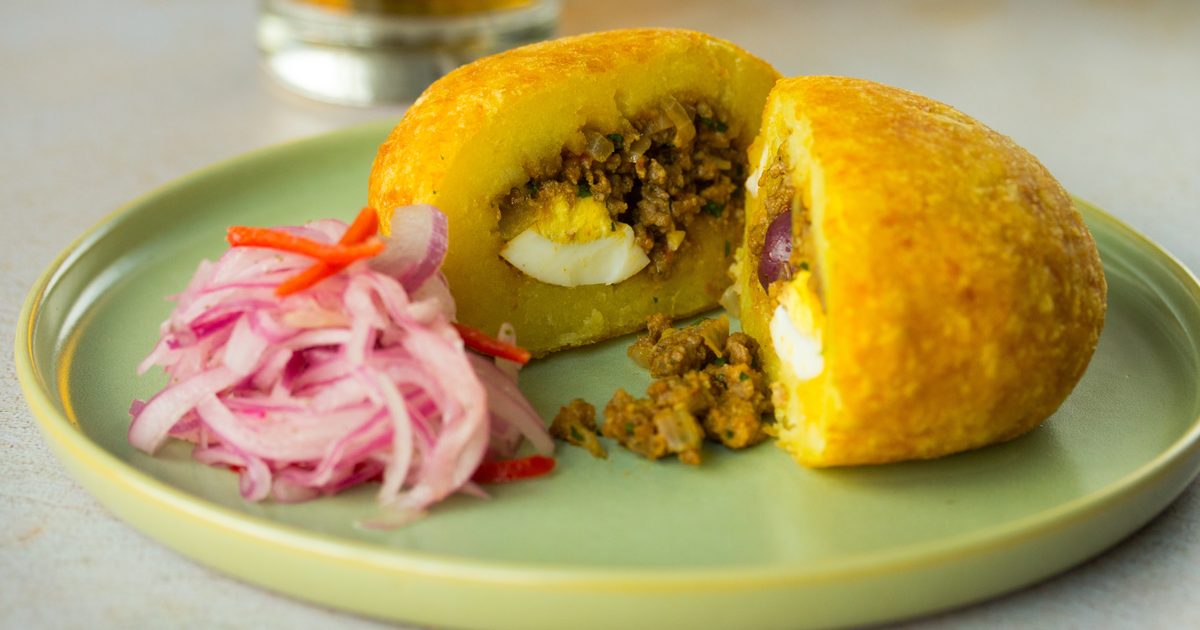
Papa rellena is Peru’s golden stuffed potato: seasoned mashed potato wrapped around ground beef cooked with ají panca, raisins, black olives and hard-boiled egg, shaped into an oval and fried until crisp. It’s a Lima street-food classic served with tangy salsa criolla, and this recipe shows you how to make one that holds together in the oil.
Papa Rellena at a Glance
AmigoFoods may earn a commission from qualifying Amazon purchases made through links on this page.
What is papa rellena?

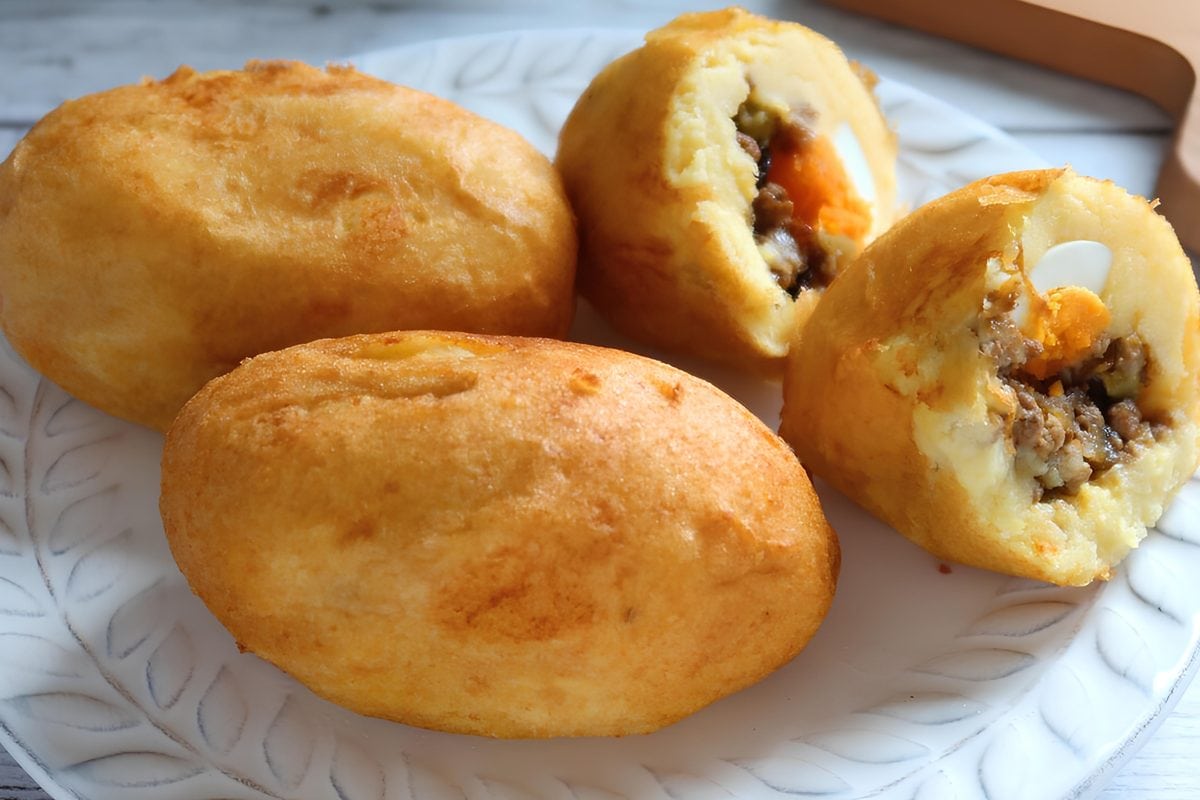
Papa rellena means “stuffed potato.” In Peru it’s a croquette-like oval of mashed potato with a savory beef filling hidden inside, dusted in flour and fried until the outside turns into a thin, crisp, golden shell while the potato inside stays soft.
The filling is what makes it Peruvian. Ground beef is cooked in an aderezo of onion, garlic and ají panca, the smoky, mild red pepper that gives the meat its deep color, then studded with sweet raisins, salty black olives and a piece of hard-boiled egg. Every bite is a little sweet, a little salty and rich.
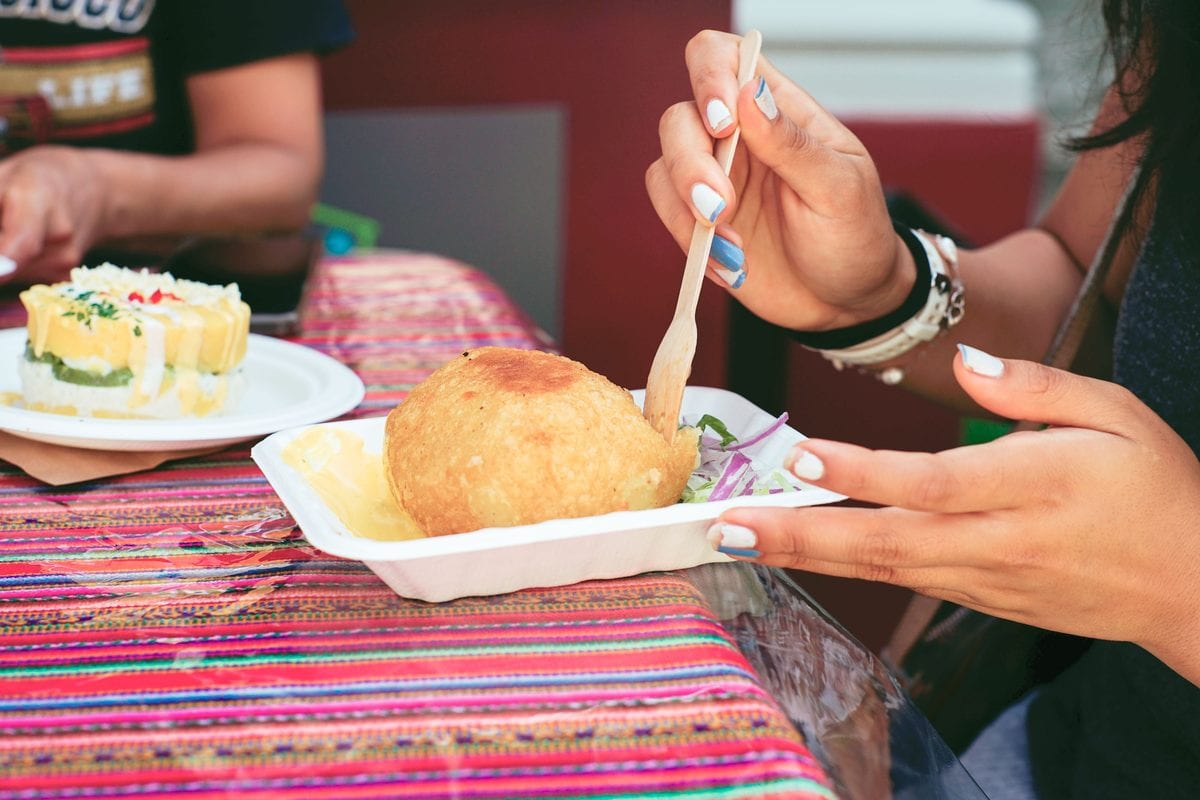
It belongs to Lima’s comida criolla, the everyday Creole cooking of the coast. You’ll find it fried fresh at market stalls and corner eateries, sold as a snack, and served at home as an entrada (starter) or as a full lunch with white rice. It’s one of the classic Peruvian street foods and a cousin of other potato favorites like causa and pastel de papa.
Where papa rellena comes from
No one has documented exactly when the first papa rellena was made. What’s clear is that it combines two traditions: the potato, which was first domesticated in the Andes thousands of years ago, and the Spanish habit of stuffing dough, vegetables and pastries with seasoned minced meat, the same instinct behind empanadas and rocoto relleno.
You’ll often read that Peruvian soldiers invented it during the War of the Pacific (1879–1884), wrapping seasoned meat in boiled potatoes so it would keep on long marches. It’s a good story, but there’s no solid record behind it, so treat it as kitchen folklore. Today the dish is cooked all over Latin America, and each country has made it its own.
Peruvian vs. Cuban, Puerto Rican and Colombian papas rellenas
If you grew up in Miami, San Juan or Bogotá, your papa rellena probably looks different from Lima’s. Here’s how the four best-known versions compare.
| Shape | Filling | Coating | Served with | |
|---|---|---|---|---|
| Peru | Long oval | Beef with ají panca, cumin, raisins, olives, hard-boiled egg | Flour, sometimes egg and flour | Salsa criolla, lime, ají; rice as a main |
| Cuba | Round ball | Picadillo (beef in tomato sofrito, often olives and raisins) | Egg, then breadcrumbs or cracker meal | On its own, with hot sauce or a cafecito |
| Puerto Rico | Round ball | Ground beef picadillo with sofrito, sometimes cheese | Flour or cornstarch | As a fritura (fried snack) |
| Colombia | Round ball | Seasoned ground meat, often with rice and hard-boiled egg | Thin flour batter, often tinted with achiote | Ají picante or hogao |
Cuban papas rellenas

Cuban papas rellenas are round potato balls filled with picadillo, rolled in egg and breadcrumbs or cracker meal, and fried until crunchy. They’re a staple of Miami cafeteria counters, eaten as a snack or alongside rice and beans, and you’ll find them in our roundup of Cuban side dishes.
Puerto Rican rellenos de papa

In Puerto Rico the dish is usually called rellenos de papa. The potato is often bound with egg and a little cornstarch, wrapped around sofrito-seasoned picadillo (sometimes with a cube of cheese), and fried as one of the island’s favorite frituras. See more in our guide to Puerto Rican food.
Colombian papas rellenas

Colombian papas rellenas are round and usually coated in a thin flour batter, which gives them a puffy, golden crust. The filling often stretches the meat with rice and chopped hard-boiled egg, and they’re served with spicy ají or hogao. They’re one of the country’s favorite bakery and street snacks; see our guide to Colombian snacks.
Ingredients for papa rellena

The full quantities are in the recipe card below. Here’s what each part does.
- Potatoes: starchy russets or all-purpose Yukon Golds. More on choosing them below.
- Ground beef: 85% lean is ideal. Some Lima cooks finely chop steak by hand instead, which gives a meatier bite.
- Ají panca paste: the flavor that makes it Peruvian. It’s mild, fruity and smoky, not hot. Look for Inca’s Food ají panca paste. In a pinch, use ancho chile paste, but the color and flavor won’t be quite the same.
- Onion, garlic, cumin and oregano: the aderezo, the cooked flavor base behind most Peruvian stews.
- Raisins and black olives: the sweet-and-salty contrast. Peruvian botija olives are traditional; botija olives are sold online, and Kalamata olives are the best supermarket swap.
- Hard-boiled eggs: chopped into the filling or tucked into the center of each potato.
- Flour and oil: a light coat of flour is what turns into the crisp shell. Use a neutral oil with a high smoke point for frying.
The best potatoes for papa rellena

In Peru, cooks use papa blanca (a white potato) or papa amarilla, the buttery yellow potato also used for causa. In the US, the closest matches are:
- Russet potatoes: dry and starchy, they make a dough that molds easily and holds its shape. Best choice for beginners.
- Yukon Gold potatoes: creamier and more flavorful, closer to papa amarilla. If the dough feels soft, mix in an egg yolk or a spoonful of flour.
- Avoid waxy red potatoes and fingerlings. They turn gluey when mashed and the dough cracks or slumps in the oil.
Boil the potatoes whole in their skins so they don’t soak up water, and never add milk or butter. A papa rellena dough is closer to a gnocchi dough than to mashed potatoes for dinner.
How to make papa rellena
1. Boil and rice the potatoes while hot
Cover the whole, unpeeled potatoes with cold salted water and simmer for 20 to 30 minutes, until a knife slides in easily. Drain, peel while they’re still hot (hold them with a towel or fork), and pass them through a potato ricer or mash until completely smooth. Mashing hot is the single most important step: hot potatoes are elastic and bind together, while cold ones turn crumbly. Season with salt, spread on a plate, cover with a towel and let cool.
2. Cook the filling
Heat the oil in a skillet over medium heat. Cook the onion until soft and translucent, about 6 minutes. Add the garlic, ají panca, cumin, oregano and tomato paste and stir for 3 to 4 minutes, until the paste darkens and smells toasty. Add the beef, breaking it up, and cook until browned. Stir in the raisins and broth and simmer until the pan is almost dry. Take it off the heat, stir in the olives and parsley, and season.
3. Cool everything
Let the filling cool to room temperature, then fold in the chopped eggs. A dry, cool filling is essential. Warm, wet filling steams inside the potato and pushes it open in the fryer.
4. Shape the papas rellenas
Divide the potato dough into 8 equal portions, each about the size of a tennis ball. With lightly floured hands, flatten one portion into an oval about ½ inch thick, cup it in your palm, and spoon about 2 tablespoons of filling into the center. Fold the edges up and over, pinch the seam closed, and roll it gently into a smooth oval about 4 inches long. Smooth any cracks with a damp fingertip. Set them on a floured tray and refrigerate for 15 to 20 minutes to firm up.
5. Coat in flour
Roll each papa rellena in flour and tap off the excess. For a sturdier, crunchier shell, dip it in beaten egg and roll it in flour a second time. This double coat is extra insurance if your potatoes were soft.
6. Fry until golden
Heat 2 to 3 inches of oil in a heavy pot to 350°F (175°C). Fry two or three at a time for 3 to 4 minutes, turning gently with two spoons, until deep golden all over. Don’t crowd the pot: too many at once drops the oil temperature, and that’s when they absorb oil and split. Drain on a wire rack and let them rest for a couple of minutes before serving.
Why papa rellena falls apart (and how to fix it)
This is the number one problem people have with papa rellena. It almost always comes down to one of these:
- The potatoes were mashed cold. Rice or mash them as soon as they’re peeled. If the dough is already crumbly, knead in an egg yolk.
- The potatoes were watery. Boil them whole in their skins, never peeled and cubed, and skip the milk and butter.
- The filling went in warm or wet. Cook it until the pan is dry and let it cool completely.
- The seams weren’t sealed. Pinch the seam closed and smooth every crack before coating.
- The oil wasn’t hot enough. Below 340°F the crust sets too slowly. Use a thermometer and fry in small batches.
- They went straight from your hands into the oil. Chilling the shaped potatoes for 15 to 20 minutes firms them up noticeably.
Air fryer and baked papa rellena
Deep frying gives the most even golden shell, but you can make a lighter version:
- Air fryer: coat in flour (the egg-and-flour double coat works best here), spray all over with oil, and air fry at 400°F (200°C) for 12 to 15 minutes, turning halfway, until golden.
- Oven: place on an oiled baking sheet, brush with oil, and bake at 425°F (220°C) for 20 to 25 minutes, turning once.
Both methods produce a patchier, less crunchy crust than frying, but the potato and filling taste the same.
What to serve with papa rellena

- Salsa criolla: the classic partner. This quick relish of thin-sliced red onion, lime juice, cilantro and ají is sharp and crunchy, cutting right through the fried potato. Here’s our salsa criolla recipe.
- Something spicy: papa rellena itself isn’t hot, so Peruvians add heat at the table with an ají sauce. A jar of Sanniti ají amarillo and rocoto pepper spread covers both mild-fruity and fiery, or use ají amarillo to make your own sauce.
- White rice: turns two papas rellenas into a full lunch, the way many Lima families eat it.
- A cold drink: pair it with chicha morada, Peru’s purple corn drink, or another of our favorite Peruvian drinks.

Make ahead, freezing and reheating
- Make ahead: the filling keeps up to 2 days in the fridge, and the flavor improves. Shaped, floured papas rellenas can wait in the fridge, covered, for up to 1 day before frying.
- Refrigerate: fried leftovers keep 3 to 4 days in a sealed container.
- Reheat: in an air fryer or a 350°F (175°C) oven for 10 to 15 minutes, until crisp outside and hot in the center. The microwave makes the crust soggy.
- Freeze: freeze shaped, floured, unfried papas rellenas on a tray, then bag them for up to 2 months. Thaw overnight in the fridge and fry as usual. If you plan to freeze them, leave out the hard-boiled egg, which turns rubbery in the freezer.
Papa rellena FAQ
What is papa rellena in English?
Papa rellena means “stuffed potato.” In English it’s usually called a Peruvian stuffed potato or a stuffed potato croquette.
Is papa rellena Peruvian or Cuban?
Both. Peru, Cuba, Puerto Rico and Colombia each have their own version. The Peruvian one is oval and seasoned with ají panca, olives and egg; the Cuban one is a round, breaded ball filled with picadillo.
Is papa rellena spicy?
No. Ají panca adds color and a smoky flavor but very little heat. The spice comes from the ají sauce served on the side.
Why is my papa rellena falling apart?
Usually the potatoes were mashed cold or were too wet, the filling was still warm, or the oil wasn’t hot enough. Mash the potatoes hot, cool the filling, seal the seams, chill before frying, and fry at 350°F in small batches.
Can I make papa rellena without egg?
Yes. Leave the hard-boiled egg out of the filling and coat the potatoes in flour only. If the dough needs extra binding, knead in a spoonful of flour instead of the yolk.
What’s the difference between papa rellena and causa?
Both start with mashed potato, but causa is a cold, layered dish seasoned with lime and ají amarillo and filled with chicken, tuna or seafood salad. Papa rellena is shaped around a hot beef filling and fried.
Can you freeze papa rellena?
Yes. Freeze them shaped and floured but not fried, without the egg, for up to 2 months. Thaw in the fridge overnight, then fry.
Papa Rellena Recipe
Papa Rellena (Peruvian Stuffed Potatoes)
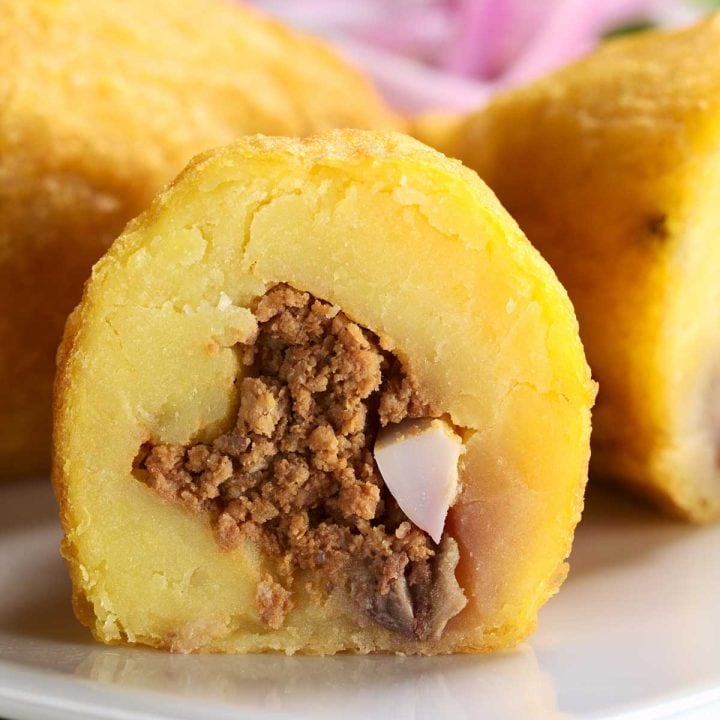
Golden Peruvian stuffed potatoes: seasoned mashed potato wrapped around ground beef cooked with ají panca, raisins, black olives and hard-boiled egg, then fried until crisp and served with salsa criolla.
Ingredients
For the potato dough
- 2 lb (900 g) russet or Yukon Gold potatoes, unpeeled
- 1 teaspoon salt
- 1 egg yolk (optional, if the dough is crumbly)
For the filling
- 2 tablespoons vegetable oil
- 1 medium red onion, finely chopped (about 1 cup)
- 3 garlic cloves, minced
- 2 tablespoons ají panca paste
- 1 teaspoon ground cumin
- ½ teaspoon dried oregano
- 1 tablespoon tomato paste
- ½ lb (225 g) ground beef
- ¼ cup raisins
- ¼ cup beef broth or water
- 8 black olives (botija or Kalamata), pitted and chopped
- 2 tablespoons chopped fresh parsley
- 2 hard-boiled eggs, chopped
- Salt and black pepper, to taste
For coating and frying
- ½ cup all-purpose flour
- 1 egg, beaten (optional, for a double coat)
- Vegetable oil, for frying
To serve
- Salsa criolla and lime wedges
- Cooked white rice (optional, to serve as a main)
Instructions
- Put the unpeeled potatoes in a large pot, cover with cold salted water and simmer 20 to 30 minutes, until a knife slides in easily. Drain and peel while hot.
- Immediately pass the hot potatoes through a ricer or mash until completely smooth. Mix in the 1 teaspoon salt, spread on a plate, cover with a towel and let cool to room temperature. If the dough feels crumbly, knead in the egg yolk.
- Meanwhile, heat 2 tablespoons oil in a skillet over medium heat. Cook the onion until soft, about 6 minutes. Add the garlic, ají panca paste, cumin, oregano and tomato paste and cook 3 to 4 minutes, stirring, until the paste darkens.
- Add the ground beef, break it up and cook until browned, 6 to 8 minutes. Add the raisins and broth and simmer until the pan is almost dry, about 5 minutes. Remove from the heat, stir in the olives and parsley, and season with salt and pepper. Let cool completely, then fold in the chopped eggs.
- Divide the potato dough into 8 equal portions. With floured hands, flatten one portion into an oval about ½ inch thick, add about 2 tablespoons of filling, fold the dough over and pinch the seam closed. Roll into a smooth oval about 4 inches long and smooth any cracks. Repeat, then refrigerate on a floured tray for 15 to 20 minutes.
- Roll each papa rellena in flour and tap off the excess. For a sturdier crust, dip in the beaten egg and roll in flour again.
- Heat 2 to 3 inches of oil in a heavy pot to 350°F (175°C). Fry 2 or 3 at a time for 3 to 4 minutes, turning gently, until deep golden all over. Drain on a wire rack.
- Serve hot with salsa criolla and lime wedges, and white rice if serving as a main.
Notes
Potatoes: russets are the easiest to shape; Yukon Golds are creamier. Avoid waxy red potatoes. Never add milk or butter to the dough.
To keep them from falling apart: mash the potatoes while hot, cool the filling completely, keep the potato wall at least ½ inch thick, chill before frying and don't crowd the pot.
Air fryer: spray with oil and air fry at 400°F (200°C) for 12 to 15 minutes, turning halfway. Oven: bake on an oiled sheet at 425°F (220°C) for 20 to 25 minutes, turning once.
Storage: refrigerate fried leftovers up to 4 days and reheat in an air fryer or 350°F oven until hot in the center. To freeze, freeze shaped, floured, unfried papas rellenas (made without the egg) for up to 2 months; thaw overnight in the fridge and fry.
More Peruvian recipes
Keep cooking with lomo saltado, Peru’s famous beef stir-fry, or anticuchos, grilled skewers from the same street-food tradition. For more starters, see our Peruvian appetizers, papa a la huancaína and our list of Peruvian side dishes, then explore all 47 dishes in our guide to Peruvian food.
More Peruvian Foods
See all →
Jorge Garcia is the founder of AmigoFoods, where he has spent over 20 years helping readers discover authentic Latin American and Spanish cuisine. Raised in a Cuban-American household, Jorge learned to cook at the hands of his mother and grandmother, carrying forward generations of family recipes. That heritage, backed by his family’s four-generation history in the Latin food industry, inspired him to launch AmigoFoods in 2003. With more than 1,000 published articles on recipes, ingredients, and food culture, Jorge’s mission is simple: make authentic Latin cooking approachable for home cooks everywhere while honoring the traditions behind every dish.