

A tortilla press (prensa para tortillas or tortilladora) is a hinged pair of flat plates that squeezes a ball of corn masa into a thin, even round in about two seconds. Put a ball of dough between two sheets of plastic, close the top plate, pull the handle down, and you have a tortilla ready for the comal. It is the one tool that makes fresh corn tortillas a weeknight thing instead of a weekend project. This guide covers how to use one step by step, how to fix tortillas that crack or stick, and which presses are worth buying.
Tortilla Press at a Glance
AmigoFoods may earn a commission from qualifying Amazon purchases made through links on this page.
What is a tortilla press?
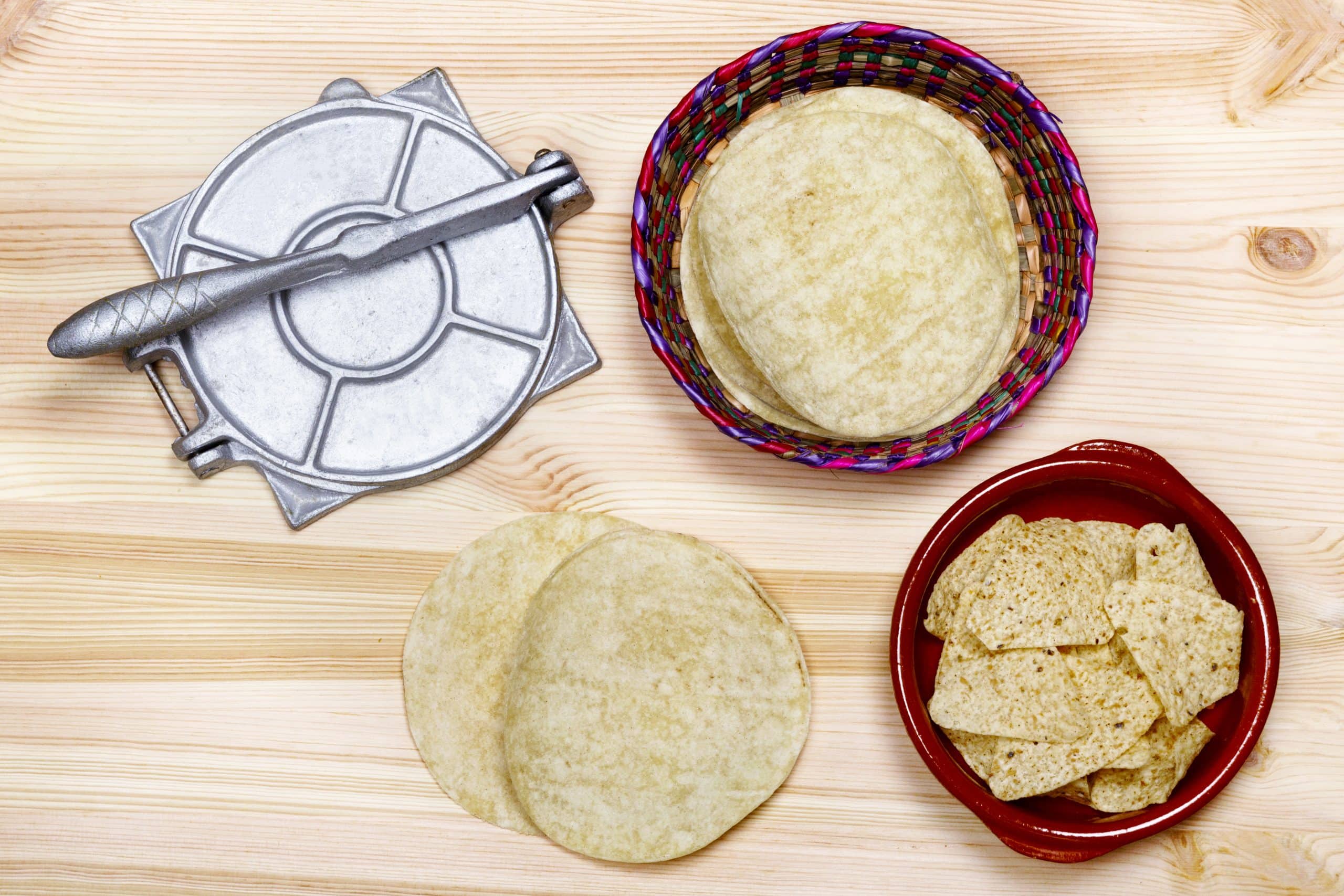
A tortilla press has three parts: a flat base plate, a flat top plate joined to it by a hinge, and a lever handle that folds over the top plate and pushes it down. The lever multiplies the pressure from your hand, and a heavy press adds its own weight, so the masa spreads evenly from the center out. Traditional presses in Mexico were carved from mesquite or other hardwoods. Today most are cast iron or cast aluminum, with a few made of steel or wood.
It is built for corn masa, the dough made from nixtamalized corn, either fresh masa or masa harina mixed with water. Corn masa has no gluten, so it stays wherever you press it. That is why a press works so well for corn tortillas and less well for flour tortillas, which we cover below.
How to use a tortilla press, step by step
This is the method most Mexican cooks and the press makers themselves describe. For the full dough recipe and how to get tortillas to puff, see our guide to making soft, puffed corn tortillas, or jump to the short recipe card below.
- Make the masa and let it rest. Mix masa harina with warm water and a pinch of salt until it feels like soft Play-Doh: smooth, springy and not sticky. Cover it and let it rest 15 to 20 minutes so the corn flour fully hydrates. Most cracking problems start here.
- Cut the liner. Cut a gallon zip-top freezer bag along both sides so it opens like a book, or cut two squares from a thin produce bag. Plastic wrap wrinkles and tears, so skip it. If you make tortillas often, reusable liners like Masienda’s press liners have a printed ruler that shows tortilla size.
- Portion the dough. Roll balls about 1 1/4 inches across, roughly 1 ounce (28 to 30 grams), a little smaller than a golf ball. That size gives a 5 1/2- to 6-inch tortilla in an 8-inch press. Keep the balls under a damp towel so they do not dry out.
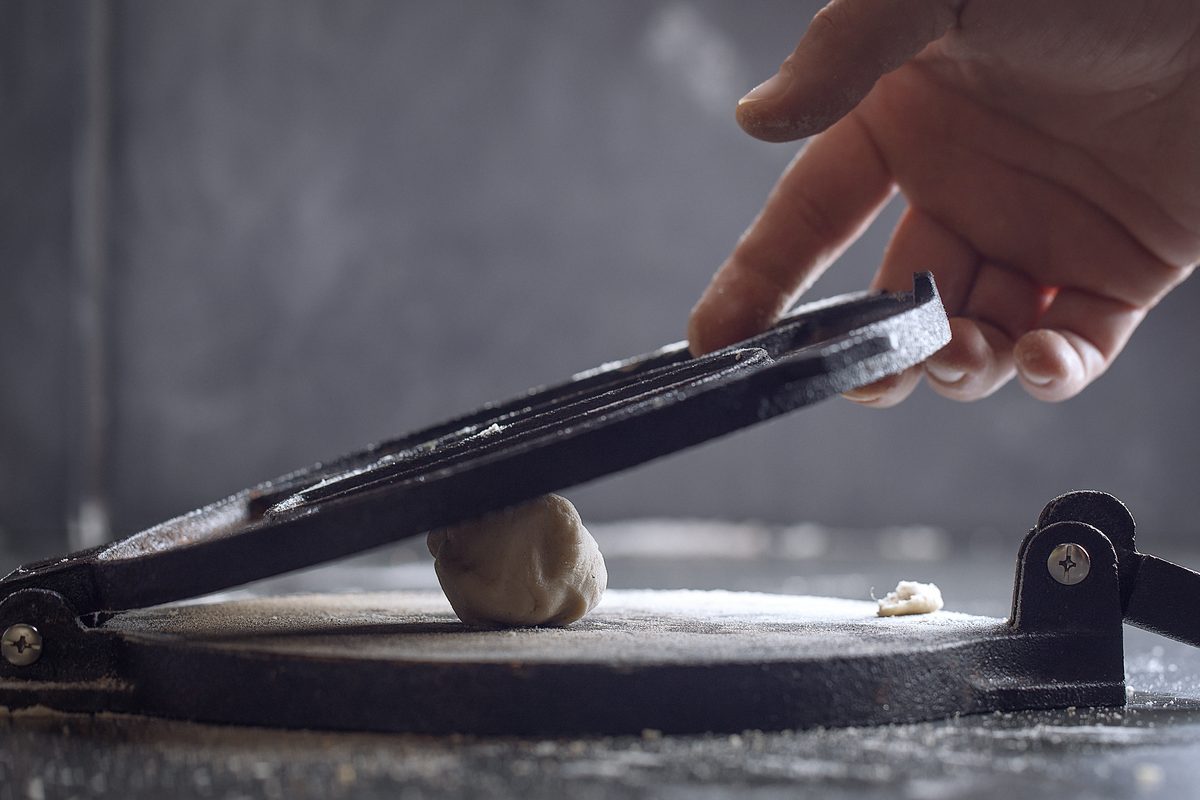
- Place the ball off center. Open the press, lay one sheet of plastic on the base and set the ball slightly toward the hinge, not in the exact middle. The hinge side gets the most pressure, and starting the ball there gives you a rounder, more even tortilla. Cover with the second sheet.
- Press gently. Close the top plate, fold the handle over and push down with steady, moderate pressure. On a heavy cast-iron press, the weight does most of the work. Pressing as hard as you can makes tortillas too thin to peel off.
- Rotate and press again. Open the press, turn the tortilla (still in the plastic) 180 degrees and press once more. This evens out the thickness, which matters because nearly every press is a little thinner at the hinge side.
- Peel and cook. Peel off the top sheet. Flip the tortilla onto your fingers, plastic side up, peel off the second sheet and lay the tortilla on a comal or cast-iron skillet heated to at least 400°F. Cook about 20 to 30 seconds until the edges dry, flip, cook 30 to 45 seconds, then flip again and press lightly with a towel to help it puff.

Troubleshooting: cracked, sticky or thick tortillas
Almost every problem traces back to the water in the dough or the pressure on the handle.
| Problem | Likely cause | Fix |
|---|---|---|
| Edges crack or split | Masa too dry | Knead in warm water 1 tablespoon at a time until the dough feels soft and springy. Keep balls covered. |
| Sticks to the plastic | Masa too wet, or a thick zip-top bag | Knead in masa harina 1 tablespoon at a time. Try a thinner liner. |
| Tears when you peel it | Pressed too thin | Use less pressure, or press only once. |
| Thick on one side | Ball placed in the center, or a press with a gap at the hinge | Start the ball toward the hinge and rotate 180 degrees for a second press. |
| Too thick everywhere | Light press, or a ball that is too big | Use smaller balls and press twice. Light aluminum presses need more push from you. |
| Will not puff | Comal not hot enough, dry masa, or a tortilla pressed too thick | Heat the comal to at least 400°F and use the second flip. Fix the hydration first. |
Cast iron vs. aluminum vs. wood vs. electric
The material decides how much a press weighs, and weight decides how even your tortillas are and how much effort they take. America’s Test Kitchen and Serious Eats both found the heavy presses easiest to use. Serious Eats weighed its presses at about 8 pounds for the Victoria, 6 3/4 pounds for the IMUSA cast iron, under 5 pounds for the Central Coast wood press and under 2 pounds for a light aluminum press, which it found too light.
| Type | Typical weight | Pros | Cons | Best for |
|---|---|---|---|---|
| Cast iron | 7 to 11 lb | Weight does the work; even tortillas; lasts generations | Can rust if stored wet; heavy to move | Anyone who makes corn tortillas often |
| Steel | About 10 lb | Very heavy and flat; powder-coated or stainless, so no seasoning | Expensive and hard to find; most stainless presses on Amazon are commercial models with few reviews | Serious, frequent tortilla makers |
| Cast aluminum | 2 to 3 1/2 lb | Cheap, light, will not rust | You supply the pressure; cheaper ones flex or break at the handle | Beginners and occasional use |
| Wood | About 5 to 6 lb | Traditional, handsome, does not chill the masa | Must be kept dry; less force than iron | Corn tortillas and gifts |
| Electric | Varies | Presses and cooks at once | Made for flour tortillas; corn tortillas often come out dry and do not puff | Flour tortillas, roti |
What size tortilla press should you buy?
Presses are sold by plate diameter, and the tortilla always comes out smaller than the plate.
- 6 inch: makes 4- to 5-inch street-taco tortillas. Compact, but limiting.
- 7 1/2 to 8 inch: the standard. Makes 5 1/2- to 6 1/2-inch tortillas, the size of a supermarket corn tortilla, plus sopes, gorditas and empanada rounds. America’s Test Kitchen recommends plates at least 8 inches wide and a handle at least 10 inches long.
- 10 inch: for 8-inch tortillas, quesadillas, oval tlacoyos and anyone who wants to try flour tortillas. Heavier and pricier.
The best tortilla presses to buy
We did not run our own kitchen tests. We picked these based on materials, weight, plate size, construction, thousands of owner reviews and published tests from America’s Test Kitchen and Serious Eats. Prices are what we saw in October 2026 and change often.
1. Best overall: Victoria 8-inch cast iron tortilla press
The Victoria 8-inch is the press most Latin home cooks end up with. It weighs about 8 pounds, comes pre-seasoned with flaxseed oil, and is made in Colombia by a family company that has made cast iron cookware since 1939. It is the best seller in its category, with about 4.5 stars from nearly 40,000 ratings, for around $30. The weakness owners mention is a fixed gap at the hinge, which can leave tortillas thicker toward the handle. Placing the ball toward the hinge and rotating once fixes it.

- CAST IRON TORTILLA MAKER: Our cast iron press is seasoned with non-GMO, kosher-certified flaxseed...
- DURABLE MANUAL TORTILLA MAKER: Our professional tortilla press was designed with the user in mind...

2. Runner-up cast iron: IMUSA 8-inch cast iron tortilla press
The IMUSA 8-inch cast iron press was Serious Eats’ pick for best budget cast iron press. It weighed in at about 6 3/4 pounds in their test, with a 7 3/4-inch round plate and a 10-inch handle, and it pressed even, round tortillas. It comes pre-seasoned with soybean oil and costs about $31. The weak spot in that test was a loosely attached handle, and at least one owner review mentions a wobbly handle. This listing is newer, with 4.1 stars from fewer than 100 ratings, so it has far fewer reviews than the Victoria. One line of the Amazon copy calls it aluminum, but the specs, the listed 7 1/2-pound weight and the Serious Eats test all say cast iron. IMUSA also makes a 10-inch version.
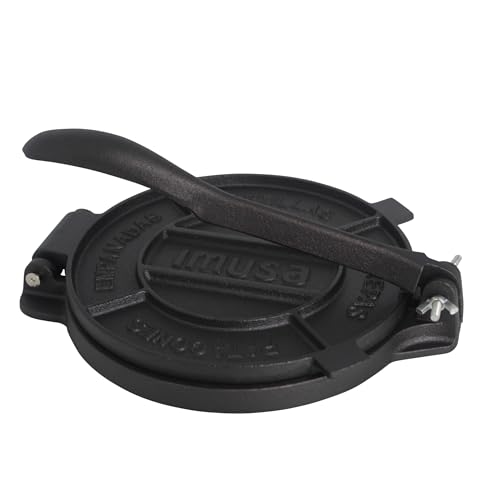
- IDEAL SIZE: This tortilla press features eight inch cast iron construction with compact dimensions...
- CAST IRON DURABILITY: This cast iron tortilla press is constructed from durable cast iron with...
3. Best large press: Victoria 10-inch HD cast iron
The Victoria 10-inch HD weighs about 10 1/2 pounds and has plates the maker says are engineered to avoid pinching. It is the one to get for 8-inch tortillas, quesadillas or a first try at flour tortillas. It costs about $80, so buy it only if you need the size.

- CAST-IRON TORTILLA MAKER: Our high-quality cast-iron press and quesadilla maker is seasoned with...
- DURABLE TORTILLA & BURRITO MAKER: Our cast-iron tortilla press was designed with the user in mind...
4. Large press for less: ARC 10-inch cast iron
The ARC 10-inch has a rust-resistant coating, non-slip feet and comes with 100 parchment rounds, at about $52 with 4.4 stars from over 5,000 ratings. Some owners report uneven tortillas and coating that flakes over time, so it is a value pick, not a lifetime tool. ARC also sells an 8-inch version for about $30.

- 【Heavy Duty】ARC tortilla press made of heavy-duty, durable, rustproof cast iron. The unique...
- 【 Reinforced Design】the improved wider and thicker roti maker handle is not breakable and has...
5. Best wood press: Central Coast Woodworks oak and walnut
The Central Coast Woodworks press is handmade in the U.S. from oak and walnut, with stainless steel hinges and a mineral oil and beeswax finish. The 8-inch model weighs about 6 pounds and has 4.6 stars from more than 1,200 ratings. The maker says it is meant for corn masa, not flour dough, and builds in a small gap at the hinge on purpose. It costs about $94, and 10- and 11 1/2-inch sizes are available.

- Handcrafted Quality – Handmade in the USA from sustainably sourced oak and walnut hardwoods, each...
- Durable Design – Built with stainless steel hinges and hardware to provide strength, stability...
6. Best budget: IMUSA 8-inch cast aluminum
The IMUSA 8-inch costs about $15 and will not rust. It has 4.2 stars from over 14,000 ratings. Because it is light, you do the pressing, and owners often find tortillas thicker in the middle. Pressing twice with a 180-degree turn helps. It is a good way to find out if you will make tortillas often before you buy iron.
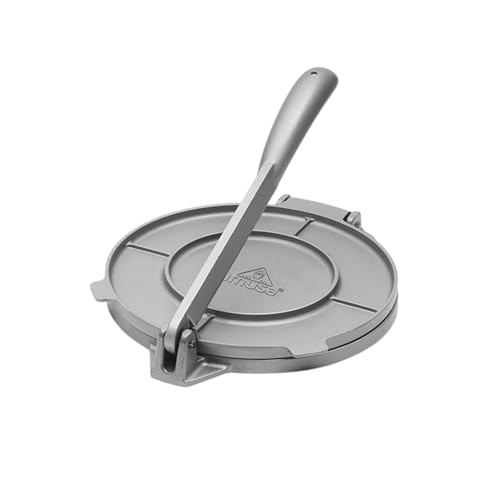
- MASTERFUL 8 INCHES TORTILLA PRESS: Measuring 8 inches, this cast aluminum Tortilla Press is perfect...
- LIGHTWEIGHT DURABILITY: Made of cast aluminum with a gray surface, this tortilla maker is lighter...
7. Made in Mexico: Gonzalez 8-inch polished aluminum
The Gonzalez press is the heavy-gauge polished aluminum style sold in Mexican markets, at about 3 1/4 pounds and $30. It is sturdier than most aluminum presses. Some reviewers mention uneven thickness or paint flaking on the outside.

- Made in Mexico by Gonzalez polished but a little rough for a professional look and feel and to make...
- It is heavy and sturdy allowing for easy handling when pressing.
Corn tortillas for your tortilla press
This short card is all you need for your first batch. For brand comparisons, fresh masa, and every reason a tortilla might not puff, read our complete corn tortilla guide.
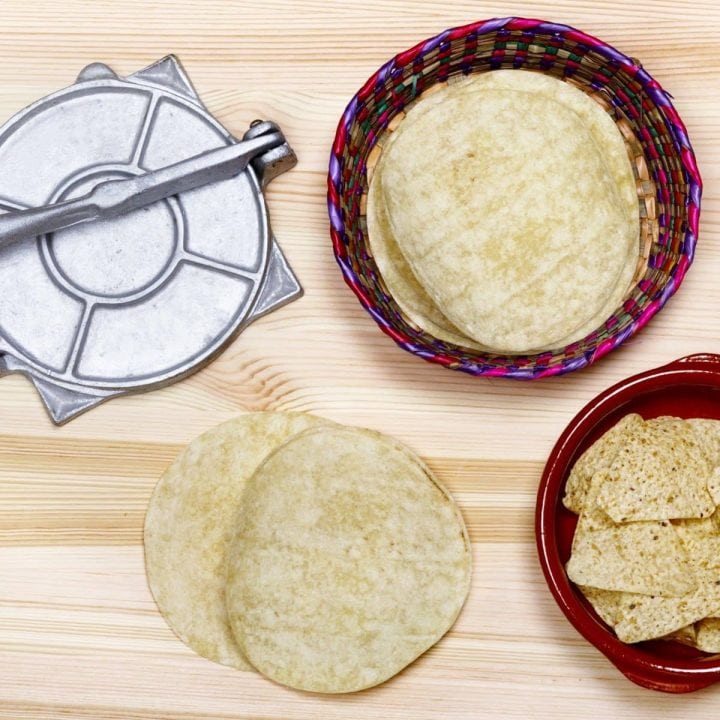
Corn Tortillas with a Tortilla Press
Fresh corn tortillas from masa harina, water and salt, pressed in a tortilla press and cooked on a hot comal until they puff. Makes 16 tortillas about 6 inches wide.
Ingredients
- 2 cups (about 230 g) masa harina, such as Maseca or Masienda
- 1/2 teaspoon kosher salt (optional)
- 1 1/2 to 1 3/4 cups warm water, plus more as needed
Instructions
- Mix the masa harina and salt in a bowl. Add 1 1/2 cups warm water and knead for 1 to 2 minutes until smooth. The dough should feel like soft Play-Doh and should not stick to your hands. If it cracks when you press a piece flat, knead in more water 1 tablespoon at a time.
- Cover with a damp towel and rest for 15 minutes.
- Divide into 16 balls about 1 1/4 inches across (about 1 ounce each). Keep them covered.
- Cut a gallon zip-top bag along both sides so it opens like a book. Heat a comal or cast-iron skillet over medium-high heat.
- Open the press and lay one side of the plastic on the base. Set a ball slightly toward the hinge and fold the plastic over it. Close the press and push the handle down with moderate pressure. Open the press, turn the tortilla half a turn in the plastic and press again, to about 1/16 inch thick.
- Peel off the top plastic. Flip the tortilla onto your fingers, peel off the second sheet and lay it on the comal.
- Cook for 20 to 30 seconds, until the edges look dry and it releases. Flip and cook for 30 to 45 seconds. Flip again and press gently with a towel for 15 to 30 seconds so it puffs.
- Stack the cooked tortillas in a towel or tortilla warmer so they steam and soften while you press and cook the rest.
Notes
Water varies by brand and humidity. Fresh masa harina needs less water; older bags need more. Judge by feel, not by the cup.
Too sticky? Knead in masa harina 1 tablespoon at a time.
No press? Press the ball between plastic with the bottom of a heavy skillet or a glass pie plate.
Storage: Refrigerate cooked tortillas in a zip-top bag for up to 5 days, or freeze for up to 3 months with parchment between them. Reheat on a hot comal.
Nutrition Information:
Yield: 16 Serving Size: 1 tortillaAmount Per Serving: Calories: 52Total Fat: 0.5gSodium: 73mgCarbohydrates: 10.8gFiber: 0.9gProtein: 1.3g
How to clean, season and store a tortilla press
A press needs very little care because the plastic liner keeps the masa off the plates.
- Before first use: rinse a cast-iron press with hot water and dry it right away. Victoria presses come pre-seasoned, so they are ready to use.
- After each use: wipe the plates with a damp cloth. Scrub stuck masa with a brush and hot water. Do not soak it, and do not put it in the dishwasher.
- Dry it completely. Dry cast iron with a towel, then warm it briefly or let it air-dry fully. Rub on a very thin film of vegetable oil, wipe off the excess and store it somewhere dry.
- Rust spots: scrub with steel wool, rinse, dry, oil lightly and warm in a 350°F oven for an hour to set the seasoning.
- Aluminum: wash with mild soap and dry. It will not rust but can dull or pit if left wet.
- Wood: wipe only, never soak, and rub with food-grade mineral oil or a board butter when it looks dry.
What else can you make with a tortilla press?
A press is a dough flattener, so it does more than corn tortillas. It does not do everything, though.
- Thicker masa antojitos: sopes, gorditas, memelas, tlacoyos and huaraches all start as pressed masa. Press with a lighter hand, or put a coin-thick spacer of folded plastic near the hinge.
- Filled masa turnovers: for enchiladas potosinas, press red chile masa into a thin round, spoon the filling onto one half and use the plastic sheet to fold and seal it.
- Empanada rounds: press balls of masa or empanada dough between parchment, then fill and fold.
- Tostones and patacones: yes. Fry thick slices of green plantain, set them between plastic in the press, press flat and fry again. Victoria even sells its press as a pataconera. See our patacones recipe.
- Flour tortillas: with a caveat. Wheat gluten springs back, so a manual press gives you a thick disc that shrinks. A heavy 10-inch press and well-rested dough help, but most cooks finish flour tortillas with a rolling pin. Some wood presses are not meant for flour at all.
- Pupusas: traditionally patted by hand, not pressed. In El Salvador the stuffed ball is flattened between the palms. A press can help, but a stuffed ball tends to burst at the edges, so press very gently, if at all. Our pupusa guide shows the hand method.
- Arepas: not really. Arepas are thick cakes of precooked corn flour, shaped by hand. A press makes them too thin and they crack. They also use a different flour from tortillas. Our Harina P.A.N. vs. Maseca guide explains why.

Tortilla press FAQ
Do I need a tortilla press to make corn tortillas?
No. A heavy skillet or a glass pie plate pressed down on the masa between plastic works, and a rolling pin works too. A press is simply faster and more even. If you make corn tortillas more than once or twice a month, a $30 cast-iron press is worth it.
Is cast iron or aluminum better for a tortilla press?
Cast iron, for most people. Its weight presses the masa evenly with little effort and it lasts for decades. Aluminum is cheaper, lighter and rust-proof, but you have to press harder, and cheap ones can flex or break at the handle.
What do you put in a tortilla press so the masa does not stick?
Two sheets of plastic cut from a zip-top freezer bag or a thin produce bag, or reusable press liners. Parchment rounds work well for empanada and flour dough. Do not oil the plates. If masa still sticks, it is too wet.
Why are my tortillas thick on one side?
Most presses close at a slight angle, so the side near the handle gets less pressure. Place the ball slightly toward the hinge, press, rotate the tortilla 180 degrees and press again.
Can you use a tortilla press for flour tortillas?
Yes, with limits. Gluten makes flour dough spring back, so pressed flour tortillas come out thick and small. Use a heavy 10-inch press and rested dough, then roll to finish. Some wood presses are made for corn only.
What size tortilla press is best?
An 8-inch press suits most homes. It makes 6-inch tortillas, the standard size for tacos and enchiladas. Choose 10 inches for larger tortillas, quesadillas or flour tortillas.
More to make with your press
Once you have the press, the rest of the Mexican masa kitchen opens up. Browse our guide to Mexican ingredients for masa harina brands, dried chiles and everything else you need for tacos, enchiladas and antojitos.
Shopping list: a Victoria 8-inch cast iron tortilla press, reusable press liners, a bag of Maseca masa harina (or Masienda heirloom masa harina), a cast-iron comal and a tortilla warmer to keep them soft.
Sources
- America’s Test Kitchen: The Best Tortilla Presses
- Serious Eats: The Best Tortilla Presses, Tested and Reviewed
- Food & Wine: How to Make Tortillas With a Tortilla Press, According to a Chef
- Victoria: Instructions for the Victoria Cast Iron Tortilla Press (PDF)
More Mexican Foods
See all →
Jorge Garcia is the founder of AmigoFoods, where he has spent over 20 years helping readers discover authentic Latin American and Spanish cuisine. Raised in a Cuban-American household, Jorge learned to cook at the hands of his mother and grandmother, carrying forward generations of family recipes. That heritage, backed by his family’s four-generation history in the Latin food industry, inspired him to launch AmigoFoods in 2003. With more than 1,000 published articles on recipes, ingredients, and food culture, Jorge’s mission is simple: make authentic Latin cooking approachable for home cooks everywhere while honoring the traditions behind every dish.