

On this page
Bocadillo de guayaba is Colombia’s beloved guava sweet: ripe guava pulp cooked down with sugar or panela until it sets into a firm, sliceable, ruby-red bar. Colombians eat it with a slice of fresh white cheese, tuck it into pastries and fried plantains, and pack it in school lunches. Here’s what bocadillo colombiano is, why the bocadillo veleño from Vélez is the most famous, how it compares with other guava pastes, and how to make it at home with fresh guavas or frozen pulp.
Bocadillo at a Glance
What Is Bocadillo de Guayaba?

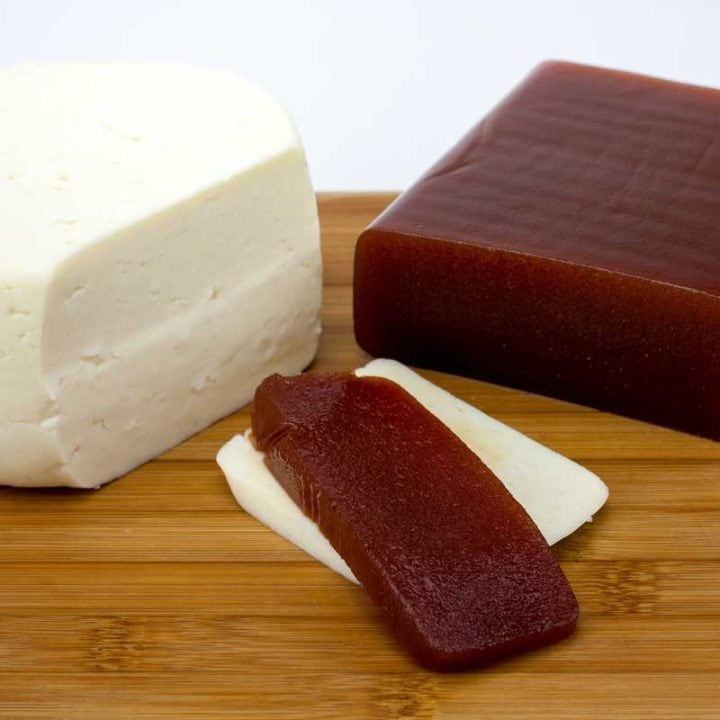
Bocadillo (pronounced boh-kah-DEE-yoh) is a guava paste, or guava “candy,” made by cooking strained guava pulp with sugar or panela for a long time, stirring constantly, until most of the water evaporates and the natural pectin in the fruit makes it set. Poured into a mold and left overnight, it becomes a firm, glossy bar that you slice with a knife. It tastes intensely of guava: sweet, floral and slightly tart.
It’s one of the most Colombian foods there is. You’ll find bocadillo in every corner shop and bus-station kiosk, in school lunchboxes, on breakfast tables and as dessert after lunch. Colombians often just call it bocadillo, and the guava is understood.
In Spain, a bocadillo is a sandwich on a crusty baguette. In Colombia, it’s this guava sweet. Same word, completely different foods. If you’re looking for the sandwich, see our guide to the Spanish bocadillo.
Bocadillo Veleño: Colombia’s Most Famous Bocadillo
The best-known bocadillo comes from Vélez, a town in the department of Santander, and the surrounding province of Vélez, which reaches into neighboring Boyacá. The region’s guava orchards and its warm, humid climate have made it Colombia’s bocadillo capital, and the sweet has been made there for around 200 years.
A bocadillo veleño is easy to recognize:
- Two colors. The classic bar pairs deep red paste from red-fleshed guavas with a paler layer made from white guavas.
- Wrapped in bijao. Each bar is wrapped in a strip of dried bijao leaf (Calathea lutea), the same broad tropical leaf Colombians use to wrap tamales. The leaf protects the sweet and adds a faint herbal aroma.
- Packed in wooden boxes. Traditional producers still pack the bars in small wooden crates.
In 2017, after producers organized to stop imitations from using the name, the Colombian government gave the bocadillo veleño a protected denomination of origin. Only bocadillo made in the Vélez region, from local guavas and following the traditional recipe, can carry the name. Back in 2006, Semana magazine had already nominated it as one of Colombia’s cultural symbols.
Types of Bocadillo
Bocadillo veleño
- Vélez, Santander
- Protected name
The classic: a firm red-and-white guava bar wrapped in dried bijao leaf.
Bocadillo de panela
- Darker
- Caramel notes
Sweetened with panela (unrefined cane sugar) instead of white sugar, for a deeper color and a rounder, caramel-like flavor.
Bocadillo con arequipe
- Layered
- Extra sweet
Guava paste layered or rolled with arequipe, Colombia’s dulce de leche.
Mini bocadillos
- Bite-size
- Lunchbox staple
Small individually wrapped bars, sold by the box for snacks and kids’ lunches.
How Colombians Eat Bocadillo

- Bocadillo con queso: the classic. A slice of bocadillo with a slice of fresh, mild, slightly salty white cheese, like queso campesino, queso costeño or queso fresco. It’s dessert, snack and breakfast side all at once.
- Plátano maduro con queso y bocadillo: a very ripe plantain, baked or fried, split and stuffed with cheese and bocadillo until both melt.
- Aborrajados: Cali’s battered, fried ripe plantains stuffed with cheese and, often, bocadillo.
- In baking: pressed into pandebono dough, folded into puff pastry for guava pastelitos, or layered into cakes and cookies.
- With hot chocolate: a piece of bocadillo and cheese alongside a cup of Colombian hot chocolate.
- Straight from the wrapper: the simplest way, especially on a road trip through Santander.
How to Make Bocadillo de Guayaba at Home
Homemade bocadillo takes only three ingredients and one long, attentive stir. The full amounts are in the recipe card.
Choosing the guavas

Use very ripe, fragrant guavas with yellow-green skin that gives slightly when pressed. Pink- or red-fleshed guavas give the classic color; white guavas make a paler, golden paste. Slightly soft, bruised fruit is perfect here. Learn more about the fruit in our guide to guayaba.
Fresh guavas can be hard to find in the US, but frozen guava pulp (pulpa de guayaba) is sold in the freezer aisle of most Latin markets. Use about 3 cups thawed pulp, strain it if it has seeds, and skip straight to step 3.
1. Soften the guavas
Wash the guavas, trim the stem and blossom ends and cut them in quarters. Simmer them in water for 8 to 10 minutes until very soft, then drain well. Excess water only adds cooking time.
2. Blend and strain
Blend the guavas until smooth, then push the purée through a fine-mesh strainer with the back of a spoon to remove all the hard seeds. You should have about 3 cups of thick pulp.
3. Cook with sugar
Put the pulp and sugar in a wide, heavy pot over medium heat and stir until the sugar dissolves. If you’d like a darker, caramel-tinged bocadillo, use grated panela instead of some or all of the sugar; Goya panela is easy to find.
4. Stir until it reaches “el punto”
Lower the heat to medium-low, add the lime juice and keep stirring, scraping the bottom and corners constantly, for 40 to 55 minutes. The paste will darken, thicken and start to spit; a long wooden spoon and an oven mitt help.
When you drag the spoon across the bottom of the pot, the paste parts and you can see the pot for a second or two before it slowly closes. The whole mass pulls away from the sides and moves as one glossy block. A small spoonful dropped on a cold plate should hold its shape without spreading.
5. Mold and let it set
Scrape the paste into an 8-inch square pan lined with parchment, smooth the top with a wet spatula and let it cool. Leave it uncovered at room temperature for at least 12 hours, ideally 24, until firm.
6. Cut and wrap
Turn the slab out, peel off the parchment and cut it into bars with a knife dipped in hot water. For a veleño touch, wrap each bar in a strip of softened bijao or banana leaf, or in parchment.
As an Amazon Associate, AmigoFoods earns from qualifying purchases.
Bocadillo vs. Other Guava and Fruit Pastes
Almost every Latin country has its own fruit paste, and they are often eaten the same way, with cheese.
| Name | Where | What it is |
|---|---|---|
| Bocadillo | Colombia | Firm guava paste with sugar or panela; often two-toned and wrapped in bijao. |
| Pasta de guayaba | Cuba, Puerto Rico, Dominican Republic | Guava paste sold in bars or tins, eaten with cheese and baked into pastelitos. |
| Goiabada | Brazil | Guava paste, typically a little less sweet; paired with cheese as Romeu e Julieta. |
| Ate de guayaba | Mexico | Guava fruit paste, one of several ates made from guava, quince and other fruit. |
| Membrillo | Spain | Quince paste rather than guava, served with Manchego. |
Where to Buy Bocadillo in the US
Latin grocery stores with a Colombian section usually carry bocadillo veleño in bijao, plus boxes of mini bocadillos. Online, you can search for bocadillo veleño on Amazon. In a pinch, a Caribbean-style guava paste bar like Dulzura Borincana guava paste works in any recipe that calls for bocadillo. For a bocadillo con arequipe at home, pair it with Colombina dulce de leche.
As an Amazon Associate, AmigoFoods earns from qualifying purchases.
How to Store Bocadillo
- Room temperature: wrapped in parchment or leaf and kept in an airtight container, homemade bocadillo keeps about 2 weeks in a cool, dry spot.
- Refrigerator: up to 2 months, well wrapped. Let it come to room temperature before eating for the best texture.
- Freezer: up to 6 months; thaw overnight in the fridge.
Homemade Bocadillo de Guayaba
Colombian guava paste made the traditional way: ripe guava pulp cooked with sugar and a squeeze of lime, stirred until it sets into firm, sliceable bars. Serve it with fresh white cheese.
Ingredients
- 2 pounds (900 g) very ripe pink guavas, or 3 cups thawed frozen guava pulp
- 4 cups water, for softening the guavas
- 3½ cups (700 g) granulated sugar, or grated panela
- 2 tablespoons fresh lime juice
Instructions
- Soften the guavas. Wash the guavas, trim the ends and quarter them. Simmer in the water for 8 to 10 minutes, until very soft. Drain well.
- Blend and strain. Blend the guavas until smooth, then press the purée through a fine-mesh strainer to remove the seeds. You should have about 3 cups of pulp. (If using frozen pulp, start here.)
- Dissolve the sugar. Combine the pulp and sugar in a wide, heavy pot over medium heat and stir until the sugar dissolves.
- Cook down. Lower the heat to medium-low, add the lime juice and cook, stirring and scraping the bottom constantly, for 40 to 55 minutes, until the paste is thick and glossy, pulls away from the sides, and a spoon dragged across the bottom leaves a trail that stays open for a second or two.
- Mold. Line an 8-inch square pan with parchment. Pour in the paste and smooth the top with a wet spatula.
- Let it set. Cool, then leave uncovered at room temperature for at least 12 hours, ideally 24, until firm.
- Cut. Turn out the slab, peel off the parchment and cut into 24 bars with a knife dipped in hot water. Wrap in parchment, bijao or banana leaves.
Notes
Frozen pulp: About 3 cups (two 14-ounce packs) of thawed frozen guava pulp replaces the fresh guavas. Strain it if it contains seeds.
Panela: Replace some or all of the sugar with grated panela for a darker, caramel-tinged bocadillo.
Doneness: If the bocadillo is still soft after 24 hours, it was undercooked. Return it to the pot and cook a little longer.
Storage: Keeps about 2 weeks wrapped in an airtight container at room temperature, 2 months refrigerated, or 6 months frozen.
Bocadillo FAQ
What is bocadillo in Colombia?
A firm sweet made from guava pulp cooked with sugar or panela until it sets. It’s sold in bars, often wrapped in bijao leaves, and usually eaten with fresh white cheese.
Is bocadillo the same as guava paste?
Yes. Bocadillo is the Colombian name for guava paste. Colombian bocadillo, especially veleño, tends to be firmer and is often made in two layers from red and white guavas.
What is bocadillo veleño?
Bocadillo from the Vélez region of Santander and Boyacá. It has a protected denomination of origin and is traditionally wrapped in dried bijao leaves.
What is bijao?
A broad tropical leaf (Calathea lutea) used across Colombia to wrap food. Dried bijao protects bocadillo and gives it a light aroma. Banana leaves or parchment are good substitutes.
What cheese goes with bocadillo?
A mild, fresh, slightly salty white cheese: queso campesino, queso costeño, queso fresco or a soft farmer’s cheese.
Can I make bocadillo with frozen guava pulp?
Yes. About 3 cups of thawed frozen guava pulp replaces the fresh guavas. Strain it if it contains seeds, then cook with the sugar as directed.
Why didn’t my bocadillo set?
It wasn’t cooked long enough. If it’s still soft after 24 hours, scrape it back into the pot and cook it a little longer, until the spoon clearly parts the paste.
Sources
- FiBL: Bocadillo Veleño protected with a denomination of origin
- Wikipedia: Bocadillo (dessert)
- El Espectador: Receta de bocadillo de guayaba
More Colombian Foods
See all →
Jorge Garcia is the founder of AmigoFoods, where he has spent over 20 years helping readers discover authentic Latin American and Spanish cuisine. Raised in a Cuban-American household, Jorge learned to cook at the hands of his mother and grandmother, carrying forward generations of family recipes. That heritage, backed by his family’s four-generation history in the Latin food industry, inspired him to launch AmigoFoods in 2003. With more than 1,000 published articles on recipes, ingredients, and food culture, Jorge’s mission is simple: make authentic Latin cooking approachable for home cooks everywhere while honoring the traditions behind every dish.