

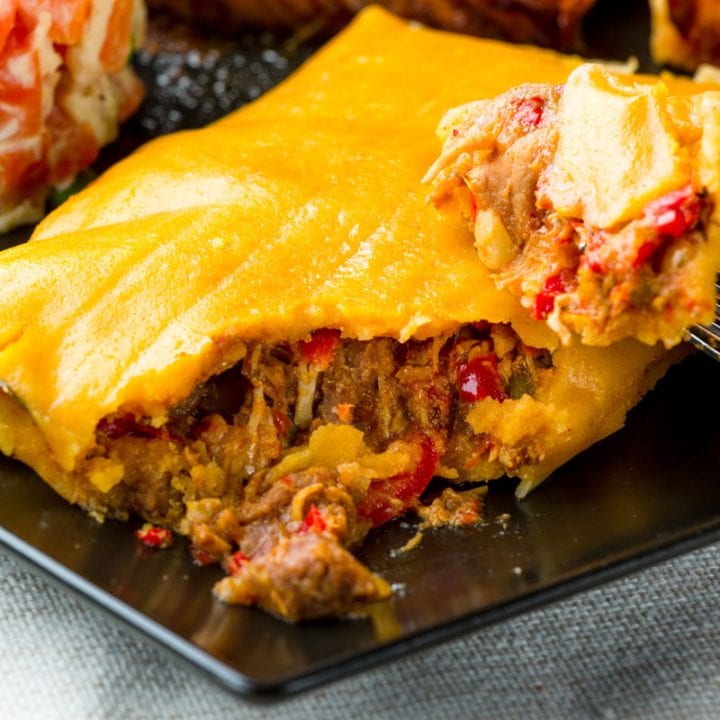
Hallacas are Venezuela’s Christmas parcels of golden corn dough filled with a sweet-and-savory meat stew, olives, raisins and capers. Wrapped in banana leaves and boiled, this 24-piece batch is a festive project best shared with a few helpers.
Hallacas at a Glance
What Are Hallacas?

A hallaca is a flat, rectangular parcel of corn dough and stew, cooked inside a banana leaf. It is the anchor of the Venezuelan Christmas plate and is rarely eaten outside the holiday season.
Every hallaca is built from four layers, and each one matters:
Hallaca vs. Tamale: What’s the Difference?
Hallacas are often called “Venezuelan tamales,” and they are cousins of the tamales eaten across Latin America. But put the two side by side and they are clearly different dishes.
| Hallaca | Mexican tamal | |
|---|---|---|
| Wrapper | Banana leaf, always | Corn husk in most of Mexico; banana leaf in the south |
| Dough | Precooked corn flour (Harina P.A.N.), broth and onoto lard, pressed very thin | Nixtamalized masa beaten with lard, thicker and fluffier |
| Filling | A three-meat guiso plus hand-placed adornos | Usually one filling: meat in salsa, cheese and chile, or sweet |
| Flavor | Savory with sweet and briny notes | Savory, spicy or sweet, depending on the type |
| Shape | Flat rectangle tied like a parcel | Folded cylinder |
| Cooking | Boiled in water, about 1 hour | Steamed |
| When | Christmas season | Year-round |
One practical consequence: you cannot swap the flours. Hallaca masa is made with Harina P.A.N., not Maseca, and the difference between Harina P.A.N. and Maseca is the reason a hallaca stays thin and silky instead of turning crumbly.
Puerto Rico’s Christmas parcel goes a step further: Puerto Rican pasteles skip corn entirely and use a masa of grated green bananas and yautía.
A Short History of the Hallaca

The name. The most cited theory, put forward by the naturalist Adolfo Ernst, traces “hallaca” to an indigenous Arawak word meaning to mix or to wrap. Older texts spell it ayaca or hayaca, and one of the earliest written mentions comes from the Italian missionary Filippo Salvatore Gilii in 1781.
The mix. The idea of corn dough wrapped in a leaf is indigenous. What Spain added was the pantry: olives, capers, raisins, almonds and wine. The result is a dish that puts native corn, European imports and Caribbean leaves in a single bite, which is why Venezuelan writer Arturo Uslar Pietri described the hallaca as a summary of the country’s history.
The legend. The popular story says hallacas were invented by enslaved and indigenous cooks who wrapped the leftovers from colonial feasts in corn dough. It is a good story, but historians dispute it, and the ingredients argue against it: olives, capers and raisins were costly imported goods, not scraps.
What no one disputes is the tradition that grew up around it. The hallacada, a day when the whole family gathers to make hallacas together, is one of the most cherished rituals of a Venezuelan December, and trading hallacas with neighbors to compare recipes is part of the fun.
Hallacas by Region
There is no single hallaca. Ask a Venezuelan whose is best and the answer is always “my mother’s,” but the regional styles break down like this:
Leaf-wrapped cousins turn up across the region too: Aruba and Curaçao make ayaka at Christmas, Trinidad has pastelles, Nicaragua has nacatamales, the Andes have humitas and Peru’s Amazon wraps rice into juane.
Hallaca Ingredients: What to Buy
Most of the shopping is ordinary: pork shoulder, beef chuck, a whole chicken, onions, leeks, peppers, tomatoes and garlic. These six items are the ones that make a hallaca taste Venezuelan:
- Harina P.A.N.The white precooked corn flour for the masa. Read more about Harina P.A.N.
Buy Harina P.A.N. on Amazon → - Onoto (annatto) seedsSteeped in lard to give the masa its golden color.
Buy annatto seeds on Amazon → - Banana leavesSold frozen at Latin and Asian markets. See hojas de plátano.
Buy banana leaves on Amazon → - PapelónUnrefined cane sugar that rounds out the guiso. Piloncillo or dark brown sugar work too.
Buy papelón on Amazon → - Ají dulceSmall, fragrant sweet peppers with almost no heat. Swap in an extra red bell pepper if you can’t find them.
- Alcaparrado & encurtidosOlives, capers and pickled vegetables: the salty, tangy side of the filling.
Buy alcaparrado on Amazon →
For the full Venezuelan pantry, see our guide to Venezuelan ingredients.
How to Make Hallacas, Step by Step
Hallacas are not hard, but there are a lot of parts. Split the work over two days and the actual assembly becomes the fun part. Exact quantities and times are in the recipe card below; this section shows what each stage should look like.
- Make the onoto lard
- Poach the chicken, save the broth
- Cook the guiso and chill it overnight
- Cut the adornos
- Clean and soften the leaves
- Knead the masa
- Spread, fill, fold and tie
- Boil for 1 hour
1Make the onoto lard
Warm 1¾ cups lard or oil with annatto seeds over low heat for a few minutes, then strain. This colored fat goes into the guiso, the masa and onto every leaf.
What to look for: a deep red-orange fat. If the seeds start crackling hard, turn the heat down; scorched annatto tastes bitter.
2Cook the guiso and let it chill
Brown the diced pork and beef, soften a big pile of onion, leek, scallion, ají dulce, pepper and garlic, then simmer everything with tomato, sweet wine, papelón, capers and pickles until the meat is tender. Add the poached chicken and thicken the pot with a little Harina P.A.N. stirred into broth.
What to look for: a guiso that holds its shape on a spoon. A runny guiso leaks through the masa and makes the hallacas soggy. Transfer it to shallow containers and refrigerate promptly, within 2 hours; chill at least 8 hours or overnight. Refrigerate the broth and chicken strips too. Cold guiso is easier to spoon neatly.
3Prepare the banana leaves
Wipe both sides of each leaf with a damp cloth, cut out the tough center rib, and cut rectangles of about 12 x 14 inches plus narrower strips (fajas) for the outer wrap. Pass each piece quickly over a gas flame or through steam.
What to look for: the leaf turns a brighter, glossier green and goes soft. That is the moment to pull it away; it will fold without cracking.
4Knead the masa

Reserve at least 10 cups broth: 8 for the masa, 1 for the guiso and 1 for thickening, topping up if needed. Mix Harina P.A.N. with warm chicken broth and salt, then work in the onoto lard until the dough is evenly golden. Divide the full batch into 24 equal balls.
What to look for: dough as soft as play-dough that doesn’t crack at the edges when you press a ball flat. Cracks mean it needs another spoonful of warm broth.
5Spread, fill and fold

Brush the shiny side of a leaf with onoto lard, press a masa ball into a thin oval, spoon the cold guiso into the center and set the adornos on top. Bring the long sides of the leaf together so the edges of the masa meet and seal over the filling, then fold the seam flat and tuck the short ends under.
What to look for: masa about ⅛ inch thick, thin enough to see the leaf’s shadow through it, with a 1-inch border of bare masa around the guiso so the edges can seal.
6Wrap, tie and boil
Wrap each parcel in a faja, then tie it with twine twice lengthwise and three times across. Lay the hallacas flat in a big pot of boiling salted water, keep them fully submerged, and boil for about 1 hour, until the masa is set and the center reaches 165°F (74°C).
What to look for: ties snug but not cutting into the parcel. The masa swells as it cooks, and string that is too tight squeezes it out through the ends.
Tips for Perfect Hallacas
The recipe: quantities for 24 hallacas, Caracas style, with the guiso, masa, adornos and wrapping in the order you’ll need them. Use the Print button to take it into the kitchen.
Venezuelan Hallacas
Venezuela's Christmas hallacas, Caracas style: thin golden corn masa filled with a sweet-savory pork, beef and chicken guiso, topped with olives, raisins and capers, wrapped in banana leaves and boiled.
Ingredients
Onoto lard
- 1¾ cups lard or neutral vegetable oil (for the guiso, masa and brushing leaves)
- ⅓ cup onoto (annatto) seeds
Chicken and broth
- 1 whole chicken (about 4 lb), or 4 lb bone-in chicken thighs and breasts
- 12 cups water
- 1 onion, halved
- Green tops of 2 leeks
- 4 garlic cloves, smashed
- 1 tablespoon salt
Guiso
- 1½ lb boneless pork shoulder, cut into ½-inch dice
- 1½ lb beef chuck, cut into ½-inch dice
- ⅓ cup onoto lard (from above)
- 2 large onions, finely chopped
- White and light-green parts of 2 leeks, finely chopped
- 1 bunch scallions, finely chopped
- 10 ají dulce, seeded and chopped (or 1 extra red bell pepper)
- 2 red bell peppers, finely chopped
- 8 garlic cloves, minced
- 3 ripe tomatoes, peeled and chopped
- 1 cup sweet red wine (vino dulce, Marsala or ruby port)
- ¼ cup grated papelón or packed dark brown sugar
- 2 tablespoons Worcestershire sauce
- 1 tablespoon yellow mustard
- ½ cup finely chopped encurtidos (pickled vegetables)
- 2 tablespoons capers, chopped
- 1 teaspoon ground cumin
- 1 teaspoon sweet paprika
- 1 teaspoon black pepper
- Salt to taste
- ¼ cup Harina P.A.N. stirred into 1 cup of the chicken broth
Masa
- 1 package (2.2 lb / 1 kg) Harina P.A.N. white corn meal
- 8 cups warm chicken broth (from above), plus more as needed
- ¾ cup onoto lard (from above)
- 2 teaspoons salt, or to taste
Adornos
- Half the poached chicken, pulled into strips
- 2 red bell peppers, cut into thin strips
- 2 onions, sliced into thin rings
- 1 cup pimiento-stuffed green olives (alcaparrado)
- ¾ cup raisins
- ¼ cup capers
- ½ cup whole blanched almonds (optional)
- 3 hard-boiled eggs, sliced (optional)
For wrapping
- 4 lb frozen banana leaves, thawed
- Cotton kitchen twine
Instructions
- Make the onoto lard. Warm the lard and annatto seeds in a small saucepan over low heat, stirring, for 5 to 7 minutes, until the fat is deep red-orange. Do not let the seeds crackle hard or the fat turns bitter. Strain and discard the seeds.
- Poach the chicken. Put the chicken, water, halved onion, leek tops, smashed garlic and salt in a large pot. Simmer gently for 45 to 60 minutes, until the thickest part reaches 165°F (74°C). Lift out the chicken, strain the broth and measure at least 10 cups, topping up with water or broth if needed (8 cups for masa, 1 cup for the guiso and 1 cup for thickening). Pull the meat from the bones: dice half for the guiso and tear the rest into strips for the adornos.
- Brown the meats. Heat ⅓ cup onoto lard in a wide, heavy pot over medium-high heat. Brown the pork and beef in batches, 5 to 6 minutes per batch, and set aside.
- Cook the sofrito. Lower the heat to medium. Add the onions, leeks, scallions, ají dulce, bell peppers and garlic and cook, stirring, until very soft, 10 to 12 minutes. Add the tomatoes and cook 5 minutes more.
- Simmer the guiso. Return the pork and beef to the pot. Add the wine, papelón, Worcestershire sauce, mustard, encurtidos, capers, cumin, paprika, black pepper and 1 cup of the broth. Cover and simmer on low for 1 to 1½ hours, stirring occasionally, until the meat is tender.
- Thicken and chill. Stir in the diced chicken, then the Harina P.A.N. mixed with broth. Cook 5 minutes, until the guiso is thick enough to hold its shape on a spoon. Season boldly with salt. Transfer to shallow containers and refrigerate promptly, within 2 hours; chill at least 8 hours or overnight. Refrigerate the reserved broth and chicken strips too.
- Prepare the leaves. Wipe both sides of the banana leaves with a damp cloth and cut out the thick center rib. Cut about 30 rectangles of 12 x 14 inches and 24 strips of about 5 x 12 inches (fajas). Pass each piece quickly over a gas flame or through steam until glossy and pliable.
- Make the masa. In a large bowl mix the Harina P.A.N. and salt. Add the warm broth gradually, kneading with your hands, then work in ¾ cup onoto lard until the dough is smooth, evenly golden and soft like play-dough, with no cracks. Add more warm broth by the spoonful if it cracks. Cover, rest 10 minutes and divide into 24 equal balls; divide the full batch evenly rather than using a fixed cup measure.
- Spread and fill. Brush the shiny side of a leaf with onoto lard. Set a masa ball in the center and press it out with greased fingers (or under a plastic bag) into a thin oval about 8 x 10 inches and ⅛ inch thick. Spoon about ⅓ cup cold guiso into the center, leaving a 1-inch border. Top with adornos: a chicken strip, 2 pepper strips, an onion ring, 2 olives, 4 raisins, a few capers and an almond or egg slice.
- Fold. Lift the two long sides of the leaf so the edges of the masa meet over the filling and press to seal. Roll the seam over and fold it flat against the hallaca, then fold both short ends underneath to form a tight rectangle. Wrap with a faja.
- Tie. Tie each hallaca with twine twice lengthwise and three times across, snug but not so tight that the masa is squeezed out.
- Boil. Bring a very large pot of salted water to a rolling boil. Add the hallacas lying flat, fully submerged (weigh them down with a plate), working in batches if needed. Boil for about 1 hour, until the masa is set and the center reaches 165°F (74°C). Lift out, drain on a rack and rest 10 minutes before opening.
Notes
Schedule: The recipe takes about 6½ hours of prep and cooking, plus at least 8 hours chilling the guiso and 10 minutes resting after boiling. Extra boiling batches take longer.
Yield: Divide the dough into 24 equal portions. Use about ⅓ cup guiso in each without overfilling; any extra guiso and adornos can be refrigerated promptly for another meal or frozen.
Make ahead: The guiso keeps 3 days in the fridge. Refrigerate cooked hallacas promptly, within 2 hours, and use within 3–4 days or freeze for up to 3–4 months for best quality. Keep them in their leaves. Reheat by boiling about 20–30 minutes from the fridge or 45–60 minutes from frozen, until the center reaches 165°F (74°C).
Andean style: Some families use raw guiso, but that variation needs its own cooking method and doneness checks; do not substitute raw meat into this cooked-filling recipe.
Flour: Use precooked corn flour such as Harina P.A.N. Nixtamalized masa harina (Maseca) has a different texture.
How to Store, Freeze and Reheat Hallacas
Hallacas were made for making ahead. Families cook them in early December and eat them for weeks, and they freeze better than almost any other holiday dish.
| Situation | What to do | Reheat time |
|---|---|---|
| Cooked, in the fridge | Keep them in their leaves, in a covered container, up to 3–4 days | Boil 20–30 minutes |
| Cooked, frozen | Cool promptly and refrigerate within 2 hours, then bag flat and freeze for best quality up to 3–4 months | Boil straight from frozen 45–60 minutes |
| Uncooked, frozen | Freeze tied, unboiled parcels made with fully cooked, chilled filling if you run out of pot space | Boil straight from frozen about 1¼ hours |
| Just one, fast | Steam a refrigerated hallaca in its leaf | About 20 minutes |
Reheat until the center reaches 165°F (74°C); the times above are estimates. Refrigerate cooked hallacas promptly, within 2 hours. Always reheat hallacas in their leaves and unwrap them at the table. The leaf is not eaten, but it keeps the masa moist and carries the aroma.
What to Serve with Hallacas

In Venezuela a hallaca is served as part of the plato navideño, the Christmas plate. The classic lineup:
Want the whole spread? See our full list of Venezuelan Christmas foods, every dish on our Venezuelan holiday dishes page, and more festive recipes from around the region under Latin Christmas foods.
Hallacas FAQ
How do you pronounce hallaca?
Ah-YAH-kah. In Venezuelan Spanish the “ll” sounds like an English “y,” and the plural is hallacas (ah-YAH-kahs).
Are hallacas the same as tamales?
No. They belong to the same family, but a hallaca uses thin precooked-corn masa, a three-meat guiso with olives, raisins and capers, and a banana-leaf wrapper, and it is boiled rather than steamed.
How long do you boil hallacas?
Boil freshly made hallacas for 1 hour in salted water, laid flat and fully submerged. Reheat cooked ones for 20–30 minutes from the fridge or 45–60 minutes from frozen.
Can I make hallacas without banana leaves?
Not really. Corn husks are too small and change the flavor. In a pinch you can wrap the masa in greased parchment and then foil, but you lose the leaf’s aroma. Frozen banana leaves are easy to find at Latin and Asian grocers.
Can I use Maseca for hallacas?
No. Maseca is nixtamalized masa harina for tortillas and tamales, and it gives a grainier, heavier dough. Hallacas need precooked corn flour such as Harina P.A.N.
Why is my hallaca masa cracking?
It is too dry. Knead in warm broth a spoonful at a time until a flattened ball has smooth edges, and keep the bowl covered while you work.
How long do hallacas last?
Up to 3–4 days in the refrigerator and about 3–4 months in the freezer, as long as they stay wrapped in their leaves.
Are hallacas gluten-free?
The masa is corn, so hallacas can be gluten-free. Check the labels on your Worcestershire sauce, mustard and pickles, which sometimes contain wheat or malt vinegar.
Do you eat the banana leaf?
No. Cut the string, open the leaf at the table and eat the hallaca straight off it.
A Venezuelan Christmas Starts with Hallacas
Making hallacas is a project, but it is the kind that gives back: a freezer full of Christmas dinners and a day spent cooking with the people you’ll share them with.
Start with the guiso the day before, invite a few helpers for the hallacada, and serve them with pan de jamón and a glass of ponche crema. Want that corn dough the rest of the year? Bollos pelones are the everyday, unwrapped cousin: stuffed with a beef guiso and served in tomato sauce. For more from the same kitchen, explore our Venezuelan food hub and the most popular Venezuelan dishes.
Sources: Venezuelan regional hallaca styles as described by Venezuelan outlets Qué Pasa and Meridiano; etymology and early written record from Adolfo Ernst and Filippo Salvatore Gilii as summarized in reference works on the hallaca.
More Venezuelan Foods
See all →
Jorge Garcia is the founder of AmigoFoods, where he has spent over 20 years helping readers discover authentic Latin American and Spanish cuisine. Raised in a Cuban-American household, Jorge learned to cook at the hands of his mother and grandmother, carrying forward generations of family recipes. That heritage, backed by his family’s four-generation history in the Latin food industry, inspired him to launch AmigoFoods in 2003. With more than 1,000 published articles on recipes, ingredients, and food culture, Jorge’s mission is simple: make authentic Latin cooking approachable for home cooks everywhere while honoring the traditions behind every dish.