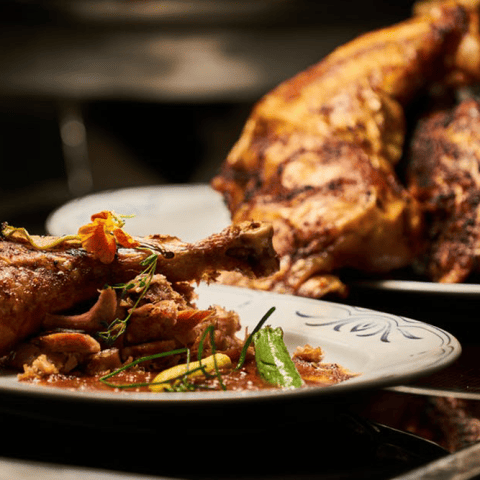
Pollo a la brasa is Peru’s beloved charcoal-roasted chicken, seasoned with ají panca, garlic, cumin, soy sauce and dark beer. This home version uses an overnight marinade and a hot oven for deeply browned skin, juicy meat and creamy ají verde on the side.
Pollo a la Brasa at a Glance
Total time13 hours 25 minutesIncludes 12 hours marinating and 10 minutes resting. A 24-hour marinade adds 12 hours.
Prep20 minutes
Cook55 minutes
Serves4servings
Key ingredientsWhole chicken, ají panca, garlic, soy sauce, dark beer and spices; cilantro, chiles, mayonnaise and cheese for ají verde.
EquipmentBlender, kitchen shears, covered marinating dish, roasting rack and pan, oven and meat thermometer.
Pollo a la Brasa Essentials
- What it is
- Whole chicken, marinated overnight, spit-roasted over charcoal
- Country
- Peru (born in Lima, 1950)
- Pronunciation
- POH-yoh ah lah BRAH-sah
- Meaning
- “Chicken over the embers”
- Key marinade flavors
- Ají panca, garlic, cumin, black pepper, soy sauce, vinegar, dark beer, huacatay
- Classic plate
- Quarter chicken, papas fritas, simple salad, ají verde and cremas
- Drink
- Chicha morada or Inca Kola
- National day
- Día del Pollo a la Brasa, third Sunday of July
What Is Pollo a la Brasa?

Pollo a la brasa is Peru’s charcoal rotisserie chicken. The name means “chicken over the embers,” and the embers are the point: the bird is cooked on a rotating spit in a closed charcoal oven, not in an electric rotisserie and not on an open grill.
Two things separate it from the rotisserie chicken sold in American supermarkets. The first is the marinade, which is dark, savory and faintly smoky on its own before the chicken ever meets the fire. The second is the fire itself. Pollerías burn hardwood charcoal, and the drippings hitting the coals for an hour or more give the skin a flavor no oven can fully copy.
In the United States it is usually sold as “Peruvian chicken” or “Peruvian rotisserie chicken.” It is the same dish. If a menu offers a quarter, half or whole chicken with fries, salad and a green sauce, you are looking at pollo a la brasa.
It sits alongside lomo saltado and ceviche as one of the three dishes Peruvians would name first if you asked what the country eats, and among the best Peruvian foods it is the one eaten most often by the most people.
The History of Pollo a la Brasa

The dish is younger than most people assume. It dates to 1950 and to a failing chicken farm in Santa Clara, in the Ate district on the eastern edge of Lima.
Roger Schuler and the five-sol chicken
The farm belonged to Roger Schuler, a Swiss immigrant whose poultry business was going under. His answer was to cook the birds himself. He set iron spits over a charcoal pit in his patio, seasoned the chickens with nothing but salt, and put a sign on the road: all the chicken you can eat for five soles.
Diners ate with their hands. There was no cutlery and no plate beyond the fries, and that informality stuck; for years, eating pollo a la brasa with a knife and fork was faintly ridiculous. The patio became a restaurant, La Granja Azul, which the Schuler family still runs on the same site.
Franz Ulrich and the rotombo
Iron spits over a pit could not keep up with demand. A Swiss metalworker named Franz Ulrich built Schuler a rotating charcoal oven, nicknamed the rotombo, that turned up to 60 chickens at once with a hand-cranked chain. That machine is the ancestor of the oven in every pollería today, and the original still works.
From a luxury to a Sunday habit
Through the 1950s and 60s, pollo a la brasa was a treat for Lima’s upper class. Pollerías multiplied through the 1970s and prices fell, and by the 1980s it was what a working family ate on Sunday. Along the way the marinade grew from plain salt into the ají panca, cumin, soy and beer mixture used now.
Heritage status and a national holiday
In 2004 Peru’s National Institute of Culture declared pollo a la brasa a Peruvian culinary specialty and part of the nation’s cultural heritage. In 2010 the Ministry of Agriculture created the Día del Pollo a la Brasa, celebrated on the third Sunday of July, the weekend before Peru’s independence holidays.
The national statistics office counts a family’s pollo a la brasa consumption in the basic basket it uses to measure the cost of living. Peru has more than 14,000 registered pollerías, they account for roughly 40 percent of the country’s fast-food business, and the average Peruvian eats the dish about three times a month.
What Goes Into the Marinade

Every pollería guards its own formula, but the base is consistent. The chicken takes on flavor two ways: the marinade goes on the outside and under the skin, and the bird sits in it for 12 to 24 hours before it reaches the fire.
| Ingredient |
What it does |
Substitute |
| Ají panca |
The dried red Peruvian chile that gives the skin its deep mahogany color and a smoky, fruity, mild heat |
Ancho chile powder plus a pinch of smoked paprika |
| Garlic |
Lots of it, crushed to a paste so it clings to the skin |
None needed |
| Cumin |
Earthy backbone; the spice most people taste first |
None needed |
| Black pepper |
Sharp heat that carries through the long cook |
None needed |
| Soy sauce |
Salt, umami and browning; a legacy of Peru’s Chinese chifa cooking |
Tamari |
| Vinegar or lime |
Acid to balance the soy and loosen the meat |
Either works |
| Dark beer (cerveza negra) |
Malty sweetness and moisture; some pollerías use chicha de jora or a splash of pisco instead |
Any dark lager or stout |
| Huacatay |
Peruvian black mint; herbal and slightly medicinal, the flavor people cannot place |
Mint plus cilantro, or skip it |
| Rosemary and oregano |
The Swiss-Peruvian touch from the original recipe |
Dried is fine |
| Ají amarillo |
Optional; adds brightness and a little more heat |
Leave it out |
Ají panca and huacatay both come as jarred pastes and should be refrigerated after opening and used according to the label. If you plan to make the dish more than once, they are the two ingredients worth buying, since nothing else delivers the same color and the same herbal note. Both are on the Peruvian pantry list in our Amazon storefront.
How a Pollería Cooks It
The oven is a brick or steel box with a charcoal bed along the bottom and a set of horizontal spits that rotate on a chain. Chickens go on the spits in rows, the door closes, and the birds turn slowly through heat and smoke for 60 to 90 minutes.
Three things happen in that box that are hard to reproduce at home. The rotation bastes the chicken in its own fat continuously, so the skin renders evenly instead of charring in one spot. The closed oven traps smoke from the drippings. And the charcoal, traditionally from algarrobo, the Peruvian carob tree, burns hot and clean with a sweetness you can taste in the skin.
The chicken comes out with skin the color of dark caramel, crackling at the edges, and meat that pulls from the bone without effort. It is carved into quarters on the spot: pecho (breast) or pierna (leg), and regulars have strong opinions about which to order.
What Pollo a la Brasa Tastes Like
Smoky first, then savory and garlicky, with the warmth of cumin and a low, fruity heat from the ají panca. The soy and beer show up as depth and a slight sweetness rather than as separate flavors. It is not spicy on its own; the heat comes from whichever sauce you spoon over it.
The skin is the prize. A good pollería chicken has skin that is thin, glossy and crisp all the way around, with the marinade concentrated on it. The meat underneath is seasoned but mild, which is exactly why the plate comes with so many sauces.
How to Make Pollo a la Brasa at Home

You will not match a rotombo, but you can get close. The marinade does most of the work, and the rest is choosing the cooking method that fits your kitchen. The full recipe card with quantities is below; this is the method.
- Make the marinade. Blend ají panca paste, garlic, soy sauce, vinegar, dark beer, oil, cumin, black pepper, oregano, rosemary, sugar, a little salt and, if you have it, huacatay paste and ají amarillo paste into a smooth, loose paste.
- Prepare the chicken. A 4 to 4½ pound bird is ideal. Pat it dry. For the oven or a kettle grill, spatchcock it (cut out the backbone and press it flat) so it cooks evenly and the skin crisps. For a rotisserie, leave it whole and truss it.
- Marinate 12 to 24 hours. Loosen the skin over the breast and thighs with your fingers and push marinade underneath, then coat the outside. Bag it or cover it and refrigerate. Overnight is the minimum; 24 hours is better.
- Prepare to roast. Preheat the oven while the chicken stays refrigerated. Remove it when ready to cook, wipe off excess marinade and discard marinade that touched raw chicken.
- Cook it using one of the four methods below, until a thermometer reads at least 165°F in the thickest breast and innermost thigh and wing, avoiding bone.
- Rest and carve. Ten minutes under loose foil, then cut into quarters and serve with fries, salad and ají verde.
Four ways to cook it
Closest to a pollería
Charcoal rotisserie
Set up a kettle grill with coals banked on both sides and a drip pan in the middle, or use a grill with a rotisserie kit. Aim for 350 to 375°F at the lid. Spin a whole trussed bird for 75 to 90 minutes, adding a handful of soaked wood chips to the coals halfway.
The everyday method
Oven
Spatchcocked bird on a rack over a sheet pan, skin side up, at 425°F for 45 to 55 minutes. Rotate the pan once. If the skin is not dark enough at the end, three minutes under the broiler finishes it. Expect less smoke and a slightly softer skin.
No rotisserie, plenty of smoke
Charcoal kettle grill
Two-zone fire, spatchcocked chicken skin side up over the cool side, lid on with the vent over the chicken. 50 to 60 minutes at around 375°F, then two or three minutes skin side down over the coals to crisp. Wood chips on the coals give you the pollería smoke.
Weeknight version
Air fryer
Works for pieces, not a whole bird. Marinate bone-in thighs or leg quarters the same way and cook at 375°F for 22 to 28 minutes, turning once, until the skin is dark and the thickest meat reads at least 165°F, avoiding bone. Larger leg quarters may take longer. Fast, and the marinade flavor is all there; you only lose the smoke.
The one rule: marinate overnight in the refrigerator and wipe off excess marinade before cooking. Keep the chicken chilled until the oven or grill is ready; there is no need to bring it to room temperature. Use a thermometer to confirm at least 165°F in the thickest breast and innermost thigh and wing with every cooking method.
Ají Verde: The Green Sauce That Comes With It

Ask anyone who has eaten pollo a la brasa in the United States what they remember, and it is the green sauce. Ají verde is a creamy, bright, slightly spicy sauce that goes on the chicken, the fries and the salad, usually in that order and then again.
Pollería versions vary, but the core is fresh chiles, cilantro, garlic, lime and mayonnaise, blended smooth. In Peru the chile is ají amarillo and there is often huacatay in it; in the US it is more often jalapeño, which is why the sauce there tends to be greener and a little sharper. A spoonful of queso fresco or cotija gives it body.
Make it at home: our ají verde recipe has both versions, the cilantro-and-jalapeño sauce from US restaurants and the huacatay sauce from Lima, plus how to set the heat.
Ají verde is one of the essential Peruvian sauces, and it is not the only one on the table. Most pollerías also set out huancaína, a plain ají amarillo cream, and the trio Peruvians call cremas: mayonnaise, ketchup and mustard.
What to Serve With Pollo a la Brasa

The classic plate has not changed since the 1950s, and Peruvians are protective of it.
Papas fritas. Thick-cut fries, always, and a lot of them. The fries are not a side so much as half the meal, and they are the reason pollerías go through several tons of potatoes a day. In Peru they are often made from yellow papa amarilla or a local floury variety.
Ensalada. A simple salad of lettuce, tomato and cucumber, sometimes with beets or avocado, dressed with lime and salt. It exists to cut the richness, not to compete.
The sauces. Ají verde, huancaína, plain ají, and the cremas above. A pollería that skimps on sauces does not stay open long.
The drink. Chicha morada, the purple corn drink, or Inca Kola, the bubblegum-yellow soda that famously held its own against Coca-Cola in Peru. A cold Cusqueña or Pilsen Callao is the adult option.
Newer pollerías have added combos: the mostrito, which pairs a quarter chicken with arroz chaufa, fries and a fried egg; chicken with tallarines verdes; or a side of salsa criolla. For more ideas, see our guide to Peruvian side dishes.
How to Order It Like a Peruvian

Pollerías sell by the fraction. Un cuarto is a quarter chicken and a full meal for one person. Medio pollo is half, for two. Un pollo entero, a whole chicken with a family-size portion of fries and salad, is the Sunday order and the one most often delivered to the door.
When you order a quarter, you choose pecho (breast, with the wing) or pierna (leg and thigh). Pierna is the local favorite because it stays juicier on the spit. Ask for extra ají verde; nobody will blink.
In Lima, La Granja Azul in Santa Clara still serves the original all-you-can-eat format. Pardos Chicken is the polished chain with branches around the country, and Norky’s and Roky’s are the everyday ones on every other corner. Don Tito, with branches across Lima’s residential districts, is the one Limeños argue is the best in the city.
Pollo a la Brasa vs. Rotisserie Chicken vs. Pollo al Carbón
The three get confused constantly, and the differences are real.
|
Pollo a la brasa |
Supermarket rotisserie |
Pollo al carbón |
| Origin |
Peru, 1950 |
United States |
Mexico and Central America |
| Marinade |
Ají panca, garlic, cumin, soy, beer, huacatay, 12 to 24 hours |
Salt, sugar and a spice rub, often injected brine |
Citrus, achiote, garlic, oregano and chiles |
| Heat source |
Hardwood charcoal in a closed rotisserie oven |
Electric or gas rotisserie |
Open charcoal grill |
| Shape |
Whole, on a spit |
Whole, on a spit |
Butterflied flat on the grill |
| Served with |
Fries, salad, ají verde |
Nothing in particular |
Tortillas, rice, beans, salsa |
Peru’s Chinese-influenced kitchens also produce chijaukay, a fried chicken in a soy-garlic glaze that shares the soy note of the pollo a la brasa marinade but is a different dish entirely. For the wider family, see the most popular Peruvian chicken dishes.
Pollo a la Brasa Outside Peru

Peruvian chicken followed Peruvian emigrants, and it found its second home in the United States. Northern Virginia and the Washington, DC suburbs have had pollo a la brasa restaurants since the late 1980s and now count dozens; the area is often called the Peruvian chicken capital of the United States. New Jersey, Queens, Miami and Los Angeles have their own clusters, and Los Angeles has a pollería listed in the Michelin Guide.
The dish travels well because the format is simple: one product, a few sides, a sauce. Outside Peru the marinade tends to lean harder on cumin and paprika (ají panca is harder to source), the fries are thinner, and the green sauce is jalapeño-based. The oven is the same. Any serious Peruvian chicken restaurant abroad imports or builds a charcoal rotisserie, because without one the dish is just roast chicken.
Spain, Chile, Bolivia and Argentina all have their own pollerías now, and in July, Peruvian communities from Madrid to Milan mark the Día del Pollo a la Brasa with the same plate Lima eats.
Frequently Asked Questions
What does pollo a la brasa mean?
Literally “chicken over the embers.” Brasa is the Spanish word for glowing coals, so the name describes the cooking method: chicken roasted over live charcoal, not grilled over flame and not baked.
Is pollo a la brasa spicy?
The chicken itself is not. Ají panca is a mild, smoky chile, and the marinade is savory rather than hot. The heat comes from the sauces on the side, especially ají verde and plain ají amarillo, and you control how much you use.
What is the difference between pollo a la brasa and rotisserie chicken?
The marinade and the fire. Pollo a la brasa sits overnight in a paste of ají panca, garlic, cumin, soy sauce and beer, then cooks over hardwood charcoal in a closed rotisserie oven. Supermarket rotisserie chicken is brined or rubbed with salt and spices and cooked on an electric or gas spit. They look similar and taste very different.
What is the green sauce served with Peruvian chicken?
Ají verde. It is a blended sauce of fresh chiles (ají amarillo in Peru, often jalapeño in the US), cilantro, garlic, lime, mayonnaise and sometimes huacatay and queso fresco. The recipe is in the ají verde section above.
Can I make pollo a la brasa in the oven?
Yes. Spatchcock the chicken, marinate it overnight, and roast it on a rack at 425°F for 45 to 55 minutes, finishing under the broiler if the skin needs more color. You lose the charcoal smoke, but the flavor of the marinade comes through clearly.
How long should the chicken marinate?
At least 12 hours, and 24 is better. The marinade needs time to season the meat under the skin, and the soy and beer need time to work on the skin so it browns deeply. Two hours produces a chicken that tastes marinated on the surface only.
How many calories are in pollo a la brasa?
A quarter chicken with skin runs roughly 450 to 550 calories depending on the cut, with the leg quarter at the higher end. Fries, salad dressing and a generous pour of ají verde can easily double that for the full pollería plate.
When is the Día del Pollo a la Brasa?
The third Sunday of July, every year, established by Peru’s Ministry of Agriculture in 2010. Pollerías across Peru run specials that weekend and it is one of the busiest days of the year for chicken sales.
Why It Matters
Pollo a la brasa is proof that a national dish does not need to be ancient. It was invented by a Swiss farmer trying to avoid bankruptcy, engineered by a Swiss metalworker, and adopted by a country that made it its own within a generation. Today it is the meal Peru shares most often, at every income level, in every region.
Eat it at a pollería if you can. If you cannot, marinate a chicken tonight and cook it tomorrow. The recipe is below, and it is closer to the real thing than you would expect.
Hungry for more? Explore all our Peruvian main dish recipes, or browse the full Peruvian food collection.
Leftovers? Shred the chicken into aguadito de pollo, Peru’s green cilantro chicken and rice soup, for a fast next-day dinner.
Jorge Garcia is the founder of AmigoFoods, where he has spent over 20 years helping readers discover authentic Latin American and Spanish cuisine. Raised in a Cuban-American household, Jorge learned to cook at the hands of his mother and grandmother, carrying forward generations of family recipes. That heritage, backed by his family’s four-generation history in the Latin food industry, inspired him to launch AmigoFoods in 2003. With more than 1,000 published articles on recipes, ingredients, and food culture, Jorge’s mission is simple: make authentic Latin cooking approachable for home cooks everywhere while honoring the traditions behind every dish.
Please Share & Spread the Love of Latin Foods!

 by