

Rosca de Reyes is a Mexican sweet bread shared on January 6, Día de Reyes. This citrus-scented ring has candied fruit and buttery sugar-paste strips, making one large loaf to slice and share.
Rosca de Reyes at a Glance
What Is Rosca de Reyes?
Rosca de Reyes means “Kings’ Ring” or “Wreath of the Kings.” Also called Mexican Three Kings bread or Kings Day bread, it belongs to the family of Mexican pan dulce. Although it is sometimes called Three Kings cake, it is a yeast bread with a tender, lightly sweet crumb rather than a cake made with baking powder.
Butter, eggs, milk, and citrus zest give the dough its richness. The fruit adds chewy sweetness, while the pale strips of sugar paste bake into a crumbly topping. The classic version is unfilled; bakeries also make versions with cream, chocolate, or fruit fillings.
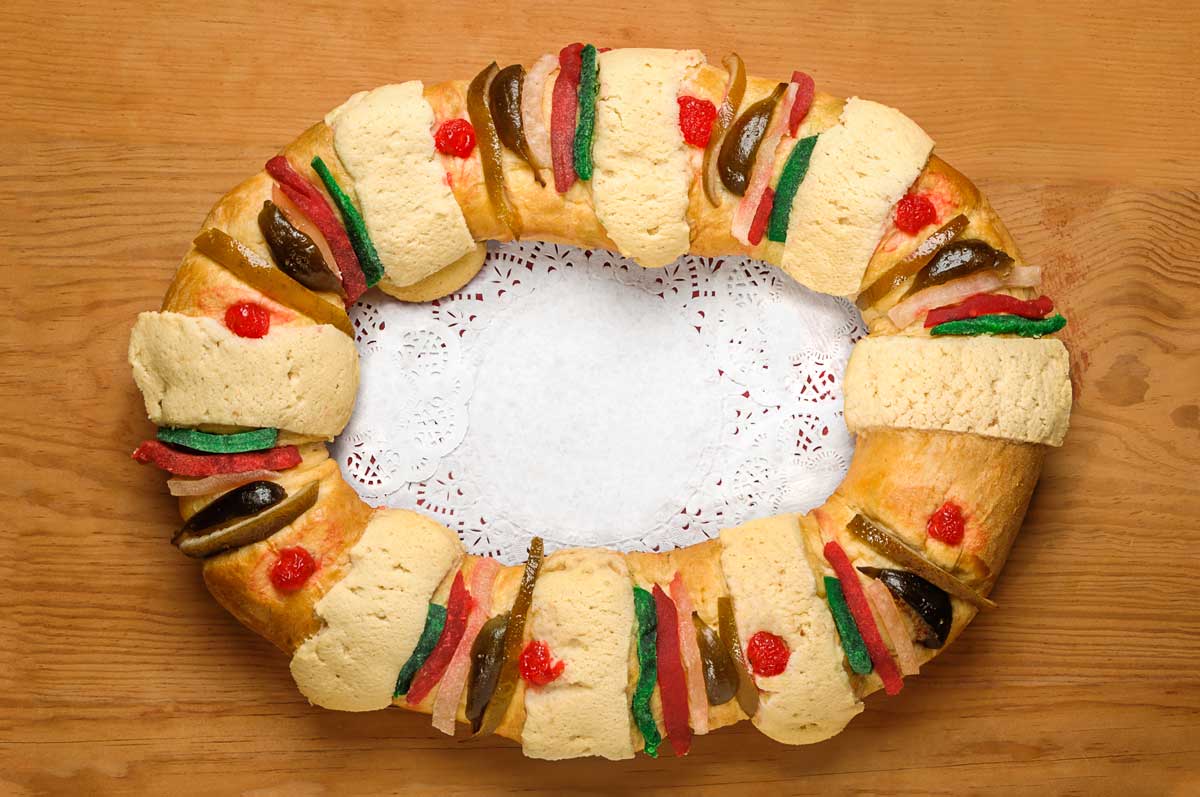
Rosca de Reyes Meaning, History & the Baby Tradition
The Mexican tradition developed from European Epiphany celebrations brought through Spain. Today, families share the bread on January 6 to celebrate the Three Wise Men’s visit to baby Jesus. Recipes and customs vary by family and region.
- The ring: commonly interpreted as a crown and a symbol of enduring love.
- The colorful fruit: recalls jewels on a royal crown.
- The baby figurine: represents baby Jesus; its concealment is associated with protecting him from King Herod.
- The finder’s role: in many Mexican families, finding the baby means supplying tamales for the February 2 Candelaria gathering.
The Smithsonian’s account of a family’s Rosca de Reyes tradition offers a personal look at the January 6 celebration and the surprise inside.
Ingredients & Decorations Explained
The recipe card below lists all quantities, including the extra egg for the wash. Before you start, set out the butter and eggs so they lose their refrigerator chill.
- Flour: weigh it if possible. Scooping packed cups can add too much flour and make the bread heavy.
- Yeast: this recipe uses active dry yeast, first checked in lukewarm milk. Hot milk can damage yeast.
- Citrus: grate only the colored peel of the orange and lemon; the white pith tastes bitter.
- Sugar paste: butter, powdered sugar, and flour form the pale decorative strips. This is separate from the bread dough.
- Fruit: candied orange peel, cherries, and figs give color and texture. Firm guava or quince paste (ate) cut into strips is another decoration option.
How to Make Rosca de Reyes: The Key Techniques
Build the dough’s strength before judging its stickiness. Butter and eggs make this dough softer than a simple white bread dough. Work the butter in gradually, then knead until the dough stretches without immediately tearing. A lightly oiled hand or dough scraper is often more useful than extra flour.
Give both rises time. The first rise should roughly double the dough. After shaping, the ring should look puffier and feel airy, with a gentle indentation returning slowly. A cool room can extend either rise.
Leave a wide opening. The dough expands inward as well as outward. A narrow hole may close while the bread proofs or bakes. Pinch the joined ends securely so the oval stays intact.
Decorate after the final rise. Brush lightly with egg wash, then add the paste and fruit without pressing out the air. Start checking at 25 minutes and use the bread’s color and internal temperature to judge doneness.
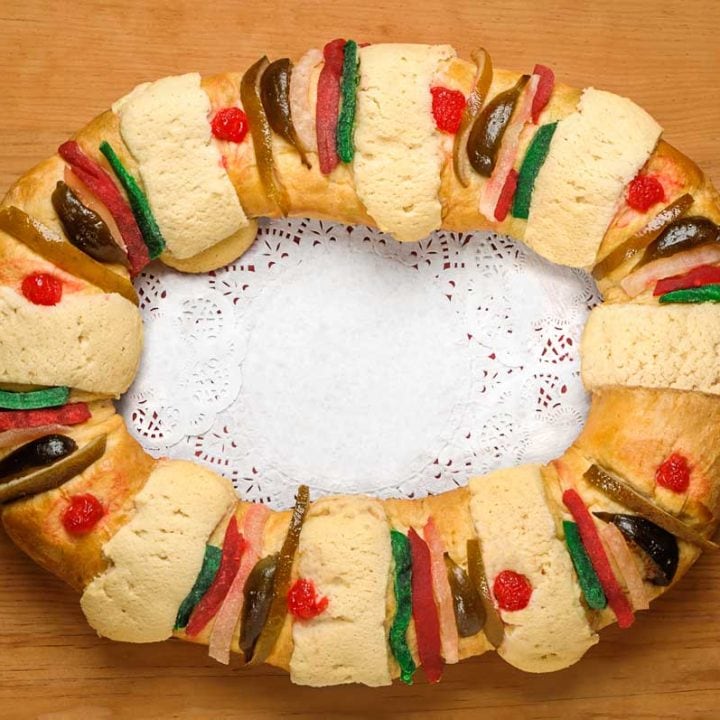
Rosca de Reyes (Mexican Three Kings Bread)
A citrus-scented Mexican sweet bread ring decorated with candied fruit and buttery sugar-paste strips.
Ingredients
- 480 g (4 cups, spooned and leveled) all-purpose flour, plus a little for shaping
- 7 g (2 1/4 teaspoons) active dry yeast
- 120 ml (1/2 cup) whole milk, lukewarm, about 105–110°F (41–43°C)
- 100 g (1/2 cup) granulated sugar, divided
- 3 large eggs, at room temperature
- 113 g (1/2 cup) unsalted butter, softened
- 1 teaspoon vanilla extract
- Finely grated zest of 1 orange and 1 lemon
- 1/2 teaspoon fine salt
- For the sugar paste: 60 g (1/2 cup) all-purpose flour, 60 g (1/2 cup) powdered sugar, and 57 g (1/4 cup) softened unsalted butter
- For the egg wash: 1 large egg beaten with 1 teaspoon water
- For decorating: 100 g (about 3/4 cup) mixed candied orange peel, candied cherries, and candied figs, cut into strips or pieces
Instructions
- Wake up the yeast. Stir the yeast into the lukewarm milk with 1 tablespoon of the measured granulated sugar. Leave for 5–10 minutes, until foamy. If it stays flat, start again with fresh yeast before adding the other ingredients.
- Mix and knead. Combine the flour, remaining granulated sugar, salt, and citrus zest. Add the yeast mixture, 3 eggs, and vanilla. Mix until a rough dough forms, then work in the softened butter a little at a time. Knead with a dough hook on low to medium-low speed for about 10–15 minutes, or by hand until smooth and elastic; hand kneading may take longer. The dough should feel soft and slightly tacky. Avoid adding large handfuls of flour.
- Let the dough rise. Place in a lightly greased bowl, cover, and leave in a warm, draft-free spot until doubled, about 1 1/2–2 hours. Enriched dough may need longer in a cool kitchen; use its size rather than the clock.
- Shape the ring. Line a large rimmed baking sheet with parchment. Gently deflate the dough and roll it into a rope about 28–30 inches long. Join the ends, pinching the seam firmly, and arrange into an oval with a generous central opening of at least 5 inches. If the dough springs back, rest it for 10 minutes before continuing.
- Proof and prepare the topping. Cover loosely and let the ring rise until visibly puffy, about 45–60 minutes. Meanwhile, mix the sugar-paste flour, powdered sugar, and butter into a soft paste. Divide into 6 pieces and flatten into short strips. Preheat the oven to 350°F (175°C).
- Decorate. Brush the risen dough gently with the egg wash. Arrange the sugar-paste strips across the ring at intervals, then place the candied fruit between them. Press lightly so the decorations adhere without deflating the dough.
- Bake. Bake on the middle rack for 25–35 minutes, until golden and cooked through. A thermometer inserted into bread, away from fruit or topping, should read about 190°F (88°C). Loosely tent with foil if the top browns before the center is done.
- Cool and share. Transfer carefully to a rack and cool for at least 30 minutes before slicing. If using a food-contact-safe baby figurine, insert it through the underside after the bread has cooled; never bake an unspecified plastic decoration. Tell everyone a figurine is inside, check children’s portions, and remove all figurines before eating. You can also display the figurine beside the bread.
Notes
Rising and cooling: additional time includes up to 3 hours of rising and 30 minutes cooling. Total time is about 3¾–4¾ hours; allow longer in a cool kitchen. Bake at 350°F (175°C) for 25–35 minutes, checking early. Use a large rimmed baking sheet lined with parchment. Figurines are optional and not edible: use only a food-contact-safe decoration, insert after cooling, and tell all guests before serving. Contains wheat, eggs, and milk. Store cooled, unfilled bread tightly wrapped at room temperature for up to 2 days, or freeze slices for up to 2 months.
Troubleshooting: Soft Bread, an Open Ring & Even Baking
| Problem | What to check |
|---|---|
| Dough is not rising | Check yeast freshness and milk temperature. Move covered dough to a warmer, draft-free place and allow more time. |
| Bread is dense or dry | Too much flour, insufficient kneading or proofing, and overbaking can all contribute. Weigh flour and check doneness early. |
| The center hole closes | Start with a larger opening and allow space for the second rise. |
| Top browns too quickly | Tent loosely with foil and continue baking until the center is cooked. |
Serving, Storage & Make-Ahead Tips
Serve slices with hot chocolate, atole, or champurrado. The bread is best the day it is baked, when the crumb is tender and the topping is fresh.
Store: once completely cool, wrap the unfilled bread tightly and keep at room temperature for up to 2 days. For longer storage, freeze wrapped slices for up to 2 months. Thaw while wrapped and warm gently before serving.
Make ahead: after kneading, cover the dough in a lightly greased bowl and refrigerate overnight. The next day, allow it to warm enough to shape, then complete the shaped rise until puffy. Cold dough needs extra time; do not rely on the same-day schedule.
Filled versions: let the baked bread cool completely before splitting and adding whipped cream or pastry cream. Refrigerate perishable fillings promptly and follow the filling recipe’s storage guidance.
Where to Buy Rosca de Reyes
For a bakery-made rosca, start with local Mexican panaderías and Latin grocery bakery counters. Ask about January 6 preorders, pickup dates, serving sizes, fillings, and whether figurines are included. Seasonal stock and delivery options vary, so confirm directly with the bakery before making plans.
Searching for “rosca de reyes near me” with your city can help locate nearby options. For shipped bread, check the dispatch date and expected arrival rather than assuming it will arrive fresh for Día de Reyes.
Rosca de Reyes FAQs
When do you eat Rosca de Reyes?
Traditionally on January 6, Día de Reyes or Epiphany. Families may share it at breakfast, in the afternoon, or at an evening gathering.
What happens if you get the baby in Rosca de Reyes?
In many Mexican families, the person who finds the baby Jesus figurine brings tamales for Día de la Candelaria on February 2. Some gatherings use several figurines, so more than one person may share the responsibility.
What is the white topping on Rosca de Reyes?
It is usually a sweet paste made with flour, sugar, and fat, placed in strips across the bread. This recipe uses butter and powdered sugar. Recipes vary, and some use shortening or include egg yolk.
Is Rosca de Reyes the same as roscón de Reyes?
They are closely related Epiphany breads. Rosca de Reyes usually refers to the Mexican version, often decorated with fruit and sugar-paste strips. Roscón de Reyes is the Spanish name; Spanish versions may feature almonds, sugar, or a cream filling. Both have regional and family variations.
Is Rosca de Reyes the same as Mardi Gras king cake?
Both belong to a broader family of festive king cakes, but they are distinct traditions. Mexican rosca is associated with January 6 and candied-fruit decorations; New Orleans king cake is associated with Carnival and often has purple, green, and gold sugar or icing.
Can I make it without a baby figurine?
Yes. The bread bakes and tastes the same without one. You can place a figurine beside the serving plate and explain the tradition without hiding a non-edible object in the loaf.
Can I freeze Rosca de Reyes?
Yes. Freeze the cooled, unfilled bread or individual slices tightly wrapped. Remove any figurines first. Thaw while wrapped, then warm gently to refresh the texture.
More Mexican Holiday Favorites
Plan the rest of your celebration with Mexican Christmas foods, explore our guide to Mexican pastries, or discover related breads in our Latin American and Spanish cakes and pastries guide.
More Mexican Desserts
See all →
Jorge Garcia is the founder of AmigoFoods, where he has spent over 20 years helping readers discover authentic Latin American and Spanish cuisine. Raised in a Cuban-American household, Jorge learned to cook at the hands of his mother and grandmother, carrying forward generations of family recipes. That heritage, backed by his family’s four-generation history in the Latin food industry, inspired him to launch AmigoFoods in 2003. With more than 1,000 published articles on recipes, ingredients, and food culture, Jorge’s mission is simple: make authentic Latin cooking approachable for home cooks everywhere while honoring the traditions behind every dish.