
Argentine cooking has a reputation for being simple, and the reputation is mostly earned. There is no long spice rack, no wall of chiles, no sauce that takes three days. What there is instead is beef, wheat, milk and a handful of herbs, worked over and over until the country got very good at them.
The other half of the story is immigration. Between 1880 and 1930 Argentina took in millions of Europeans, most of them Italian and Spanish, and they rewrote the pantry — the pasta, the pizza, the cheese on the grill, the crescent pastry at breakfast.
Here are the fifteen ingredients that hold the whole thing together, and what each one is actually for.
The 15 at a Glance
| Ingredient | What it is | Where it shows up |
|---|---|---|
| Beef | Grass-fed, cut Argentina’s own way | The asado, the parrilla, everywhere |
| Chorizo & morcilla | Fresh pork sausage and blood sausage | Choripán, the first round of the asado |
| Provoleta | A disc of provolone built for the grill | The starter nobody skips |
| Chimichurri | Chopped parsley, garlic, oregano, vinegar | On grilled meat, on bread, on everything |
| Salsa criolla | Diced onion, tomato and pepper in vinegar | Choripán, milanesa, cold cuts |
| Salsa golf | Mayonnaise and ketchup, invented here | Prawns, chips, palta, sandwiches |
| Ají molido & oregano | The dry seasonings, and there are few | Chimichurri, empanadas, provoleta |
| Wheat flour | Empanada tapas, facturas, pizza, pasta | Breakfast, bakery, every corner |
| Maíz blanco | Dried white corn for locro | Locro, the national holiday stew |
| Porotos | Dried beans, usually white | Locro, carbonada, winter |
| Charque | Salted, sun-dried meat | Northern cooking, older than the cow |
| Dulce de leche | Milk and sugar cooked down slowly | Alfajores, cakes, ice cream, toast |
| Dulce de membrillo & batata | Quince and sweet potato pastes | Eaten with cheese, and with pastry |
| Yerba mate | Dried leaf of a South American holly | All day, every day, shared |
| Malbec | A French grape that found its country | The table, and the export economy |
Fernet makes sixteen, and Argentines would say it belongs on the list. It gets its own section below.
The Fire
Beef

Argentina eats an enormous amount of beef and cuts it in ways that do not map onto anyone else’s butchery.
Asado de tira is short rib sawn across the bones into strips.
Vacío is flank, cooked whole and slowly until the outside is crisp.
Entraña is skirt, the one that cooks fastest.
Bife de chorizo is a thick sirloin strip and has nothing to do with sausage.
Matambre is the thin sheet of meat between the hide and the ribs, usually rolled and stuffed.
Beef consumption changes with prices and household budgets, so a single national average does not describe every Argentine table.
Argentina is still near the top of the world table, and the asado is still a sequence rather than a dish: offal and sausage first, then the big cuts, over coals that were made from wood and then moved under the grill by hand.
The grass-fed pampas cattle are the reason people travel for this, and the beef repertoire runs well past the grill into milanesas, empanada fillings and stews.
If you are cooking one, hosting an asado is more about timing than technique.
Chorizo, morcilla and longaniza

Argentine chorizo is a fresh sausage of pork and beef, seasoned lightly, and cooked rather than cured.
That is the whole difference from the hard red Spanish chorizo of the same name: no pimentón required, no drying room, and it will not keep.
Split lengthwise, put in a crusty roll and covered in chimichurri, it becomes choripán, which is what Argentina eats standing up.
Morcilla is the blood sausage that comes off the grill at the same time — soft, dark, sometimes made sweet with raisins and nuts in the morcilla dulce version.
It is the other half of the opening round, and the point of an Argentine asado is that both are eaten before the beef, not after.
Longaniza is the longer, thinner, more heavily seasoned relative, and it turns up across Latin America in forms that have drifted a long way apart.
Provoleta

Provoleta is not just provolone on a grill. It is a distinct cheese, made in discs roughly 10 to 15 cm across and barely a centimetre and a half thick, spun during production so the curd is dense enough to hold its shape over fire.
Put ordinary provolone on a parrilla and it will slump through the bars.
The credit goes to Natalio Alba, a Calabrian immigrant in Córdoba, who worked it out in the 1940s; the method entered the Argentine food code in 1955 and he registered the name in 1963.
It is the clearest single example of what Italian immigration did to Argentine cooking — an Italian cheese redesigned for an Argentine fire.
It goes on hot, gets oregano and a pinch of chili flakes, and comes off crusted outside and molten inside. It is served first, with bread, while the beef is still cooking.
What Goes On Top
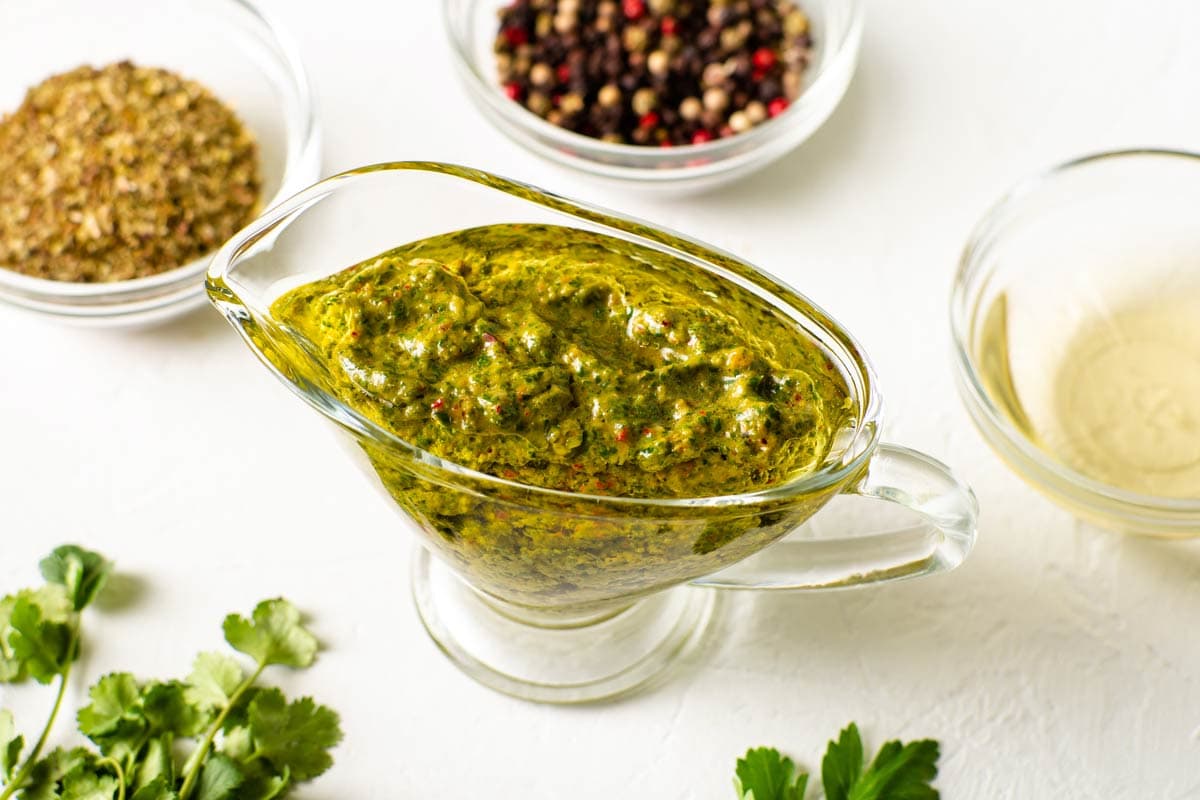
Chimichurri
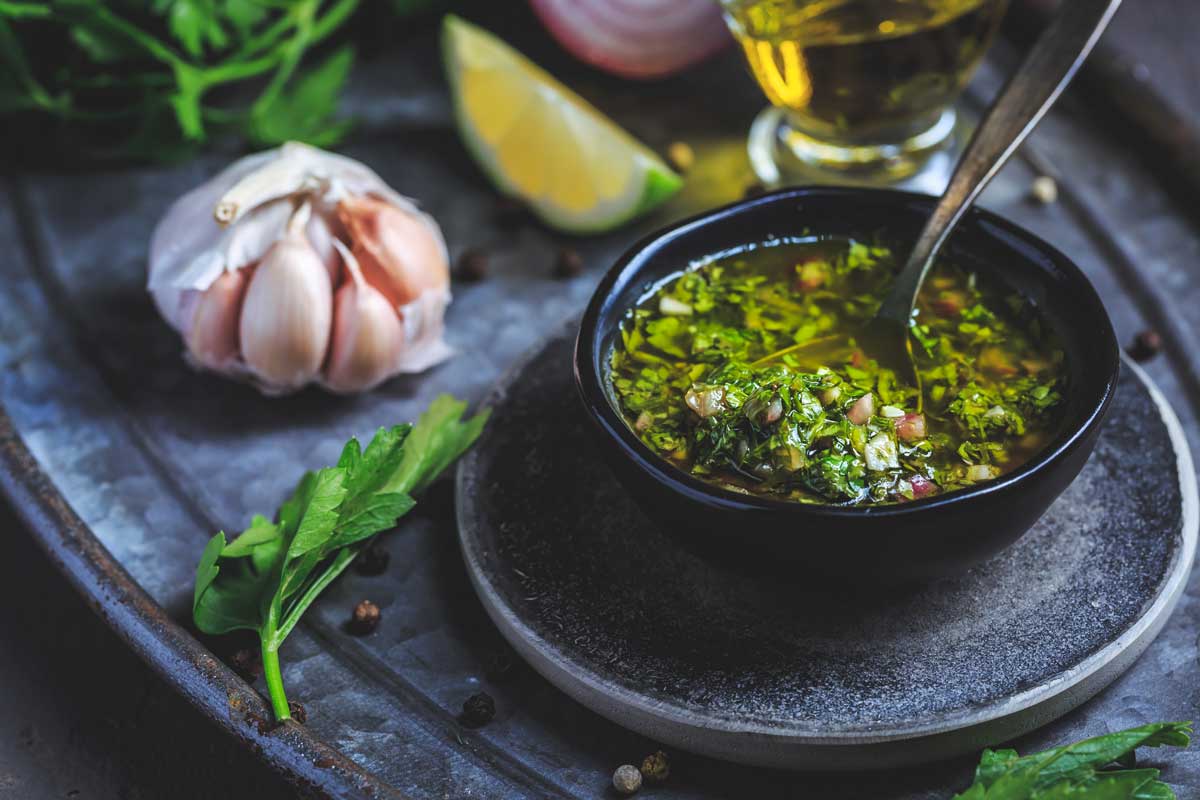
Chimichurri is flat-leaf parsley, garlic, dried oregano, ají molido, vinegar and oil, and the orthodox version is chopped by hand.
Blending it turns it into a green purée, which is a different and lesser thing — you want to see the individual pieces and feel them.
It is a condiment, not a marinade. Argentines put it on after the meat is cooked, or alongside, and the vinegar is there to cut fat rather than to tenderise anything.
There is a chimichurri rojo with more pimentón, and a looser salmuera brushed on during cooking, which is the only thing that legitimately touches raw meat.
The name’s origin is genuinely unknown. The story about an Irishman called Jimmy McCurry is repeated everywhere and has no evidence behind it at all.
Salsa criolla

Salsa criolla is onion, tomato and red and green pepper, all diced small, dressed with oil and vinegar and left to sit for an hour.
It is the second sauce on the table, and where chimichurri is herbal and sharp, this one is sweet and crunchy.
It goes on choripán next to the chimichurri, on cold milanesa, on a plate of leftover asado.
Between the two of them and salsa golf, you have nearly the whole of the Argentine condiment repertoire, which is short by design.
Salsa golf

Salsa golf is mayonnaise and ketchup, and Argentina invented it — or at any rate the story everyone tells is that Luis Federico Leloir, bored of eating prawns with plain mayonnaise at a Mar del Plata golf club in the mid-1920s, started mixing things into it until this worked. His companions named it after the club.
Leloir went on to win the Nobel Prize in Chemistry in 1970, for work on sugar nucleotides rather than on sauce.
The attribution is a well-worn anecdote rather than a documented fact, but it is the version Argentina keeps, and salsa golf is now on prawns, chips, palta reina and half the sandwiches in the country.
Ají molido, oregano and pimentón
The entire Argentine spice cabinet is roughly four jars: dried oregano, ají molido, pimentón and cumin.
That is not an oversight. Argentine food is not spicy, and Argentines will tell you so before you ask.
Ají molido is crushed dried red chili, coarse, with seeds, and mild — closer in function to chili flakes than to cayenne. It goes into chimichurri, onto provoleta, and into empanada filling.
Oregano is used dried and in quantity, far more than fresh. Pimentón and cumin carry the empanada and the stews of the north-west, where the cooking is closest to Bolivia and least like Buenos Aires.
Wheat, and the Italian Inheritance
Flour

The pampas grow wheat as well as cattle, and flour does more work in Argentina than anywhere else in South America.
Empanada dough comes in two kinds — criolla, made with beef fat and baked or fried plain, and hojaldrada, laminated and flaky — and the fold on the edge, the repulgue, traditionally tells you what is inside.

Medialunas are the breakfast: small, dense, glazed crescents that are sweeter and heavier than a croissant.
De manteca are made with butter and syrup-glazed; de grasa are made with lard, larger and less sweet. They belong to the wider world of facturas, the bakery pastries sold by the dozen every afternoon.
Beyond that, wheat is milanesa breadcrumbs, pizza with a deep crust and an unreasonable amount of cheese, fresh pasta on Sundays, and tortas fritas when it rains.
The whole of it traces back to the Italian roots of Argentine cuisine, and the empanada arrived separately, from Spain by way of the Arab world.
From the Interior
Maíz blanco and porotos

Away from Buenos Aires the pantry gets older.
Dried white corn sold for locro (maíz blanco partido) and dried white beans are the base of locro, with squash, and whatever pork and beef there is.
Locro is a pre-Columbian dish with Spanish additions, and it is the one thing Argentina eats on its patriotic holidays: 25 May and 9 July, cooked in enormous pots, in winter.
Use the corn specified in your recipe: maíz pisingallo is popcorn, not another name for locro corn. Hominy has a different processing method and needs a recipe that specifies it. Soak dried corn and beans in the refrigerator and follow their package and recipe cooking directions.
The same beans and squash turn up in carbonada criolla and across the Argentine stews that carry the interior through the cold months.
Charque

Charque is meat salted and dried in the sun, and the technique is Andean and long pre-dates the Spanish — it was llama and guanaco before it was beef.
The Quechua word ch’arki is where the English word jerky comes from.
In Argentina it belongs to the north-west, where it goes into stews and gets pounded and shredded into fillings.
Follow the product’s desalting instructions, keeping the meat refrigerated during soaking and water changes. It is not a Buenos Aires ingredient, and that is rather the point of including it.
Sweet
Dulce de leche

Dulce de leche is milk and sugar cooked down for hours with a little bicarbonate, until the sugars brown and the whole thing thickens.
It is not caramel: caramel is sugar cooked alone, dulce de leche is a slow Maillard reaction in milk, and they taste nothing alike.
Two grades matter. Clásico is loose enough to spread on toast. Repostero is much thicker, and it is what holds an alfajor together or fills a torta rogel without sliding out the sides.
The famous origin story — a maid in 1829 leaving sweetened milk on the fire while Juan Manuel de Rosas met Juan Lavalle — is a good story and almost certainly not true.
Versions of cooked-down sweet milk exist in a dozen countries, and Uruguay claims this one too.
What is not in dispute is how much of it Argentina eats: it is the base of a whole category of desserts, and choosing between the major brands is a real argument there.
Dulce de membrillo and batata

The other sweet is firmer. Quince paste and sweet-potato paste are sold in rectangular bricks and sliced with a knife, and the batata version often has bits of chocolate through it.
A slab of either with a slab of fresh cheese is queso y dulce, also called postre vigilante or Martín Fierro, and it is what an Argentine restaurant brings when you ask for dessert without wanting to think.
Both pastes also fill pastry: pasta frola is a lattice tart built around one of them, and the same bricks turn up throughout Argentine desserts.
What Argentina Drinks
Yerba mate

Yerba mate is the dried and milled leaf of Ilex paraguariensis, a South American holly, and Argentina is the world’s largest producer — grown in Misiones and Corrientes, regulated since 2002 by the Instituto Nacional de la Yerba Mate. In 2013 a law made mate the national infusion outright. Across the border, Paraguayans drink it ice-cold as tereré; see our guide to Paraguayan ingredients.
Two things surprise newcomers. The first is that con palo — with stems — is the standard Argentine cut, milder and slower to go bitter than the stemless Uruguayan or Brazilian style.
The second is that the gourd is shared: one person, the cebador, refills it and passes it round, and everybody drinks through the same bombilla. Saying gracias means you are done, so do not say it until you are.
Preparing it properly is mostly about water temperature — around 80°C, never boiling — and about not disturbing the bombilla once it is in.
Malbec

Malbec is a French grape from Cahors, in the south-west, where it makes a hard, tannic, dark wine.
In Mendoza it makes something rounder and riper, and the difference is altitude: the Uco Valley vineyards sit between roughly 900 and 1,500 metres, with intense sun, cold nights and almost no rain.
How it got there is less tidy than the official story. On 17 April 1853 Domingo Faustino Sarmiento launched the project that created Mendoza’s Quinta Normal agricultural school and brought in the French agronomist Michel Aimé Pouget, who had been running Chile’s equivalent.
Wines of Argentina made that date Malbec World Day in 2011. But no document shows when the first Malbec vines actually arrived, some sources put it decades later, and the honest version is that Malbec established itself in Argentina over a period between the 1850s and 1890.
Wine was declared Argentina’s national drink by law in 2013, the same year as mate. It is not just Malbec — torrontés is the white worth seeking out — but Malbec is the one that carried the Argentine drinks list abroad.
Fernet

Fernet-Branca is a bitter Italian amaro from a Milanese distillery founded in 1845, made with a long list of herbs the company does not disclose.
It tastes like medicine, which is more or less what it was sold as.
Argentina drinks more of it than any other country on earth, by a wide margin. Branca opened a plant outside Buenos Aires in 1925 — still its only production facility outside Italy — and Córdoba is credited with the thing that made it national: fernet con coca, roughly one part fernet to three parts Coca-Cola, poured over ice in a tall glass.
It is at every asado, and it is an acquired taste that most visitors do not acquire on the first try.
Where to Start
Three things will get an Argentine shelf going: a yerba mate set with a gourd and bombilla, a jar of dulce de leche, and ají molido with dried oregano for chimichurri.
The chimichurri you can make in ten minutes with what is already in the kitchen, and it will improve almost anything you grill.
The beef is the hard part to import and the easy part to approximate — ask a butcher for short ribs cut across the bone and you have asado de tira. Everything else is in the Argentine ingredients hub, the street food, and everything we have written about Argentine food. For the Andean side of the border, see our guide to Bolivian ingredients.
Questions About Argentine Ingredients
What is the most important Argentine ingredient?
Beef, and it is not close. The cuts, the fire and the order they come off the grill in organise the whole cuisine. Chimichurri is second only because it exists to go on the beef.
Is Argentine food spicy?
No. The hottest thing on most tables is ají molido, crushed dried red chili that is milder than chili flakes. Argentines are consistently surprised by how much heat other Latin American countries use.
What is the difference between chimichurri and salsa criolla?
Chimichurri is herbal and sharp — parsley, garlic, oregano, vinegar and oil. Salsa criolla is sweet and crunchy — diced onion, tomato and pepper in a vinaigrette. They frequently appear on the same table and often on the same choripán.
Is Argentine chorizo the same as Spanish chorizo?
Argentine chorizo is commonly a fresh pork-and-beef sausage that must be cooked. Spanish chorizo is seasoned with pimentón and comes in both fresh cooking and dry-cured forms; check the label rather than assuming it is ready to eat.
Why can’t I just grill normal provolone?
Because it will melt through the grill. Provoleta is made denser and in a thinner disc specifically so it holds together over fire. If you cannot find it, a thick slice of provolone in a cast-iron pan is the workaround.
Is dulce de leche the same as caramel?
No. Caramel is sugar cooked on its own. Dulce de leche is milk and sugar browned together over hours, which is a different reaction and a different flavour — milkier, less bitter, and thicker.
What does con palo mean on a bag of yerba mate?
That the stems are included. Con palo is the standard Argentine cut and is milder and slower to turn bitter. Sin palo is pure leaf, stronger, and more common in Uruguay and Brazil.
Why is Malbec associated with Argentina rather than France?
Because it grows better there. Malbec is French, from Cahors, but Mendoza’s altitude, sun and dry air produce a softer, riper wine, and Argentina planted far more of it than France ever did.
More Argentine Foods
See all →
Jorge Garcia is the founder of AmigoFoods, where he has spent over 20 years helping readers discover authentic Latin American and Spanish cuisine. Raised in a Cuban-American household, Jorge learned to cook at the hands of his mother and grandmother, carrying forward generations of family recipes. That heritage, backed by his family’s four-generation history in the Latin food industry, inspired him to launch AmigoFoods in 2003. With more than 1,000 published articles on recipes, ingredients, and food culture, Jorge’s mission is simple: make authentic Latin cooking approachable for home cooks everywhere while honoring the traditions behind every dish.